
Quick answer
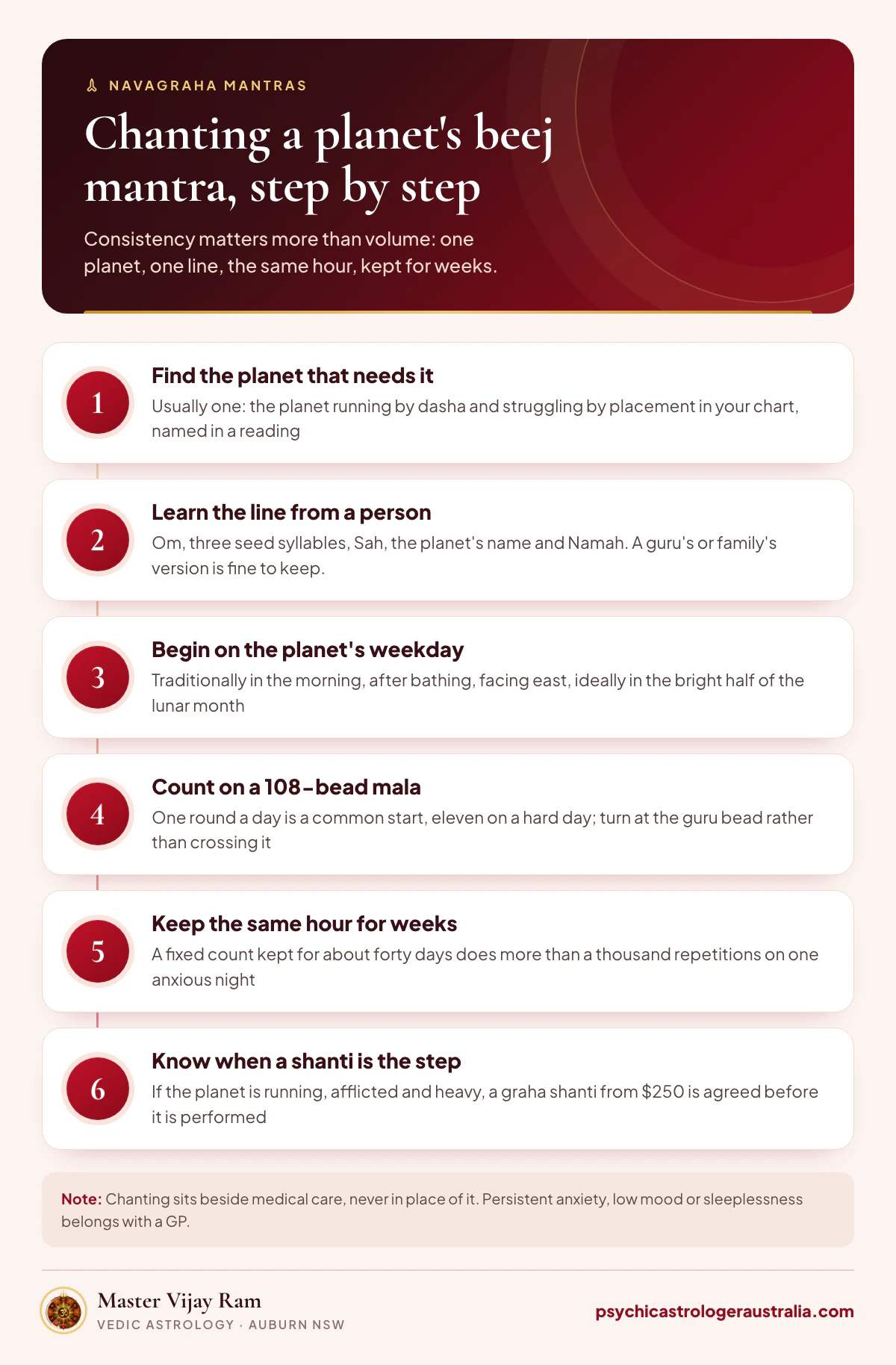
The navagraha mantras are short prayers, one for each of the nine planets of Vedic astrology. The beej mantras, such as Om Hraam Hreem Hraum Sah Suryaya Namah for the Sun, are chanted on the planet's weekday, usually in the morning, counted on a 108-bead mala. Consistency matters more than volume, and a family or guru's version is fine.
What are the navagraha mantras?
A navagraha mantra is a short prayer addressed to one of the nine grahas of Vedic astrology, and families chant the navagraha mantras to steady a planet whose period is weighing on them. The best known are the beej, or seed, mantras: a single line per planet built from sacred syllables and the planet's name. They ask for time rather than money, need no priest, and can be said at a kitchen bench as well as at a temple.
This page gives all nine exactly, explains how to pronounce and count them, and says plainly when chanting is enough and when the chart calls for more. That larger step, a planetary shanti performed on a chosen muhurat, is described on the graha shanti puja service; most people never need it.
What is a beej mantra, and how is it built?
A beej mantra is a mantra built around seed syllables, sounds the tradition treats as carrying a deity's or a planet's essence in compressed form. Each of the nine navagraha versions has the same shape: Om, three seed syllables made from one consonant with three vowels, the syllable Sah, the planet's name in the form that means to that planet, and Namah, a bow.
So Om Hraam Hreem Hraum Sah Suryaya Namah is, roughly, a seed-call to the Sun followed by salutations to Surya. The names are older forms in places: Mars is Bhauma, son of the earth; Jupiter is Guru; Saturn is Shani; and the endings change with each name.
What are the nine beej mantras for the planets?
These are the beej mantras for the planets in one consistent spelling, with the weekday traditionally linked to each. Rahu and Ketu have no weekday of their own, so families borrow one.
| Planet | Day | Beej mantra |
|---|---|---|
| Sun (Surya) | Sunday | Om Hraam Hreem Hraum Sah Suryaya Namah |
| Moon (Chandra) | Monday | Om Shraam Shreem Shraum Sah Chandraya Namah |
| Mars (Mangal, Bhauma) | Tuesday | Om Kraam Kreem Kraum Sah Bhaumaya Namah |
| Mercury (Budh) | Wednesday | Om Braam Breem Braum Sah Budhaya Namah |
| Jupiter (Guru) | Thursday | Om Graam Greem Graum Sah Gurave Namah |
| Venus (Shukra) | Friday | Om Draam Dreem Draum Sah Shukraya Namah |
| Saturn (Shani) | Saturday | Om Praam Preem Praum Sah Shanaye Namah |
| Rahu | No day of its own; Saturday is common | Om Bhraam Bhreem Bhraum Sah Rahave Namah |
| Ketu | No day of its own; Tuesday or Saturday | Om Sraam Sreem Sraum Sah Ketave Namah |
If your guru, your temple or your grandmother taught you a slightly different version, keep it. Spellings and even syllables vary between lineages, and a mantra received from your own tradition carries that tradition with it.
How do you pronounce them?
Slowly, and without worrying about sounding foreign. The long aa is the vowel in father, ee as in see, and au as in cow, so Hraam, Hreem and Hraum climb through three distinct sounds; Sah is short, and Namah ends in a light breath rather than a hard h.
The clusters at the start take a little practice: hr, shr, kr, br, gr, dr, pr, bhr and sr are each said as one quick sound. Australian-born children can pick them up faster than their parents expect, and learning the line from a person, even over a video call, fixes the rhythm better than reading it.
When is the best time to chant?
The tradition prefers the morning, after bathing and before eating, facing east, and it begins a planet's practice on that planet's own weekday, ideally in the bright half of the lunar month. The panchang day starts at sunrise, so an early Monday chant before dawn still belongs to Sunday, a detail weekday fasting for each planet also turns on.
Ordinary life bends the rule, and the tradition allows it. A nurse finishing nights can chant at the end of her shift, which is her morning; a parent with a newborn can chant at the same quiet hour each evening. What matters is the same time each day, kept for weeks, not the perfect hour kept once.
How many times should you chant, and why use a mala?
A mala keeps the count so the mind can stay with the sound. The usual japa mala has 108 beads and a larger guru bead; you move one bead per repetition with the thumb and middle finger, and at the guru bead you turn the mala round rather than crossing it. One full round a day is a common starting point, and eleven repetitions is an honest minimum on a hard day.
Consistency matters more than volume. A fixed number at a fixed time for forty days or so, which many teachers ask for, does more than a thousand repetitions on one anxious night; texts and family traditions also give large totals for a full anushthan of each planet, and those totals differ from book to book, so a reading, not a website, should set one. Rudraksha beads and how to choose one covers the mala itself.
Which planet's mantra should you chant?
Usually one, chosen from your chart. The planet worth working with is the one that is both running by dasha and struggling by placement, and that overlap normally names one planet, occasionally two; reciting all nine every day is a lovely devotion but a thin remedy. Daily navagraha remedies for each planet sets out the habit that goes with each mantra.
Some families do recite all nine as a morning round, one or eleven repetitions each, in the order Sun, Moon, Mars, Mercury, Jupiter, Venus, Saturn, Rahu, Ketu. That is a fine practice of reverence; it simply is not the same as a prescription.
What about the Shani mantra?
The Shani mantra people search for most is the beej line above, Om Praam Preem Praum Sah Shanaye Namah, chanted on Saturdays, and many families also use the short name mantra Om Sham Shanaishcharaya Namah. The tradition pairs either with the Hanuman Chalisa, with a lamp of sesame oil lit as the light fades, and above all with Saturn's own virtues: patience, honest work and service to people who labour.
In 2027 Sade Sati falls on Aquarius, Pisces and Aries Moons while Saturn is in Pisces, and on Pisces, Aries and Taurus Moons while it is in Aries from 3 June to 19 October. Anyone in that window who wants a fuller plan can look at Sade Sati and Shani remedies; for most of them, a steady Saturday mantra is the backbone of it.
What is the Navagraha Stotram, and is it the same thing?
It is a different and older-sounding practice. The Navagraha Stotram is a hymn of a verse for each planet, traditionally attributed to the sage Vyasa, and many families recite the whole hymn once a day as a prayer to all nine together rather than working with one planet.
Both are valid. The stotram suits a household that wants a short daily devotion for everyone in it; a beej mantra suits a person working with one planet through one difficult period. Children often learn the stotram first, because a verse is easier to remember than a seed syllable.
Should you chant aloud, in a whisper or silently?
The tradition names three ways: aloud, in a whisper, and in the mind, and it rates the silent form highest once the sound is secure. Beginners do best saying the mantra softly aloud, so the ear corrects the tongue, and moving to a whisper or silence later.
A recording is a good teacher of pronunciation and a poor substitute for practice. Playing a mantra on a loop in the car is pleasant; planet mantra chanting in the traditional sense means your own voice, your own count and your own attention.
When is a graha shanti puja the step instead?
When the planet is both running and badly placed and the person is already carrying its weight: a Saturn period in Sade Sati with Saturn afflicted in the chart, Rahu on the Moon in its own mahadasha, or a person too unwell, too exhausted or too newly a parent to keep a daily count. Then a shanti is performed on the person's behalf, with the japa, the havan and the offerings done properly, while they keep a small practice of their own.
Master Vijay Ram performs that work personally at his place of practice in Auburn on a muhurat chosen for it, and clients join by video if they wish. A consultation is $50; a shanti starts from $250, and the figure is agreed before anything is performed. Which planet needs pacifying, and how explains the reading behind it, and an online puja or havan with him describes how the rite itself runs.
What can a mantra not do?
It cannot end a dasha early, change a decision someone else has made, or treat an illness. Chanting can calm a mind, and many people find it does, but persistent anxiety, low mood or sleeplessness belong with a GP and with services such as Beyond Blue, and the mantra sits beside that care rather than replacing it.
Nor can it promise a result, or settle a legal, financial or visa problem, which still needs a lawyer, an adviser or Home Affairs. The tradition offers mantras as a way of meeting a hard period with steadiness and devotion, which is a great deal, and no honest teacher sells them as anything more.
How does Master Vijay Ram teach a mantra?
He reads the chart first to find the planet that is running and struggling, then gives you one mantra with its pronunciation said aloud, the day to begin, the daily count and the length of time to keep it. A consultation is $50, by phone, video or WhatsApp, in English, Hindi or Punjabi, and most people leave with a practice rather than anything to pay for; he sells no malas, beads or gemstones.
Callers through Vedic astrology readings in Brisbane keep Queensland time with no daylight saving, so in summer their dawn chant comes very early and their evening call lands an hour later in Sydney. In person, readings take place at his practice in Auburn by appointment.
Read next
- Navagraha Remedies: Simple Daily Practices for Each PlanetNavagraha remedies for the nine planets: the day, the mantra, a daily act and a habit to ease off, adapted to Austral…
- Graha Shanti Puja: Which Planet Needs Pacifying and HowGraha shanti puja: how the birth chart shows which planet needs pacifying, Shani and Rahu shanti, what the rite invol…
- Ex Love Spell vs Vashikaran: What Actually WorksEx love spell or vashikaran: what each word really means, what a Vedic reading can honestly do about an ex, and the p…
Frequently asked questions
What are the beej mantras for the nine planets?
Om Hraam Hreem Hraum Sah Suryaya Namah for the Sun; Om Shraam Shreem Shraum Sah Chandraya Namah for the Moon; Om Kraam Kreem Kraum Sah Bhaumaya Namah for Mars; Om Braam Breem Braum Sah Budhaya Namah for Mercury; Om Graam Greem Graum Sah Gurave Namah for Jupiter; Om Draam Dreem Draum Sah Shukraya Namah for Venus; Om Praam Preem Praum Sah Shanaye Namah for Saturn; Om Bhraam Bhreem Bhraum Sah Rahave Namah for Rahu; Om Sraam Sreem Sraum Sah Ketave Namah for Ketu.
How many times should a navagraha mantra be chanted?
A common starting point is one full round of a 108-bead mala each day, with eleven repetitions as an honest minimum on a hard day. Many teachers ask for a fixed daily count kept for about forty days. Texts and family traditions give much larger totals for a full anushthan, and those totals differ, so a reading should set a count rather than a website.
What is the best time to chant planet mantras?
Traditionally the morning, after bathing and before eating, facing east, beginning on the planet's own weekday, ideally in the bright half of the lunar month. Shift workers and new parents can choose another fixed hour, such as the end of a night shift or a quiet evening, because chanting at the same time every day matters more than chanting once at the perfect hour.
Can I chant all nine planet mantras every day?
Yes, as a devotion. Some families recite all nine each morning, one or eleven repetitions each, in the order Sun, Moon, Mars, Mercury, Jupiter, Venus, Saturn, Rahu, Ketu, and that is a fine practice of reverence. As a remedy, though, the chart usually points to one planet, the one both running by dasha and struggling by placement, and that planet's mantra is given most of the attention.
What is the Shani mantra?
The Shani beej mantra is Om Praam Preem Praum Sah Shanaye Namah, traditionally chanted on Saturdays, and many families also use the short name mantra Om Sham Shanaishcharaya Namah. The tradition pairs it with the Hanuman Chalisa, a lamp of sesame oil lit as the light fades, and Saturn's own virtues of patience, honest work and service. It is the usual backbone of a Sade Sati practice.
Is it wrong to use a different spelling of a mantra?
No. Spellings, and sometimes syllables, vary between lineages and families, because the mantras were passed on by sound long before they were written in Roman letters. If your guru, temple or family taught you a version, keep it. What matters is that you learn it from someone who says it aloud, keep the pronunciation steady and chant with attention.
Do I need a rudraksha mala to chant?
No. A rudraksha mala is traditional, and many people use one, but a mala of tulsi, sandalwood or crystal, or simply counting on the fingers, works for counting. The point of the mala is to keep the count so that the mind can stay with the sound. Whatever you use, the guru bead is traditionally not crossed; you turn the mala round and continue.
Can women chant navagraha mantras?
Yes. Many women chant navagraha mantras daily, and many teachers today give them to women and men alike. Some families keep their own customs, for example around menstruation, and those are matters of family tradition rather than a rule every Hindu follows. If your family has a custom, follow it; if not, chant with the same care anyone would.
When should I ask for a graha shanti instead of chanting?
When the planet is both running and badly placed and you are already carrying its weight, or when illness, exhaustion or a newborn makes a daily count impossible. Then a shanti can be performed on your behalf. Master Vijay Ram performs it personally in Auburn on a chosen muhurat, from $250, agreed before anything is done, after a $50 consultation that decides whether it is needed.
People also ask
Which navagraha mantra is most powerful?
None is more powerful in itself. The useful one is the mantra for the planet that is running by dasha and struggling in your chart, chanted consistently. A Saturn mantra in a Saturn period does more for that person than any other line, and the same mantra may do little for someone whose difficulty lies elsewhere.
Can I chant a navagraha mantra without a guru?
Yes. The beej mantras are widely chanted by families without formal initiation, and many teachers give them freely. Learning the pronunciation from a person, even on a video call, is wiser than reading it, and a guru's or family's version of a mantra is always fine to keep.
How long does it take for a planet mantra to work?
There is no promised timeline, because a mantra is a practice, not a treatment. Many teachers ask for about forty days of a fixed daily count, and people often describe feeling steadier before anything outward changes. A mantra cannot end a dasha early or replace medical care.
Should I chant mantras aloud or silently?
The tradition names three ways, aloud, whispered and silent, and rates the silent form highest once the sound is secure. Beginners do best chanting softly aloud so the ear can correct the tongue, then moving to a whisper or to silent repetition as the mantra settles.
References & further reading
Serving clients across Australia
Confidential consultations by phone, video & WhatsApp — including: