
Quick answer
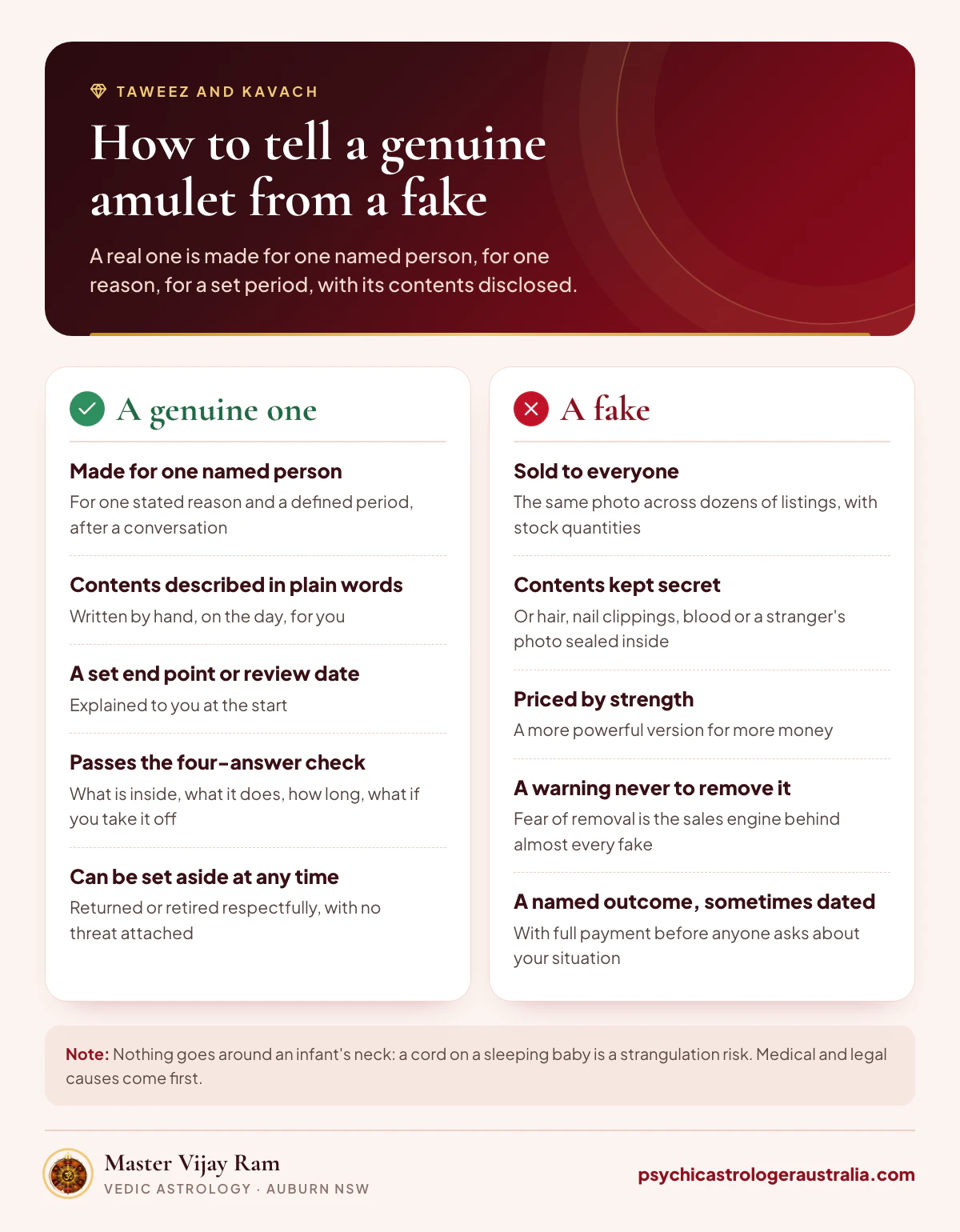
A genuine taweez or kavach is prepared for one named person, for one stated reason, for a set period, and its maker will tell you plainly what is inside it. Anything sold to anyone, priced by strength, or paired with a warning never to remove it is a fake.
What a taweez and a kavach actually are
A taweez is a written amulet from the Islamic folk tradition. Verses or divine names are written on paper or thin metal, folded, and sealed inside a small case that is worn on the body. A kavach is its Vedic counterpart: a yantra or mantra inscribed on copper, silver or bhojpatra leaf, energised for one person, then worn or kept in the home.
Both are meant to work as a boundary. Neither is meant to be jewellery, and neither is meant to be mass-produced. The word that carries the weight in both traditions is prescribed. A real one is made for a named person, for a stated reason, for a defined period. Swap the person and the object means nothing at all. That single fact separates the practice from the market that has grown up around it.
Why fakes exist, and what they are really selling
Fear is easy to sell. A pouch costs a few dollars to make, ships anywhere, needs no consultation, and leaves the seller no obligation to you afterwards. So a trade has grown up around small sealed objects sold with a warning attached: wear this, or the trouble gets worse. The warning is the product. The pouch is packaging.
The tell is that a fake is sold to everybody. It has no relationship to your chart, your household or your complaint, because it was made before anyone knew you existed. The warning signs are close cousins of those set out in Is Vashikaran Real or Fake? How to Spot a Scam, since the sales method behind both is identical: manufacture urgency, take the money first, go quiet when nothing changes.
The four-answer amulet check
Before accepting any protective object, ask four questions. Master Vijay Ram calls this the four-answer amulet check, and it sorts genuine work from rubbish faster than any argument about tradition.
- What is written or placed inside it, described in plain words?
- What exactly is it meant to do, stated narrowly rather than as a promise about your whole life?
- How long are you meant to wear it, and what brings that to an end?
- What happens if you take it off, lose it, or decide against it?
A genuine practitioner answers all four calmly and without threat. Fakes usually manage the first three and fail the fourth, because fear of removal is the engine that keeps a buyer paying. The same four answers should be available for any piece of spiritual protection and cleansing you are offered.
What goes inside a real one, and what never should
Contents differ by tradition. A taweez usually holds Quranic verses or divine names in a set arrangement, sometimes with a numerical grid. A kavach holds a yantra drawn by hand, a bija mantra, or both, occasionally with ash or a herb tied to the rite performed for it. Written by hand, on the day, for you.
What should never be inside: hair, nail clippings, blood, cloth taken from a bed, or a photograph of a third person obtained without their knowledge. Anything requiring another person's body matter has crossed out of protection into something else entirely. In the Quranic tradition, verses used for faith-based ruqyah are recited aloud far more often than they are ever worn, which tells you where the weight really sits.
Signs you are looking at a fake
None of these is subtle once you know to look for it.
- The same photograph appears across dozens of listings, with stock quantities.
- The seller will not say what is inside, or says the contents are secret.
- It is priced by strength, with a more powerful version available for more money.
- It arrives with an instruction never to remove it, under any circumstances.
- A named outcome is promised, sometimes with a date attached to it.
- No birth details were taken, no conversation was had, no question was asked about your health.
- Payment in full is demanded before anyone has asked about your situation.
Families across Greater Western Sydney who enquire about negative energy and evil eye removal in Parramatta often own two or three of these already, bought in a bad week and never mentioned to anyone. That does not make them foolish. It makes them worried, which is the state the whole trade is built on.
Comparing the protection options honestly
Most people asking about a taweez or kavach have never been shown the alternatives side by side. There are several, and for a good number of situations the right answer is the plainest one on the list rather than the most impressive.
| Option | Best suited to | Limits worth knowing |
|---|---|---|
| Prescribed kavach made for one named person | A specific, assessed vulnerability that keeps recurring after a clearing | Meaningful only for the person it was made for; has an end point; needs review |
| Taweez written for a named person | Someone inside that faith tradition who wants a written boundary alongside recitation | Contents must be disclosed; recitation usually carries more weight than the object |
| Blessed thread or raksha sutra | Everyday low-level worry, and children old enough to wear one safely | Modest in effect; wears out; not a response to a serious disturbance |
| Shop-bought nazar bead or charm | Cultural comfort and family habit | Not prepared for you; carries no assessment; harmless, but should not be leaned on |
| Daily practice with no object at all | Most people, most of the time | Requires consistency; gives you nothing to show visitors, which some find hard |
Anyone who has already sought Vedic help across Adelaide should expect that same comparison before an object is prepared, not afterwards.
How a genuine kavach is actually prepared
The order of the work is the part people rarely hear about. First a conversation: the complaint in your own words, when it began, what changed in the household around that time, what has already been tried, and whether a doctor has looked at the physical symptoms. Then birth details, and a reading of the chart against the pattern described.
Only then does the question of an object arise, and most often the answer is that none is needed. Where one is warranted, Vijay Ram ji prepares it personally at his own place of practice, over the days the rite requires. Families in Melbourne's western growth corridor who come for the negative energy and evil eye removal work done for Werribee households hear the same sequence: settle the home first, decide about an object second.
Wearing one properly, without superstition
Instructions belong to the item rather than to the internet, so follow what your practitioner told you and not what a forum insists. Broadly: keep it dry, keep it clean, take it off before bathing unless told otherwise, do not lend it, and do not open it out of curiosity. Opening it does not curse you. It simply ruins something made by hand.
Two habits cause most of the trouble. The first is treating an object as a substitute for ordinary care, sleep and honesty at home. The second is checking it constantly for signs, which turns a boundary into an anxiety. Something worn on the body marks a line; washing out accumulated heaviness is what cleansing the aura is for.
What a protective object cannot do
A kavach does not make anyone love you. It does not win a court case, clear a debt, pass an exam, secure a visa, or change another adult's decision. It does not replace medication, and it does not stop grief. Told otherwise, you are being sold something.
Nor does an object repair a bond that has already broken. If a partner has left, that sits on completely different ground, the ground covered in how this is handled for families in Perth's northern corridor, and nothing worn on a wrist substitutes for it. Protection is defensive by nature. It holds a line while other things get done. Expecting it to act on your behalf is where most disappointment begins.
When this is not the answer
Most people who ask about a protective object do not need one, and saying so plainly matters more than any sale. Persistent tiredness, brain fog, hair loss, palpitations and low mood are far more often thyroid disease, iron or B12 deficiency, sleep apnoea, perimenopause, diabetes or a medication side effect. Dread, intrusive thoughts, hearing voices and the sense of being watched belong first with a GP and, where needed, a psychologist or psychiatrist. Frightening behaviour inside a household may be family violence, which is a police matter, with 000 for anything immediate. Bullying at work, debt and visa trouble all have legal remedies.
Those come first, every time. Spiritual work sits alongside them and never instead of them. Where a disturbance still does not fit after proper medical review, careful assessment of the kind described under jinn and how they are removed has its place.
Children, elders and the question of consent
Nothing goes on a child without both parents knowing. Nothing goes around an infant's neck at all, because a cord on a sleeping baby is a strangulation risk and no tradition asks you to accept that. For older children, a thread on the wrist, removable, explained honestly rather than as a threat.
Adults deserve the same courtesy. Do not slip an amulet into a partner's bag, a parent's pillow or a colleague's desk drawer. An object placed on someone without their knowledge is a decision made about their life without them, whatever the intention behind it. A parent worried about a child's sudden change is usually better served by Protecting Children From Black Magic & Negative Energy than by buying anything at all.
Price, pressure and the bill you should refuse
Materials cost money. Silver, copper, bhojpatra and the items used in a rite have a real price, and a practitioner's time has a real value. That much is straightforward, and it should be stated in advance in plain numbers rather than hinted at.
What should never appear on a bill: a fee to lift something the seller claims to have detected in you, a charge that rises because the problem is described as stronger than expected, an upgrade to a more powerful version, or payment for a remedy demanded before anyone has assessed your situation. Vijay Ram ji's fees are fixed instead: a consultation is $50, and spell or prayer work, where it is warranted, starts from $250, agreed before it is performed and never raised afterwards, which takes that pressure away. Callers looking for Vedic help across the Gold Coast who have already paid a large sum up front tend to describe the same script, almost word for word.
Renewal, retirement and what to do when it ends
A prescribed item has an end. Some are worn for a set number of weeks, some until a particular period passes, some until the situation they were made for has settled. When that point arrives, return the item to the practitioner if you can. Otherwise retire it respectfully, buried in clean earth, placed in running water, or burned, according to the tradition it came from. Do not bin it in front of children as a joke, and do not let old ones pile up in a drawer.
If the old trouble resurfaces once an item is retired, treat that as information rather than failure. It usually means a fresh look at energy that has settled on a person or a home makes more sense than another object.
The life that does most of the protecting
Ask any honest practitioner what actually protects a household and the answer is dull. Sleep. Meals eaten together. A doorway kept clear. Salt water over the floors on a Saturday. Not broadcasting a pregnancy, a new job or a windfall to everyone within earshot. Feeding whoever turns up. Settling arguments before bed.
None of that photographs well and none of it sells. It is also what people are describing when they say a house feels light. An object, at its best, is a temporary support while those habits are rebuilt, which is the thinking behind How to Protect Yourself from Black Magic: Daily Remedies. If you keep one thing from this article, keep the four-answer amulet check and use it on whatever you are offered next.
Read next
- Negative Energy From a Neighbour: What to Do Without Starting a WarNegative energy from a neighbour: what the fear usually is, what to rule out, the protection that stays on your side …
- Nazar and Pregnancy: Traditional Protection, and What Belongs With Your MidwifeNazar in pregnancy: the gentle customs, from a black thread to godh bharai and seemantham, and what your midwife or G…
- Visiting India: Nazar, Gifts and Protection When You Travel HomeVisiting India and nazar: small protections before you fly, taking praise without fear, gifts and biosecurity, jet la…
Frequently asked questions
Is it safe to open a taweez and look at what is inside?
Opening one will not harm you. What it does is destroy something written by hand, and in most traditions that ends its use. The better move is to ask before you accept it. A practitioner who will not describe the contents in plain words has already told you what you need to know.
My kavach arrived with no instructions for wearing it. Does that matter?
It matters a great deal. A prescribed item comes with a person it belongs to, a purpose, a wearing method and an end point. Silence on all four suggests it was made for nobody in particular. Go back and ask. If no clear answer comes, treat it as an ornament and nothing more.
Is it dangerous to stop wearing a protective item suddenly?
No. Anyone telling you that catastrophe follows removal is selling fear rather than protection. A genuine item can be set aside, returned or retired respectfully at any time. If unease follows, that is worth discussing, because it usually points to the original worry never having been addressed rather than to the object itself.
Someone gave me an amulet as a gift without asking. Should I wear it?
Only if you want to, and only once you know what is inside it and who made it. A gift given with love still carries an obligation you did not choose. Thank the giver, ask the four questions, and if the answers stay vague, keep it somewhere respectful rather than on your body.
Can two people share one taweez, or pass a kavach down through the family?
A prescribed item is tied to one person's chart and one situation, so sharing it makes little sense in either tradition. Heirlooms are a different matter: an old family piece carries memory and continuity, which has its own quiet value. Simply do not expect it to answer a specific problem it was never made for.
What should I do with an amulet that has broken or reached its end?
Return it to the practitioner who made it, if that is possible. If not, retire it respectfully according to its tradition, by burying it in clean earth, placing it in running water, or burning it. Do not throw it in the household rubbish in front of children, and do not hoard old ones in a drawer.
Are the blue evil eye beads sold in shops the same thing as a kavach?
They are not. A bead bought off a rack is cultural habit, and there is nothing wrong with that. A kavach is made for a named person after an assessment, for a stated purpose, for a defined period. Wearing a bead is harmless. Leaning on one in a serious situation is where people come unstuck.
Can a taweez be prepared for someone who does not know about it?
Not ethically. Preparing something for an adult who has not agreed to it makes a decision about their life without them in the room. Parents may act for young children, and that is different. For everyone else the honest route is a conversation first, however uncomfortable, even where the concern is genuine and kind.
My amulet has hair and a small photograph sealed inside. What does that mean?
It means it was not made as protection. Body matter and images of a third person belong to work aimed at influencing that person, not at shielding you. Stop wearing it, keep it aside rather than destroying it in anger, and speak with someone experienced about what was actually done and why.
Does a genuine practitioner ever refuse to make one?
Often, and that refusal is a good sign. Most enquiries turn out not to need an object at all. Where the pattern points to a medical cause, a legal problem or an ordinary run of difficulty, saying so plainly is the useful answer. An object handed to everyone who asks is not a prescription.
Can I wear a kavach alongside a taweez or other religious items?
Usually yes, though it is worth telling whoever prescribed each one. Traditions do not cancel each other out. What causes trouble is collecting items from many sources at once, none of them aware of the others, until nobody can say what is being worn or why. Fewer, and understood, is better.
Will wearing a metal amulet interfere with medical treatment or scans?
Metal must come off for an MRI, and staff will ask you to remove anything worn on the body before surgery or certain scans. Taking it off for a medical procedure causes no spiritual harm whatsoever. Tell your practitioner if you need to set it aside for a longer stretch so the guidance can be adjusted.
What is a fair way to price this, and what should never appear on a bill?
Materials and time can reasonably be charged, stated in advance and in plain numbers. What should never appear is a fee to remove something the seller claims to have detected, a price that rises because the problem is described as stronger, an upgrade to a powerful version, or payment for a remedy demanded before anyone has assessed your situation.
How long should a prescribed item be worn before it is reviewed?
That depends on what it was made for, and no honest practitioner sets a universal figure. Some are worn for a set number of weeks, others until a particular period passes or the situation settles. The point is that a review date exists and was explained to you at the start. Open-ended wearing is a warning sign.
I already bought something that turned out to be fake. Has any harm been done?
In most cases no harm beyond the money and the worry. A mass-produced pouch with nothing meaningful inside does nothing in either direction. The exception is anything holding another person's hair, blood or photograph, which should be set aside and discussed. Otherwise retire it quietly and start again from a proper assessment.
People also ask
Do taweez and kavach actually work?
Both traditions hold that a prescribed object supports a person while other work is done, and many people say they feel steadier wearing one. What no honest practitioner will offer is a guaranteed outcome or a fixed timeframe. A mass-produced item sold to anyone has no such basis at all. The assessment behind an object matters far more than the object itself.
What is written inside a taweez?
Traditionally, Quranic verses or divine names written by hand in a set arrangement, sometimes with a numerical grid, folded and sealed into a small case. A genuine maker will describe the contents in plain words if you ask. What should never be inside is hair, nail clippings, blood, or a photograph of someone taken without their knowledge.
Is wearing a taweez permitted in Islam?
Scholars differ, and it is honest to say so rather than pretend otherwise. Many hold that written Quranic verses worn for protection are permissible, while others consider any worn amulet impermissible and direct people to recitation instead. If this matters to you, ask your own imam rather than a seller. Recitation is accepted across every view.
Can a kavach protect a house rather than a person?
Some are made for a dwelling rather than a body, placed at an entrance or in a particular direction rather than worn. The preparation differs, and so does the assessment behind it, since a household involves several people at once. In practice, clearing the home comes first. An object placed in an unsettled house is doing the wrong job.
How can you tell a real amulet from a fake one?
Ask what is inside it, what precisely it is meant to do, how long it is worn, and what happens if you remove it. Genuine makers answer all four calmly. Fakes manage the first three and then threaten on the fourth. Add the obvious checks: mass listings, secret contents, prices by strength, payment demanded before anyone has asked about you.
References & further reading
Serving clients across Australia
Confidential consultations by phone, video & WhatsApp — including: