
Quick answer
A totka is a small folk charm or quick remedy a household does for itself, such as a lemon and seven chillies hung by the entrance; a tona is a charm aimed at harming someone. Most household totke are harmless habits, some need care around children, pets and fire, and anything involving blood, animals, graves, someone’s belongings or food is never acceptable.
What are totke and tona?
A totka is a small folk charm or quick remedy that a household does for itself: a lemon and chillies at the shop door, a black dot behind a baby’s ear, a pinch of salt at the threshold. Tona is the word for the other kind, a charm meant to work against someone, and families often run the two together as tona totka. Totke is simply the plural, and almost every Indian family in Australia keeps a few.
The plain totka meaning matters because the fear attached to tona tends to leak into the harmless habits, and the casual tone of the habits leaks into the harmful charms. Black magic removal describes what Master Vijay Ram offers a family that fears tona; this page sorts the charms themselves into three honest piles.
Why do families keep totke at all?
Because they were handed down with love, they cost almost nothing, and they give a worried person something to do with their hands. A grandmother who ties a thread or hangs a lemon is saying that she is watching over the house, and children grow up feeling that care whatever they believe about the lemon.
Many totke also carry a practical root. A fresh bundle at the shop door every week tells customers the owner is attentive; a dot behind a baby’s ear reminds visitors not to fuss over the child; salt at the door makes a family sweep the threshold. What salt, lemon and chillies mean tells the stories behind the three most common ones.
Which totke are harmless habits?
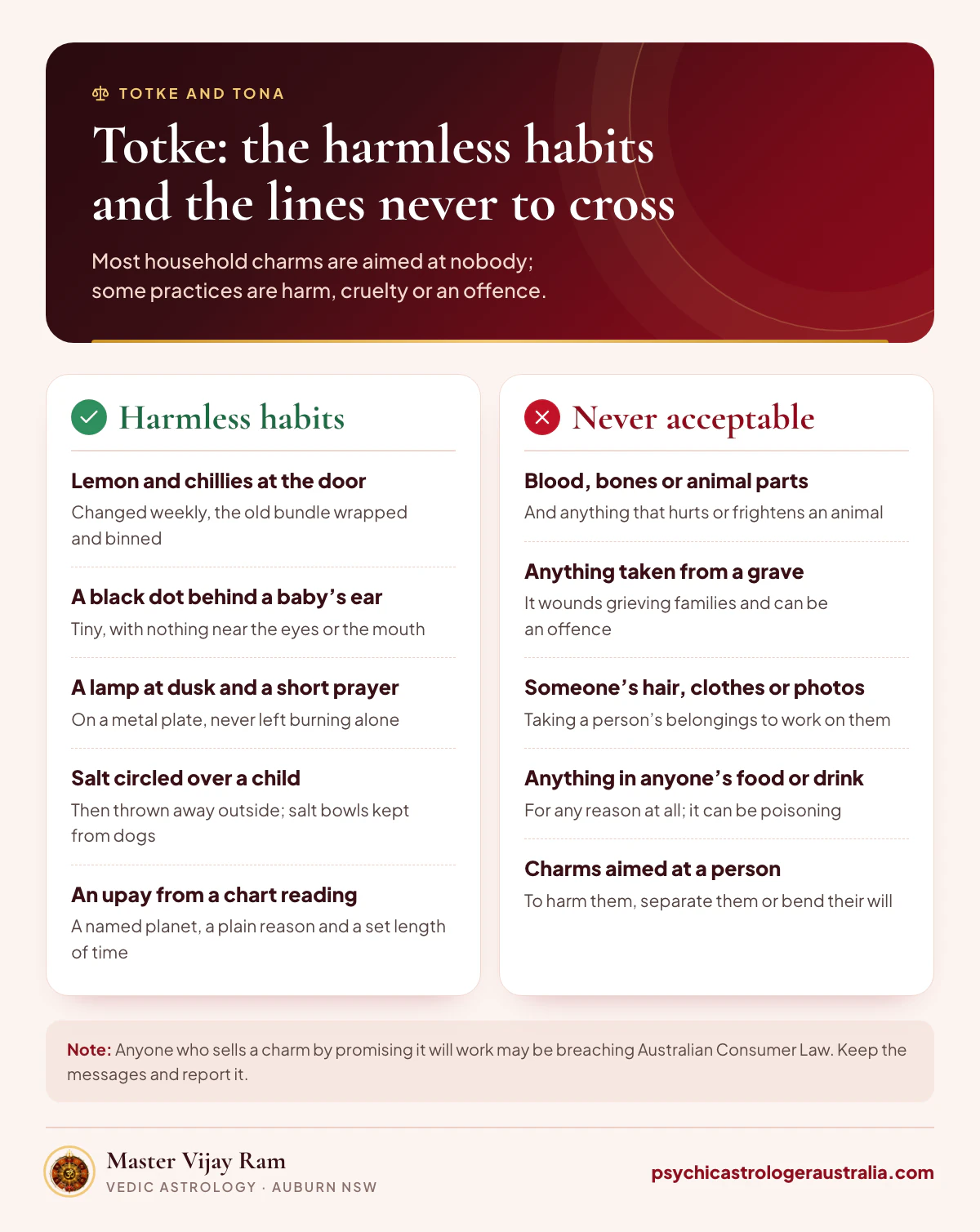
The ones that stay inside your own home or shop, are aimed at nobody, and cannot hurt a child, a pet or the house. A lemon and seven chillies hung at the door and changed weekly, a small black dot behind a baby’s ear with nothing near the eyes, a lamp at dusk, a tulsi plant by the entrance, a short prayer before a journey, and a pinch of salt circled over a child and thrown away outside all belong here.
Nothing bad follows if a family skips any of them, and no deity is offended by a household that keeps none. They are customs, and their value lies in the calm they bring rather than in any force of their own.
Which ones need care?
A middle group is harmless in intention and risky in practice, usually because of fire, smoke, salt or children. Chilli burnt on a pan fills a room with smoke that irritates the chest, and burning anything on charcoal indoors can produce carbon monoxide; alum spits when heated; camphor is dangerous if a small child swallows it; a bowl of salt eaten by a dog in quantity is a vet emergency.
None of these needs to be given up entirely, only done with sense: outdoors, briefly, away from children and pets, with the smoke alarm left alone. Phitkari and its limits shows how one of them can be kept safely.
Which charms are never acceptable?
Some practices sold or whispered as totke cross a line that no tradition worth the name allows. They are listed here only so that you recognise them and walk away; no method is given and none should be sought. Each of them is either harm to a living being, interference with another person, or an offence in Australian law, and usually more than one of those.
- Anything involving blood, bones or animal parts, and anything that hurts, kills or frightens an animal.
- Anything taken from a grave, a cemetery or a cremation ground, which wounds grieving families and can be an offence.
- Taking someone’s hair, nails, clothes, photographs or belongings to work on them.
- Putting anything into anyone’s food or drink, for any reason, which can be poisoning.
- Leaving objects at someone’s door, car, workplace or grave to frighten them.
- Any charm meant to make a person ill, leave a partner, lose a job, fall in love or do anything against their own will.
These are what the word tona describes, and they are what make harmful totke dangerous: not to the target, in most cases, but to the person doing them, whose fear, guilt and secrecy grow with every attempt. Master Vijay Ram refuses all of them, and he will not explain how they are done.
How do common totke sort out?
The table sorts the practices families ask about into the three piles, with the practical reason and the sensible alternative where one is needed.
| Practice | Which pile | Why | What to do |
|---|---|---|---|
| Lemon and seven chillies at the door | Harmless | A custom aimed at nobody | Change it weekly; wrap and bin the old one |
| A black dot behind a baby’s ear | Harmless with care | Eyes and skin are delicate | A tiny dot, nothing near the eyes, nothing in the mouth |
| A bowl of salt by the door | Harmless with care | Salt eaten in quantity is dangerous to dogs | Keep it high; sweep up spills |
| Chilli or alum burnt on coals | Needs care | Smoke irritates; charcoal indoors can produce carbon monoxide | Outdoors, briefly, children and pets away |
| Items floated in a river or the sea | Not in Australia | It can be littering or illegal dumping | A temple collection, compost, the green bin or your garden |
| Feeding a dog, a crow or a cow | Harmless with care | Human food can harm wildlife and pets | Proper food, where it is allowed, and someone’s animal only with permission |
| Blood, bones, graves, someone’s hair or food | Never | Harm, cruelty or an offence | Nothing; talk to someone instead |
What is Lal Kitab, and are its remedies totke?
Lal Kitab, the red book, is a set of Urdu-language books on astrology and remedies first published in Punjab in the last century, usually attributed to Pandit Roop Chand Joshi. Its remedies are famously simple and inexpensive, such as a particular donation, a gift to a sister or a daughter, feeding an animal, or keeping a small object at home, which is why Lal Kitab totke fill so many websites and videos.
Within that tradition, though, a remedy is chosen for a specific planet from a specific chart, and doing one meant for a planet that is fine in your chart is said to unsettle it. Some Lal Kitab instructions also ask for things to be floated in running water; in Australia that can count as littering or illegal dumping, so the item goes to a temple collection or the green bin instead.
What is the difference between an upay and a totka from a video?
The question of upay vs totka comes down to where the remedy came from. An upay is a remedy given after a reading of your chart, for a named planet or period, with a reason you can repeat back: this mantra because Saturn is pressing on your Moon, this donation on Saturdays for the length of this phase. A totka from a video is the same instruction for everyone who watches, whatever their chart.
Most video totke are harmless and useless; some are neither. Be wary of anything that promises money, love or revenge within a fixed number of days, asks you to act at midnight or in secret, needs something belonging to another person, or sends you to a seller for special ingredients. Undoing a spell tried from TikTok helps anyone who has already gone down that road.
A real upay usually turns out to be smaller and duller than the video promised: a mantra at a set hour, a fast that fits your health, a donation, a change in conduct. A full kundli reading is where such remedies come from.
What if you have already tried a harmful totka?
Stop, and do not repeat it to make sure. Dispose of anything you used quietly and safely, wrapped in the general waste, not at a crossroads or anyone’s door, and do not tell the person it was aimed at; a confession made in panic usually does more damage than the charm ever could. If anyone may have eaten or drunk something they should not have, call the Poisons Information Centre on 13 11 26, or 000 if they are unwell.
Then deal with what drove you to it, which is usually heartbreak, envy, money or fear. A counsellor, a GP or a calm conversation with a reader who will not judge you helps far more than a counter-charm. Families who fear that something was put in their own food can read the fear of black magic through food.
What if someone offers to sell you a totka?
Household totke cost a family a few dollars at a grocer and need nobody’s help. Anyone who tells you that you are cursed and must pay them to remove it, or sells a charm and promises it will work, may be engaging in misleading or unconscionable conduct under Australian Consumer Law, and NSW Fair Trading, Consumer Affairs Victoria, Queensland’s Office of Fair Trading and WA Consumer Protection all take complaints.
Keep the messages, do not send more money, and report it. A genuine practitioner never needs you frightened in order to help you.
Will Master Vijay Ram give you a totka?
No. He sells no totke, ingredients or charms, and he refuses any work aimed at another person. What he offers is a reading: a consultation costing $50, in English, Hindi or Punjabi and by phone, video or WhatsApp, that looks at your chart and your dates and says whether your trouble needs anything beyond the ordinary household customs.
Where a remedy is warranted it is an upay with a reason, or a puja, havan or jaap from $250, priced and agreed with you before anything is done; he performs it personally, and a puja or havan in Auburn explains how the family can follow by video.
Totke in Adelaide, Canberra and the Gold Coast
The questions arrive from everywhere: a shopkeeper in Salisbury asking whether the lemon at the door is enough, a student in Canberra worried about a totka a friend sent on Instagram, a family on the Gold Coast unsure whether a Lal Kitab video was safe to follow. Black magic removal in Salisbury covers the northern Adelaide side of the work.
Readings for Adelaide clients run by phone, video or WhatsApp, and Hobart, Newcastle and Wollongong callers are looked after in exactly the same way. Adelaide sits half an hour behind Sydney all year, and face-to-face sessions are held only in Auburn, by appointment.
What a totka cannot do
A totka cannot cure an illness, mend a marriage, return a lover, win a court case or settle a debt, and it cannot be guaranteed by anyone who sells it. A tona cannot be undone by a counter-tona, and the tradition holds that harm sent out tends to come home.
What the harmless habits can do is keep a household calm, close a day well and carry a grandmother’s care into an Australian home. All of this is faith and custom, never medical, legal or financial advice.
Read next
- Jadu Tona Explained: Signs, Myths and the Vedic ResponseJadu tona explained: what jadu, tona and totka mean, the signs families report, four myths, and how a Vedic reading r…
- Kala Jadu, Sihr and Voodoo: Which Tradition Is Your Family Describing?Kala jadu, sihr, voodoo, hooniyam and the evil eye: what each tradition means by harm, what undoes it, and how a Vedi…
- Kala Jadu Removal for Indians & Punjabis in AustraliaKala jadu removal explained for Indian and Punjabi families in Australia: the stage-by-stage process, what you are as…
Frequently asked questions
How is a totka different from a tona?
A totka is a small folk remedy or charm that a household does for its own protection, such as the lemon-and-chilli string at the entrance or a black dot behind a baby’s ear. A tona is a charm worked against someone else, meant to harm or control them. The words are often said together as tona totka, but one is protection and the other is an attempt at harm.
Are totke safe to do at home?
Most household totke are harmless when they stay in your own home, are aimed at nobody and cannot hurt a child, a pet or the house. Those involving fire, smoke, salt or camphor need care: outdoors or briefly, away from children and pets, with the smoke alarm left alone. Anything involving another person, blood, animals or food should never be done.
Which totke should never be done?
Anything involving blood, bones or animal parts, anything that harms an animal, anything taken from a grave or cremation ground, taking a person’s hair, clothes, photographs or belongings, putting anything in anyone’s food or drink, leaving objects at someone’s door, and any charm meant to control or harm another person. These cross ethical lines and often legal ones, and no genuine practitioner will teach them.
What are Lal Kitab totke?
Lal Kitab is a set of Urdu-language books on astrology and remedies first published in Punjab last century and usually attributed to Pandit Roop Chand Joshi. Its remedies are simple and inexpensive, such as donations, feeding animals or keeping a small object. In that tradition each remedy suits a particular planet in a particular chart, so copying one from a video without a reading misses its point.
What is the difference between an upay and a totka?
An upay is a remedy given after your chart has been read, for a named planet or period, with a reason you can repeat: a mantra, a donation, a fast or a change in conduct. A totka, especially one from a video, is the same instruction for everyone regardless of their chart. Upay tend to be smaller and duller than video totke promise, and far more honest.
Is it safe to follow totke from YouTube or Instagram?
Many are harmless and simply do nothing. Be wary of any that promise money, love or revenge within a set number of days, tell you to act at midnight or in secret, need something belonging to another person, or send you to a seller for special ingredients. Those are the signs of a charm that crosses a line or a sales pitch dressed as tradition.
I did a totka against someone and now regret it. What should I do?
Stop, and do not repeat it to make sure. Dispose of anything you used quietly in the general waste, not at a crossroads or their door, and do not confess in a panic. If anyone may have eaten or drunk something they should not have, call the Poisons Information Centre on 13 11 26. Then deal with what drove you to it, with a counsellor, a GP or a calm reader.
Someone wants money to remove a curse with a totka. Is that legal?
A person who tells you that you are cursed and must pay them to remove it, or sells a charm and promises it will work, may be engaging in misleading or unconscionable conduct under Australian Consumer Law. Keep the messages, send no more money, and complain to NSW Fair Trading, Consumer Affairs Victoria, Queensland’s Office of Fair Trading or WA Consumer Protection, depending on where you live.
Does Master Vijay Ram give totke?
He does not sell totke, ingredients or charms, and he refuses any work aimed at another person. He gives upay, remedies chosen after reading your chart and dates in a $50 consultation, and where a puja, havan or jaap is warranted he performs it personally in Auburn, from $250, at a price you agree to first. Most callers leave with a small home practice and nothing to buy.
People also ask
What does totka mean?
Totka means a small folk remedy or charm, usually done by a household for its own protection or luck: a lemon and chillies at the door, a black dot behind a baby’s ear, salt at the threshold, a prayer before a journey. The plural is totke. They are customs passed down in families rather than rites from scripture, and the harmless ones are aimed at nobody.
Do totke really work?
Families who keep the harmless ones say they bring calm and a sense of being watched over, and that is real. They do not cure illness, fix money or change another person’s mind, and none can be guaranteed. Where a trouble persists, a reading of the chart and the dates says more than a new totka, and the ordinary causes come first.
What is a tona in black magic?
A tona is a charm or working meant to act against someone, to harm them, separate them or bend their will. It is the opposite of a household totka, which protects the family that keeps it. The Vedic response to a feared tona is protection and removal for the person affected, never a counter-tona, and nobody is named or accused.
Are Lal Kitab remedies safe?
Most are simple and harmless, such as donations, feeding animals or keeping a small object, but they are meant to be chosen for a specific planet in a specific chart, and that tradition holds that a wrong remedy can unsettle a planet that was fine. Any instruction to float items in a river or the sea should be swapped for a temple collection or the green bin in Australia.
References & further reading
Serving clients across Australia
Confidential consultations by phone, video & WhatsApp — including: