

Quick answer
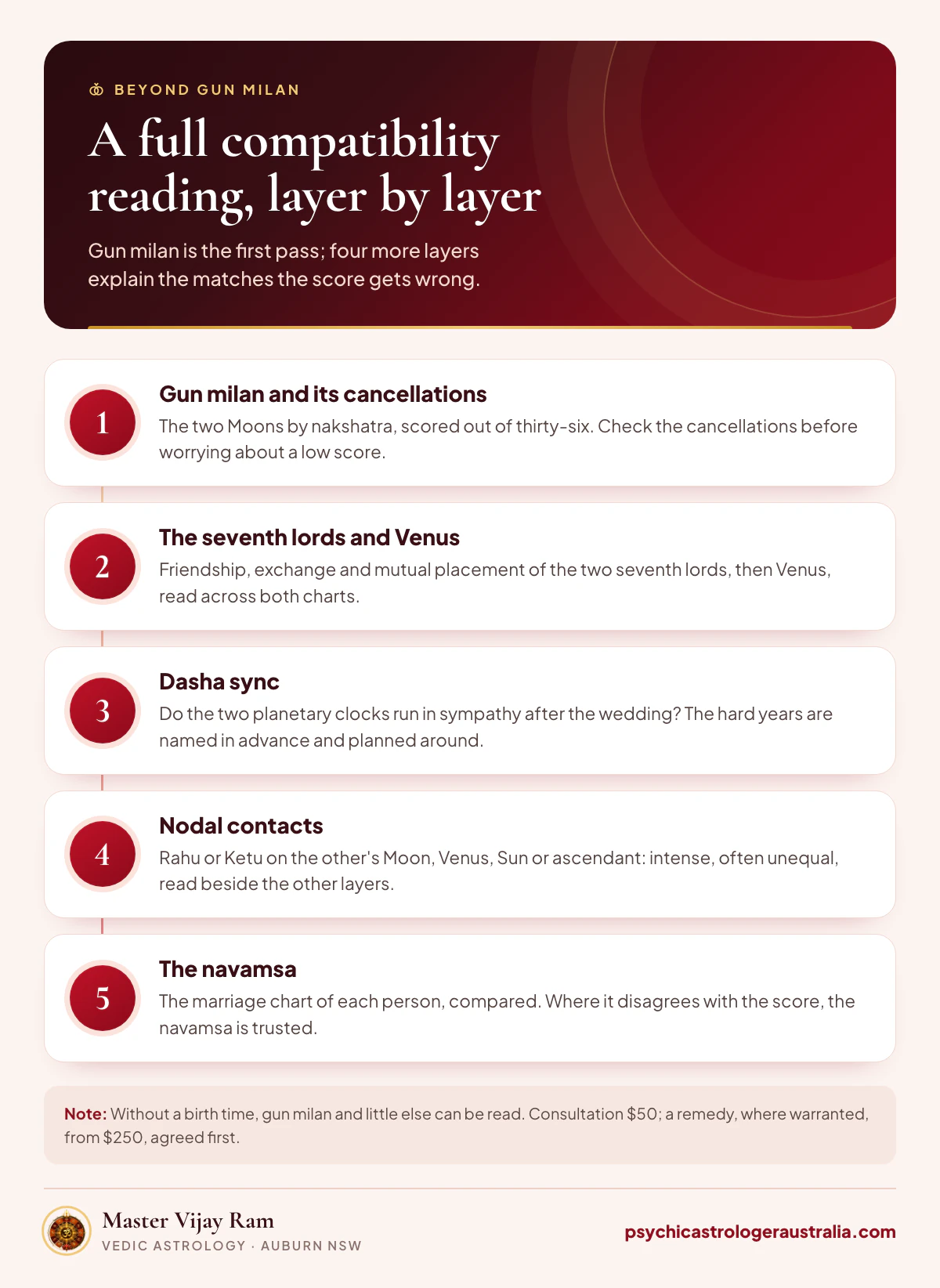
Marriage compatibility astrology does not end at the gun milan score. A full reading adds four layers: whether the two dashas run in sympathy, whether Rahu or Ketu in one chart sits on the other's Moon, Venus or ascendant, how the seventh lords and Venus relate across the charts, and what the navamsa shows. They explain the matches the score gets wrong.
Why the score is where a reading starts, not where it ends
Marriage compatibility astrology, as most Australian families meet it, is a number out of thirty-six, produced by an app in a few seconds and treated as a verdict. The number is gun milan, the ashtakoot matching of the two Moons by nakshatra, and it is a real and useful first pass. It is also blind to most of what makes a marriage work or fail, because it reads one point in each chart and nothing else.
Compatibility beyond gun milan is what a full reading adds: the seventh lords and Venus across both charts, the two dasha clocks, the nodal contacts, and the navamsa. Master Vijay Ram has read matches this way for more than forty years, and the four layers below are the ones that most often overturn a score, in both directions.
Gun milan explained covers the score itself, and nakshatra compatibility the layer just beneath it. This page is about everything after that.
Layer one: the two seventh lords and Venus across the charts
The seventh house carries partnership, and its lord carries the shape of the marriage a person is built for. The first thing a full reading does is set the two seventh lords beside each other: are they friends, are they in each other's signs, does one sit in the other's seventh house? Then Venus, the planet of affection, is read across the charts in the same way, and the Moon of each person is set against the other's Venus.
A pair whose seventh lords are natural enemies and whose Venuses sit in mutual sixth and eighth positions can score thirty out of thirty-six and still spend a marriage misunderstanding each other. A pair with a modest score and the seventh lords in exchange often have the thing the score was trying to measure. A love and marriage prediction reading begins with this layer.
Layer two: dasha sync, two people in the same season
Dasha compatibility is the most neglected layer and, in Vijay Ram ji's experience, the one that explains the most. Every chart runs its own planetary clock, and two people who marry while one is in a Jupiter period and the other in a Saturn sub-period over the seventh house are, quite literally, in different seasons. One wants to build; the other needs to endure.
A reading sets the two timelines side by side for the years after the proposed wedding and looks for sympathy: periods that favour partnership in both charts at once, and stretches where both will be under strain together, which is harder than one at a time. How the dasha system works explains the clock for readers who want the mechanics.
Mismatched dashas are not a reason to refuse a match. They are a reason to know in advance which years will ask for patience, and that knowledge is worth more than any score.
Layer three: nodal contacts, the pull that feels like fate
Nodal contacts are the placements of Rahu and Ketu in one chart against the Moon, Venus, Sun or ascendant of the other. Where one person's Rahu sits on the other's Moon or Venus, the bond has an unmistakable intensity: it feels fated, it is hard to leave, and it is often unequal, with one partner far more attached than the other.
Families call these love marriages against all advice; the chart calls them nodal contacts and reads them with care. They can be long and real, and they can also be the pattern behind the couples who separate and return for years without settling. A reading names the contact, says which way it runs, and sets it beside the other layers rather than letting it decide alone. Rahu, Ketu and relationships is the longer treatment.
Layer four: the navamsa, the chart of the marriage itself
The navamsa, the ninth divisional chart, is read in the tradition as the chart of marriage and of the partner, and no serious matching skips it. A planet that looks strong in the birth chart and sits debilitated in the navamsa promises more than it delivers; a modest Venus that rises in the navamsa delivers more than it promised.
The two navamsas are compared the way the birth charts are: seventh lords, Venus, the Moon, and the ascendant of each against the other. It is slower work than a score, and it is where the quiet marriages, the ones that outlast their louder cousins, usually show themselves.
Moon to Moon: temperament and the daily weather
The gun milan score is built on the two Moons, and the Moons still matter after the score is set aside, because they describe temperament: how each person handles money, silence, a mother-in-law, a bad week. Moons in signs that nourish each other make an ordinary Tuesday easier; Moons in mutual sixth and eighth positions make the same Tuesday work.
None of this is destiny. It is weather, and a couple who know their weather pack for it.
Mars, and the manglik question handled briefly
Mars in certain houses is the manglik condition families worry about most, and it belongs in a compatibility reading as one factor among many rather than as a veto. Many Mars placements cancel, many are matched by the other chart, and the ones that remain are addressed before the wedding rather than feared after it. The manglik dosha check and remedies is the page for that question on its own.
Where a remedy for Mars or for an afflicted Venus is warranted, a puja or havan performed personally starts from $250 and is agreed before it is performed. It is a prayer for the affliction to ease, offered alongside the match, never a condition of it.
The layers, what each checks, and what a mismatch looks like
The table sets the layers out in the order a full reading takes them.
| Layer | What it checks | What a mismatch looks like in life | What helps |
|---|---|---|---|
| Gun milan | The two Moons by nakshatra, out of thirty-six | A low score with nadi or bhakoot dosha; often less than it seems | Checking the cancellations before worrying |
| Seventh lords and Venus | Friendship, exchange and mutual placement across the charts | Chronic misunderstanding; affection that costs one partner too much | Knowing the pattern; counselling early rather than late |
| Dasha sync | Whether the two planetary clocks run in sympathy after the wedding | One partner building while the other endures; years of being out of step | Naming the hard years in advance and planning around them |
| Nodal contacts | Rahu or Ketu of one chart on the other's Moon, Venus, Sun or ascendant | Intensity, inequality, separations and returns that never settle | Reading the contact beside the other layers, not alone |
| Navamsa | The marriage chart of each person compared with the other | Promise without delivery; a strong birth chart that goes quiet in marriage | Weighting the navamsa over the score where they disagree |
| Mars and manglik | Mars in the first, fourth, seventh, eighth or twelfth, and its cancellations | Friction and temper where the condition is real and unmatched | Matching, cancellation, or a remedy agreed before the wedding |
Horoscope compatibility by date of birth alone: what is lost without a time
Horoscope compatibility by date of birth alone is what the free apps offer, and it is thinner than it looks. Without a birth time the ascendant is unknown, so the houses are unknown, so the seventh lord, the navamsa and most of the layers above cannot be read at all. The Moon may be known if it did not change sign that day, which leaves gun milan and little else.
An approximate time, to within an hour or two, recovers most of the reading, and Vijay Ram ji will say how much confidence each layer carries when the time is uncertain. He does not pretend to a precision the data cannot support.
When the score is high and the reading says wait
A score of thirty with the seventh lords at war and both dashas entering strain in the first two years is a match the full reading describes honestly: not impossible, but better entered with open eyes and perhaps a later date. Families do not always want to hear it, and the chart's value is in saying it before the wedding rather than after.
The advice in that case is rarely no. It is usually a date, a conversation, and sometimes a remedy for the planet doing the damage.
When the score is low and the reading says yes
The other direction is more common than people expect. A score of fourteen with a nadi dosha that cancels on inspection, seventh lords in exchange, Venus and Moon connected across the charts and dashas that run in sympathy for the next decade is a strong match wearing a bad number. Many good marriages in Adelaide, Perth and Parramatta began with a family reluctantly accepting that reading.
The relationship compatibility consultation exists for exactly this: to put the score in its place.
How Master Vijay Ram reads a match
Both sets of birth details, as exact as possible, and the proposed date if there is one. He reads gun milan first and says what its doshas are worth, then the seventh lords and Venus, then the two dasha timelines side by side, then the nodes, then the navamsas. He names the years that will ask for patience and the ones that favour the couple, and he says plainly where the layers disagree and which he trusts. The consultation is $50, by phone, video or WhatsApp, in English, Hindi or Punjabi.
South Australian families usually book through the Adelaide consultation page; the reading is held from Auburn wherever the two charts live.
Honest limits
This is faith-based guidance, not psychological or legal advice. A compatibility reading describes tendencies and timing in two charts; it does not know whether two people are kind to each other, and it is not a substitute for the conversations a couple need to have about money, children, parents and faith before they marry. Relationships Australia offers pre-marriage counselling for exactly those conversations.
What the full reading offers is a map of the weather for the years ahead, read from both charts, and a fair hearing for a match the score was about to condemn.
Read next
- Kundli Matching for Marriage: Gun Milan Explained and What a Low Score MeansKundli matching for marriage: how Gun Milan scores 36 points, what each koota measures, why a low score is not a verd…
- Rahu, Ketu and Relationships: Karmic Partners ExplainedRahu and Ketu in relationships: the nodes in the 7th house, what karmic means in Vedic terms, nodal contacts in synas…
- Kundli Reading Explained: What Your Birth Chart RevealsWhat a Kundli reading reveals about your life, personality, career and destiny. Master Vijay Ram explains Vedic astro…
Frequently asked questions
Is gun milan enough to decide a marriage match?
No. Gun milan matches the two Moons by nakshatra and gives a score out of thirty-six, which is a useful first pass and blind to most of what makes a marriage work. A full reading adds the seventh lords and Venus across the charts, the two dasha timelines, the nodal contacts and the navamsa. Those layers overturn the score in both directions more often than families expect.
What is dasha compatibility?
Every chart runs its own planetary clock, and dasha compatibility asks whether the two clocks run in sympathy after the wedding: periods that favour partnership in both charts at once, and stretches where both partners will be under strain together. Two people in different seasons, one building while the other endures, are out of step in ways no score shows, and naming the hard years in advance is the practical value.
What are nodal contacts in synastry?
The placements of Rahu and Ketu in one chart against the Moon, Venus, Sun or ascendant of the other. Rahu on a partner's Moon or Venus makes a bond intense, fated-feeling and often unequal, with one person far more attached. Such bonds can be long and real, and they are also the pattern behind couples who separate and return for years. A reading names the contact and reads it beside the other layers.
Can a low gun milan score still be a good match?
Often. A score of fourteen with a nadi dosha that cancels on inspection, seventh lords in exchange, Venus and Moon connected across the charts and dashas running in sympathy for the next decade is a strong match wearing a bad number. Master Vijay Ram reads the cancellations first and the deeper layers next, and many families accept a match they were about to refuse once the full reading is explained.
Can a high score still be a poor match?
Yes. A score of thirty with the seventh lords as natural enemies, Venuses in mutual sixth and eighth positions and both dashas entering strain in the first two years is a match the full reading describes honestly: not impossible, but better entered with open eyes and perhaps a later date. The advice is rarely no; it is usually a date, a conversation and sometimes a remedy.
Why does the navamsa matter in matching?
The navamsa, the ninth divisional chart, is read as the chart of marriage and of the partner. A planet strong in the birth chart but debilitated in the navamsa promises more than it delivers; a modest Venus that rises in the navamsa delivers more than it promised. The two navamsas are compared the way the birth charts are, and where the navamsa and the score disagree, the navamsa is trusted.
Can compatibility be read from the date of birth alone?
Only thinly. Without a birth time the ascendant and the houses are unknown, so the seventh lord, the navamsa and most of the deeper layers cannot be read, which leaves gun milan and little else. An approximate time within an hour or two recovers most of the reading, and Vijay Ram ji says how much confidence each layer carries rather than pretending to precision the data cannot support.
Is the manglik question part of a compatibility reading?
Yes, as one factor among many rather than a veto. Mars in the first, fourth, seventh, eighth or twelfth house is checked for cancellations and matched against the other chart, and the placements that remain are addressed before the wedding. Where a remedy for Mars or an afflicted Venus is warranted, a puja or havan is performed personally from $250, agreed first, and never made a condition of the match.
What does a full compatibility reading cost?
A consultation is $50, by phone, video or WhatsApp, in English, Hindi or Punjabi, with both charts read together: gun milan and its cancellations, the seventh lords and Venus, the two dasha timelines, the nodes and the navamsas. Master Vijay Ram names the years that favour the couple and the ones that ask for patience, and says plainly where the layers disagree and which he trusts.
People also ask
What is checked in kundli matching beyond the 36 points?
The seventh lords and Venus of each chart against the other, whether the two dasha timelines run in sympathy after the wedding, any Rahu or Ketu contacts on the partner's Moon, Venus, Sun or ascendant, and the navamsa of each person compared with the other. The Mars placement is checked for cancellations as one factor rather than a veto.
How accurate is horoscope compatibility by date of birth?
Without a birth time it is limited to the Moon, which gives gun milan and little else, because the ascendant, the houses, the seventh lord and the navamsa all depend on the time. An approximate time within an hour or two recovers most of a full reading. An honest astrologer states how much confidence each layer carries.
What does a nodal contact between two charts mean?
Rahu or Ketu of one person sitting on the Moon, Venus, Sun or ascendant of the other. The bond feels fated, is hard to leave and is often unequal in attachment. It can be long and real, and it is also the pattern behind couples who separate and return without settling. A full reading sets it beside the other layers rather than letting it decide alone.
Can two people with different dashas have a good marriage?
Yes. Mismatched dashas are a reason to know which years will ask for patience, not a reason to refuse a match. A reading sets the two timelines side by side for the years after the wedding and names the stretches where both partners will be under strain at once, which is harder than one at a time, so the couple can plan around them.
Which chart is most important for marriage in Vedic astrology?
The navamsa, the ninth divisional chart, is read as the chart of marriage and of the partner, and serious matching compares the two navamsas as carefully as the birth charts. The birth chart still supplies the seventh lord, Venus, the Moon and the dasha clock; the navamsa shows what each planet delivers in marriage, and it is trusted over the score where they disagree.
References & further reading
Serving clients across Australia
Confidential consultations by phone, video & WhatsApp — including: