

Quick answer
Vimshottari dasha is the Vedic timing system that gives nine planets fixed periods adding up to 120 years, in a sequence that starts from the nakshatra the Moon occupied at your birth. Each mahadasha divides into nine antardashas and each of those into pratyantars, so a chart's promises are read as seasons with a start and an end rather than as fixed traits.
What is the Vimshottari dasha?
The Vimshottari dasha is the timing system of Vedic astrology that gives each of nine planets a fixed period of rulership, in a fixed order, adding up to 120 years. Where the birth chart shows what a life contains, the dasha shows when each part of it is likely to come forward. It is the reason a Vedic reading can speak about seasons rather than traits.
The word means one hundred and twenty, and the system is laid out in the Brihat Parashara Hora Shastra, the text most Jyotish practice descends from. Other dasha systems exist, Yogini and Chara Dasha among them, but Vimshottari is the one almost every Indian astrologer reaches for first. A kundli reading with Master Vijay Ram is built on it.
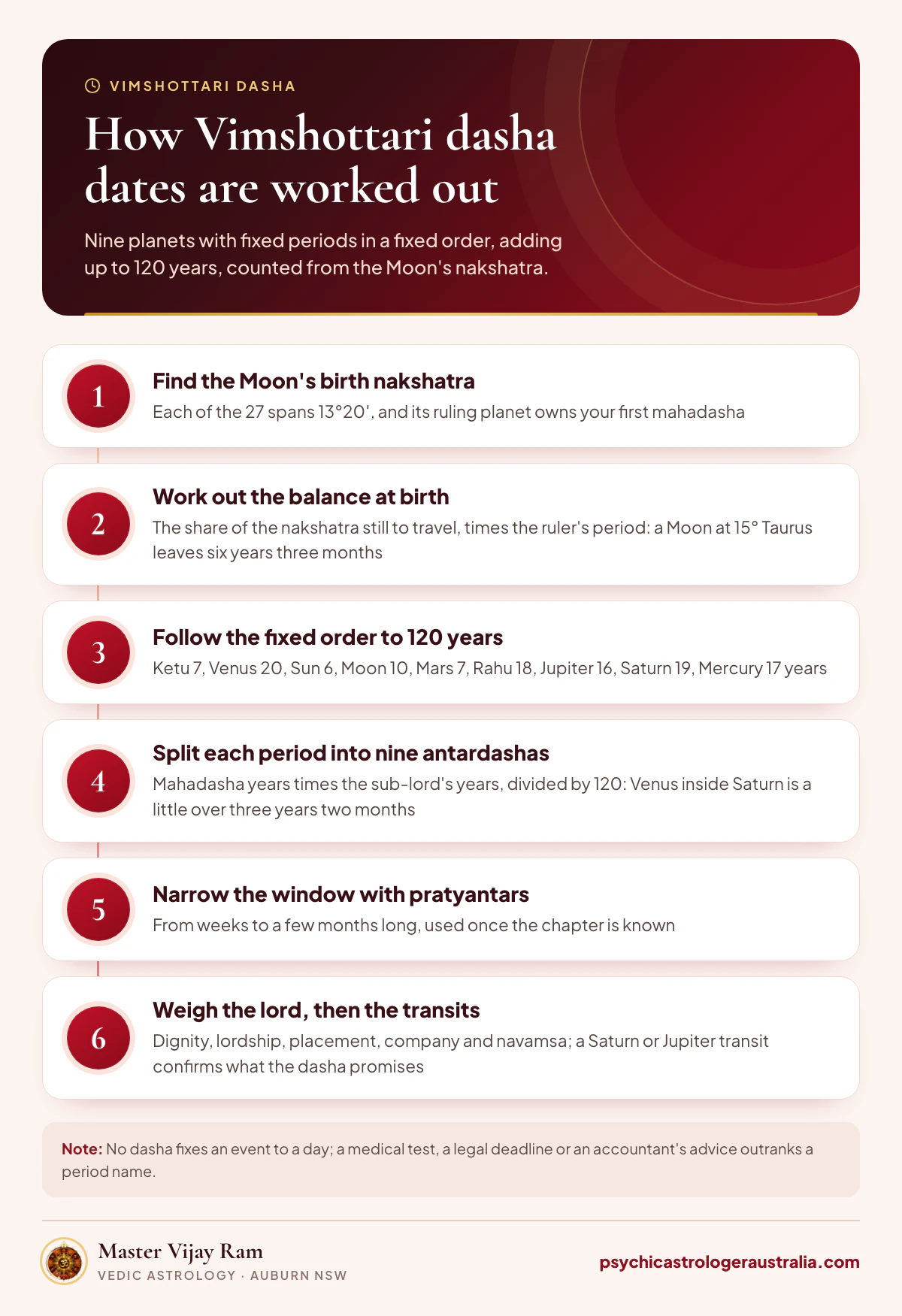
Why 120 years, and why the Moon decides where you start
The nine periods are Ketu seven years, Venus twenty, the Sun six, the Moon ten, Mars seven, Rahu eighteen, Jupiter sixteen, Saturn nineteen and Mercury seventeen, always in that order. Nobody lives the whole cycle, so what matters is where in it you are born. That is decided by the nakshatra, the lunar mansion of 13°20′, that the Moon occupied at the moment of your birth.
Each of the twenty-seven nakshatras has a ruling planet, and the sequence of rulers repeats three times around the zodiac: Ketu for Ashwini, Venus for Bharani, the Sun for Krittika, and so on through Mercury for Ashlesha before Ketu returns at Magha. Your first mahadasha belongs to the ruler of your birth nakshatra, and the rest follow in order. Two babies born on the same date in different hours can start in different periods, because the Moon crosses a nakshatra in roughly a day.
How is the dasha balance at birth calculated?
The Moon rarely sits at the start of a nakshatra, so the first period is nearly always a fraction. The dasha calculation takes the part of the nakshatra the Moon has still to travel and gives you the same fraction of that planet's full period. A Moon that has crossed three-quarters of Rohini leaves a quarter of the Moon's ten years, which is two and a half years of Moon dasha from birth.
Take a Moon at exactly 15° of Taurus. Rohini runs from 10°00′ to 23°20′ of Taurus, so the Moon is 5° into a span of 13°20′, has used 37.5 per cent of it and has 62.5 per cent remaining. Multiply by the Moon's ten years and the balance at birth is six years and three months.
From there the sequence is fixed: Mars from six years and three months to thirteen years and three months, Rahu to thirty-one years and three months, Jupiter to forty-seven years and three months, Saturn to sixty-six years and three months, Mercury to eighty-three years and three months, then Ketu, Venus and the Sun for anyone who lives that long. Every date in a dasha reading descends from that single fraction, which is why the birth time matters and why the ayanamsa matters even more.
Mahadasha, antardasha and pratyantar: the three levels
A mahadasha is the main period; inside it the same nine planets rule in turn as antardashas, each taking a share of the main period in proportion to its own length; inside each antardasha the nine rule again as pratyantars. The share rule is simple: an antardasha lasts the mahadasha length multiplied by the sub-lord's own length and divided by 120. Venus inside Saturn is therefore nineteen times twenty over 120, a little over three years and two months.
| Antardasha lord | Own mahadasha | Share of any mahadasha | Inside Venus (20 y) | Inside Saturn (19 y) | Inside the Moon (10 y) |
|---|---|---|---|---|---|
| Ketu | 7 years | 5.8% | 1 y 2 m | 1 y 1 m | 7 m |
| Venus | 20 years | 16.7% | 3 y 4 m | 3 y 2 m | 1 y 8 m |
| Sun | 6 years | 5.0% | 1 y 0 m | 11 m | 6 m |
| Moon | 10 years | 8.3% | 1 y 8 m | 1 y 7 m | 10 m |
| Mars | 7 years | 5.8% | 1 y 2 m | 1 y 1 m | 7 m |
| Rahu | 18 years | 15.0% | 3 y 0 m | 2 y 10 m | 1 y 6 m |
| Jupiter | 16 years | 13.3% | 2 y 8 m | 2 y 6 m | 1 y 4 m |
| Saturn | 19 years | 15.8% | 3 y 2 m | 3 y 0 m | 1 y 7 m |
| Mercury | 17 years | 14.2% | 2 y 10 m | 2 y 8 m | 1 y 5 m |
The levels answer different questions. The mahadasha and antardasha together set the theme and the chapter; the pratyantar, which lasts from weeks to a few months, is used to narrow a window once the chapter is known. A reading that quotes a pratyantar for an event ten years away is quoting more precision than most birth times support.
In what order do the antardashas run?
Each mahadasha opens with its own lord as the first antardasha and then follows the standard sequence from that point. The Venus mahadasha runs Venus, Sun, Moon, Mars, Rahu, Jupiter, Saturn, Mercury and Ketu; the Saturn mahadasha runs Saturn, Mercury, Ketu, Venus, Sun, Moon, Mars, Rahu and Jupiter. Because the first antardasha is the lord's own, the opening stretch of any mahadasha shows that planet's nature most plainly.
The same rule produces the pratyantars inside each antardasha, beginning with the antardasha lord. Software does the arithmetic in a moment; the skill is in reading what the names mean for one particular chart.
What does a dasha actually do?
A dasha brings forward whatever its planet signifies in your chart: the houses it rules, the house it sits in, the planets it is joined to or aspected by, and the things it naturally stands for. A Jupiter period for a person whose Jupiter rules the second and fifth houses from a Sagittarius lagna, and sits in the ninth, tends to bring family, children, study and faith to the front. The same Jupiter period for a Taurus lagna, where Jupiter rules the eighth and eleventh, brings gains with upheaval attached.
This is why there is no good or bad planet in the abstract, and why a list of dasha periods on an app tells you almost nothing without the chart beneath it. The period is the stage and the chart decides the play; marriage timing by dasha shows the method applied to a single question.
How do you judge whether a period will be kind?
Master Vijay Ram weighs the dasha lord on five counts before he says anything about the years ahead. The first is dignity: a planet in its own sign, exalted or in a friend's sign gives its period more easily than one debilitated or combust. The second is lordship: lords of the first, fifth and ninth houses and the kendra lords are the chart's allies, while lords of the sixth, eighth and twelfth bring their houses' difficulties when they rule.
The third is placement, the house the lord occupies; the fourth is company, the planets it sits with and the aspects it receives; the fifth is the navamsa, the ninth divisional chart, where a planet strong in the main chart can prove weak or the reverse. Only after those is the transit of Saturn and Jupiter laid over the period, because a transit confirms what a dasha promises rather than creating it.
Why two people in the same mahadasha live different years
Siblings often share a mahadasha for a stretch, and parents ask why one child's Rahu years brought a scholarship abroad while the other's brought a lost deposit. The answer is the lagna, which turns the same Rahu into a different house's agent, and the antardasha, which runs on a different clock for each birth. A Rahu-Jupiter antardasha and a Rahu-Saturn antardasha are not the same season even for the same person.
The lesson for anyone reading about their own dasha online is that the mahadasha name is the least informative part of the reading. The sub-period, the chart and the running transits carry the information.
Dasha sandhi: the changeover
The last months of one mahadasha and the first of the next are called dasha sandhi, the junction, and the tradition treats them as unsettled, especially at the junctions it names as sharp: Mars to Rahu, Jupiter to Saturn and Mercury to Ketu. People describe the years before a big change as a time when the old things stopped working before the new ones began. Dasha sandhi has a page of its own.
How does the dasha work with transits?
The dasha is the loaded promise and the transit is the trigger, which is the rule behind most Vedic timing. In 2027 Saturn moves from sidereal Pisces into Aries on 3 June 2027 and returns to Pisces on 20 October 2027, and Jupiter re-enters Leo on 26 June 2027 before moving into Virgo on 27 November 2027. Those movements matter most to the people whose running antardasha already points at the houses Saturn and Jupiter will touch.
A Saturn antardasha with Saturn transiting your Moon sign is a Sade Sati year inside a Saturn period, which is heavier than either alone; a Jupiter antardasha with Jupiter crossing your lagna is the opposite. The yearly forecast reading is built on exactly this overlay of period and transit, and the Rahu mahadasha shows how one eighteen-year period is read in full.
Why do apps get the dasha dates wrong?
Three settings change a dasha date, and an app often hides all three. The ayanamsa, the correction between the tropical and sidereal zodiacs, moves the Moon's nakshatra position: a difference of two degrees between two ayanamsas shifts a Venus or Saturn dasha by about three years. Master Vijay Ram uses Lahiri, the ayanamsa of India's national calendar, which stood at 24°14′ on 1 Jan 2027.
The birth time is the second: the Moon moves about half a degree an hour, and a birth time rounded to the nearest hour can move a Moon-ruled period by a month or more. The third is the year length, since some software uses a year of 365.25 days and some a year of 360, which drifts the dates by weeks across a lifetime. Finding your Moon sign explains the ayanamsa question for the chart as a whole.
A worked example: a teacher in Hobart
A secondary teacher in her late forties, born with the Moon at 15° Taurus, had the Moon balance of six years and three months from the earlier example, which put her into Saturn's mahadasha at forty-seven years and three months. Saturn ruled her ninth and tenth houses from a Taurus lagna and sat in the tenth, in Aquarius, its own sign. That is a Saturn with every reason to give its period well, and the first Saturn-Saturn antardasha brought a promotion to head of faculty rather than the dread the word Saturn had put into her.
The reading also marked the Saturn-Ketu antardasha, thirteen months long and two periods later, as the stretch to keep quiet in, because Ketu sat in her eighth house. Hobart clients read in Sydney time and most prefer video, which suits a chart with this much arithmetic to show.
What dasha timing cannot do
It cannot fix an event to a day, and anyone who tells you a dasha makes something certain has stopped reading the chart. It cannot override free will: a period opens a door and the person decides whether to walk through it. And it cannot replace evidence where evidence exists; a medical test, a legal deadline or an accountant's advice always outranks a period name.
This is faith-based guidance, not medical, legal or financial advice, and he says so at the start of every reading. A claim that can never turn out wrong is not a prediction, which is a fair test to apply to any astrologer, including this one.
How Master Vijay Ram reads your dasha
He needs your date, time and place of birth. He casts the chart with the Lahiri ayanamsa, fixes the balance at birth from the Moon's exact degree, lists the next ten years of antardashas, weighs each lord on the five counts above, and lays the 2027 transits over the result. You come away knowing which period you are in, when it changes, and what each of the next few chapters tends to ask of a person with your chart.
The consultation is $50, by phone, video or WhatsApp anywhere in Australia, in English, Hindi or Punjabi, or in person at Auburn by appointment. Where a period lord is weak enough that the tradition prescribes a shanti, a puja or havan is performed personally at his own place of practice from $250, agreed before it is performed; most dasha readings end with understanding rather than a remedy, and online puja and havan describes what is performed when one is called for. Understanding your dasha in kundli terms is the most useful thing a reading gives, because it turns a chart into a calendar.
Three generations, three dashas: reading a family's periods in Brisbane
On Brisbane's southside, in Sunnybank, Runcorn and Eight Mile Plains, a dasha question is often a family question. Grandparents in India, parents in their forties and children at school each run a different period, because the sequence starts from each person's own birth nakshatra; there is no family dasha, only several Vimshottari clocks running side by side.
Laid next to each other, they explain a good deal. In Vijay Ram ji's experience the year a family moved to Queensland often sits inside a Rahu mahadasha or antardasha for at least one adult, a teenager's Mercury antardasha can be why the senior years are going better than anyone feared, and a grandparent's Saturn period can be why the yearly flight out to see the family in Logan now feels like a long haul.
Brisbane keeps Australian Eastern Standard Time all year, and India has no daylight saving either, so the gap stays at four and a half hours: a one o'clock call in Sunnybank is half past eight in the morning in Amritsar, in January and in July alike. That makes it easy to put three generations on one video call, with each chart cast for its own birthplace.
A southside family can book Brisbane astrology readings by phone or WhatsApp, and a family reading by video lets each person hear their own period described in turn. Grandparents who are more at home in their first language can follow along through a reading in Punjabi or Hindi.
Read next
- Dasha Sandhi: The Changeover Between Planetary PeriodsDasha sandhi: why the changeover between mahadashas feels like a cliff, how long it lasts, the junctions and the shar…
- Saturn Mahadasha, Rahu Antardasha: The Sub-Period People FearSaturn mahadasha, Rahu antardasha: why it lasts 2 years 10 months 6 days, what it tends to bring, why it is not a doo…
- Kundli Reading Explained: What Your Birth Chart RevealsWhat a Kundli reading reveals about your life, personality, career and destiny. Master Vijay Ram explains Vedic astro…
Frequently asked questions
How many years does each mahadasha last?
The nine Vimshottari periods are fixed: Ketu seven years, Venus twenty, the Sun six, the Moon ten, Mars seven, Rahu eighteen, Jupiter sixteen, Saturn nineteen and Mercury seventeen, which add up to 120. Everyone runs them in that order; the only thing that differs from person to person is where in the cycle the birth falls and how much of the first period remains at birth.
How do I find out which dasha I am in?
You need your date, time and place of birth. The Moon's exact position gives the birth nakshatra and its ruler, the unused fraction of that nakshatra gives the balance of the first period, and the fixed sequence runs from there. Reliable software will show it, but the ayanamsa setting must be the same as the astrologer's, otherwise the dates can differ by years.
What is the difference between mahadasha and antardasha?
The mahadasha is the main period, from six to twenty years long, and sets the theme of that stretch of life. The antardasha is the sub-period inside it, from a few months to a few years, and sets what happens within the theme. Readings are usually made at the antardasha level, because a twenty-year Venus period is too broad to time anything.
Which dasha is the best one?
None in the abstract. A period is kind when its planet is well placed in your chart, rules helpful houses, keeps good company and is strong in the navamsa, and difficult when the opposite is true. The same Jupiter mahadasha can be the best years of one life and a period of expensive expansion in another, which is why the lord is judged before the name.
Does my dasha change if my birth time is wrong?
Yes, by a little or a lot. The Moon moves about half a degree an hour, and the balance at birth is calculated from its exact degree, so an error of an hour shifts a Moon-ruled period by a month or more and a Venus-ruled one by more than that. Give the most accurate time you have, say if it is approximate, and the reading will tell you how much depends on it.
Why do two apps give me different dasha dates?
Usually the ayanamsa. Lahiri, Raman and the Krishnamurti ayanamsa differ by a degree or more, and a difference of two degrees moves a Venus or Saturn dasha by about three years. The year length also matters, since some software counts 365.25-day years and some 360-day years, and a rounded birth time adds its own drift. Master Vijay Ram uses Lahiri with the exact degree.
Can a remedy shorten a difficult dasha?
No remedy changes the length or the order of the periods, and he says so plainly. What the tradition offers is a shanti for the period lord, meant to soften what the period asks rather than to remove it. Where the chart warrants one, a puja or havan is performed personally at Auburn from $250, agreed before it is performed, after a $50 consultation; most dasha readings need none.
Is Vimshottari dasha used for everyone?
It is the default system in most of Indian astrology and the one taught first, but the classical texts give other systems for particular charts. Yogini dasha and Chara dasha are the common alternatives, and some astrologers cross-check Vimshottari against one of them before timing a major event. In practice Vimshottari carries the reading and the others confirm it.
What is a pratyantar dasha?
The third level of the system: inside each antardasha the nine planets rule again in the same order, each for a share proportional to its length, giving periods of weeks to a few months. Pratyantars are used to narrow a window once the mahadasha and antardasha have identified the chapter. They are too fine to rely on when the birth time is uncertain.
People also ask
What is Vimshottari dasha in simple words?
It is a planetary calendar for one life. Nine planets take turns ruling, in a fixed order and for fixed lengths adding up to 120 years, and the point where your turn-taking begins is set by the nakshatra the Moon was in when you were born. Each ruling planet brings forward the parts of your chart it governs.
How is the dasha calculated from the nakshatra?
Each nakshatra has a ruling planet, and the Moon's exact degree shows how much of its nakshatra it had still to cross at birth. That fraction of the ruler's full period is the balance of the first dasha. The remaining periods then follow in the fixed order, each for its full length, from the end of that balance.
What happens when a mahadasha changes?
The junction, called dasha sandhi, is read as an unsettled stretch of months in which the old lord's business winds down and the new lord's begins. It is sharpest at the junctions the tradition singles out, such as Mars giving way to Rahu or Jupiter to Saturn. People often describe it as the time when old arrangements stopped working before new ones started.
How long is the Rahu mahadasha?
Eighteen years, the third longest after Venus and Saturn. Inside it the antardashas run Rahu, Jupiter, Saturn, Mercury, Ketu, Venus, Sun, Moon and Mars, with Rahu's own sub-period lasting two years and eight months and Jupiter's about two years and five months. What those years bring depends on Rahu's sign, house and dispositor in the chart.
Can two people have the same dasha?
People born within the same day often share a mahadasha, and siblings commonly overlap for years. They still live different periods, because the same planet rules different houses for different lagnas, the antardashas start at different times, and the transits of Saturn and Jupiter touch different houses in each chart.
References & further reading
Serving clients across Australia
Confidential consultations by phone, video & WhatsApp — including: