
Quick answer
Bhakoot dosha means the Bhakoot koota of kundli matching scores nothing because the two partners' Moon signs sit 2-12, 6-8 or 5-9 apart, a loss of all 7 points. It is commonly cancelled when both signs share a lord, as Aries and Scorpio do, or when the two lords are friends. Even uncancelled, it is a prompt to read further, not a sentence.
What is Bhakoot dosha?
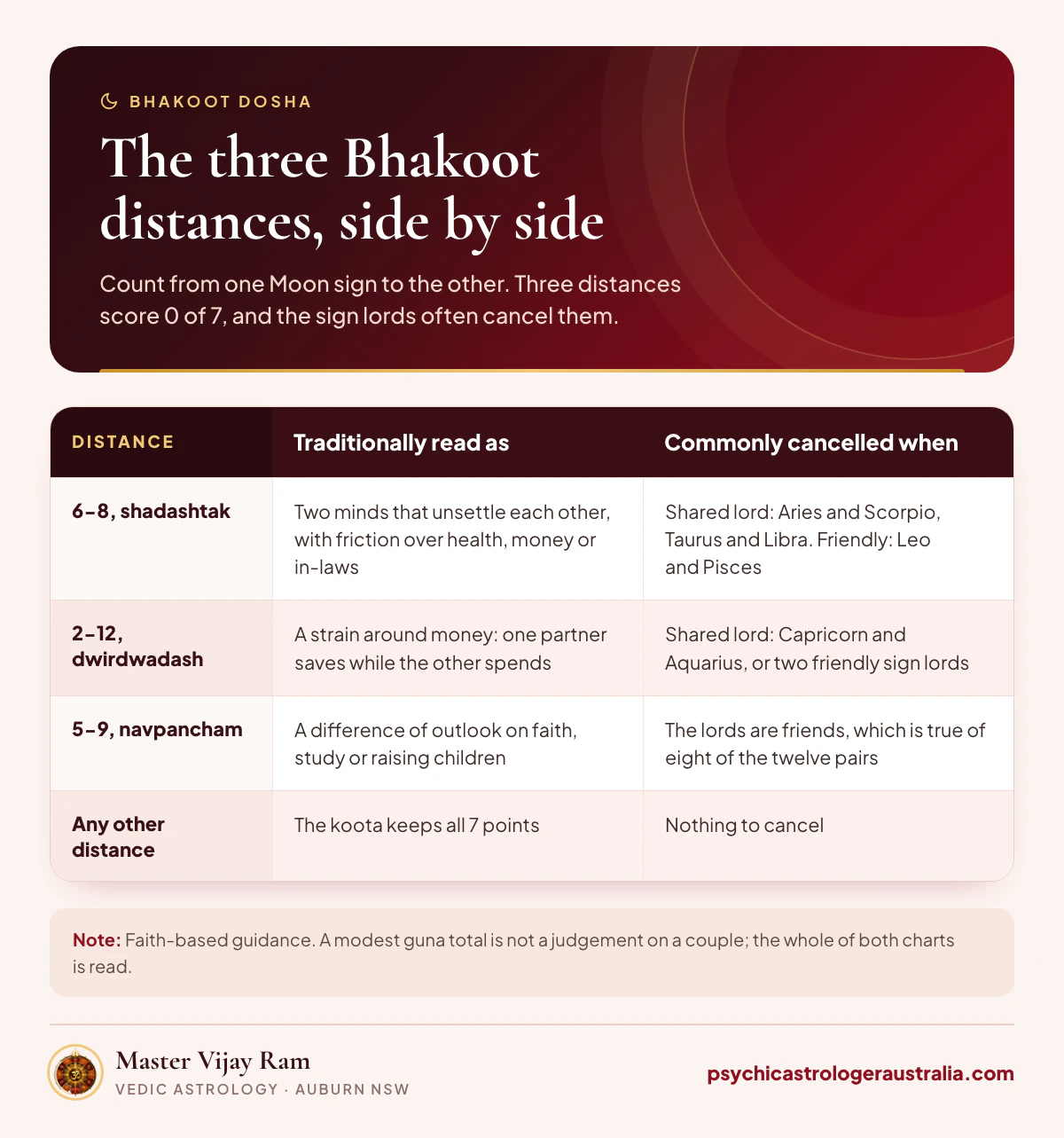
Bhakoot dosha is a result in Ashtakoot matching that is given when the Moon signs of two partners stand in one of three uneasy distances from each other: two and twelve, six and eight, or five and nine. The Bhakoot koota, sometimes called Rashi koota, is worth 7 of the 36 points, and any of those three distances scores none of them. Only Nadi weighs more, which is why families notice when Bhakoot goes missing.
Where Nadi compares the two birth stars, Bhakoot looks only at the two Moon signs, the rashis. That makes it quick to check and easy to misread. Master Vijay Ram reads it inside a full compatibility reading for couples, with the sign lords, the cancellations and the rest of both charts on the table together.
How is the Bhakoot distance counted?
Count from one partner's Moon sign to the other's, calling the starting sign one, and then count back the other way. If her Moon is in Leo and his is in Pisces, Pisces is the eighth sign from Leo and Leo is the sixth sign from Pisces, so the pair is six-eight. The same counting gives two-twelve for neighbouring signs and five-nine for signs of the same element.
Every other distance, the same sign, three-eleven, four-ten and seven-seven, earns the full 7 points. Bhakoot is therefore all or nothing: a couple keep the seven or lose them entirely. If you are unsure of your rashi, how to find your Moon sign walks through it, and a Western sun sign is a different thing altogether.
Which Moon-sign pairs fall in Bhakoot dosha?
Find your own Moon sign in the first column and look for your partner's sign along the same row. If it appears, the koota scores zero before any cancellation is applied; if it does not, the full seven points are kept.
| Your Moon sign | 2-12 (dwirdwadash) | 6-8 (shadashtak) | 5-9 (navpancham) |
|---|---|---|---|
| Mesha (Aries) | Taurus, Pisces | Virgo, Scorpio | Leo, Sagittarius |
| Vrishabha (Taurus) | Gemini, Aries | Libra, Sagittarius | Virgo, Capricorn |
| Mithuna (Gemini) | Cancer, Taurus | Scorpio, Capricorn | Libra, Aquarius |
| Karka (Cancer) | Leo, Gemini | Sagittarius, Aquarius | Scorpio, Pisces |
| Simha (Leo) | Virgo, Cancer | Capricorn, Pisces | Sagittarius, Aries |
| Kanya (Virgo) | Libra, Leo | Aquarius, Aries | Capricorn, Taurus |
| Tula (Libra) | Scorpio, Virgo | Pisces, Taurus | Aquarius, Gemini |
| Vrishchika (Scorpio) | Sagittarius, Libra | Aries, Gemini | Pisces, Cancer |
| Dhanu (Sagittarius) | Capricorn, Scorpio | Taurus, Cancer | Aries, Leo |
| Makara (Capricorn) | Aquarius, Sagittarius | Gemini, Leo | Taurus, Virgo |
| Kumbha (Aquarius) | Pisces, Capricorn | Cancer, Virgo | Gemini, Libra |
| Meena (Pisces) | Aries, Aquarius | Leo, Libra | Cancer, Scorpio |
Six of the twelve possible partner signs fall in one of the three distances, so on paper the dosha turns up in half of all pairings. That alone should calm the room: something this common cannot be a rare misfortune, and the cancellations further down remove a good share of it.
Why is the 6-8 pairing, shadashtak, the most feared?
The sixth and eighth houses are dusthanas, houses of difficulty: the sixth of disputes, debts and illness, the eighth of sudden change and hidden matters. A shadashtak dosha places each partner's Moon in one of those houses counted from the other, so the tradition reads two minds that unsettle each other, with friction over health, money or in-laws. It is the distance elders worry about most and the only one that most families know by name.
In practice a 6-8 Bhakoot pairing more often describes a difference in emotional rhythm than a disaster. One partner settles a worry by talking it through, the other by going quiet; one wants the plan, the other wants room. Named early, that difference is something a couple can work with, and the lords of the two signs decide whether the dosha is even counted.
What do the 2-12 and 5-9 pairings traditionally signal?
The two-twelve pairing, dwirdwadash, joins the second house of savings and family with the twelfth house of spending and loss. The tradition reads it as a strain around money: one partner saves while the other spends, or the household's outgoings run ahead of its income in the early years. A frank budget conversation is the ordinary remedy that sits beside any spiritual one.
The five-nine pairing, navpancham, is the gentlest of the three, and some families barely count it. Five and nine are trikonas, houses of children, learning and faith, so the concern is a difference of outlook on religion, study or raising children rather than open conflict. Traditions differ on its weight, and many astrologers treat an uncancelled five-nine far more lightly than a six-eight.
When is Bhakoot dosha cancelled?
The commonly cited cancellation rests on the two sign lords. If both Moon signs are ruled by the same planet, the dosha is set aside, and among the three distances that happens in exactly three pairs: Aries with Scorpio (Mars), Taurus with Libra (Venus) and Capricorn with Aquarius (Saturn). If the two lords are friends, the dosha is commonly set aside as well.
| Sign lords | 2-12 pairs | 6-8 pairs | 5-9 pairs |
|---|---|---|---|
| Same lord (commonly cancelled) | Capricorn-Aquarius | Aries-Scorpio, Taurus-Libra | None |
| Mutual friends (commonly cancelled) | Taurus-Gemini, Cancer-Leo, Virgo-Libra, Scorpio-Sagittarius, Pisces-Aries | Leo-Pisces | Aries-Leo, Aries-Sagittarius, Leo-Sagittarius, Taurus-Virgo, Taurus-Capricorn, Gemini-Libra, Libra-Aquarius, Scorpio-Pisces |
| One lord friendly, the other neutral (traditions differ) | Leo-Virgo | Gemini-Capricorn, Cancer-Sagittarius, Virgo-Aquarius | Cancer-Scorpio, Cancer-Pisces, Virgo-Capricorn, Gemini-Aquarius |
| Neutral or hostile (usually read as standing) | Aries-Taurus, Gemini-Cancer, Libra-Scorpio, Sagittarius-Capricorn, Aquarius-Pisces | Taurus-Sagittarius, Cancer-Aquarius, Aries-Virgo, Gemini-Scorpio, Leo-Capricorn, Libra-Pisces | None |
Two patterns stand out. Most five-nine pairs have friendly lords, which is one reason that distance is so often set aside, while most six-eight pairs do not, which is one reason shadashtak keeps its reputation.
The friendships used here are the natural ones of the classical texts. Some astrologers also weigh the temporary friendships inside each chart, and traditions differ on whether a friendship that runs only one way is enough, so the third row is where two readings of the same couple most often part company. A sound Bhakoot dosha cancellation names its rule; it never just changes the total.
How does Bhakoot relate to Graha Maitri?
Graha Maitri, worth 5 points, scores the friendship of the same two Moon-sign lords that the Bhakoot cancellation looks at. The two kootas therefore tend to move together: a pair whose lords are mutual friends keeps the Graha Maitri points even while losing Bhakoot on paper, and the cancellation then restores the seven. A pair of hostile lords tends to lose on both lines at once.
So a score sheet showing zero for Bhakoot and five for Graha Maitri should make anyone pause before panicking. The same friendship is being counted twice, once as a loss and once as a gain, and a careful reader reconciles the two instead of adding them blindly. How the eight kootas fit together is set out in Gun Milan scoring and low totals.
What does a Bhakoot check look like for two example couples?
Take an illustrative couple in Geelong: his Moon in Leo, hers in Pisces. That is six-eight, so the koota scores zero, but the Sun and Jupiter are mutual friends and the bhakoot dosh is commonly set aside. The reading moves on to the seventh houses and the dashas, and the word shadashtak never needs to reach the family group chat.
Now an illustrative couple in Wollongong: her Moon in Taurus, his in Sagittarius. This is six-eight as well, but Venus and Jupiter are not friends, so no cancellation applies and the dosha stands. It is still not a verdict; it is a flag to read the two seventh lords, Venus, the navamsa and the timing with extra care, and to talk honestly about how each of them handles a hard month.
Does Bhakoot dosha matter when the total score is high?
It matters to the reading, but less to the decision than people fear. A couple at 28 who lost Bhakoot have scored 28 of the 29 points the other seven kootas allow, which is a strong match on everything else. A couple at 19 who lost it without a cancellation deserve a closer look at the whole chart, not an automatic refusal.
A modest guna total is not a judgement on a couple. The points system reads only the Moon, while the seventh house, its lord, Venus, Jupiter and the timing periods carry at least as much weight, and plenty of long marriages began with an unremarkable score.
How is Bhakoot weighed against the rest of both charts?
The Bhakoot result describes how two Moons sit with each other, which is the emotional weather of a marriage. The structure of the marriage is read elsewhere: each partner's seventh lord and the house it sits in, Venus, Jupiter, the D9 chart, and whether both partners' dashas favour marriage in the same years, which is the work of a marriage timing reading. The heavier koota beside it has exceptions of its own, set out in Nadi dosha and when it is cancelled.
Finer comparison of the two birth stars, beyond the sign distance, belongs to the nakshatra layer of matching. Taken together, these layers usually settle a Bhakoot question one way or the other within a single reading.
Which remedies are traditionally offered for Bhakoot dosha?
If no cancellation applies and the families ask for a remedy, the tradition looks to the two Moon-sign lords. Their mantras, prayer on the weekdays they rule and a shanti for the lord under the most strain are the usual forms, often with food given to those who need it. Plain conduct counts as well: a six-eight couple who agree in advance how they will handle a difficult week are doing what the remedy intends.
Any such puja is done by Vijay Ram ji himself in Auburn, timed to a suitable muhurat, and a couple in Townsville or Newcastle can watch by video. The fee starts from $250 and is settled with the family in advance; the online puja and havan service explains the arrangement. A remedy serves the two people, not the arithmetic, and he says so when none is needed.
What happens in a Bhakoot reading with Master Vijay Ram?
It costs $50 and runs over the phone, on video or through WhatsApp, and he needs the birth date, time and place of both partners. He confirms the two Moon signs, which matters when a Moon sat near the end of a sign on the day of birth, names the distance and states which cancellation, if any, applies. Then he reads the parts of both charts that the koota cannot see.
Couples from Newcastle to the Sunshine Coast, Cairns and Townsville arrange it the same way, and calls that include parents overseas are set around the elders' day. The astrology readings for Geelong couples page shows how a call runs from regional Victoria, and an in-person appointment means a visit to Auburn, his only place of practice.
What can a Bhakoot reading not settle?
It cannot measure kindness, honesty about money or how two people repair after an argument, and those decide more marriages than any pair of Moon signs. It reads the emotional fit the tradition describes and the timing the dashas show, and it says where care will be needed. The decision stays with the couple and their families.
Nothing here is medical, legal or financial advice; it is guidance from a faith tradition. A counsellor can help a couple rehearse the conversations a six-eight pairing finds hard, before the wedding rather than after, and Relationships Australia, listed below, runs pre-marriage programs.
Read next
- Nadi Dosha in Kundli Matching: What It Means and When It Is CancelledNadi dosha explained: the three nadis and their 27 nakshatras, why the same nadi scores 0 of 8, the commonly cited ca…
- Manglik Dosha and Marriage: What It Means, When It Cancels and the RemediesManglik dosha and marriage: which Mars placements count, how strength is judged, the classical cancellations, Kumbh V…
- Sihr Removal in Australia: Signs of Sihr and How Ruqyah HelpsSihr removal in Australia explained: the signs worth taking seriously, what to rule out first, how ruqyah actually wo…
Frequently asked questions
What is Bhakoot dosha in simple words?
It is what a kundli matching report shows when the two partners' Moon signs sit two-twelve, six-eight or five-nine apart from each other, and the Bhakoot line drops to zero out of seven. The tradition reads those distances as friction in emotional rhythm, money or outlook, and the dosha is commonly set aside when the two sign lords are the same planet or friends.
Which Bhakoot is the most serious: 6-8, 2-12 or 5-9?
Most families and astrologers treat six-eight, shadashtak, as the most serious, because it ties the two Moons to the sixth and eighth houses of disputes and sudden change. Two-twelve is read mainly as a strain around money and spending. Five-nine is usually treated as the mildest, and most five-nine pairs have friendly sign lords, so it is often set aside altogether.
Is Bhakoot dosha cancelled for Aries and Scorpio Moons?
Commonly, yes. Aries and Scorpio sit six-eight from each other, but both are ruled by Mars, and a shared sign lord is the best-known Bhakoot cancellation. The same applies to Taurus with Libra, both ruled by Venus, and Capricorn with Aquarius, both ruled by Saturn. Those are the only three same-lord pairs that fall in a Bhakoot distance.
Can we marry if Bhakoot dosha is not cancelled?
Many couples do. An uncancelled Bhakoot dosha is a reason to read the seventh houses, Venus, Jupiter and the timing of both charts with care, and to talk honestly about the friction the distance describes. A modest guna total is not a judgement on anyone, and the choice rests with the two people and their families.
Does Bhakoot dosha cause divorce?
No placement or koota causes a divorce; people make decisions. The tradition reads an uncancelled six-eight pairing as two minds that can unsettle each other, which is useful to know and easier to manage once named. Whether a marriage lasts depends on the whole of both charts, the dashas and, above all, how the two people treat each other.
Is Bhakoot the same as Rashi koota?
Yes. Bhakoot, sometimes spelt Bhakut, is also called Rashi koota because it compares the two rashis, the Moon signs, rather than the birth stars. It is the seventh of the eight Ashtakoot kootas and is worth 7 points. South Indian porutham matching has a similar check called Rasi porutham, with its own rules and exceptions.
Why does my report show 0 for Bhakoot but 5 for Graha Maitri?
Because both kootas look at the lords of the two Moon signs. Graha Maitri awards 5 points when those lords are mutual friends, and that same friendship is the commonly cited reason to cancel a Bhakoot dosha. A careful astrologer reconciles the two lines, and in most such cases the seven Bhakoot points are restored once the cancellation is applied.
Do we need a puja for Bhakoot dosha?
Usually not. Most Bhakoot questions end with a cancellation or with a whole-chart reading that puts the koota in proportion. Where the dosha stands and the family wants a remedy, mantra for the two sign lords and a shanti are the traditional forms; with Master Vijay Ram a puja starts from $250 and is agreed before anything is performed.
Does Bhakoot use the Moon sign or the sun sign?
The Moon sign, read in the sidereal zodiac that Vedic astrology uses. A Western star sign is based on the Sun in the tropical zodiac and is a different measurement altogether, so it cannot be used for Bhakoot. A kundli cast from the birth date, time and place gives the rashi, usually printed beside the birth nakshatra.
People also ask
What is bhakoot dosha?
When two partners' Moon signs are 2-12, 6-8 or 5-9 apart, the Bhakoot koota of Ashtakoot matching scores nothing, and that loss of 7 points out of 36 is Bhakoot dosha. It is commonly set aside when both signs share a lord or the two lords are friends, so the raw result needs reading before anyone worries.
What is shadashtak dosha?
Shadashtak is the six-eight form of Bhakoot dosha, where each partner's Moon sign falls in the sixth or eighth house from the other's. The tradition reads it as emotional friction, sometimes over health, money or in-laws. It is commonly cancelled for Aries with Scorpio, Taurus with Libra and Leo with Pisces, where the sign lords are the same or friendly.
How is bhakoot dosha cancelled?
The commonly cited cancellation is a shared lord or friendly lords for the two Moon signs. Aries and Scorpio, Taurus and Libra, and Capricorn and Aquarius share lords; many other pairs have lords who are mutual friends. Traditions differ on one-way friendships and on extra conditions, so ask which rule the astrologer has applied.
Is 5-9 bhakoot dosha bad?
It is usually treated as the mildest of the three distances. Five and nine are trikonas, houses of children, learning and faith, so the tradition's concern is a difference of outlook rather than conflict. Eight of the twelve five-nine pairs have mutually friendly sign lords, which means the dosha is commonly cancelled for most of them.
Which remedies help with bhakoot dosha?
The traditional remedies are mantra and prayer for the two Moon-sign lords, a shanti for the lord under strain and charity, with honest conduct between the couple counting as much as any rite. A consultation with him is $50; a puja, if the family wants one, begins at $250 and is fixed before it is performed.
References & further reading
Serving clients across Australia
Confidential consultations by phone, video & WhatsApp — including: