

Quick answer
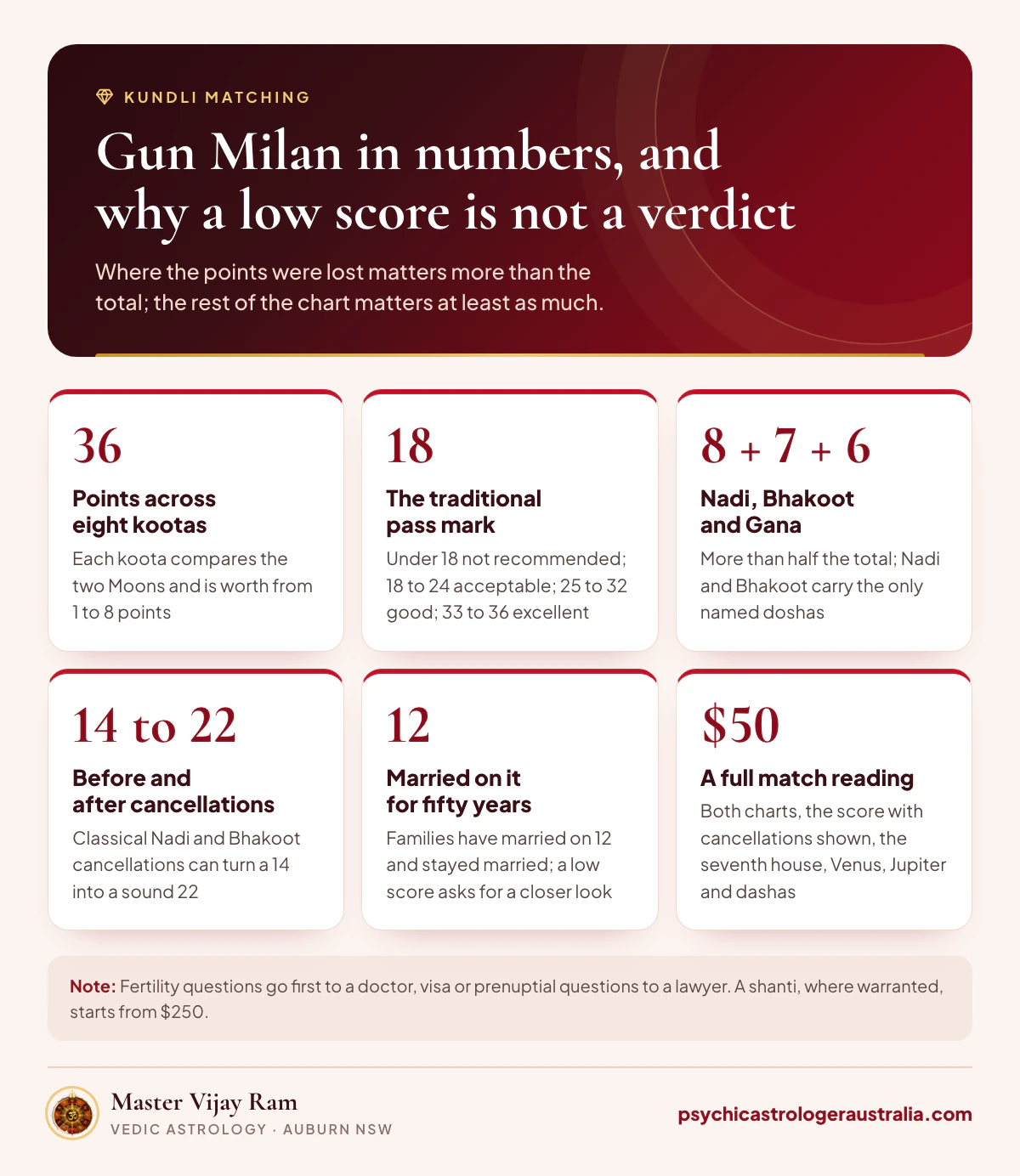
Kundli matching for marriage compares two birth charts, most visibly through Gun Milan, which scores eight Moon-based kootas out of 36 points. Eighteen is the traditional pass mark, but Nadi and Bhakoot doshas, their cancellations, Manglik status and the dasha periods decide far more than the headline number, so a low score is a prompt for a proper reading rather than a verdict.
What is kundli matching for marriage?
Kundli matching for marriage is the comparison of two birth charts to see how two people are likely to live together: temperament, health, children, money, loyalty and the timing of the years ahead. The best-known part of it is Gun Milan, a points system out of 36 that most Indian families in Australia have heard of even when they have never seen a chart. It is also the part most often misread, because a number travels faster than the reasoning behind it.
Master Vijay Ram has matched charts for families across Australia for more than four decades, often with one partner born in Ludhiana or Hyderabad and the other in Parramatta or Perth. The score matters to him less than what sits behind it. A love and marriage prediction reading looks at the whole of both charts, with Gun Milan as the opening page rather than the last word.
How does Gun Milan score 36 points?
Gun Milan, also called Ashtakoot matching, compares the Moon in each chart across eight kootas, or categories. Each koota carries a fixed maximum, and the eight maximums add to 36. The method is Moon-based: it reads the birth nakshatra and rashi of each partner rather than the Sun sign that Western horoscopes use.
| Koota | What it compares | Maximum points |
|---|---|---|
| Varna | Spiritual temperament and the balance of ego | 1 |
| Vashya | Mutual influence and attraction | 2 |
| Tara | Birth-star distance: health and fortune together | 3 |
| Yoni | Physical and sexual compatibility | 4 |
| Graha Maitri | Friendship between the two Moon-sign lords: mental rapport | 5 |
| Gana | Temperament: deva, manushya or rakshasa | 6 |
| Bhakoot | Distance between the Moon signs: money, family and emotional flow | 7 |
| Nadi | Constitution, health and children | 8 |
The weighting tells you where the tradition puts its worry. Nadi alone is worth 8 of the 36 gunas, Bhakoot 7 and Gana 6, and those three together make up more than half the total. A couple can lose the single Varna point and never notice; a couple who lose all 8 on Nadi have a dosha the whole family will hear about.
What does each koota actually measure?
Varna and Vashya are small and mostly about who leads in day-to-day decisions. Tara counts the nakshatra distance from each Moon to the other and asks whether the two stars sit in a supportive relationship. Yoni assigns each nakshatra an animal and checks whether the two animals are friendly, neutral or hostile, which is the tradition's way of talking about physical compatibility without saying so.
Graha Maitri compares the planets that rule the two Moon signs, a proxy for whether two minds enjoy each other. Gana sorts people into the gentle, the practical and the forceful, and penalises a gentle-forceful pairing. Bhakoot measures the distance between the two Moon signs, and certain distances, six-eight and two-twelve especially, score zero and are read as friction over money, health or family.
Nadi divides every nakshatra into three streams, Adi, Madhya and Antya, loosely tied to the three doshas of Ayurveda. The same stream for both partners scores zero and is called Nadi dosha. It is the single heaviest line in the whole method and the one with the most cancellations, which is exactly why it needs a person rather than a calculator.
What counts as a good score, and is 18 really the pass mark?
Most panchangs and most families use the same bands. Under 18 is traditionally not recommended, 18 to 24 is acceptable, 25 to 32 is good, and 33 to 36 is excellent and rare. Those bands are a convention rather than a law, and different regions apply them with different strictness.
The number also hides its own arithmetic. A 24 with full Nadi and Bhakoot points and a few small losses elsewhere is a comfortable match; a 24 that reaches 24 only because the five small kootas are perfect while Nadi scores zero is a different conversation entirely. Two couples with the same score can have opposite prospects, which is why Master Vijay Ram reads the kootas before he reads the total.
Which doshas matter most, and when do they cancel?
Only two of the eight kootas carry a named dosha: Nadi and Bhakoot. Both have classical cancellations that a careful astrologer applies before announcing a result, and both are the usual reason two families arrive with different numbers for the same couple.
| Dosha | Scored when | Commonly set aside when |
|---|---|---|
| Nadi dosha (0 of 8) | Both Moons fall in the same Nadi stream | Same rashi but different nakshatras; same nakshatra but different padas; the two Moon-sign lords are friends or the same planet |
| Bhakoot dosha (0 of 7) | The Moon signs sit two-twelve, six-eight or five-nine apart | The two sign lords are the same planet or mutual friends; the Moon-sign lords are exalted or own-sign; a strong Graha Maitri score |
A chart that scores 14 before cancellations can read as a sound 22 after them. That is not generosity; it is the method working as written. The reverse also happens, when a software result applies a cancellation that the tradition reserves for a narrower case, and a 26 is really a 19.
Why a low score is not a verdict
Three things rescue low scores far more often than families expect. The first is the cancellation list above. The second is that Gun Milan reads only the Moon, while the seventh house, its lord, Venus, Jupiter and the dasha periods carry at least as much weight in a marriage and are invisible to the points system.
The third is the ordinary truth that families have married on 12 and stayed married for fifty years. A low score is a reason to look harder, and sometimes a reason for a remedy. It is not a prophecy.
The honest reading of a difficult score takes the pair of charts apart line by line and says which losses are real and which are technicalities. How the birth stars themselves are compared, beyond the points, is covered in nakshatra compatibility and the layers beneath the score.
What can a high score hide?
A 30 can sit on top of a Manglik mismatch, a seventh lord in the eighth house, a combust Venus in one chart, or a dasha sequence that puts both partners through Saturn at once in the first three years of marriage. None of those appear in Gun Milan. They appear in a full compatibility reading, and they are the reason a high score is a relief rather than a permit.
This is where the Moon-based method shows its age. It was built for a world of early, arranged marriages in which the Moon's temperament questions were the pressing ones. For a couple of 31 and 33 in Melbourne who already share a lease, the questions are timing, money, children and the pressure of two families in two countries, and those live elsewhere in the chart; the layers beyond Gun Milan are where most of the useful information sits.
How is horoscope matching done when one partner was born in India?
Horoscope matching for marriage starts with four facts for each person: date, time and place of birth, and the time zone in force on the day. The last one catches people out. A birth recorded in India is in Indian Standard Time, while a January birth in Sydney is in daylight saving time, and a chart cast with the wrong offset can move the ascendant by a whole sign and the Moon by several degrees.
Master Vijay Ram asks for the birth certificate or hospital record wherever it exists, because a remembered time of around seven in the evening is enough for Gun Milan but not for the finer work. Readers in Sydney, Canberra and Wollongong usually consult him by phone or video, and families in Cairns or Darwin do the same across the time difference; the Sydney astrology page explains how the calls run and what to have ready.
What happens when the families disagree about the score?
It is common for the two families to have had the charts matched separately and to arrive with different numbers. Usually the difference comes from a different ayanamsa setting, a different nakshatra boundary for a Moon sitting near one, or one astrologer applying cancellations and the other not. None of those is a sign of a hidden flaw; they are a sign that the method has settings.
The useful step is one reading that both families can hear at the same time, with the settings stated and the cancellations shown. Vijay Ram ji often does this by a three-way video call with a parent in Chandigarh and the couple in Brisbane, and he says plainly what he has set aside and why. When the number stays low after that, he says so too, and he says what, if anything, a remedy would address.
Are online kundli milan calculators reliable?
A kundli milan online tool is reliable for the arithmetic and unreliable for the judgement. It counts the points correctly if the birth data and the ayanamsa are entered correctly, and it usually applies the most common Nadi and Bhakoot cancellations. It cannot see the seventh house, the dashas, Manglik status, or a Moon one degree from a nakshatra boundary where the whole Tara and Nadi result flips.
Use a calculator to get the conversation started and to check that nobody has mistyped a birth time. Then ask a person to read what the calculator cannot. The difference between the two is the difference between a result and a reading, and the kundli reading explainer sets out what a full chart contains that a points table does not.
How does Master Vijay Ram read a match?
The consultation is $50, by phone, video or WhatsApp from anywhere in Australia or overseas. He casts both charts from the birth details, runs the Ashtakoot score with the cancellations shown, and then reads the parts Gun Milan does not cover: the seventh house and its lord in each chart, Venus and Jupiter, Manglik status, the current and coming dashas, and the two timelines laid side by side. A relationship compatibility reading is the formal version of this for a couple who want the full written picture.
Most matches end there, with a clear answer and a date range to think about. Where a dosha is real and has not cancelled, he may suggest a specific puja, Nadi or Bhakoot shanti most commonly, and spell or prayer work of that kind starts from $250, with the figure agreed before anything is performed. It is done personally on an auspicious muhurat at his place of practice in Auburn, and the online puja and havan page explains how a family joins from a distance.
What kundli matching cannot do
It cannot make a decision for you, and it cannot see character. A chart shows tendencies and timing; it does not show whether someone is kind, whether they are honest about money, or how they behave when they are tired. Those are learnt across a table, not from a nakshatra.
It is also faith-based guidance, not medical, legal or financial advice. Questions about fertility belong first with a doctor, questions about a visa or a prenuptial agreement with a lawyer, and a relationship that is already frightening belongs with 1800RESPECT or the police rather than with any astrologer. Vijay Ram ji says this on the call when it applies, and a full kundli reading is offered as a next step only where it will add something.
Questions couples ask before the family meeting
Does the score go up if we marry later? No. The Moon-based score is fixed at birth, but the timing reading changes with the dashas, and a difficult period can be waited out.
Can one partner's chart be remedied so the match improves? A shanti addresses a dosha in a chart, not the arithmetic between two charts, and it is prescribed for the person rather than the pairing.
Should we match charts if we have already decided? Many couples do, and the reading becomes a timing and preparation tool rather than a verdict, which is often its best use; the marriage timing guide picks that thread up.
Read next
- Nadi Dosha in Kundli Matching: What It Means and When It Is CancelledNadi dosha explained: the three nadis and their 27 nakshatras, why the same nadi scores 0 of 8, the commonly cited ca…
- Marriage Compatibility Beyond Gun Milan: Dasha Sync and Nodal ContactsMarriage compatibility beyond gun milan: dasha sync, nodal contacts, the seventh lords and the navamsa read together,…
- Kundli Reading Explained: What Your Birth Chart RevealsWhat a Kundli reading reveals about your life, personality, career and destiny. Master Vijay Ram explains Vedic astro…
Frequently asked questions
What is a good score in kundli matching?
Most families use the same bands: under 18 out of 36 is traditionally not recommended, 18 to 24 is acceptable, 25 to 32 is good and 33 to 36 is excellent. The bands are a convention, and the composition of the score matters more than the total. A 24 with full Nadi and Bhakoot points is a comfortable match; a 24 that lost all its Nadi points is a dosha conversation.
Is 18 out of 36 enough to marry?
Eighteen is the traditional threshold, so a match at 18 is considered acceptable provided no Nadi or Bhakoot dosha is sitting inside that number without a cancellation. Master Vijay Ram reads an 18 the same way he reads a 30: koota by koota, then the seventh house, Venus, Jupiter, Manglik status and the dashas of both charts, because those decide more than the Moon-based score does.
What happens if gun milan is low?
A low score is a prompt to look harder, not a verdict. The first check is the cancellation list for Nadi and Bhakoot dosha, which rescues a surprising number of matches. The second is the rest of the chart, which the points system does not read. Where a dosha is real and has not cancelled, a specific shanti puja may be suggested, and the figure for that is stated and agreed before anything is performed.
Does Nadi dosha cancel if both have the same rashi?
In the classical rules, yes, when the two Moons share the same rashi but fall in different nakshatras, and also when they share a nakshatra but different padas, or when the two Moon-sign lords are friends or the same planet. Different regions apply the list with different strictness, which is why one astrologer may count the dosha and another set it aside for the same couple.
Can kundli matching be done online from Australia?
Yes. Master Vijay Ram matches charts by phone, video or WhatsApp for couples and families anywhere in Australia and overseas, and a three-way call with parents in India is common. What he needs is the date, time and place of birth for both people, with the time zone confirmed, and the birth certificate or hospital record where it exists. In person is possible in Auburn by appointment.
Why do two astrologers give different kundli matching scores?
Almost always because of settings rather than skill: a different ayanamsa, a Moon sitting within a degree of a nakshatra boundary, or one reader applying the Nadi and Bhakoot cancellations and the other not. One reading that both families hear together, with the settings and cancellations stated, usually settles it. If the score stays low after that, an honest astrologer says so.
Does a high gun milan score mean a happy marriage?
It means the Moon-based temperament checks are favourable, which is good news but not the whole picture. A high score can sit on top of a Manglik mismatch, an afflicted seventh house or a difficult dasha sequence in the first years of marriage, none of which Gun Milan reads. A full compatibility reading looks at those, and at the two timelines side by side.
How much does kundli matching cost with Master Vijay Ram?
The consultation is $50, by phone, video or WhatsApp, and it covers both charts, the Ashtakoot score with cancellations shown, and the deeper reading of the seventh house, Venus, Jupiter, Manglik status and the dashas. Most matches end there. Where a Nadi or Bhakoot shanti is genuinely warranted, that puja starts from $250 and the figure is agreed before it is performed.
Is kundli matching necessary for a love marriage?
It is not required by anyone but the families, and many love-marriage couples still ask for it, either to reassure parents or to understand their own timing. Used that way it becomes a preparation tool rather than a verdict: when to marry, which years will be demanding, and whether any dosha is worth a remedy. A couple who have already decided lose nothing by knowing.
People also ask
What is ashtakoot matching?
Ashtakoot matching is the eight-category system behind Gun Milan. It compares the Moon's nakshatra and sign in two charts across Varna, Vashya, Tara, Yoni, Graha Maitri, Gana, Bhakoot and Nadi, awarding up to 1, 2, 3, 4, 5, 6, 7 and 8 points respectively for a total of 36. Nadi, Bhakoot and Gana carry the most weight and the only named doshas.
How many gunas should match for marriage?
Eighteen of the 36 gunas is the conventional minimum, 25 or more is considered good, and 33 to 36 is rare and excellent. The spread matters more than the total, because losing all eight Nadi points or all seven Bhakoot points is a dosha regardless of how the small kootas score, unless one of the classical cancellations applies.
What is nadi dosha in kundli matching?
Nadi dosha is scored when both partners' Moons fall in the same Nadi stream, Adi, Madhya or Antya, and it costs all eight Nadi points. The tradition reads it as a concern for health and children. It is cancelled in several classical situations, such as the same rashi with different nakshatras, and where it stands a Nadi shanti puja is the usual remedy.
Can you marry with bhakoot dosha?
Many couples do. Bhakoot dosha is scored when the Moon signs sit two-twelve, six-eight or five-nine apart, and it is set aside when the sign lords are the same planet or friends, among other cancellations. Where it stands, an astrologer weighs it against the seventh house and the dashas before suggesting a shanti, and the final decision remains the couple's and the families'.
Is online kundli matching accurate?
Online tools are accurate at arithmetic and weak at judgement. With correct birth data they count the points and apply the common cancellations, but they cannot read the seventh house, Venus, Jupiter, Manglik status, the dashas or a Moon sitting on a nakshatra boundary. Use a calculator to start the conversation and a person to finish it.
References & further reading
Serving clients across Australia
Confidential consultations by phone, video & WhatsApp — including: