

Quick answer
A new job muhurat is a favourable window for beginning work. In Australia the employer sets the start date, so families time what they control: signing the contract, resigning only after it is signed, and leaving home on the first morning. Rikta tithis and Rahu kaal are avoided, and simple observances such as curd and sugar are household custom.
What is a new job muhurat?
A new job muhurat is a favourable window chosen for beginning employment, used by families who want the first step of a new role taken at a good time. In India it is often called a joining date muhurat, and some households take it as seriously as a wedding date. In Australia the employer sets the start date, so the real question is which parts of the process are still yours to time.
There are more than people think. Accepting the offer, signing the contract, handing in a resignation and leaving home on the first morning are usually in your hands, and a muhurat for a new beginning at work can attach to any of them without asking a manager to change anything.
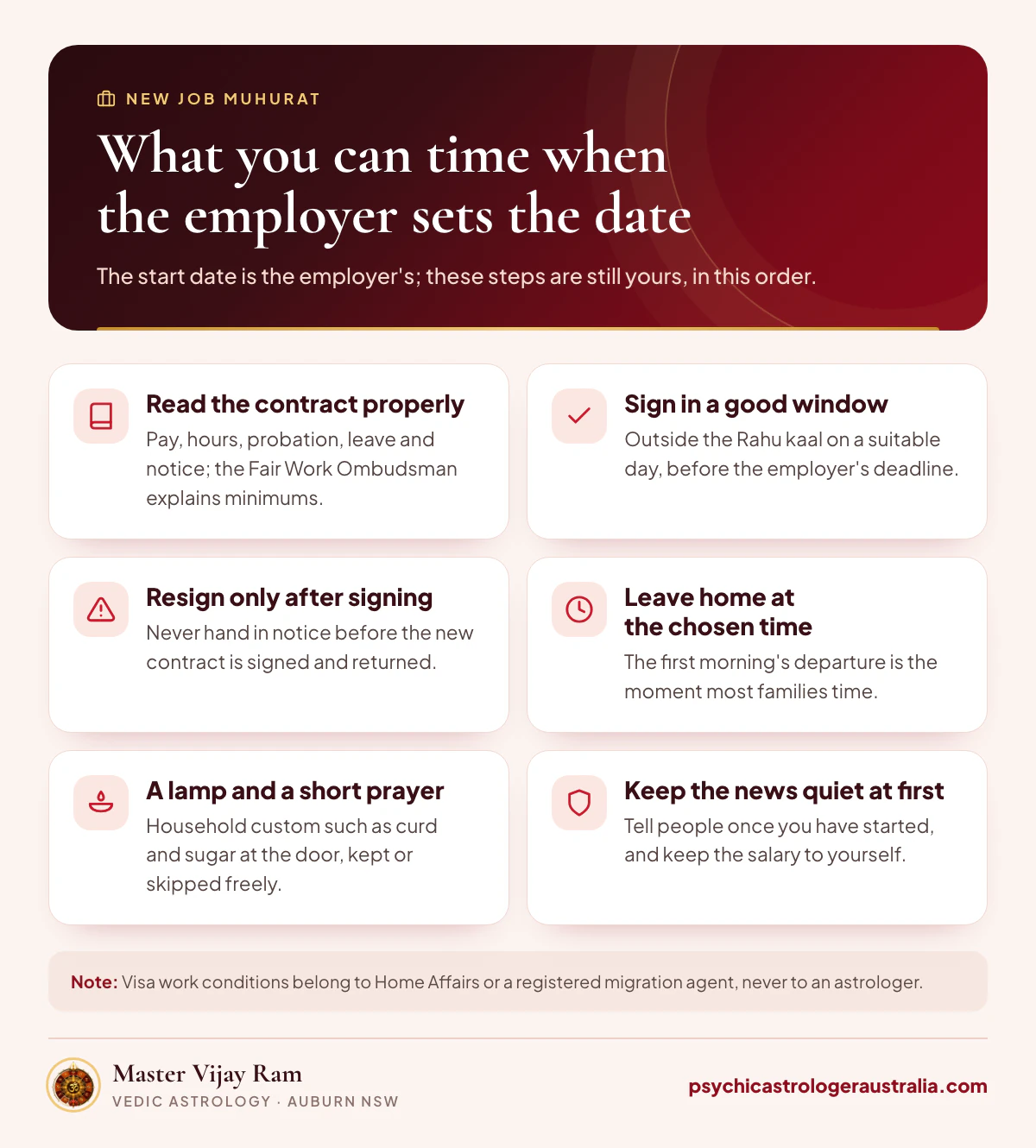
Who decides the start date, and what can you time?
The employer, almost always. Rosters, inductions, security passes and payroll cycles are built around set days, and asking for a later start on astrological grounds is rarely a good first impression. When you are looking for an auspicious day to join a job and an offer says "start date to be agreed", there may be room to suggest a day within the employer's window, and that is where a consultation helps.
| Step | Who sets it | Can it carry a muhurat? |
|---|---|---|
| Accepting the verbal offer | You, within a day or two | Sometimes: a short delay to a good window is usually fine |
| Signing the written contract | You, by the employer's deadline | Yes: sign in a chosen window after reading it properly |
| Resigning from the old job | You, after the new contract is signed | Yes, within your notice obligations |
| The first day | The employer | Rarely; suggest a day only if the offer invites it |
| Leaving home on the first morning | You | Fully: the moment most families time |
The order matters more than any panchang. Never resign before the new contract is signed, whatever the stars suggest.
What does the muhurat look at?
The day's panchang first. Rikta tithis, the fourth, ninth and fourteenth of each fortnight, and Amavasya are usually avoided for beginnings, and the Rahu kaal is avoided within the day. Weekdays are read by their planets: Wednesday, Mercury's day, is favoured for communication, trade and office work; Thursday, Jupiter's, for teaching, law, finance and advice; Sunday for government roles and positions of authority, in some traditions.
Then the person. Chandra bala, the transiting Moon counted from the natal Moon, and tara bala, the day's nakshatra counted from the birth nakshatra, decide whether a good day in general is good for this person. Many astrologers also check the tenth house of career and its lord, and whether the running dasha supports a change of role.
- Nakshatras often listed for starting work include Ashwini, Rohini, Pushya, Hasta, Chitra, Anuradha, Uttara Phalguni, Uttara Ashadha, Uttara Bhadrapada and Revati; lists vary between texts.
- For a shift that begins at night, as many nursing and hospitality roles do, the panchang of the evening matters, and the departure from home is the natural moment to time.
Does the chart show whether this is the right job?
It shows tendencies and timing, which is not the same thing. A favourable dasha or a strong transit to the tenth house is traditionally read as a supportive time for a change, and a demanding one as a time to prepare rather than leap. When to change jobs by dasha and transit goes through those signals in detail.
Whether a particular employer, salary or manager is right is a question for research, references and your own judgement. A reading can help you see your pattern, such as why every third role ends in conflict with a boss, and career and business readings take that wider view.
What small observances do families keep on the first day?
Nothing elaborate, and nothing anyone at work needs to see; a first day job puja in most homes takes five minutes. The common ones are a lamp at the home altar, a short prayer to Ganesha for an unobstructed start, the elders' blessing at the door and a spoonful of curd and sugar on the way out, a custom many Indian households keep before any important beginning.
- A short Hanuman Chalisa or Gayatri recitation on the way, for steadiness rather than luck.
- Touching the threshold or the parents' feet before leaving.
- Leaving home in the chosen window, even if that means arriving early and getting a coffee nearby.
- Keeping the first payslip aside for a small offering or a donation, a custom some families follow.
Each of these is household custom. Families differ, and a person who keeps none of them has lost nothing.
What practical steps matter more than the hour?
Read the contract before you sign it, and ask questions about anything unclear: the classification and pay, the hours and overtime, the probation period, leave and the notice either side must give. The Fair Work Ombudsman explains minimum pay and conditions under awards and agreements, and is the right first stop if something looks wrong.
Check the paperwork the new employer asks for, such as tax file and superannuation choice forms, and keep copies. If your visa carries work conditions, confirm that the role fits them through Home Affairs or a registered migration agent; an astrologer cannot advise on that and should never try.
What about nazar and keeping a new job quiet?
Many families feel a new job, like a new car, attracts envy, and the old advice is simply discretion: tell people once you have started, not when the offer arrives, and keep the salary to yourself. Nazar on a new job or purchase sets out the gentle remedies families use.
Discretion also has a plain workplace reason. Offers sometimes change or fall through before the start date, and a job that has not been announced cannot be awkwardly un-announced.
What if the only start date falls on a poor day?
Start on it. A graduate nurse in Darwin given a Tuesday in an unremarkable fortnight, or an engineer in Perth whose induction is fixed for a Saturday, should turn up and do well. Time the act you control, the departure from home or the signature on the contract, and let the employer's day stand.
The tradition has always allowed for this. Where the outer event cannot move, the inner beginning is placed in a good window, and an honest astrologer helps you do that rather than making you anxious about a date you could never have changed.
What do the first weeks need more than a muhurat?
Sleep, preparation and patience. The first month in a new role is tiring for everyone, and the nerves, mistakes and second thoughts that come with it are normal. If the anxiety grows rather than settles, a GP or the Employee Assistance Program many employers offer is the right place to start.
For the spiritual side, a steady daily practice, such as a mantra at the same time each morning, does more over a probation period than any single auspicious minute. The midday Abhijit window is handy for signing a contract when the day is fixed and nothing else suits.
What about a job that begins with a move?
Some new jobs start with relocation: a mining role out of Darwin, a hospital contract in regional Victoria, a transfer from Sydney to Perth. Then there are two beginnings to think about, leaving the old home and starting the new work, and families often time the departure more carefully than the first shift, because it is the larger change.
Fly-in fly-out and rotating rosters make any fixed muhurat impractical after the first swing. A simple routine at each departure, the same short prayer and the same goodbye at the door, serves those workers and their families better than chasing a window every fortnight.
Do government and private jobs need different muhurats?
Tradition reads them slightly differently. A government or public-service role is linked with the Sun, authority and the tenth house, so some families prefer a Sunday or a day strong for the Sun when they have a choice. Private-sector and business roles lean on Mercury and Jupiter, and Wednesday or Thursday are often favoured.
In practice the difference is small, and the employer's date usually decides. Families in Brisbane, on the Central Coast and in Sydney often ask about the public service in particular, because offers there tend to arrive with fixed start dates months ahead.
How does a consultation for a new job work?
Master Vijay Ram looks at the offer, the contract deadline and the start date, then gives a window for signing and a window for leaving home on the first day, in your own city's clock. A consultation is $50, by phone, video or WhatsApp in English, Hindi or Punjabi; families in Victoria can read how readings work for Melbourne.
Where someone wants a Ganesh or Saraswati puja for a new role, he performs it personally at his place of practice in Auburn on a chosen muhurat; a puja for a new role starts from $250, agreed before it is performed, and most people need nothing more than a lamp at home. No puja secures a job, passes a probation or replaces doing the work well.
Read next
- Vidyarambha: Starting a Child’s Learning on an Auspicious DayVidyarambha, a child’s first letters: Vijayadashami on Sat 9 Oct 2027, Vasant Panchami, regional customs, the safe wa…
- Akshaya Tritiya 2027: Date and Why the Day Is AuspiciousAkshaya Tritiya 2027 is Sunday 9 May in Australia and India, Sun and Moon exalted. Puja and purchase windows by city …
- Spiritual Cleansing Service: What to Expect From Start to FinishWhat a spiritual cleansing service involves from first call to follow-up: the stages, what you are asked for, and why…
Frequently asked questions
Which day is good to join a new job?
Wednesday, Mercury’s day, is often favoured for office work, communication and trade, and Thursday, Jupiter’s, for teaching, law, finance and advice. Some families prefer Sunday for government roles. The tithi, nakshatra, Rahu kaal and your own Moon matter as much as the weekday, and the employer’s fixed date usually decides in the end.
Can I ask my employer to change my start date for a muhurat?
Only if the offer invites you to agree a date, and even then suggest a day within their window rather than asking for a long delay. Otherwise accept the date they set and time what you control: signing the contract, leaving home on the first morning, or a short prayer before you go.
Should I resign on an auspicious day?
If you can, choose a good window for handing in the resignation, but only after the new contract is signed and returned. Resigning early to catch a good day risks being left without either job if the offer changes. Give the notice your current contract or award requires, and keep it professional.
What should I do on the first day of a new job?
Many families light a lamp at the altar, say a short prayer to Ganesha, take the elders’ blessing and eat a little curd and sugar before leaving. These are household customs, not rules. The practical part matters more: sleep well, plan the route, arrive early and bring the documents the employer asked for.
Does the chart show if a new job will last?
It shows tendencies and timing, such as whether the running dasha supports change and how the tenth house is being transited. It cannot promise that a particular job will last or go well. Research, references, a careful reading of the contract and your own judgement decide that more than any chart.
Is a puja needed before starting a new job?
No. A lamp and a short prayer at home are enough for most people. Some families ask for a Ganesh or Saraswati puja for a major role, which Master Vijay Ram performs personally at his place of practice in Auburn from $250, agreed beforehand. No puja secures a job or replaces doing it well.
My induction is on a Tuesday in Rahu kaal. What should I do?
Go to the induction. Time the act you control, such as leaving home earlier in a better window or signing the contract on a good day beforehand, and say a short prayer before you set out. The tradition does not ask anyone to miss work or make a poor first impression for the panchang.
Who can help if my new job’s pay or conditions seem wrong?
The Fair Work Ombudsman explains minimum pay and conditions under awards and agreements and is the first place to ask. A union or an employment lawyer can help further. If a visa condition is involved, Home Affairs or a registered migration agent decides. An astrologer cannot advise on any of these.
People also ask
What is the best time to join a new job?
Whatever day and time the employer sets for the start, with the parts you control placed in good windows: the contract signed outside the Rahu kaal on a suitable day, and the departure from home on the first morning timed if you wish. A consultation gives both in your own city’s clock.
Which nakshatra is good for joining a job?
Lists vary, but commonly named stars for beginning work include Ashwini, Rohini, Pushya, Hasta, Chitra, Anuradha, Revati and the three Uttara nakshatras. The day’s nakshatra is also counted from your birth nakshatra, called tara bala, to see whether it suits you personally.
Is it good to join a job on Saturday?
Saturday is Saturn’s day, and some families avoid it for beginnings while others accept it for work of discipline and service. If an employer’s induction is on a Saturday, attend it and time your departure from home or your contract signature instead.
What do you eat before starting a new job?
Many Indian families give a spoonful of curd with sugar before any important beginning, including a first day at work or an interview. It is a household custom meant for a calm, auspicious start, often given by a mother or grandmother at the door, and nothing bad follows for anyone who skips it.
References & further reading
Serving clients across Australia
Confidential consultations by phone, video & WhatsApp — including: