
Quick answer
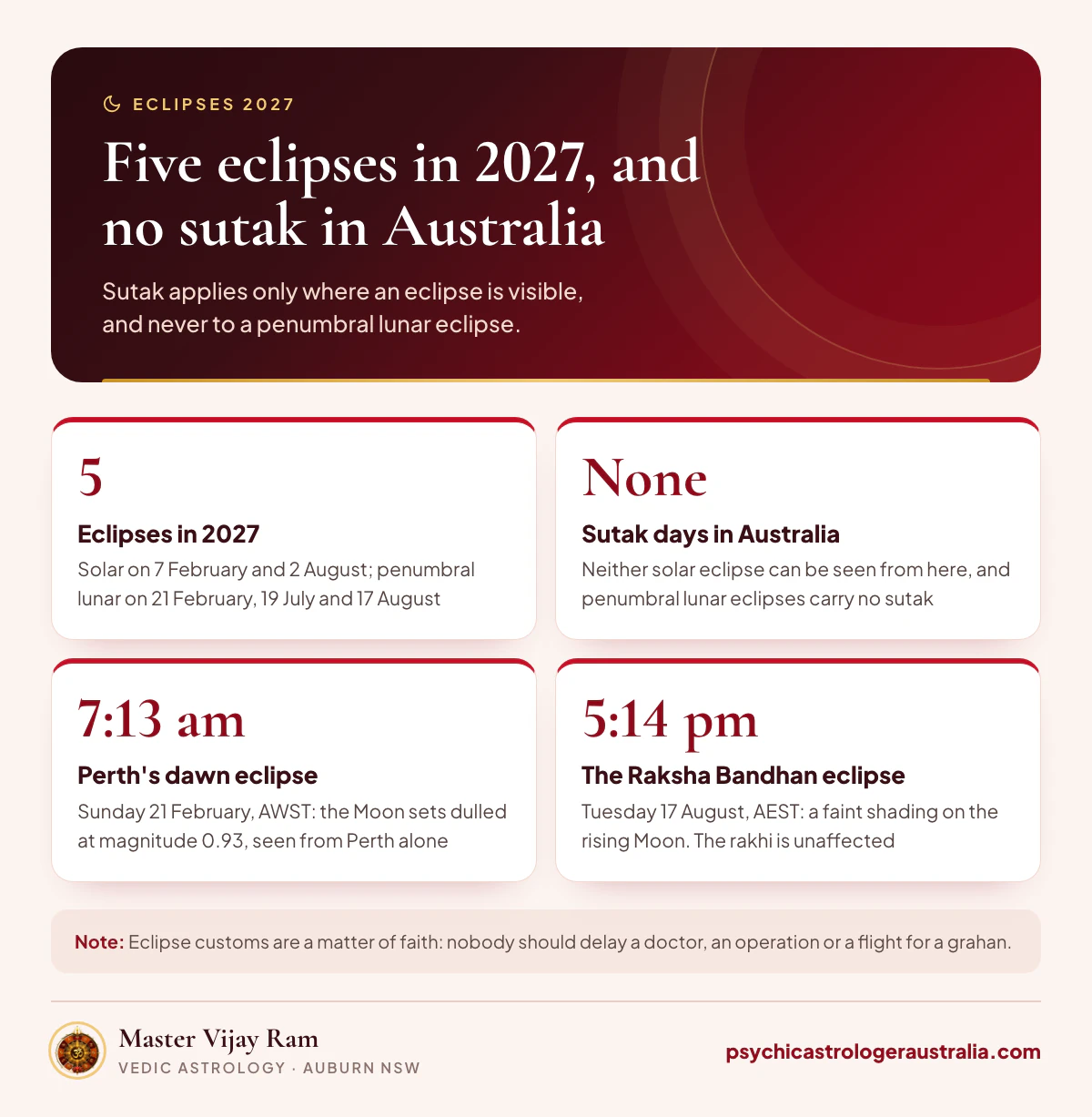
There are five eclipses in 2027: an annular solar eclipse on 7 February and a total solar eclipse on 2 August, neither visible from Australia, and three penumbral lunar eclipses on 21 February, 19 July and 17 August. Because sutak applies only to a visible eclipse and penumbral eclipses carry none, no sutak kaal falls on Australia in 2027. Perth alone sees the February lunar eclipse at dawn.
Eclipses 2027 in Australia at a glance
An eclipse, grahan in Hindi and Punjabi, is the moment the Moon passes in front of the Sun or the Earth's shadow passes over the Moon, and it is the one event in the Hindu calendar that depends entirely on where you are standing. The eclipses of 2027 for Australia are a quiet set: two solar eclipses that happen on the other side of the world and three lunar eclipses so faint that only one of them, in Perth, will be noticed by anyone looking up.
That quietness has a practical consequence. Sutak, the period of restraint before an eclipse, applies only where the eclipse can be seen, and penumbral lunar eclipses carry no sutak at all. For families in Australia, 2027 is a year without a single closed eclipse day, and this guide explains why, eclipse by eclipse, and what the tradition and the chart say about each.
Which of the five eclipses can be seen from Australia?
| Date (Sydney) | Eclipse | Greatest eclipse (Sydney) | From Australia | Notes |
|---|---|---|---|---|
| Sun 7 Feb 2027 | Annular solar eclipse | 3:00 am AEDT | Not visible from Australia | |
| Sun 21 Feb 2027 | Penumbral lunar eclipse | 10:13 am AEDT | Visible from Perth | Penumbral magnitude 0.93 |
| Mon 19 Jul 2027 | Penumbral lunar eclipse | 2:03 am AEST | Visible from Sydney, Brisbane, Adelaide, Darwin, Perth, Hobart | Penumbral magnitude 0.00 — too faint to notice |
| Mon 2 Aug 2027 | Total solar eclipse | 8:07 pm AEST | Not visible from Australia | |
| Tue 17 Aug 2027 | Penumbral lunar eclipse | 5:14 pm AEST | Visible from Sydney, Brisbane, Adelaide, Hobart | Penumbral magnitude 0.55 |
Computed with the Swiss Ephemeris (Lahiri ayanamsa for Vedic positions) and checked against US Naval Observatory data. Times are rounded to the minute.
The table is computed for the greatest eclipse in Sydney time. The two solar eclipses fall at 3:00 am and 8:07 pm here, when the Sun is below the Australian horizon, so there is nothing to see and nothing to shield your eyes from. The July lunar eclipse has a penumbral magnitude of about 0.001, a dimming no eye can detect. The February lunar eclipse is visible from Perth as the Moon sets at dawn, and the August one from the eastern and southern capitals as the Moon rises in the early evening.
What is sutak kaal, and does it apply in 2027?
Sutak kaal is the stretch of restraint before an eclipse: four prahars, about twelve hours, before a solar eclipse and three prahars, about nine hours, before a lunar one, lasting until the eclipse ends. During it temples close, cooking and eating stop, new work is not begun and the devout sit in japa. Two rules decide whether it applies, and both are old. Sutak is observed only where the eclipse is visible, because an eclipse nobody can see is not an eclipse for that place; and a penumbral lunar eclipse, in which the Moon passes only through the Earth's outer shadow and merely dims, is not counted as a grahan for religious purposes.
| Eclipse | Visible from Australia? | Kind | Sutak in Australia |
|---|---|---|---|
| Annular solar, Sunday 7 February | No | Solar, annular | None |
| Penumbral lunar, Sunday 21 February | Perth only, at moonset | Lunar, penumbral | None: penumbral eclipses carry no sutak |
| Penumbral lunar, Monday 19 July | Technically everywhere, invisible to the eye | Lunar, penumbral | None |
| Total solar, Monday 2 August | No | Solar, total | None |
| Penumbral lunar, Tuesday 17 August | Sydney, Brisbane, Adelaide, Hobart at moonrise | Lunar, penumbral | None: penumbral eclipses carry no sutak |
So the honest answer is that there is no sutak kaal in 2027 anywhere in Australia. Relatives in India may keep one for the August solar eclipse, whose partial phases reach parts of the subcontinent in the late afternoon; they should follow their local panchang, and you need not match them from here.
The annular solar eclipse of 7 February
The year's first eclipse is an annular one, a ring of Sun left around the Moon, with greatest eclipse at 3:00 am AEDT on Sunday 7 February, which is midnight in Perth and the evening of the 6th in Universal Time. Its path runs across the southern Pacific, South America and the Atlantic, and no part of it is visible from Australia. It falls on the new moon of Magha, the Mauni Amavasya that Sydney's calendar also lists for 7 February, with the Sun at about 23° of sidereal Capricorn, Makara, beside Rahu, which is in Makara all year.
For Australia it is a date to know and nothing more: no sutak, no closed temple, and no reason to move a Sunday that happens to be a clean day in the panchang. The full and new moon dates for 2027 show where the eclipse sits in the lunar month.
The penumbral lunar eclipse of 21 February: Perth's dawn eclipse
Two weeks later, on the full moon of Magha, the Moon passes deep into the Earth's outer shadow, with a penumbral magnitude of 0.93, deep enough that a careful observer will see the Moon's northern edge dulled. Greatest eclipse is 10:13 am AEDT on Sunday 21 February, when the Moon has already set in the east; in Perth it is 7:13 am AWST, with the Moon low in the western sky at dawn, which makes Perth the only Australian city that sees this eclipse.
Even in Perth it carries no sutak, because it is penumbral. Families who like to mark it can bathe and offer a prayer after moonset, and that is the whole of the observance.
The total solar eclipse of 2 August: the great eclipse, seen from elsewhere
The total solar eclipse of 2 August 2027 is one of the longest of the century, with more than six minutes of totality along a path through southern Spain, Morocco, Egypt and the Arabian Peninsula. Greatest eclipse is 8:07 pm AEST on Monday 2 August, 6:07 pm in Perth, with the Sun well below every Australian horizon. It falls on the new moon of Shravana, the Hariyali Amavasya, with the Sun at about 15° of sidereal Cancer, Karka, beside Ketu, which shares Karka with the Sun all year.
In India the partial phases reach parts of the west and north in the late afternoon, so relatives there may keep sutak and close temples for the evening. In Australia there is nothing to keep; the Monday is an ordinary working day in the panchang, and a muhurat on it is judged by its tithi, nakshatra and lagna like any other.
The lunar eclipse of 17 August: the Raksha Bandhan evening
The last eclipse of the year falls on Shravana Purnima, which is Raksha Bandhan, with greatest eclipse at 5:14 pm AEST on Tuesday 17 August, as the Moon rises in the east over Sydney, Brisbane, Adelaide and Hobart. Its penumbral magnitude is 0.55, enough for a faint shading on the rising Moon for those who know to look, and too little for anyone who does not. Darwin and Perth miss it, since their Moon has not risen when it ends.
The question families ask is whether the rakhi is affected, and it is not. A penumbral eclipse carries no sutak, so the morning and the afternoon aparahna window are both open until the Purnima ends at 5:29 pm AEST, and the Raksha Bandhan timing by city already allows for the Bhadra of the Monday afternoon and evening, over by about 4:14 am on the Tuesday, which is the real constraint on the date.
Why is a penumbral eclipse treated differently?
The Earth casts two shadows: the dark umbra at the centre and the pale penumbra around it. In a total or partial lunar eclipse the Moon enters the umbra and a bite of darkness crosses it; in a penumbral eclipse the Moon crosses only the penumbra and dims a little, often imperceptibly. The panchang tradition, which judges a grahan by what can be seen, does not count the penumbral kind, and Drik Panchang, like most published panchangs, lists them without sutak or observance.
The magnitude figures in the table measure how far into the shadow the Moon goes, with 1.0 meaning fully inside the penumbra. The February eclipse at 0.93 is nearly that; the July one at 0.001 barely touches it.
What do Rahu and Ketu have to do with eclipses?
Eclipses happen only when the new or full moon falls near the lunar nodes, the two points where the Moon's path crosses the Sun's, and Vedic astrology personifies those nodes as Rahu and Ketu. The old story of the demon whose head and tail swallow the Sun and Moon is the myth of exactly that geometry. In 2027 Rahu sits in Makara and Ketu in Karka for the whole year, which is why the February solar eclipse falls in Makara and the August one in Karka.
In a birth chart an eclipse matters when it falls close to your Moon, your lagna or a planet, within a few degrees, and more so during a Rahu or Ketu dasha. For most people a given eclipse touches nothing personal and passes as weather. Rahu and Ketu in relationships explains the nodes' character, and the Kaal Sarp and Pitra dosh reading covers the charts in which the nodal axis dominates.
What is traditionally avoided during a visible eclipse, and what is sensible?
- Cooking and eating stop for the sutak, and food prepared beforehand is kept with a few leaves of tulsi; after the eclipse the house is swept, everyone bathes and the kitchen restarts.
- Temples close their doors and reopen with a bath of the deity; home shrines are covered.
- New work, journeys and muhurats are not begun; japa, especially of the Sun or Moon mantra and the Mahamrityunjaya, is the proper use of the hours.
- Something is given away afterwards: grain, clothing or a donation in the name of the eclipsed light.
- Pregnant women are asked in many families to rest indoors and avoid sharp tools; it is a custom of care, with no medical basis, and a doctor's advice outranks it on any real question.
- Never look at a partially eclipsed Sun without proper eclipse glasses. In 2027 no Australian will be tempted, since neither solar eclipse rises here.
Since no 2027 eclipse is visible from Australia in the way that triggers sutak, these are customs to understand rather than to apply this year. Families who wish to mark the visible lunar eclipses in Perth and the east can bathe and offer a prayer afterwards and leave the kitchen alone.
Do the eclipses close any muhurat dates in 2027?
No date in Australia is closed by an eclipse in 2027. A careful astrologer still looks at the eclipse days before placing a wedding or a griha pravesh on them, partly out of respect for relatives who may be observing sutak in India and partly because the new moon of 7 February and 2 August are poor tithis for beginnings anyway. The eclipse fortnight, the two weeks between a solar and a lunar eclipse, is treated by some lineages as a time to finish rather than to start, which in 2027 covers the second half of February and the first half of August.
Raksha Bandhan on 17 August is unaffected, Guru Purnima on 19 July is unaffected, and Diwali, Holi, Navratri and the wedding seasons do not come near an eclipse at all; a muhurat consultation will say so plainly for any specific date.
How does Master Vijay Ram read the 2027 eclipses in a chart?
Master Vijay Ram has read charts for more than forty years, and his method with eclipses is the classical one. The two solar eclipses fall at about 23° of sidereal Makara and 15° of sidereal Karka; if your Moon, your lagna or a major planet sits within a few degrees of either point, the eclipse is personal and he reads it against the dasha you are running. If nothing in the chart is touched, he says so, and the year's forecast moves on to Saturn and Jupiter, which matter far more. The yearly forecast covers all five eclipses alongside those transits.
Where an eclipse does land on a sensitive point, the remedies are the old ones: japa of the Sun or Moon mantra, a donation on the day, and in a few cases a graha shanti performed for Rahu or Ketu. He performs that personally at his own place of practice in Auburn on an auspicious muhurat, with the family joining by video; a puja or havan starts from $250 and the figure is agreed before anything is performed. The consultation is $50, by phone, video or WhatsApp, for clients in Melbourne, Adelaide, Hobart or anywhere else.
What an eclipse cannot do
An eclipse is a shadow with a timetable, and the customs around it are a matter of faith and family rather than medicine or law. It will not harm a pregnancy, spoil cooked food or decide a court case, and nobody should delay a doctor, an operation or a flight for a grahan that cannot even be seen from here. Vedic astrology is offered as faith-based guidance; what the 2027 eclipses offer Australia is a clear sky, a few dates worth knowing, and one dawn in Perth worth getting up for.
Read next
- Rahu Kaal, Yamaganda and Gulika: The Times Families AvoidHow Rahu kaal, Yamaganda and Gulika are worked out from local sunrise and sunset, why Indian times are wrong here, an…
- Vaisakhi and Mesha Sankranti 2027 in AustraliaMesha Sankranti 2027 is Wednesday 14 April in Sydney. How Vaisakhi, Puthandu, Vishu, Bihu and Pohela Boishakh share t…
- Is Vashikaran Real or Fake? How to Spot a ScamVashikaran is a real Vedic practice, but much of what is sold under the name is not. Learn the claims scammers repeat…
Frequently asked questions
Is there a solar eclipse visible in Australia in 2027?
No. The annular solar eclipse of Sunday 7 February peaks at 3:00 am AEDT, with the Sun below the horizon everywhere in Australia, and its path crosses the southern Pacific and South America. The total solar eclipse of Monday 2 August peaks at 8:07 pm AEST, after sunset across the country, along a path through Spain, Morocco, Egypt and the Arabian Peninsula. Neither can be seen from any Australian city.
Is there sutak for the eclipses of 2027 in Australia?
No. Sutak is observed only where an eclipse is visible, and the two solar eclipses of 2027 are not visible from Australia. The three lunar eclipses are penumbral, with the Moon passing only through the Earth's outer shadow, and penumbral eclipses carry no sutak in ordinary panchang practice. Families in India may keep sutak for the August solar eclipse, whose partial phases reach parts of the subcontinent.
Which lunar eclipse can be seen from Perth in 2027?
The penumbral lunar eclipse of Sunday 21 February, at greatest eclipse 7:13 am AWST, with the Moon low in the west at dawn and its northern edge noticeably dulled at a penumbral magnitude of 0.93. The eastern states have already lost the Moon below the horizon by then. It carries no sutak, being penumbral; a bath and a prayer after moonset is the traditional way to mark it.
Does the 17 August 2027 eclipse affect Raksha Bandhan?
No. The penumbral lunar eclipse of Tuesday 17 August peaks at 5:14 pm AEST as the Moon rises over Sydney, Brisbane, Adelaide and Hobart, with a magnitude of 0.55, and a penumbral eclipse carries no sutak. The rakhi can be tied through the afternoon aparahna as usual, until the Purnima ends at 5:29 pm AEST. The real constraint on Raksha Bandhan 2027 is the Bhadra of the previous afternoon and evening, which is why the day is Tuesday.
What is a penumbral lunar eclipse?
One in which the Moon passes through the Earth's outer, lighter shadow, the penumbra, without entering the dark umbra. The Moon dims rather than darkens, and at low magnitudes the change is invisible. Because the panchang tradition judges a grahan by what can be seen, penumbral eclipses are listed without sutak or observance by Drik Panchang and most published almanacs, which is why all three lunar eclipses of 2027 pass without restriction.
What is the eclipse of 2 August 2027 and where is it visible?
A total solar eclipse with more than six minutes of totality, among the longest of the century, along a path across southern Spain, Morocco, Algeria, Tunisia, Libya, Egypt, Saudi Arabia, Yemen and Somalia. Greatest eclipse is 10:07 Universal Time, 8:07 pm AEST in Sydney, with the Sun set across Australia. The Sun stands at about 15° of sidereal Cancer, beside Ketu, on the new moon of Shravana.
What should not be done during an eclipse?
During a visible eclipse's sutak the tradition stops cooking and eating, closes temples, covers the home shrine, avoids new beginnings and journeys, and spends the hours in japa, with a bath and a donation afterwards. Looking at a partially eclipsed Sun without eclipse glasses is the one genuinely dangerous act. In 2027 none of this applies in Australia, because no visible eclipse here triggers sutak.
Do eclipses affect pregnant women?
Many families ask expectant mothers to stay indoors, rest and avoid sharp tools during a visible eclipse. It is a custom of care, not a medical fact, and there is no evidence that an eclipse harms a pregnancy. Vijay Ram ji describes it as a tradition to respect if it brings a family comfort, and says that a doctor's or midwife's advice outranks it on any real question, especially with no visible eclipse in Australia in 2027.
How does an eclipse affect my horoscope?
Only when it falls close to a sensitive point. The 2027 solar eclipses place the Sun at about 23° of sidereal Makara in February and 15° of sidereal Karka in August; if your Moon, lagna or a major planet sits within a few degrees of those points, the eclipse is read against your running dasha, with more weight during a Rahu or Ketu period. For most people a given eclipse touches nothing and passes as weather.
People also ask
How many eclipses are there in 2027?
Five: an annular solar eclipse on 7 February, a penumbral lunar eclipse on 21 February, a penumbral lunar eclipse on 19 July, a total solar eclipse on 2 August and a penumbral lunar eclipse on 17 August, in Australian dates. The February and August pairs form the year's two eclipse seasons, each a solar and a lunar eclipse a fortnight apart.
What time is the lunar eclipse in Australia in 2027?
The 21 February eclipse peaks at 10:13 am AEDT, after moonset in the east, and 7:13 am AWST in Perth, where it is visible at dawn. The 19 July eclipse peaks at 2:03 am AEST and is too faint to see. The 17 August eclipse peaks at 5:14 pm AEST as the Moon rises over Sydney, Brisbane, Adelaide and Hobart, and 3:14 pm AWST in Perth, before moonrise there.
Is sutak observed for a penumbral lunar eclipse?
No. Sutak is kept for eclipses that can be seen, and a penumbral eclipse, in which the Moon only passes through the Earth's outer shadow and dims, is not counted as a grahan for religious purposes. Drik Panchang and most published panchangs list penumbral eclipses without any sutak or observance, which covers all three lunar eclipses of 2027.
Which signs are affected by the 2027 eclipses?
The solar eclipses fall in sidereal Makara in February and sidereal Karka in August, the signs Rahu and Ketu occupy all year. People with the Moon, the lagna or a major planet within a few degrees of about 23° Makara or 15° Karka feel them most, and anyone in a Rahu or Ketu dasha should have them read. For everyone else the effect is slight, and a reading of the chart settles it.
Can I plan a wedding or griha pravesh on an eclipse day in 2027?
No Australian date is closed by an eclipse in 2027, since none is visible here in the way that triggers sutak. Careful astrologers still avoid the eclipse days themselves, partly for relatives keeping sutak in India and partly because the new moons of 7 February and 2 August are poor tithis for beginnings in any case. The rest of each month is judged on its own panchang.
References & further reading
Serving clients across Australia
Confidential consultations by phone, video & WhatsApp — including: