
Quick answer
Jhaad-phoonk is a folk healing practice in which a healer sweeps a person with neem twigs or peacock feathers while reciting and blowing over them. As a grandmother’s prayer for a fretful child it is harmless. It must never delay a doctor: a child with fever, anyone with jaundice and anyone bitten by a snake go to hospital first.
What is jhaad-phoonk?
Jhaad-phoonk is a folk healing practice in which a healer sweeps a person from head to foot with a bunch of neem twigs or peacock feathers, reciting a mantra under their breath and blowing over the person at the end of each pass. The name says it plainly: jhaad is to sweep, as with a jhaadu or broom, and phoonk is to blow. You will also hear it called jhar phoonk, and in its gentlest household form simply nazar jhaadna, sweeping away the evil eye.
It is one of the oldest healing customs in north India and one of the most argued about. Evil eye and nazar removal is the Vedic work Master Vijay Ram does; this page explains the folk practice, respects the gentle forms, and draws the line at which it must stop.
Where is it practised, and by whom?
Across villages and city neighbourhoods in north and central India, in Nepal, and among families whose grandparents carried it to Fiji and elsewhere, jhaad-phoonk is done by three kinds of people. A grandmother does it at home for a baby who cried all evening after visitors; a local folk healer, often called an ojha or a baba, does it for fever, fits, fear or a suspected spirit; and in Muslim households a similar practice of reciting and blowing is called dam.
The healers range from devout elders who ask for nothing to people who make a living from frightened families. Who an ojha or a baba really is sorts out the titles and what each should look like.
Why neem twigs and peacock feathers?
Neem is the bitter tree of Indian villages, long trusted to keep insects off stored grain and planted near houses for its shade, so a neem branch carries a reputation for keeping harm away. The bitterness itself is read as protective, the same logic that hangs a lemon and chillies at a shop door.
The peacock feather, morpankh, is Krishna’s crown ornament and the bird is Kartikeya’s mount, so it carries devotion with it. Peacocks also kill and eat small snakes, and folk belief turned that into a reputation for drawing out poison, which is exactly why the feather turns up where it is most dangerous, at a snakebite.
What happens in a typical session?
The person sits or lies down, and the healer passes the twigs or feathers over them in long downward strokes, from the crown to the feet, often seven or eleven times, reciting quietly and blowing at the end of each sweep. Some healers then blow over a glass of water and give it to the person to drink, or tie a black thread on the wrist.
In many homes the person doing the sweeping yawns as they go and reads the yawns as the nazar leaving. Yawning is catching and comes easily in a quiet, repetitive moment, which is worth knowing before anyone draws conclusions from it.
What is nazar jhaadna at home?
Nazar jhaadna is the household version: a grandmother sweeps a fretful baby with a few feathers, a soft cloth or her own hand, says a prayer, and blows gently over the child once. Done that way, with a baby who is feeding, alert and without a fever, it is a harmless act of love that has calmed generations of anxious parents.
Keep it gentle: nothing touches the baby’s eyes or face, nothing goes in the mouth, no smoke or camphor near the child, and no thread around the neck. The salt and lemon versions families also use are covered in salt and lemon nazar utarna.
Where must jhaad-phoonk stop?
At any illness that needs a doctor, and above all at three: a child with a fever, anyone with jaundice, and anyone bitten by a snake. These are the cases where folk healing has cost lives, because every hour spent being swept is an hour not spent being treated. The rule is not negotiable: hospital first, prayer alongside, never instead.
A child with a fever who is drowsy, floppy, hard to wake, breathing fast, refusing feeds or has a rash needs a doctor or a hospital now, and a young baby with any fever needs a doctor the same day. Yellow skin or yellow eyes at any age is a reason for a doctor and blood tests that day, not a folk sweep. If you are unsure, healthdirect on 1800 022 222 will tell you where to go, and 000 is for emergencies.
Prayer has its place in all of this, and it is beside the bed, not instead of the bed. A grandmother can say her mantra in the hospital car park, at home while the child sleeps after treatment, or over the phone from India, and the tradition loses nothing by it.
What should happen after a snakebite in Australia?
Call 000 straight away and keep the person lying still and calm, because movement spreads venom. If you know how, apply a firm bandage over the bite and along the whole limb while you wait; never cut the bite, suck it or tie it off, and never take the person to a healer, a temple or a relative’s house first.
Families from rural India sometimes carry a memory of the village healer as the first stop after a snakebite, and doctors there have long warned that the time lost is what kills. In Darwin, on the Central Coast or on a Perth bush block, the first stop is the ambulance, and anyone who wants a first aid course can find one through the Red Cross or a similar provider.
Which forms are gentle, and which are never acceptable?
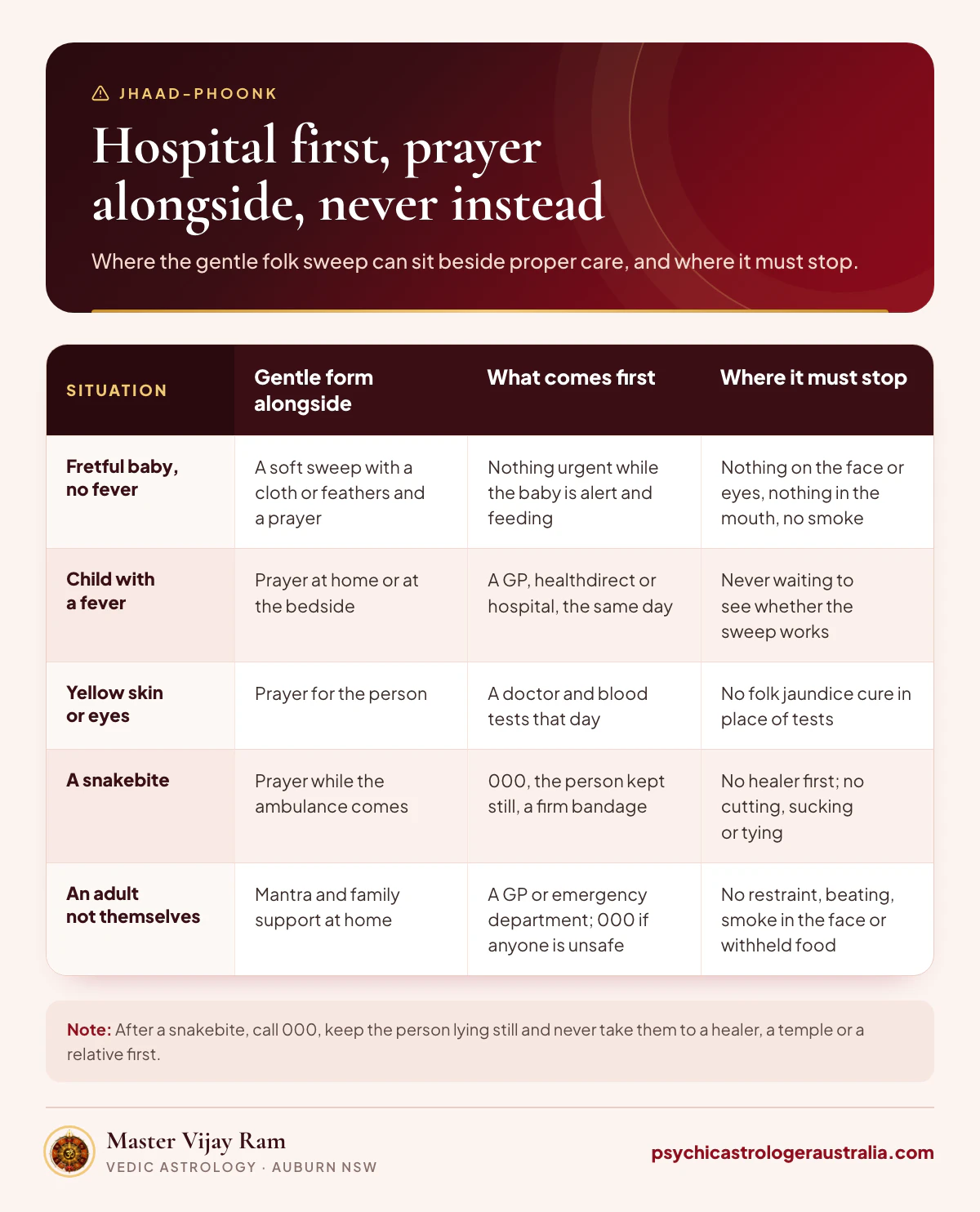
The table sets out the line situation by situation. The middle column is not optional; the last column describes practices that are abuse whatever they are called.
| Situation | A gentle form that can sit alongside | What must come first | Where it must stop |
|---|---|---|---|
| A baby fretful after visitors, feeding well, no fever | A grandmother’s sweep with a cloth or feathers and a prayer | Nothing urgent while the baby is alert and feeding | Nothing on the face or eyes, nothing in the mouth, no smoke |
| A child with a fever | Prayer at home or at the bedside | A GP, healthdirect or hospital, the same day | Never waiting to see whether the sweep works |
| Yellow skin or eyes | Prayer for the person | A doctor and blood tests that day | No folk jaundice cure in place of tests |
| A snakebite | Prayer while the ambulance comes | 000, the person kept still, a firm bandage | No healer first; no cutting, sucking or tying |
| An adult acting unlike themselves | Mantra and family support at home | A GP or emergency department; 000 if anyone is unsafe | No restraint, beating, smoke in the face or withholding food |
| Heaviness after praise, no illness | A single sweep, as custom | The ordinary causes checked | Weekly sweeps for months: read the pattern instead |
Any version that strikes a person with brooms or chains, holds them down, burns chilli or other smoke in their face, keeps them from food, water or sleep, or puts anything into a child’s mouth is abuse, and in Australia it is a police matter. Exorcism versus quiet spiritual healing explains why forceful rites do harm.
How is a Vedic healer’s mantra work different?
It starts in a different place. Master Vijay Ram begins with the birth chart and a plain timeline of what happened and when, asks what doctors have already said, and never touches, sweeps or examines the person; anything he performs takes place where he practises, in Auburn, with no water to drink and nothing to swallow.
The classic Vedic prayer for someone who is ill is the Maha Mrityunjaya mantra, from Rigveda 7.59.12, addressed to Tryambaka, the three-eyed one. The Maha Mrityunjaya mantra explains how families chant it, and a japa of it for a parent in hospital runs alongside the treatment, never in competition with it.
He does not diagnose illness, promise recovery, name anyone as the cause of a sickness, or charge more because someone is frightened. Health and wellbeing guidance describes what a reading can add while the doctors do their work.
What if an elder insists on a healer first?
It happens, especially when a grandparent has just arrived from India or rings from there every evening. Arguing about whether jhaad-phoonk works rarely helps; agreeing on the order does. Take the child to the doctor now, and invite the elder to pray, sweep gently or recite at home once the child has been seen, so that nobody’s faith is mocked and nobody’s health is risked.
If a relative is pushing for a healer to treat something serious instead of a hospital, the safety of the person who is ill comes before family harmony. Most elders accept the order once it is put to them as both, not either.
What does a consultation involve, and what does it cost?
Speaking with Master Vijay Ram costs $50 for a consultation, by phone, video or WhatsApp and in English, Hindi or Punjabi, and the conversation covers the chart and the timeline, never symptoms in place of a doctor. Many calls about jhaad-phoonk end with practical advice: see the GP, keep the grandmother’s prayer, and stop the weekly sweeps.
Should a nazar shanti or a Maha Mrityunjaya japa be warranted, the starting price is $250, settled with you in advance, and he carries it out himself in Auburn while the family watches by video if they like; puja and japa performed in Auburn explains how.
From Darwin to the Central Coast
In the Top End, snakes are part of daily life, and a family in Palmerston or Humpty Doo should know that a bite goes by ambulance to Royal Darwin Hospital, not to anyone’s healer. On the Central Coast or in Perth’s outer suburbs the bush is just as close, and in Sydney, Melbourne and Brisbane the hospital is never far.
Consultations for Darwin families are by phone, video or WhatsApp, as for every city. The Territory runs half an hour behind Sydney in winter and an hour and a half in summer, so mention your local time, and know that Auburn is the only place he sees anyone in person.
What jhaad-phoonk cannot do
It cannot bring down a fever, clear jaundice, neutralise venom, treat an infection or cure an illness of the mind. No sweep, feather, mantra or glass of blown-over water can be guaranteed, and no honest healer will say otherwise.
What the gentle forms can do is comfort a frightened child and steady an anxious grandmother, and that is worth something when it sits beside proper care. This is faith and custom, not medical, legal or financial advice: hospital first, prayer alongside, never instead.
Read next
- Phitkari (Alum) for Negative Energy: The Folk Remedy and Its LimitsPhitkari (alum) against nazar and negative energy: what alum really is, why its melted shape means nothing, safe use …
- The Broom in Hindu Homes: Lakshmi, Sweeping After Sunset and Where to Keep ItBroom vastu and jhadu rules explained: Lakshmi, why families don’t sweep after sunset, where to keep a broom, a new b…
- Ruqyah Healing in Australia: Sessions, Cost & What HappensWhat a ruqyah session in Australia really involves, how an honest fee is built up, what should never be charged for, …
Frequently asked questions
What is jhaad-phoonk?
Jhaad-phoonk is a folk healing practice from north India in which a healer sweeps a person with neem twigs or peacock feathers while reciting a mantra and blowing over them. Jhaad means to sweep and phoonk means to blow. It ranges from a grandmother’s gentle prayer over a fretful baby to a village healer’s treatment for fever or fear, and it is also called jhar phoonk.
Is jhaad-phoonk safe for a baby?
The gentle household form can be, for a baby who is feeding well, alert and without a fever: a soft sweep with a cloth or feathers, a prayer and a gentle breath, once. Nothing should touch the eyes or face, nothing goes in the mouth, and no smoke or camphor comes near the child. A baby with a fever or who will not feed sees a doctor first.
Can jhaad-phoonk cure jaundice?
No. Yellow skin or yellow eyes can signal liver, blood or gallbladder problems, and in a newborn it needs checking promptly. It calls for a doctor and blood tests the same day, not a folk sweep. Families who want to pray can do so at home or beside the bed while the person is treated, but no sweeping or blown-over water should delay the tests.
What should I do if someone is bitten by a snake?
Call 000 immediately and keep the person lying still and calm, because movement spreads venom. If you know how, apply a firm bandage over the bite and along the whole limb while you wait. Never cut, suck or tie off the bite, and never take the person to a healer, a temple or a relative first. Prayer can happen in the ambulance or the hospital.
Why are peacock feathers used for nazar and jhaad-phoonk?
The peacock feather, morpankh, is Krishna’s crown ornament, and the peacock is the mount of Kartikeya, so the feather carries devotion. Peacocks also eat small snakes, and folk belief turned that into a reputation for drawing out poison. That belief is harmless as a symbol at home and dangerous after a real snakebite, where only an ambulance and antivenom help.
Why does the person doing nazar jhaadna yawn?
Many families read repeated yawning during the sweep as the nazar leaving the child. Yawning is catching and comes easily during a quiet, repetitive activity, especially in the evening, so it happens whether or not anything was there. It is part of the custom’s texture rather than a sign to act on, and it should never be used to judge how serious a problem is.
Is it wrong to take my grandmother’s jhaad-phoonk seriously?
No. A grandmother’s prayer and gentle sweep over a child are an act of love, and many families keep them as part of who they are. The only thing that matters is the order: medical care first whenever someone is unwell, then the prayer beside it. Most elders accept that once it is put to them as both together rather than one against the other.
How is Vedic mantra healing different from jhaad-phoonk?
Master Vijay Ram starts from the birth chart and a timeline, never touches or sweeps the person, gives nothing to drink, and keeps any japa or shanti to Auburn, where he practises. He does not diagnose illness, promise recovery or name anyone as a cause. A Maha Mrityunjaya japa for someone in hospital runs alongside medical treatment, never in place of it.
What does a consultation cost if a family wants prayer for someone who is ill?
The first step is a $50 consultation on the phone, by video or over WhatsApp, held in English, Hindi or Punjabi, and it looks at the chart and the timeline rather than the symptoms. If the reading points to a Maha Mrityunjaya japa or a nazar shanti, the price begins at $250, with the price settled first, and he performs it himself in Auburn while medical treatment carries on.
People also ask
What does jhar phoonk mean?
Jhar phoonk, or jhaad-phoonk, means sweeping and blowing. A folk healer or an elder passes neem twigs, peacock feathers or a cloth over a person while reciting, and blows over them, to lift nazar, fear or illness. The gentle household version is harmless beside proper care; using it in place of a doctor for fever, jaundice or a snakebite is dangerous.
Does nazar jhaadna work?
Families who keep it say it calms a fretful child and an anxious household, and that comfort is real. It does not treat illness. A baby who is feeding well and alert can be swept gently with a prayer once; a baby who has a fever, will not feed or seems unwell needs a doctor that day, with the grandmother’s prayer alongside rather than first.
Is jhaad-phoonk legal in Australia?
Praying, reciting and gently sweeping a willing person is ordinary religious practice. What is not acceptable anywhere is striking someone, restraining them, burning smoke in their face, keeping them from food, water or sleep, putting things in a child’s mouth, or delaying medical care for a child. Those are abuse or neglect whatever they are called, and they are matters for the police.
What is the difference between an ojha and an astrologer?
Village communities in north and east India call on an ojha, a folk healer, when someone has a fever, a fit, a fright or a snakebite, and many ojhas work by sweeping, blowing and reciting. A Vedic astrologer reads the birth chart and a timeline, never treats the body, and sends anyone unwell to a doctor first, which is how Master Vijay Ram works.
References & further reading
Serving clients across Australia
Confidential consultations by phone, video & WhatsApp — including: