
Quick answer
An exorcism is a forceful public rite; spiritual healing is quiet, private work that begins with an honest assessment and leaves medical care untouched. Most people who fear possession do not need either, and a genuine practitioner will say so before anything is arranged.
What people picture when they hear the word exorcism
The word carries a great deal of freight. Most people picture a darkened room, raised voices, someone held down, and a long rite that ends in exhaustion. That image comes largely from film and from a handful of dramatic cases reported in the news. It is not what serious spiritual work looks like, and it is not how Master Vijay Ram works. Across forty years of practice he has met many households convinced that only something forceful would help them. Very few of them needed anything of the kind. What they needed first was an honest assessment, a settled house, and a straight answer about whether anything spiritual was involved at all. What follows sets out the difference between a forceful rite and quiet healing, so you can decide with your eyes open rather than out of fear.
What quiet spiritual healing does instead
Quiet work begins with listening, not with ritual. The first conversation is about the timeline: when the trouble started, what changed in the house that month, who is sleeping badly, and what the doctors have already said. Only then does Vijay Ram ji say whether a remedy is warranted at all. When it is, releasing a spirit from a home is carried out by him personally at his own place of practice, not in your living room in front of an audience. Nobody is held, shouted at, or asked to perform for onlookers. The person at the centre is usually asked to do very little beyond sleeping properly and keeping to an ordinary routine. Consultations run by phone, video and WhatsApp, and the remedy happens where he practises, which is why your address makes no difference to the work.
Why the forceful version carries real risk
Harm from forceful rites has been documented in many countries, and it tends to follow the same pattern: a frightened family, a confident stranger, restraint, fasting, sleeplessness, and hours of pressure on someone who is already unwell. People have been badly injured that way. Some have died. Even when nobody is touched, a dramatic rite teaches a household that the person is dangerous and that the danger is winning, and that belief is very hard to undo afterwards. There is a quieter cost too. If a medical problem was driving the behaviour, every hour spent in ritual is an hour not spent in a clinic. The signs that genuinely point towards spirit disturbance are narrower than most people assume, and they are set out in Spirit & Ghost Disturbance: Signs and Safe Clearing rather than guessed at in the moment.
The Quiet Room Test before you agree to anything
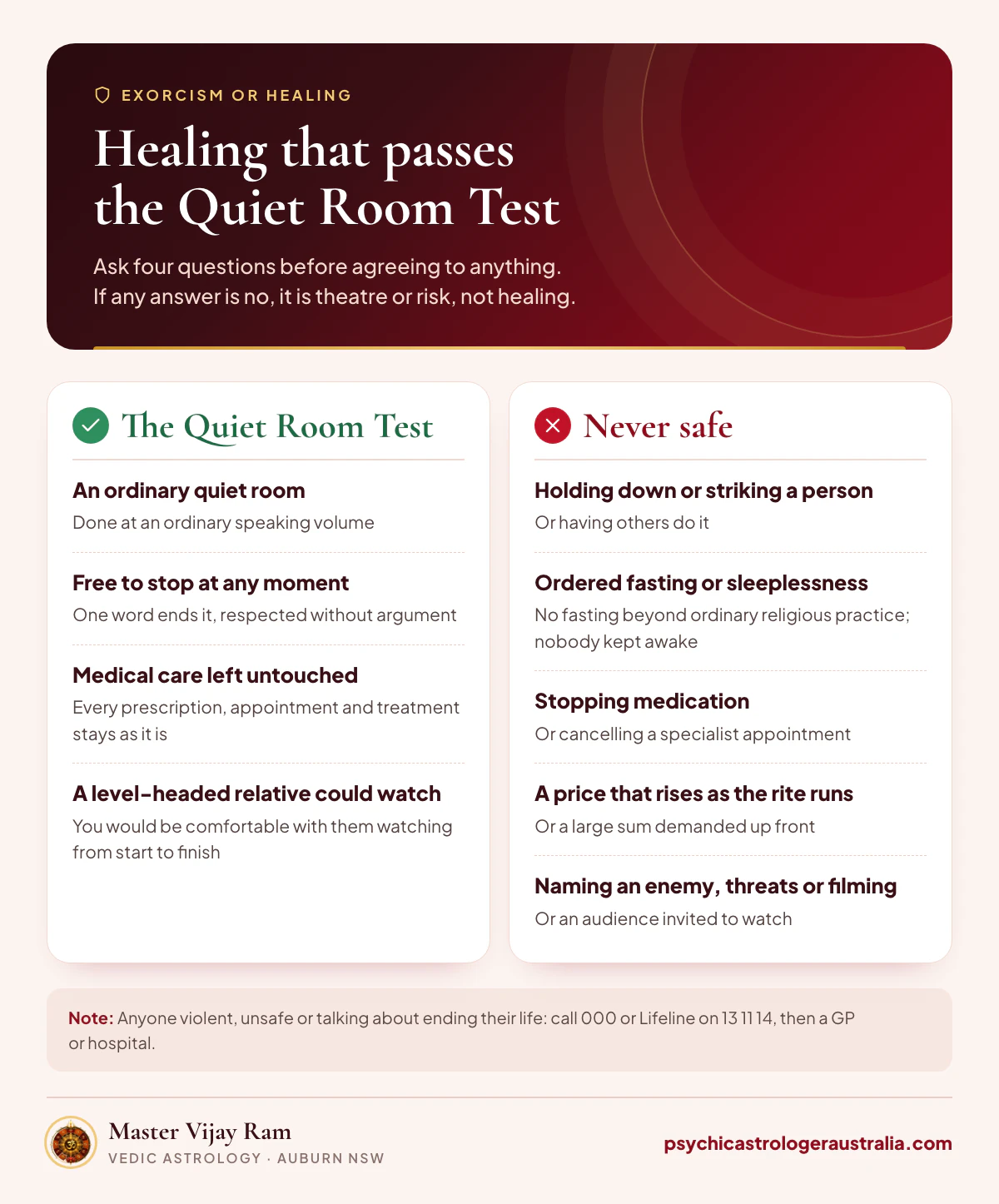
Vijay Ram ji offers a plain rule of thumb he calls the Quiet Room Test. Before agreeing to any spiritual procedure, ask four questions. Could this be done in an ordinary quiet room, at an ordinary speaking volume? Can the person stop it at any moment by saying one word, and will that be respected without argument? Does it leave every prescription, appointment and treatment exactly as it stands? Would you be comfortable if a level-headed relative watched the whole thing from start to finish? If any answer is no, you are looking at theatre or at risk, not at healing. That test applies just as much to the everyday requests that come through negative energy and evil eye removal across the Mornington Peninsula as it does to anything calling itself an exorcism.
Comparing the options honestly
People rarely choose between only two things. In practice there are several reasonable responses to a suspected disturbance, and more than one can run at the same time. A medical assessment and a quiet remedy are not rivals. Where a household follows Islamic practice, ruqyah healing may sit more naturally than anything else, and it is recitation rather than confrontation. The table sets out what each option suits and where each one stops.
| Option | Best suited to | Limits worth knowing |
|---|---|---|
| A formal exorcism or deliverance rite | Rare cases inside a faith community, led by accountable clergy, with the person's consent | Public and frightening; easily imitated by untrained people; never a substitute for a medical opinion |
| Ruqyah by a trained reciter | Muslim households wanting scripture-based work they can continue at home | Depends entirely on the reciter's honesty; recitation alone will not settle a house in constant conflict |
| Quiet Vedic remedial work | Long-running heaviness in a person or a home once an assessment points that way | Needs accurate details and patience; not appropriate when the picture is clearly medical |
| Medical and psychiatric assessment | Any sudden change in speech, memory, behaviour, sleep or seizures | Cannot address what a household experiences as spiritual; a diagnosis can take time |
| Household routine and daily practice | Mild unsettledness after a loss, a move or a long stretch of stress | Slow, and it will not hold if an underlying cause is left untreated |
| Waiting and watching for now | Vague worry with no clear pattern yet | Only safe while nobody is in danger and nothing is escalating |
Consent, capacity and who is actually asking
Most enquiries about exorcism do not come from the person concerned. They come from a mother, a husband, a sister. That matters. An adult who has not asked for help should not become the subject of a rite because relatives have decided something is wrong with them. Vijay Ram ji will speak with a worried family, and he will often help them work out what they are really seeing. But work on a person is arranged with that person's knowledge. Work on a home is a different matter and can be done for the household as a whole. That standard does not change for someone looking for Vedic help across Newcastle, or for an enquiry made from a property hours from the nearest town. Everything discussed stays confidential, including the fact that you made contact.
When this is not the answer
A great many cases that look like possession are nothing of the sort. Sudden changes in speech, memory or personality can come from temporal lobe epilepsy, an infection causing delirium, a thyroid disorder, a head injury, or a reaction to medication. First-episode psychosis, mania in bipolar disorder, severe dissociation and post-traumatic stress can all produce voices, blank periods and behaviour a family has never seen before. Untreated sleep apnoea, alcohol withdrawal and drug withdrawal do it too. In older people, delirium and dementia are far more common than anything spiritual. Legal matters have their own path: family violence, coercive control, threats and custody disputes need police, a lawyer or a family violence service, not a ritual. Those things come first, always. Vijay Ram ji says so plainly when that is what he sees.
How an assessment works before any remedy is proposed
Nothing is decided in the first ten minutes. Vijay Ram ji asks for birth details where they are available, then walks through the timeline in plain language: what changed, when, and who else in the household noticed it. He asks what has already been ruled out medically, and what is still being investigated. Much of what arrives from Ipswich turns out to be strain, grief or plain exhaustion, and it is named as such.
Where a remedy is warranted, he explains what it involves before anything begins, and its fee, from $250, is agreed with you at that point; the consultation itself is $50. The sequence from first call through to review is described in Spiritual Cleansing Service: What to Expect From Start to Finish, so there is nothing hidden in the middle of it.
What a gentle clearing actually involves
There is no spectacle. Vijay Ram ji performs the work himself at his own place of practice, using mantra, havan and the offerings suited to the case. Where the picture points to an entity rather than to ordinary heaviness, the work on jinn disturbance follows the same quiet pattern: preparation, the work itself, then a period of watching. The person affected is not present for it and does not need to be. They are asked to sleep at regular hours, eat properly, keep taking whatever a doctor has prescribed, and avoid retelling the whole story to every visitor. Families often expect to be handed something dramatic to do. Usually they are given less to do, not more. Calm is part of the remedy, not a reward for finishing it.
What is never part of safe work
Some things should end a conversation on the spot. No genuine practitioner will hold a person down, strike them, or have others do it. None will order fasting beyond ordinary religious practice, or keep somebody awake. None will tell you to stop medication or cancel a specialist appointment.
- A large sum demanded up front, or a price that rises while the ritual is running
- Naming an enemy and encouraging you to act against them
- Threats about what will happen to you if you walk away
- Filming the person, or inviting an audience to watch
- Refusing to explain what is being done and why
The honest markers of a real disturbance are specific and rather dull, and Signs of Jinn Disturbance at Home and How Ruqyah Helps sets them out at length.
Fear is a symptom in its own right
Fear does real damage on its own. A household that believes something is hunting it stops sleeping, stops eating at normal hours, and stops having people over. Children pick it up within days. The tiredness then produces exactly the symptoms everybody is already frightened of, and the loop tightens another turn. A forceful rite feeds that loop, because it treats the fear as proof. Quiet work does the opposite. The first instruction is almost always about sleep, meals and ordinary daylight. Whether the enquiry comes from someone searching for an astrologer in Wollongong or from the far side of the country, the earliest advice sounds unremarkable, and it is meant to. Settling a household is not a delay before the real work. Very often it is most of the work.
When the trouble is really about a relationship
A fair number of enquiries about possession turn out to be about a marriage. A partner who has become cold, secretive or unrecognisable gets described as taken over by something. Sometimes there is a spiritual layer to it. Often there is an affair, an addiction, untreated depression, or years of unspoken resentment. Calling it possession lets everybody avoid the harder conversation. Vijay Ram ji will say when what sits in front of him is a relationship problem rather than an entity, and that is closer to the ground covered by a love spell specialist across South East Queensland than to anything resembling an exorcism. He will not perform work intended to override another adult's will. Where a relationship can be helped, it is helped honestly, with both people's dignity left intact.
Aftercare and keeping the calm
The weeks after any clearing matter more than the day of it. Sleep at consistent hours. Keep the house aired and free of clutter. Keep medical appointments. Limit how often the story is retold, because retelling keeps the fear fresh in everyone. A short daily practice suits most households better than a long one nobody keeps up. Where someone still feels drained once the main work is done, gentle aura and chakra cleansing can be repeated at intervals without any drama attached. Expect an uneven few weeks rather than a straight line, and remember that one bad night is not a failure. What genuinely predicts a return is whatever was never dealt with: the conflict, the untreated illness, the arrangement nobody wanted to change.
Deciding between a rite and a remedy
Put the questions in order. First, has anything medical been ruled out by somebody qualified to rule it out? Second, is anyone unsafe right now, because that comes before everything else. Third, is there a clear pattern in time, or only a bad run of months? Fourth, does the person concerned actually want help. If the answers still point somewhere spiritual, ask for the quietest method that could plausibly work, and hold whoever offers it to an ordinary room, an ordinary voice, the freedom to stop, and untouched medical care. Steady spiritual protection and cleansing is usually worth more than one dramatic event. Most people who write in are told they need no remedy at all, and that is the honest answer rather than a soft one.
If a relative seems possessed in Australia, who should you call first?
Anywhere in Australia, the first call for someone who is violent, unsafe or talking about ending their life is 000, and Lifeline answers on 13 11 14 at any hour. After that comes a GP or the emergency department of the nearest hospital, where sudden changes in speech, memory or behaviour can be checked properly. Spiritual help can follow, but it never goes first.
Pressure for a forceful rite usually arrives from a distance: a relative overseas on a late video call, a clip forwarded around a group chat, or a stranger who offers to come to the house and sort it out. Families in Craigieburn and Epping, in Melbourne's north, and in Sunshine and St Albans in the west describe that push often. Any rite that restrains, starves or keeps someone awake is a matter for the police here, whatever name it goes by.
Quiet work needs nobody to travel and nobody to be brought anywhere. Master Vijay Ram assesses by phone, video or WhatsApp, with consultations in Hindi and Punjabi as well as English, and anything warranted is performed by him in Auburn, the one place he sees people in person, by appointment. A family asking about negative energy removal in Craigieburn or black magic removal in Sunshine is assessed exactly as a household down the road from him would be.
Read next
- Negative Energy at Home? A Spiritual Cleansing Guide for Sydney ResidentsNegative energy at home in Sydney: what to rule out first, a room-by-room practice with household items, and what a r…
- Spirit & Ghost Disturbance: Signs and Safe ClearingSigns of spirit or ghost disturbance, the everyday causes that imitate one, how a safe clearing is done and what shou…
- Jinn Removal Service in Australia: How It Works & CostsHow jinn removal works in Australia, what a fee should and should not cover, why your suburb never changes the price,…
Frequently asked questions
What is the difference between an exorcism and a quiet spiritual clearing?
An exorcism is usually a public rite performed on a person, with volume, duration and often an audience. A quiet clearing is private work carried out by the practitioner at his own place of practice, with the affected person doing very little beyond resting and keeping to routine. One relies on confrontation; the other relies on assessment first, then a specific remedy, then a period of watching.
Should any spiritual rite be performed on a person who has not agreed to it?
No. An adult who has not asked for help should not become the subject of a rite because relatives have decided something is wrong with them. Master Vijay Ram will speak with a worried family and help them work out what they are actually seeing, and work on a home can be done for the household. Work on a person is arranged with that person's knowledge.
Is it risky to attend a deliverance session run by someone you have never met?
It can be. Ask before you go whether anyone will be held, whether the session can be stopped by the person at any moment, and whether medical care continues unchanged. If the answers are vague, do not attend. Sessions that rely on restraint, fasting, sleeplessness or fear have caused serious injury in several countries, and fear alone worsens what a family already dreads.
My relative shouted in an unfamiliar voice during a ritual. Does that prove possession?
Not on its own. A frightened, exhausted person under pressure in a loud room will often behave in ways nobody recognises, and the ritual itself can produce what it claims to reveal. Seizure activity, dissociation, delirium and acute psychosis all cause unfamiliar speech. What matters far more is the pattern before the ritual: when it began, what changed, and what a doctor has already excluded.
Can a psychiatric diagnosis and a spiritual disturbance both be true at once?
Yes, and pretending otherwise helps nobody. A diagnosis explains what is happening in the body and mind; it does not settle what a family senses in the house. The safe order is simple. Treatment continues exactly as prescribed, the treating doctor is never contradicted, and any spiritual work sits alongside that care as support rather than as a replacement for it.
What should I do if a practitioner tells me to stop prescribed medication?
Leave. That single instruction tells you everything about the person giving it. Stopping antipsychotics, antidepressants, anticonvulsants, thyroid medication or heart medication can be dangerous within days, and withdrawal can produce exactly the frightening behaviour a family then reads as proof of possession. Vijay Ram ji asks clients to keep every prescription and appointment, and to tell their doctor what else they are doing.
Is fasting, restraint or sleep deprivation ever part of responsible spiritual work?
Restraint and sleep deprivation, never. Fasting only within a person's ordinary religious practice, and never for someone who is unwell, pregnant, diabetic or elderly. Hunger and lost sleep make anyone confused, irritable and emotionally raw, and that state is then presented as evidence. Any method whose effects depend on wearing a person down is producing symptoms rather than removing them.
Why would a gentle method achieve more than a dramatic one?
Because most of what a family is living with is fear, tiredness and disrupted routine, and drama makes all three worse. A quiet approach settles the household first, which often removes half the symptoms before any remedy is performed. It also keeps the picture clear, so a medical cause is not buried under noise. Force impresses onlookers. Calm gives you something you can keep.
How do I tell an attachment from ordinary grief after a death in the family?
Grief has a shape. It moves in waves, it eases slightly between them, and it centres on the person who died. Sleep is broken, but food and work slowly return. What raises a different question is a household-wide change with no emotional logic, affecting people who were not close to the deceased, and worsening steadily rather than easing. Even then, exhaustion and depression are checked first.
Are children ever suitable for this kind of work?
Children are never put through a rite. If a child is unsettled, the first questions are about sleep, screens, school, bullying, illness and what the adults around them are arguing about. Children absorb household fear quickly and show it in their bodies. Where anything is done at all, it is done for the home and for the parents, quietly, and a GP or paediatrician is seen first.
How should I describe what is happening so it can be assessed properly?
Plainly, and in order of time. Say when you first noticed something, what else changed that month, who else in the house has been affected, and what a doctor has already checked. Avoid interpreting as you go. Saying a room feels cold at three in the morning is more useful than saying a spirit lives there. Vijay Ram ji works from the sequence, not the label.
Does a clearing have to be repeated every year?
No. Repeat work is offered when something specific calls for it, not on a schedule that happens to suit the practitioner. Anyone who tells you a yearly ritual is compulsory is selling a subscription. What genuinely holds the calm is unremarkable: regular sleep, an aired and uncluttered home, treated illness, and whatever daily practice you will actually keep up without being reminded.
What if the trouble seems tied to the house rather than to one person?
That is common, and it is easier to work with. Ordinary causes are checked first: damp, mould, a gas or carbon monoxide problem, faulty wiring, noise from a neighbour, poor ventilation, or a room nobody ever uses. If those are excluded and the pattern still holds, work for the home is arranged for the household as a whole, and nobody has to be present for it.
Is a longer ritual better value than a shorter one?
Length is not a measure of anything. A rite that runs for six hours is not six times more effective than one that runs for one; it is usually six hours of exhaustion for everyone in the room. Vijay Ram ji works to what the case needs, and the fee is fixed before anything is performed, so duration is never used to justify a price.
How long should a household give a quiet approach before reviewing it?
Review rather than abandon. Agree at the start what you are watching for, then look again after a few weeks using the same questions you started with: sleep, appetite, arguments, and the specific thing that first worried you. Improvement is usually uneven, so judge the direction rather than any single night. If nothing at all has shifted, say so plainly and reconsider the cause.
People also ask
Is exorcism safe?
It depends entirely on who performs it and how. A rite led by accountable clergy, with consent and with medical care continuing, carries far less risk than a session run by a stranger using restraint, fasting or sleeplessness. Serious injury has occurred in the second kind in several countries. If anyone will be held down or kept awake, do not proceed.
What is the alternative to an exorcism?
A quiet assessment followed, only if warranted, by a specific remedy performed by the practitioner at his own place of practice. The person concerned does not attend and is asked mainly to sleep properly and keep to an ordinary routine. Medical treatment continues untouched throughout. Most households that enquire are told no remedy is needed, and are given practical advice instead.
Can an entity be removed without a dramatic ritual?
Yes. Nothing in the traditions requires an audience, volume or force. Master Vijay Ram performs the work himself, privately, using mantra, havan and the offerings suited to the case, then watches the weeks that follow. Families often expect to be handed something dramatic to do, and are surprised to be given less to do rather than more.
What are the warning signs of an unsafe spiritual practitioner?
A large sum demanded before anything is done, or a price that rises partway through a ritual. Instructions to stop medication. Restraint, striking, fasting or forced wakefulness. Naming an enemy and urging you to act against them. Threats about what happens if you leave. Filming the person, or inviting spectators. Refusing to explain what is being done and why.
Does exorcism work for mental illness?
No, and treating mental illness as possession delays care that does work. First-episode psychosis, mania, severe dissociation and post-traumatic stress can all look alarming to a family who has never seen them before. They need a doctor, and often urgently. Spiritual support can sit alongside that treatment for comfort and steadiness, but never in place of it.
References & further reading
Serving clients across Australia
Confidential consultations by phone, video & WhatsApp — including: