
Quick answer
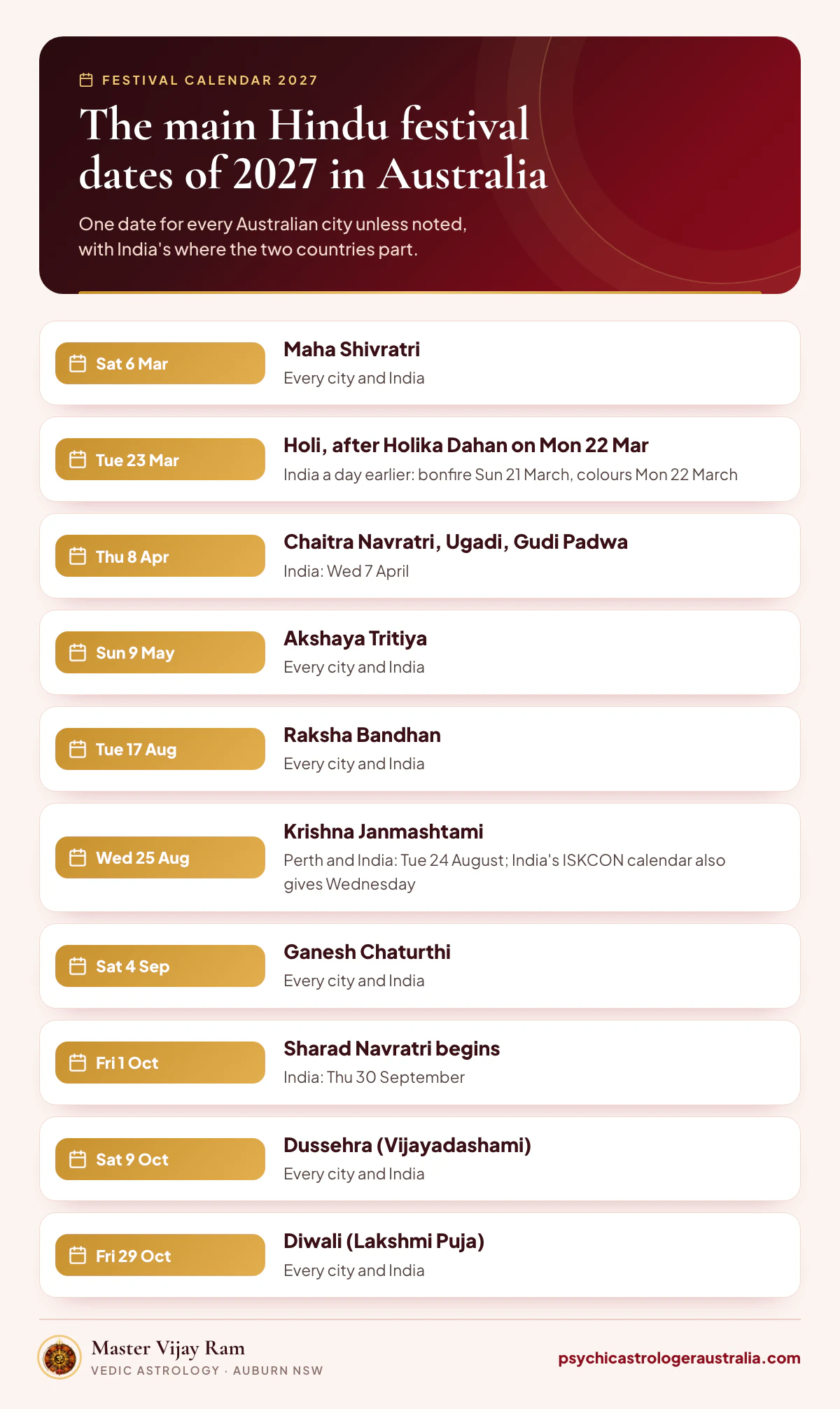
The main Hindu festival dates for Australia in 2027 are Maha Shivratri on Saturday 6 March, Holi on Tuesday 23 March, Raksha Bandhan on Tuesday 17 August, Ganesh Chaturthi on Saturday 4 September, Navratri from Friday 1 October, Dussehra on Saturday 9 October and Diwali on Friday 29 October. India keeps Holi, Navratri and, for Smarta families, Janmashtami a day earlier.
Hindu festival dates 2027 in Australia at a glance
The Hindu calendar is a lunisolar calendar that fixes most festivals by the tithi, the lunar day, and a few by the Sun's entry into a sidereal sign. A tithi begins and ends at a single instant for the whole planet, so the only question for an Australian family is which local day that instant falls in, and the answer is not always the one printed on a calendar from Delhi or Mumbai.
The table below gives every major festival of 2027 for Sydney and Melbourne, Brisbane, Adelaide, Perth and Darwin, with India beside them. Every row was computed from the Swiss Ephemeris with the Lahiri ayanamsa and the rule each tradition uses, then checked against the published Indian panchangs for the days when the two countries part company.
| Festival | Sydney / Melbourne | Brisbane | Adelaide | Perth | Darwin | India |
|---|---|---|---|---|---|---|
| Vasant Panchami | Fri 12 Feb | Fri 12 Feb | Fri 12 Feb | Thu 11 Feb | Fri 12 Feb | Thu 11 Feb |
| Maha Shivratri | Sat 6 Mar | Sat 6 Mar | Sat 6 Mar | Sat 6 Mar | Sat 6 Mar | Sat 6 Mar |
| Holika Dahan | Mon 22 Mar | Mon 22 Mar | Mon 22 Mar | Mon 22 Mar | Mon 22 Mar | Sun 21 Mar |
| Holi (Rangwali) | Tue 23 Mar | Tue 23 Mar | Tue 23 Mar | Tue 23 Mar | Tue 23 Mar | Mon 22 Mar |
| Chaitra Navratri / Ugadi / Gudi Padwa | Thu 8 Apr | Thu 8 Apr | Thu 8 Apr | Thu 8 Apr | Thu 8 Apr | Wed 7 Apr |
| Ram Navami | Thu 15 Apr | Thu 15 Apr | Thu 15 Apr | Thu 15 Apr | Thu 15 Apr | Thu 15 Apr |
| Hanuman Jayanti | Wed 21 Apr | Wed 21 Apr | Wed 21 Apr | Tue 20 Apr | Wed 21 Apr | Tue 20 Apr |
| Akshaya Tritiya | Sun 9 May | Sun 9 May | Sun 9 May | Sun 9 May | Sun 9 May | Sun 9 May |
| Nag Panchami | Fri 6 Aug | Fri 6 Aug | Fri 6 Aug | Fri 6 Aug | Fri 6 Aug | Fri 6 Aug |
| Raksha Bandhan | Tue 17 Aug | Tue 17 Aug | Tue 17 Aug | Tue 17 Aug | Tue 17 Aug | Tue 17 Aug |
| Krishna Janmashtami | Wed 25 Aug | Wed 25 Aug | Wed 25 Aug | Tue 24 Aug | Wed 25 Aug | Tue 24 Aug |
| Hartalika Teej | Fri 3 Sep | Fri 3 Sep | Fri 3 Sep | Fri 3 Sep | Fri 3 Sep | Fri 3 Sep |
| Ganesh Chaturthi | Sat 4 Sep | Sat 4 Sep | Sat 4 Sep | Sat 4 Sep | Sat 4 Sep | Sat 4 Sep |
| Sharad Navratri begins (Ghatasthapana) | Fri 1 Oct | Fri 1 Oct | Fri 1 Oct | Fri 1 Oct | Fri 1 Oct | Thu 30 Sep |
| Durga Ashtami | Fri 8 Oct | Fri 8 Oct | Fri 8 Oct | Fri 8 Oct | Fri 8 Oct | Thu 7 Oct |
| Dussehra (Vijayadashami) | Sat 9 Oct | Sat 9 Oct | Sat 9 Oct | Sat 9 Oct | Sat 9 Oct | Sat 9 Oct |
| Dhanteras | Wed 27 Oct | Wed 27 Oct | Wed 27 Oct | Wed 27 Oct | Wed 27 Oct | Wed 27 Oct |
| Diwali (Lakshmi Puja) | Fri 29 Oct | Fri 29 Oct | Fri 29 Oct | Fri 29 Oct | Fri 29 Oct | Fri 29 Oct |
| Govardhan Puja | Sat 30 Oct | Sat 30 Oct | Sat 30 Oct | Sat 30 Oct | Sat 30 Oct | Sat 30 Oct |
| Bhai Dooj | Sun 31 Oct | Sun 31 Oct | Sun 31 Oct | Sun 31 Oct | Sun 31 Oct | Sun 31 Oct |
| Dev Uthani Ekadashi | Wed 10 Nov | Wed 10 Nov | Wed 10 Nov | Wed 10 Nov | Wed 10 Nov | Wed 10 Nov |
Each festival follows the rule its tradition uses — the tithi present at sunrise, midday, afternoon, midnight or after sunset — applied on the city's own clock; where the tithi meets none of those moments locally, the day it covers most of the daylight is shown. Makar Sankranti is a solar date (see the Vedic sun-sign table). Computed with the Swiss Ephemeris (Lahiri ayanamsa for Vedic positions) and checked against US Naval Observatory data. Times are rounded to the minute.
Canberra, Hobart, Newcastle, Wollongong, the Central Coast and Geelong keep Sydney and Melbourne's dates; the Gold Coast, the Sunshine Coast, Cairns and Townsville keep Brisbane's. Where a city is a day apart from India, the reason is explained festival by festival further down, and each festival has its own page with the local puja times.
How the dates were computed, and why a city can differ from India
A tithi is one twelfth of the Moon's gain on the Sun, so each one lasts a little under a day and starts at the same moment everywhere. Hindu festival dates 2027 in Australia therefore depend on one thing: whether the tithi is present at the moment the festival's rule checks, measured on the local clock and against the local sunrise.
Sydney runs four and a half hours ahead of India in winter and five and a half in summer, and Perth two and a half. When a tithi boundary falls in that gap, one country's sunrise or sunset is inside the tithi and the other's is not, and the festival moves by a day. Holi 2027 is the clearest case: the Phalguna Purnima begins at 11:52 pm Sydney time on Sunday 21 March, which is still 6:22 pm on Sunday in Delhi, so India lights Holika on the Sunday evening and Australia on the Monday.
Where a tithi meets none of the rule's moments in a city, a locally kshaya tithi, the day it covers most of the daylight is used, which is what the Indian panchangs do. Those cases are marked on the individual festival pages, and they are rare: Nag Panchami in Sydney, Hanuman Jayanti in Perth and Navratri's first day in India.
Which rule fixes each festival?
Five rules cover almost every festival in the Hindu calendar 2027, and knowing which one applies tells you why a date sits where it does.
| Festival | Tithi | Rule that fixes the day |
|---|---|---|
| Maha Shivratri, Janmashtami | Magha Krishna Chaturdashi; Shravana Krishna Ashtami | Nishita: the tithi present at the midnight that ends the day |
| Holika Dahan, Dhanteras | Phalguna Purnima; Ashwin Krishna Trayodashi | Pradosh: the tithi present after sunset |
| Ram Navami, Ganesh Chaturthi | Chaitra Shukla Navami; Bhadrapada Shukla Chaturthi | Madhyahna: the tithi present at midday |
| Dussehra, Bhai Dooj, Raksha Bandhan | Ashwin Shukla Dashami; Kartika Shukla Dwitiya; Shravana Purnima | Aparahna: the tithi present in the afternoon, outside Bhadra for the rakhi |
| Navratri, Durga Ashtami, Akshaya Tritiya, Vasant Panchami, Hanuman Jayanti, Nag Panchami, Teej, Ekadashi | The named tithi | Udaya: the tithi present at sunrise |
| Diwali, Karva Chauth | Ashwin Amavasya; Kartika Krishna Chaturthi | Pradosh on the Amavasya; the moonrise inside the Chaturthi |
| Makar Sankranti, Pongal, Lohri | Solar | The Sun's entry into sidereal Makara, with Lohri on the eve |
Holi is the one exception that uses no tithi of its own: Rangwali Holi is simply the morning after Holika Dahan, wherever you are.
January to March: Lohri, Makar Sankranti, Vasant Panchami, Maha Shivratri and Holi
The year opens with the solar festivals. The Sun enters sidereal Makara on Friday 15 January 2027 in Sydney time and late on Thursday 14 January in India, after sunset there, so most Indian panchangs also keep Makar Sankranti and Pongal on the Friday. Lohri, the eve of the Sankranti in Punjab, is Wednesday 13 January 2027 by the moment or Thursday 14 January by the next-day rule; Australian Punjabi families keep one of those evenings or follow their gurdwara's notice. The Makar Sankranti and Lohri 2027 page sets the two dates side by side.
Vasant Panchami is Friday 12 February 2027 in Sydney, Brisbane, Adelaide and Darwin, but Thursday 11 February in Perth and India, because the Panchami ends at 8:49 am Sydney time on the Friday, after the eastern sunrise and before Perth's. Maha Shivratri is Saturday 6 March 2027 everywhere, India included, with the night vigil running into Sunday morning.
Holika Dahan is Monday 22 March 2027 in every Australian city and Sunday 21 March in India, and Rangwali Holi follows on Tuesday 23 March here and Monday 22 March there. The Holi 2027 page gives the bonfire times after sunset for each city.
April to June: Chaitra Navratri, Ram Navami, Hanuman Jayanti and Akshaya Tritiya
Daylight saving ends on Sunday 4 April 2027, and the spring festivals of the Indian calendar arrive in the Australian autumn. Chaitra Navratri, Ugadi and Gudi Padwa begin on Thursday 8 April 2027 in Australia and Wednesday 7 April in India; Ram Navami is Thursday 15 April 2027 everywhere, fixed by the midday rule.
Hanuman Jayanti on the Chaitra Purnima is Wednesday 21 April 2027 in the eastern and central cities, but Tuesday 20 April in Perth and India, where the Purnima meets no sunrise and the day it fills is used. Akshaya Tritiya, the day that needs no muhurat, is Sunday 9 May 2027 everywhere, and the Australian window is far longer than India's because the Tritiya runs until 1:34 pm Sydney time but only until 9:04 am in Delhi.
July to September: Nag Panchami, Raksha Bandhan, Janmashtami, Teej and Ganesh Chaturthi
Nag Panchami is Friday 6 August 2027 everywhere. Raksha Bandhan is Tuesday 17 August 2027 everywhere, India included, because Bhadra fills the first half of the Purnima through Monday afternoon and evening; in Australia the rakhi can be tied through the Tuesday afternoon, while in India the window closes at 12:59 pm. The same Purnima carries a penumbral lunar eclipse at 5:14 pm AEST, for which the tradition observes no sutak.
Janmashtami is the year's most divided date. The Ashtami is present at midnight in Perth and India on Tuesday 24 August 2027, but in Sydney, Brisbane, Adelaide and Darwin it runs from 12:55 am to 11:50 pm on Wednesday 25 August, spanning no local midnight, so the day it fills is used; India's ISKCON calendar also gives the Wednesday. Hartalika Teej is Friday 3 September 2027 and Ganesh Chaturthi is Saturday 4 September 2027 everywhere, with the midday sthapana window intact in every Australian city.
October and November: Navratri, Dussehra, Karva Chauth, Diwali and the days around it
Sharad Navratri begins with Ghatasthapana on Friday 1 October 2027 in Australia and Thursday 30 September in India, where the Pratipada meets no sunrise. Daylight saving returns on Sunday 3 October, in the middle of the nine nights, and Mercury turns retrograde on Friday 8 October, the Durga Ashtami. Dussehra is Saturday 9 October 2027 everywhere, with the Vijay muhurat in the Saturday afternoon of each city, so the festival dates 2027 in Sydney and Melbourne run straight from the nine nights into the Diwali fortnight.
Karva Chauth is the one festival of 2027 the panchangs disagree on, with the moonrise rule giving Monday 18 October and the sunrise rule Tuesday 19 October. Dhanteras is Wednesday 27 October, Diwali and Lakshmi Puja fall on Friday 29 October 2027 in every city and in India, Govardhan Puja is Saturday 30 October and Bhai Dooj is Sunday 31 October. Dev Uthani Ekadashi, which reopens the wedding season, is Wednesday 10 November 2027.
Daylight saving and the four Australian clocks
A single tithi instant lands on four different clocks in Australia, and two of them change twice a year. New South Wales, Victoria, the ACT, Tasmania and South Australia end daylight saving on Sunday 4 April 2027 and begin it again on Sunday 3 October 2027; Queensland, the Northern Territory and Western Australia never change.
| Where you are | Standard time | Daylight saving | Compared with Sydney |
|---|---|---|---|
| NSW (incl. Central Coast), Victoria (incl. Geelong), ACT, Tasmania | AEST, UTC+10 | AEDT, UTC+11 | Same as Sydney all year |
| Queensland (Brisbane, Gold Coast, Sunshine Coast, Townsville, Cairns) | AEST, UTC+10 | None | Same April–October; 1 hour behind October–April |
| South Australia (Adelaide) | ACST, UTC+9:30 | ACDT, UTC+10:30 | 30 minutes behind all year |
| Northern Territory (Darwin) | ACST, UTC+9:30 | None | 30 minutes behind April–October; 1½ hours behind October–April |
| Western Australia (Perth) | AWST, UTC+8 | None | 2 hours behind April–October; 3 hours behind October–April |
In 2027 daylight saving ends on Sunday 4 April and begins on Sunday 3 October.
In practice this means Perth is two hours behind Sydney for the winter festivals, Raksha Bandhan and Janmashtami among them, and three hours behind for Diwali. It is why Janmashtami's midnight lands on different dates in the two cities, and why a Perth family should never take a Sydney puja time and simply subtract.
Eclipses and Mercury retrograde in the festival year
Two solar eclipses, on 7 February and 2 August 2027, are invisible from Australia, so no sutak applies here. Of the three lunar eclipses, the penumbral eclipse of 21 February is visible from Perth only, the one of 19 July is too faint to see, and the one of 17 August 2027, Raksha Bandhan, reaches magnitude 0.55 at 5:14 pm AEST over Sydney, Brisbane, Adelaide and Hobart. The eclipses 2027 page explains why penumbral eclipses carry no sutak in most traditions.
Mercury is retrograde from 10 February to 3 March, from 11 June to 5 July and from 8 October to 29 October 2027, so Navratri and Dussehra fall inside the third period and Diwali's Lakshmi Puja comes the evening after Mercury turns direct at 1:11 am AEDT that morning. The Mercury retrograde 2027 calendar has every time zone, and the festival pujas themselves are unaffected; it is contracts and purchases that deserve the second look.
The wedding and griha pravesh seasons of 2027
Hindu weddings and house-warmings pause during Chaturmas, the four months from Devshayani Ekadashi in July to Dev Uthani Ekadashi on Wednesday 10 November 2027, and again during Kharmas, when the Sun is in sidereal Dhanu from 16 December 2027 until Makara Sankranti on 15 January. Between those pauses the panchangs publish their vivah muhurats, and Australian families are usually choosing between a handful of weekends.
No list of auspicious dates appears on this site, because a date is only auspicious for a particular couple or a particular house once it has been checked against their charts. A muhurat consultation is how that is done, and the vivah muhurat 2027 page explains the reasoning for the wedding season.
Using the calendar for a puja or a remedy
Many of the remedies Master Vijay Ram recommends after a reading are timed to a festival: a Rudrabhishek on Maha Shivratri, a Chandi havan in Navratri, a Lakshmi puja on Diwali night, a Ganesh puja on Chaturthi for a stalled venture. When a client cannot perform the puja themselves, it is performed personally on request at his own place of practice in Auburn on the auspicious muhurat, with the family joining by video if they wish.
A consultation is $50; a puja or havan performed on request starts from $250, and the figure is agreed before anything is performed. This is faith-based guidance, not medical, legal or financial advice, and the calendar above is offered to every family whether or not they ever book a reading.
Why your temple's date may differ
Every date here is computed for the city centre and for the rules named above. A temple may follow a regional panchang, a Vaishnava calendar, or a decision to hold its public celebration on the nearest weekend, and none of those is wrong; the festival belongs to the community that keeps it.
Where this calendar and your temple differ, the tithi times on the festival page will show you why, and the honest answer is usually that both days are inside the tithi somewhere. A yearly forecast reads these dates against your own chart, which is where a calendar stops and astrology begins.
Festivals from Townsville to Hobart
In the capitals the public festivals are easy to find; in the regions the home puja is often the whole celebration. The Central Coast community holds Janmashtami and Ganesh Chaturthi through its own Hindu temple association, Townsville has broken ground on a Durga Mahalakshmi temple, Cairns Hindu Samaj uses halls and parks, and Geelong families drive to Carrum Downs or the western suburbs for the big nights while a temple at Lara waits to be built.
For all of them the Indian festivals 2027 fall on the same dates as their capital's, and the puja at home follows the same clock. That is the point of a calendar built for Australian cities rather than copied from India: a family in Maroochydore or Burnie can open it and know, without a phone call, which evening to light the lamp.
Read next
- Vivah Muhurat 2027: Wedding Season for Australian FamiliesVivah muhurat 2027 for Australian families: the two wedding seasons, the closed periods, nakshatras and tithis, the p…
- Panchang Explained: Tithi, Vara, Nakshatra, Yoga and KaranaPanchang explained: the five limbs, tithi, vara, nakshatra, yoga and karana, how to read a panchang page, and why you…
- Kala Jadu Removal for Indians & Punjabis in AustraliaKala jadu removal explained for Indian and Punjabi families in Australia: the stage-by-stage process, what you are as…
Frequently asked questions
When is Diwali 2027 in Australia?
Lakshmi Puja is on Friday 29 October 2027 in every Australian city and in India. The Amavasya runs from 2:19 am AEDT on the Friday to 12:37 am AEDT on the Saturday, covering Friday evening everywhere from Brisbane to Perth. Dhanteras is Wednesday 27 October, Govardhan Puja Saturday 30 October and Bhai Dooj Sunday 31 October; the city-by-city sunset and Pradosh windows are on the Diwali page.
When is Holi 2027 in Australia?
Holika Dahan is Monday 22 March 2027 in every Australian city, after local sunset, and Rangwali Holi is Tuesday 23 March. India is a day earlier, with the bonfire on Sunday 21 March and colours on Monday 22 March, because the Purnima begins at 6:22 pm Delhi time on the Sunday, which is already 11:52 pm in Sydney. Public Holi events in Australia are usually held on the nearest weekend.
When does Navratri 2027 start in Australia?
Ghatasthapana is Friday 1 October 2027 in every Australian city, with the Pratipada present at sunrise and ending at 10:06 am AEST. India begins on Thursday 30 September, because there the Pratipada meets no sunrise and the day it fills is used. Durga Ashtami is Friday 8 October in Australia and Thursday 7 October in India, and Dussehra is Saturday 9 October in both countries.
Why is Janmashtami on different dates in Sydney and Perth?
The Ashtami is present at midnight in Perth on Tuesday 24 August 2027, as it is in India, so Perth keeps the Tuesday vigil. In Sydney, Brisbane, Adelaide and Darwin the same tithi runs from 12:55 am to 11:50 pm on Wednesday 25 August and spans no local midnight, so the day it fills is used and the vigil is Wednesday night. India's ISKCON calendar also gives Wednesday 25 August.
Is Raksha Bandhan 2027 on Monday 16 or Tuesday 17 August?
Tuesday 17 August 2027 everywhere, India included. The Purnima begins at 2:59 pm AEST on the Monday, but Bhadra occupies the first half of the tithi through Monday afternoon and evening, and the rakhi is not tied in Bhadra. On Tuesday the Purnima is present through the afternoon in Australia, until 5:29 pm AEST, while in India it ends at 12:59 pm, so Indian families tie the thread in the morning.
What is the difference between the Australian and Indian Hindu calendar?
There is one calendar; what differs is the clock. A tithi begins and ends at one instant for the whole world, and each festival's rule checks whether that tithi is present at sunrise, midday, afternoon, sunset or midnight. Because Sydney is four and a half to five and a half hours ahead of India, a tithi boundary can fall between an Australian sunrise and an Indian one, moving the festival by a day in one country only.
Do Melbourne, Brisbane and Perth have different festival dates?
Melbourne, Canberra and Hobart match Sydney for every festival in 2027, and Brisbane matches Sydney for all of them too, because the eastern cities share the same sunrise within half an hour. Perth differs for three festivals: Vasant Panchami and Hanuman Jayanti fall a day earlier there, with India, and Janmashtami's midnight vigil is Tuesday 24 August rather than Wednesday 25 August. Adelaide and Darwin follow the east.
Which 2027 festivals fall during Mercury retrograde?
Mercury is retrograde from 10 February to 3 March, 11 June to 5 July and 8 October to 29 October 2027. Vasant Panchami falls in the first period, and Navratri, Dussehra, Karva Chauth and Dhanteras in the third, with Mercury turning direct at 1:11 am AEDT on Diwali morning. The festivals and their pujas are not affected; contracts, purchases and account openings made in those weeks deserve a careful second reading.
Does an eclipse affect any festival in 2027?
The penumbral lunar eclipse of 17 August 2027 reaches magnitude 0.55 at 5:14 pm AEST over Sydney, Brisbane, Adelaide and Hobart, on the Raksha Bandhan Purnima. Most traditions observe no sutak for a penumbral eclipse, so the rakhi day is not restricted, though families who avoid eclipse hours can tie the thread earlier in the afternoon. Neither solar eclipse of 2027 is visible from Australia.
People also ask
What are the main Hindu festivals in 2027?
For Australian families the main 2027 dates are Maha Shivratri on 6 March, Holi on 23 March, Ram Navami on 15 April, Akshaya Tritiya on 9 May, Raksha Bandhan on 17 August, Janmashtami on 25 August in the east, Ganesh Chaturthi on 4 September, Navratri from 1 October, Dussehra on 9 October and Diwali on 29 October, with Makar Sankranti on 15 January opening the year.
Why do Hindu festival dates change every year?
Because they follow the Moon. A lunar month is about twenty-nine and a half days, so twelve of them fall eleven days short of the solar year, and every festival drifts earlier until a leap month, an adhik maas, pushes the calendar back. There is no leap month in 2027, which is why Diwali comes ten days earlier than in 2026, on 29 October rather than 8 November.
Is the Hindu festival calendar the same in Australia and India?
The festivals and the tithis are identical; the dates can differ by a day because the two countries' sunrises are hours apart in real time. In 2027 Holi, Navratri, Durga Ashtami and Smarta Janmashtami are a day earlier in India, while Diwali, Dussehra, Ganesh Chaturthi, Raksha Bandhan and Maha Shivratri fall on the same date in both. Perth sits between the two for a few festivals.
How are Hindu festival dates calculated?
From the positions of the Sun and Moon. A tithi is one twelfth of the Moon's gain on the Sun, and each festival belongs to a named tithi in a named lunar month. A rule then fixes the civil day: the tithi present at sunrise for most observances, at midday for Ganesh Chaturthi and Ram Navami, in the afternoon for Dussehra, after sunset for Diwali and at midnight for Shivratri and Janmashtami.
Which Hindu festivals are public holidays in Australia?
None of them is a national public holiday in Australia, although some employers and schools allow leave for Diwali and some councils stage official Diwali and Holi events. Families usually hold the home puja on the correct evening and attend the community celebration on the nearest weekend, which is why the temple calendar and this calendar can show different days for the same festival.
References & further reading
Serving clients across Australia
Confidential consultations by phone, video & WhatsApp — including: