
Quick answer
A panchang is the Hindu almanac that describes each day through five limbs: the tithi (the Moon's angle from the Sun), the vara (weekday from sunrise), the nakshatra (the Moon's star), the yoga (the sum of the Sun's and Moon's longitudes) and the karana (half a tithi). It is local: sunrise and your city decide which day a tithi or festival falls on.
What is a panchang?
A panchang is the Hindu almanac that describes every day through five measurements of the Sun and the Moon, and it is the page families open before a puja, a fast, a festival or a wedding. The word means five limbs, and the five limbs of the panchang are the tithi, the vara, the nakshatra, the yoga and the karana. Together they say what kind of day it is, in the tradition's terms, at a particular place.
That last phrase matters more in Australia than anywhere else. A panchang is computed for a city's sunrise and clock, so a day that is right in Delhi can be wrong in Adelaide, and the reasons are set out below. When the question is not what the day is but which hour suits your own chart, that is the work of choosing a muhurat for an important date.
What do the five limbs measure?
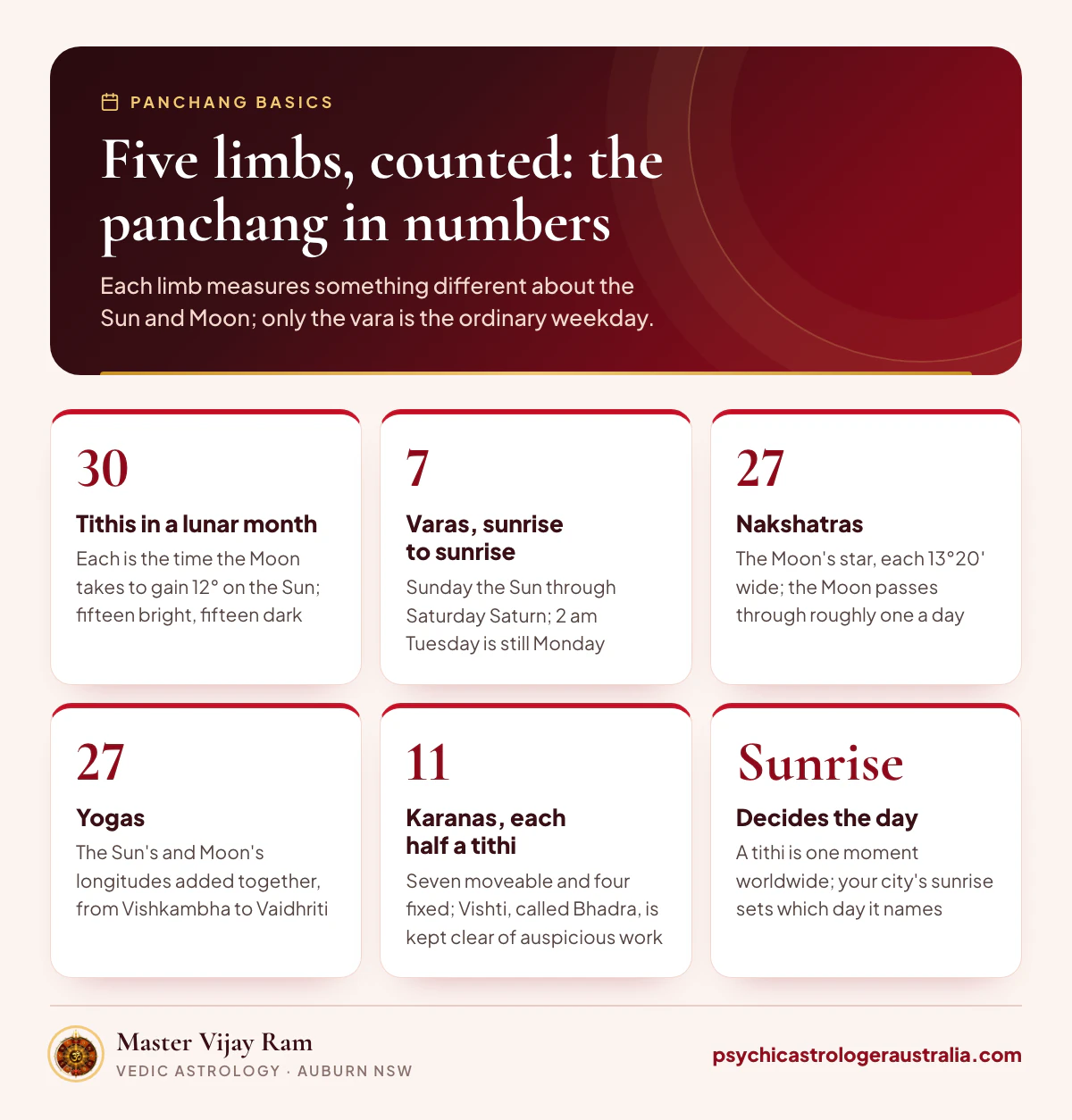
Each limb measures something different, and only one of them, the vara, is the ordinary weekday. The other four come from the positions of the Sun and the Moon, which is why they change at odd hours rather than at midnight. The table sets them side by side before each is explained.
| Limb | What it measures | How many | Roughly how long | What families use it for |
|---|---|---|---|---|
| Tithi | The angle between the Moon and the Sun, in steps of 12° | 30 in a lunar month | About a day, sometimes noticeably less or more | Festivals, fasts, Ekadashi, Purnima and Amavasya, death anniversaries |
| Vara | The weekday, counted from sunrise | 7 | Sunrise to sunrise | Weekly fasts and the planet that rules the day |
| Nakshatra | The Moon's star, one of 27 sections of 13°20′ | 27 | About a day | Naming, muhurat, the Moon's daily quality |
| Yoga | The sum of the Sun's and Moon's longitudes, in 27 sections | 27 | About a day | Avoiding a few difficult yogas for beginnings |
| Karana | Half a tithi | 11 (7 moveable, 4 fixed) | About half a day | Avoiding Vishti, also called Bhadra, for auspicious work |
What is a tithi, and why does it start at odd hours?
A tithi is the time the Moon takes to gain 12° on the Sun. Thirty of them make a lunar month: fifteen in the bright half, Shukla paksha, from Pratipada to Purnima, and fifteen in the dark half, Krishna paksha, ending at Amavasya. Because the Moon's speed varies, a tithi can last noticeably less or more than a day, and it begins whenever the angle is reached, in the middle of a meeting or the middle of the night.
To give each calendar day a single tithi, most panchangs use the udaya rule: the tithi present at local sunrise names the day. A tithi that begins after one sunrise and ends before the next touches no sunrise at all and is called kshaya, skipped; one that spans two sunrises appears twice. Festivals add their own rules on top, the midnight rule for Janmashtami or the afternoon for Dussehra, which is why the 2027 Hindu festival calendar for Australia names the rule beside each date.
The new moon and full moon are themselves tithis, and their days move with the city as every other tithi does; Amavasya 2027 by Australian city shows the new moons of the year with their local times.
What is vara, and why does the day begin at sunrise?
Vara is the weekday, each ruled by a planet: Sunday the Sun, Monday the Moon, Tuesday Mars, Wednesday Mercury, Thursday Jupiter, Friday Venus and Saturday Saturn. The difference from the civil calendar is where the day begins. In the panchang a day runs from sunrise to sunrise, so two in the morning on a Tuesday is still Monday night.
That matters in ordinary ways. A Monday fast is kept from Monday's sunrise, a child born at four in the morning on a Saturday was born on a Friday by vara, and a nurse coming off a night shift in Adelaide is, in the tradition's terms, still living the previous day.
What does the nakshatra of the day tell you?
The nakshatra is the Moon's star: the zodiac divided into twenty-seven sections of 13°20′, each with its own deity and character, and the Moon passes through roughly one a day. The panchang gives the nakshatra in force at sunrise and the time it ends.
Families use it in three ways. A newborn's name syllable comes from the Moon's nakshatra at birth, which is the work of choosing a baby's name by nakshatra; some stars, Pushya and Rohini among them, are traditionally favoured for beginnings; and the day's star, counted from your own birth star, is part of how a muhurat is judged. How to find your Moon sign and star explains where your own nakshatra comes from.
What is yoga in a panchang?
It is not the yoga of postures, and not the yogas of a birth chart such as Gajakesari. Panchang yoga adds the Sun's longitude to the Moon's and divides the total into twenty-seven sections of 13°20′, each with a name, from Vishkambha at the start to Vaidhriti at the end.
Most of them carry no strong weight in everyday use. A few are traditionally avoided for beginnings, Vyatipata and Vaidhriti best known among them, and an astrologer choosing a wedding or a griha pravesh hour simply steps around them.
What is a karana, and what is Bhadra?
A karana is half a tithi, so there are sixty in a lunar month drawn from eleven names. Seven are moveable and repeat in a cycle through the month: Bava, Balava, Kaulava, Taitila, Gara, Vanija and Vishti. Four are fixed and fall once a month, around the new moon: Shakuni, Chatushpada, Naga and Kimstughna.
Vishti is the one families notice, under its other name, Bhadra, because auspicious work is traditionally kept out of it. In 2027 it decides Raksha Bandhan: the Purnima runs from Monday 16 August at 2:59 pm to Tuesday 17 August at 5:29 pm AEST, Bhadra fills its first half through Monday afternoon and evening, and so the rakhi is tied on Tuesday, in Australia through the afternoon.
How do you read a panchang page?
Start with the place. A useful page names the city it was computed for and gives that city's sunrise and sunset, and if it does not, everything below it is for somewhere else. Then read the five limbs in order, each with the time it ends, remembering that a limb listed for the day may change in mid-morning or in the small hours.
Next come the hours to avoid: Rahu kaal, Yamaganda and Gulika kaal, each an eighth of the daylight on a pattern that depends on the weekday, all of them shifting with local sunrise and sunset. Last come the festival and fasting notes, which usually state the rule that fixed them. Learning how to read a panchang is mostly learning to check the city, the clock and the end times before believing the headline.
Why does the city change the day?
Because the tithi is one moment for the whole planet but sunrise is not. When a tithi begins shortly before or after sunrise, cities a few hours apart can land on different calendar days, and the same thing happens between Australia and India.
Vasant Panchami 2027 shows it plainly. The Panchami tithi runs from Thursday 11 February at 8:35 am to Friday 12 February at 8:49 am AEDT, so it is present at Friday's sunrise in Sydney, Brisbane, Adelaide and Darwin but at Thursday's sunrise in Perth, and India keeps it on Thursday too. Janmashtami behaves the same way, falling on Tuesday 24 August in Perth and India and Wednesday 25 August in the eastern and central cities.
| City | Date | Magha Shukla Panchami (local time) | Rule applied |
|---|---|---|---|
| Sydney | Fri 12 Feb 2027 | Thu 11 Feb 2027, 8:35 AM AEDT – Fri 12 Feb 2027, 8:49 AM AEDT | tithi present at sunrise (udaya tithi) |
| Melbourne | Fri 12 Feb 2027 | Thu 11 Feb 2027, 8:35 AM AEDT – Fri 12 Feb 2027, 8:49 AM AEDT | tithi present at sunrise (udaya tithi) |
| Brisbane | Fri 12 Feb 2027 | Thu 11 Feb 2027, 7:35 AM AEST – Fri 12 Feb 2027, 7:49 AM AEST | tithi present at sunrise (udaya tithi) |
| Perth | Thu 11 Feb 2027 | Thu 11 Feb 2027, 5:35 AM AWST – Fri 12 Feb 2027, 5:49 AM AWST | tithi present at sunrise (udaya tithi) |
| Adelaide | Fri 12 Feb 2027 | Thu 11 Feb 2027, 8:05 AM ACDT – Fri 12 Feb 2027, 8:19 AM ACDT | tithi present at sunrise (udaya tithi) |
| Canberra | Fri 12 Feb 2027 | Thu 11 Feb 2027, 8:35 AM AEDT – Fri 12 Feb 2027, 8:49 AM AEDT | tithi present at sunrise (udaya tithi) |
| Hobart | Fri 12 Feb 2027 | Thu 11 Feb 2027, 8:35 AM AEDT – Fri 12 Feb 2027, 8:49 AM AEDT | tithi present at sunrise (udaya tithi) |
| Darwin | Fri 12 Feb 2027 | Thu 11 Feb 2027, 7:05 AM ACST – Fri 12 Feb 2027, 7:19 AM ACST | tithi present at sunrise (udaya tithi) |
| New Delhi (reference) | Thu 11 Feb 2027 | Thu 11 Feb 2027, 3:05 AM IST – Fri 12 Feb 2027, 3:19 AM IST | tithi present at sunrise (udaya tithi) |
The tithi is one moment everywhere; only the clock and the sunrise differ, which is why a city can fall a day apart from India. Computed with the Swiss Ephemeris (Lahiri ayanamsa for Vedic positions) and checked against US Naval Observatory data. Times are rounded to the minute.
Why can a calendar printed in India mislead in Australia?
A wall calendar from Delhi, Ahmedabad or Chennai is computed for an Indian city in Indian Standard Time. Sydney is four and a half hours ahead of India in winter and five and a half during daylight saving, Adelaide half an hour behind Sydney all year, and Perth two and a half hours ahead of India, so every end time on the printed page has to be converted, and the sunrise-based dates sometimes change with it.
Daylight saving adds a second shift. In 2027 it ends on Sunday 4 April at 3:00 am and starts again on Sunday 3 October at 2:00 am in New South Wales, Victoria, the ACT, Tasmania and South Australia, while Queensland, the Northern Territory and Western Australia never change. A panchang that ignores the change is an hour out for half the year.
Month names can differ as well. North Indian calendars end the lunar month at the full moon and southern and western ones at the new moon, so the same Amavasya can carry two different month names; neither is wrong, and a family simply follows its own.
Which panchang should a family in Australia follow?
One computed for your own city, used consistently. Many temples publish a local calendar for their community, and online panchangs let you set the city so that sunrise and the clock are right; a family that keeps its temple's dates and its own customs is doing exactly what the tradition intends. A panchang in Australia that has been converted from India is a guide to the moment, not to the local day.
Where temples disagree, it is usually because they follow different rules or different home traditions rather than because one has made an error. Asking which rule a date follows settles most arguments at the dinner table.
What can a panchang not do?
It describes the day, not you. A favourable tithi and a good nakshatra do not make an hour right for a particular person, because a muhurat also weighs the day's star against your birth star and the Moon's position against your chart, which how a muhurat is chosen explains in full.
Nor can it decide a medical, legal or financial question. A surgery date belongs with the surgeon, a settlement date with the conveyancer, and a visa appointment with Home Affairs; the panchang can sit beside those decisions for families who want it to, and nothing more. The Hindu calendar is a way of keeping time with meaning, not a forecast.
How does Master Vijay Ram use the panchang?
He uses a panchang computed for the client's own city to fix the day of a puja, the start of a fast or the hour of a ceremony, and then checks that day against the birth charts involved. When a puja or havan is wanted, he performs it personally at his place of practice in Auburn on the muhurat chosen, the client joining by video if they wish; puja and havan on a chosen muhurat explains how. A consultation is $50, and puja work starts from $250, agreed before anything is performed.
Clients who book through Vedic astrology readings in Adelaide sit half an hour behind Sydney all year, which is exactly the kind of detail a panchang printed elsewhere gets wrong. He sells no gemstones, beads or printed almanacs; what you pay for is the reading and, where agreed, the puja.
Read next
- Hindu Festival Dates 2027 in Australia: The Full CalendarEvery major Hindu festival date for 2027 in Australian time, city by city, with the India date beside it and the rule…
- Guru Purnima in Australia: Honouring TeachersGuru Purnima in Australia: the Ashadha full moon, why it is Vyasa Purnima, how to find the day for your city and simp…
- 11 Signs of Negative Energy in Your Life (and How to Clear It)Eleven signs of negative energy, the ordinary causes to rule out first, and the three-doors test that tells you wheth…
Frequently asked questions
What are the five limbs of the panchang?
The tithi, vara, nakshatra, yoga and karana. The tithi is the angle between the Moon and the Sun in steps of 12°, the vara is the weekday counted from sunrise, the nakshatra is the Moon's star, the yoga comes from adding the Sun's and Moon's longitudes, and the karana is half a tithi. Together they describe a day in the tradition's terms for one particular place.
How do you read a panchang?
Check the city first, because a panchang is computed for one place's sunrise and clock. Then read each of the five limbs with the time it ends, since any of them can change mid-morning or in the middle of the night. Next look at Rahu kaal, Yamaganda and Gulika kaal, which shift with sunrise and sunset, and finally the festival notes, which usually state the rule that fixed each date.
Why is a festival on a different day in Australia than in India?
Because a tithi is one moment worldwide but sunrise is not. When a tithi begins near sunrise, Australia and India can land on different calendar days. Vasant Panchami 2027 is Friday 12 February in Sydney, Brisbane, Adelaide and Darwin but Thursday 11 February in Perth and India, and Janmashtami 2027 is Tuesday 24 August in Perth and India but Wednesday 25 August in the eastern and central cities.
What is a tithi in simple words?
A tithi is a lunar day: the time the Moon takes to move 12° further ahead of the Sun. Thirty tithis make a lunar month, fifteen in the bright half ending at Purnima and fifteen in the dark half ending at Amavasya. Because the Moon's speed varies, a tithi can be noticeably shorter or longer than a solar day, and it can begin at any hour.
Why does the Hindu day start at sunrise?
The panchang counts the vara, or weekday, from one sunrise to the next, as the tradition always has. So a child born at four in the morning on a Saturday was born on a Friday by vara, and a Monday fast begins at Monday's sunrise rather than at midnight. Shift workers and anyone up before dawn find this matters more than they expect.
What is Bhadra, and why is it avoided?
Bhadra is the popular name of Vishti, one of the eleven karanas, the half-tithis of the panchang. Auspicious work is traditionally kept out of it. In 2027 it decides Raksha Bandhan: Bhadra fills the first half of the Purnima through Monday 16 August, so the rakhi is tied on Tuesday 17 August, through the afternoon in Australia and in the morning in India.
Can I use an Indian panchang in Australia?
Only with care. A calendar printed in India gives Indian Standard Time and Indian sunrise, so every end time must be converted, and sunrise-based dates can move a day. Sydney is four and a half hours ahead of India in winter and five and a half in daylight saving, and Perth is two and a half hours ahead. A panchang computed for your own city avoids the problem.
What is the difference between panchang yoga and kundli yoga?
Panchang yoga is one of twenty-seven daily divisions made by adding the Sun's and Moon's longitudes, from Vishkambha to Vaidhriti, and a few, such as Vyatipata and Vaidhriti, are avoided for beginnings. Kundli yogas, such as Gajakesari or Raj yoga, are combinations of planets in a birth chart. The two share a word and nothing else, and neither is the yoga of postures.
Does a good panchang day make a muhurat?
Not by itself. A favourable tithi and nakshatra describe the day for everyone, while a muhurat also weighs the day's star against your birth star, the Moon's position against your chart and the hour against the local sunrise. That is why two families with the same panchang can be given different hours for the same kind of ceremony.
People also ask
What is a panchang used for?
Families use it to fix the days of festivals and fasts, to time a puja, to choose a name syllable from the nakshatra and to avoid Rahu kaal or Bhadra for auspicious work. Astrologers use it as the first step in choosing a muhurat, which is then checked against the birth charts of the people involved.
How many tithis are there in a month?
Thirty: fifteen in the bright half, Shukla paksha, from Pratipada to Purnima, and fifteen in the dark half, Krishna paksha, ending at Amavasya. Because a tithi follows the Moon's angle from the Sun rather than the clock, one can be skipped in the calendar and another can cover two sunrises.
Which panchang is correct for Australia?
One computed for your own city, with its sunrise, time zone and daylight saving. Temple calendars published for a local community and online panchangs set to your city both work. Differences between temples usually come from different rules or home traditions rather than from mistakes.
What are the 11 karanas?
Seven moveable karanas, Bava, Balava, Kaulava, Taitila, Gara, Vanija and Vishti, which repeat through the lunar month, and four fixed ones, Shakuni, Chatushpada, Naga and Kimstughna, which fall once a month around the new moon. Each karana is half a tithi, and Vishti, also called Bhadra, is avoided for auspicious work.
References & further reading
Serving clients across Australia
Confidential consultations by phone, video & WhatsApp — including: