
Quick answer
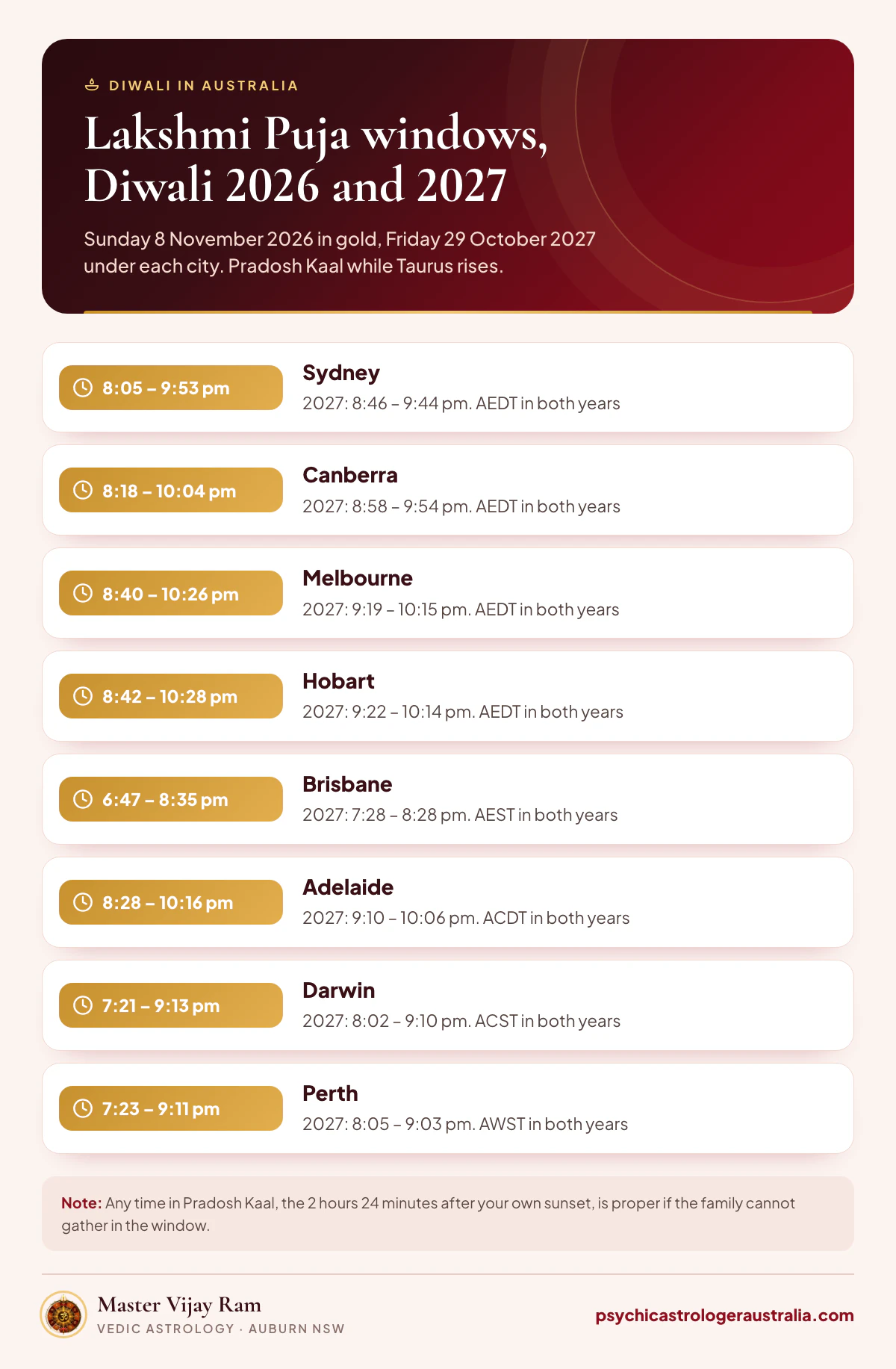
Diwali, the night of Lakshmi Puja, falls on Sunday 8 November 2026 and Friday 29 October 2027 in every Australian city, the same dates as India. The puja is performed in Pradosh Kaal, the two hours and twenty-four minutes after local sunset, ideally while Vrishabha (Taurus) is rising: in Sydney that is 8:05 to 9:53 pm in 2026 and 8:46 to 9:44 pm in 2027.
Diwali 2026 and 2027 at a glance
Diwali is the Hindu festival of lights whose central night, Lakshmi Puja, is held on the Amavasya that closes the month of Ashwin in the amanta calendar, called Kartika Amavasya in the north Indian reckoning. The new moon is a single instant for the whole planet, so for Diwali 2026 and 2027 in Australia the only question for a family is which local evening it falls in.
In both years the answer is the same in every Australian city and in India: Lakshmi Puja is on Sunday 8 November 2026 and on Friday 29 October 2027. What changes from city to city is the time, because the puja belongs to Pradosh Kaal, the two hours and twenty-four minutes after local sunset, and sunset in Brisbane is nearly two hours ahead of Perth's on the clock.
Both tables below give sunset, Pradosh Kaal, the Vrishabha (Taurus) rising window and the narrower overlap of all three for sixteen Australian cities, with New Delhi as a reference. The numbers were computed with the Swiss Ephemeris and checked against United States Naval Observatory sunrise and sunset data.
Why is the date the same in Australia and India?
In 2026 the Amavasya begins at 4:58 pm AEDT on Sunday 8 November and ends at 6:02 pm AEDT on Monday 9 November, which is 11:28 am on the Sunday to 12:32 pm on the Monday in India. Sunday evening in every Australian city falls inside it; Monday evening falls after it has ended. India's Sunday evening is inside it too, so 8 November is Diwali everywhere.
In 2027 the Amavasya runs from 2:19 am AEDT on Friday 29 October to 12:37 am AEDT on Saturday 30 October. That end point is 7:07 pm on Friday 29 October in India, so the Indian Pradosh window is cut short at 7:07 pm, while Australia's Friday evening, which happens several hours earlier in real time, is covered from sunset to the end of Pradosh. Again there is a single date, 29 October, for both countries.
The years when Australia and India split are the ones in which the Amavasya begins or ends in the gap between an Australian sunset and an Indian one. That gap is roughly four to six hours of real time, and when a tithi boundary lands inside it, Sydney and Delhi can light their lamps a day apart. Neither 2026 nor 2027 does that, which is why no Australian temple needs to argue about the date this time.
What is Pradosh Kaal?
Pradosh Kaal is the period of about two hours and twenty-four minutes, three muhurtas of 48 minutes each, that begins at local sunset. It is the time the tradition assigns to Lakshmi Puja because the goddess is invited at the threshold between day and night, when the household lamps are lit. Everything in the tables is measured from the sunset of your own city, which is why the window in Darwin begins at 6:46 pm in 2027 and in Hobart at 7:50 pm.
Sunset here means the moment the upper edge of the Sun disappears below a flat horizon, the astronomical definition. Hills and buildings to the west make the visible sunset a few minutes earlier; the tradition does not require that precision, and the windows are generous enough to absorb it.
Why is Vrishabha lagna preferred for Lakshmi Puja?
The lagna is the sign rising on the eastern horizon, and it changes roughly every two hours. Taurus, Vrishabha, is a sthira or fixed sign, and the reasoning passed down in the panchang tradition is simple: Lakshmi invited while a fixed sign rises is more likely to stay. Leo, Simha, also fixed, rises around midnight and is used by families who perform a second, late puja; Master Vijay Ram can calculate that window for your city on request, since it is not in the tables below.
In late October and early November Vrishabha rises in the evening across Australia, between about half an hour and an hour and a half after sunset depending on the city and the year. Where it overlaps Pradosh Kaal while the Amavasya is still running, the three conditions coincide and you have the window most panchangs print as the Lakshmi Puja muhurat. That is the last column of each table.
Lakshmi Puja times for Diwali 2026
| City | Date | Sunset | Pradosh Kaal | Vrishabha (Taurus) rising | Pradosh + Vrishabha + Amavasya |
|---|---|---|---|---|---|
| Sydney | Sun 8 Nov | 7:29 pm AEDT | 7:29 pm – 9:53 pm | 8:05 pm – 10:27 pm | 8:05 pm – 9:53 pm |
| Melbourne | Sun 8 Nov | 8:02 pm AEDT | 8:02 pm – 10:26 pm | 8:40 pm – 11:04 pm | 8:40 pm – 10:26 pm |
| Brisbane | Sun 8 Nov | 6:11 pm AEST | 6:11 pm – 8:35 pm | 6:47 pm – 9:05 pm | 6:47 pm – 8:35 pm |
| Perth | Sun 8 Nov | 6:47 pm AWST | 6:47 pm – 9:11 pm | 7:23 pm – 9:43 pm | 7:23 pm – 9:11 pm |
| Adelaide | Sun 8 Nov | 7:52 pm ACDT | 7:52 pm – 10:16 pm | 8:28 pm – 10:50 pm | 8:28 pm – 10:16 pm |
| Canberra | Sun 8 Nov | 7:40 pm AEDT | 7:40 pm – 10:04 pm | 8:18 pm – 10:40 pm | 8:18 pm – 10:04 pm |
| Hobart | Sun 8 Nov | 8:04 pm AEDT | 8:04 pm – 10:28 pm | 8:42 pm – 11:10 pm | 8:42 pm – 10:28 pm |
| Darwin | Sun 8 Nov | 6:49 pm ACST | 6:49 pm – 9:13 pm | 7:21 pm – 9:33 pm | 7:21 pm – 9:13 pm |
| Gold Coast | Sun 8 Nov | 6:11 pm AEST | 6:11 pm – 8:35 pm | 6:47 pm – 9:05 pm | 6:47 pm – 8:35 pm |
| Newcastle | Sun 8 Nov | 7:25 pm AEDT | 7:25 pm – 9:49 pm | 8:01 pm – 10:23 pm | 8:01 pm – 9:49 pm |
| Wollongong | Sun 8 Nov | 7:32 pm AEDT | 7:32 pm – 9:56 pm | 8:10 pm – 10:30 pm | 8:10 pm – 9:56 pm |
| Geelong | Sun 8 Nov | 8:05 pm AEDT | 8:05 pm – 10:29 pm | 8:43 pm – 11:07 pm | 8:43 pm – 10:29 pm |
| Sunshine Coast | Sun 8 Nov | 6:10 pm AEST | 6:10 pm – 8:34 pm | 6:46 pm – 9:04 pm | 6:46 pm – 8:34 pm |
| Cairns | Sun 8 Nov | 6:25 pm AEST | 6:25 pm – 8:49 pm | 6:59 pm – 9:13 pm | 6:59 pm – 8:49 pm |
| Townsville | Sun 8 Nov | 6:24 pm AEST | 6:24 pm – 8:48 pm | 6:58 pm – 9:12 pm | 6:58 pm – 8:48 pm |
| Central Coast | Sun 8 Nov | 7:28 pm AEDT | 7:28 pm – 9:52 pm | 8:04 pm – 10:26 pm | 8:04 pm – 9:52 pm |
| New Delhi (reference) | Sun 8 Nov | 5:31 pm IST | 5:31 pm – 7:55 pm | 5:55 pm – 7:51 pm | 5:55 pm – 7:51 pm |
Pradosh Kaal is taken as the 144 minutes after local sunset; Vrishabha is the sidereal Taurus ascendant. Many families simply begin the puja in Pradosh Kaal; the last column is the narrower window traditional panchangs prefer. Computed with the Swiss Ephemeris (Lahiri ayanamsa for Vedic positions) and checked against US Naval Observatory data. Times are rounded to the minute.
The 2026 windows are long, because Vrishabha begins rising only half an hour or so after sunset. Sydney has 8:05 to 9:53 pm AEDT, Melbourne 8:40 to 10:26 pm, Brisbane 6:47 to 8:35 pm AEST, Adelaide 8:28 to 10:16 pm ACDT, Perth 7:23 to 9:11 pm AWST and Darwin 7:21 to 9:13 pm ACST. A family that begins at any point in the first hour of its window will finish well inside it.
Lakshmi Puja times for Diwali 2027
| City | Date | Sunset | Pradosh Kaal | Vrishabha (Taurus) rising | Pradosh + Vrishabha + Amavasya |
|---|---|---|---|---|---|
| Sydney | Fri 29 Oct | 7:20 pm AEDT | 7:20 pm – 9:44 pm | 8:46 pm – 11:08 pm | 8:46 pm – 9:44 pm |
| Melbourne | Fri 29 Oct | 7:51 pm AEDT | 7:51 pm – 10:15 pm | 9:19 pm – 11:43 pm | 9:19 pm – 10:15 pm |
| Brisbane | Fri 29 Oct | 6:04 pm AEST | 6:04 pm – 8:28 pm | 7:28 pm – 9:46 pm | 7:28 pm – 8:28 pm |
| Perth | Fri 29 Oct | 6:39 pm AWST | 6:39 pm – 9:03 pm | 8:05 pm – 10:25 pm | 8:05 pm – 9:03 pm |
| Adelaide | Fri 29 Oct | 7:42 pm ACDT | 7:42 pm – 10:06 pm | 9:10 pm – 11:32 pm | 9:10 pm – 10:06 pm |
| Canberra | Fri 29 Oct | 7:30 pm AEDT | 7:30 pm – 9:54 pm | 8:58 pm – 11:20 pm | 8:58 pm – 9:54 pm |
| Hobart | Fri 29 Oct | 7:50 pm AEDT | 7:50 pm – 10:14 pm | 9:22 pm – 11:50 pm | 9:22 pm – 10:14 pm |
| Darwin | Fri 29 Oct | 6:46 pm ACST | 6:46 pm – 9:10 pm | 8:02 pm – 10:14 pm | 8:02 pm – 9:10 pm |
| Gold Coast | Fri 29 Oct | 6:03 pm AEST | 6:03 pm – 8:27 pm | 7:27 pm – 9:45 pm | 7:27 pm – 8:27 pm |
| Newcastle | Fri 29 Oct | 7:16 pm AEDT | 7:16 pm – 9:40 pm | 8:42 pm – 11:02 pm | 8:42 pm – 9:40 pm |
| Wollongong | Fri 29 Oct | 7:22 pm AEDT | 7:22 pm – 9:46 pm | 8:50 pm – 11:10 pm | 8:50 pm – 9:46 pm |
| Geelong | Fri 29 Oct | 7:54 pm AEDT | 7:54 pm – 10:18 pm | 9:24 pm – 11:48 pm | 9:24 pm – 10:18 pm |
| Sunshine Coast | Fri 29 Oct | 6:03 pm AEST | 6:03 pm – 8:27 pm | 7:25 pm – 9:43 pm | 7:25 pm – 8:27 pm |
| Cairns | Fri 29 Oct | 6:21 pm AEST | 6:21 pm – 8:45 pm | 7:39 pm – 9:53 pm | 7:39 pm – 8:45 pm |
| Townsville | Fri 29 Oct | 6:19 pm AEST | 6:19 pm – 8:43 pm | 7:39 pm – 9:53 pm | 7:39 pm – 8:43 pm |
| Central Coast | Fri 29 Oct | 7:19 pm AEDT | 7:19 pm – 9:43 pm | 8:45 pm – 11:07 pm | 8:45 pm – 9:43 pm |
| New Delhi (reference) | Fri 29 Oct | 5:39 pm IST | 5:39 pm – 8:03 pm | 6:37 pm – 8:33 pm | 6:37 pm – 7:07 pm |
Pradosh Kaal is taken as the 144 minutes after local sunset; Vrishabha is the sidereal Taurus ascendant. Many families simply begin the puja in Pradosh Kaal; the last column is the narrower window traditional panchangs prefer. Computed with the Swiss Ephemeris (Lahiri ayanamsa for Vedic positions) and checked against US Naval Observatory data. Times are rounded to the minute.
The 2027 windows are about an hour shorter. Diwali comes ten days earlier in the solar year, so Taurus rises later relative to sunset and its overlap with Pradosh Kaal shrinks to roughly an hour: Sydney 8:46 to 9:44 pm AEDT, Melbourne 9:19 to 10:15 pm, Brisbane 7:28 to 8:28 pm AEST, Adelaide 9:10 to 10:06 pm ACDT, Perth 8:05 to 9:03 pm AWST and Darwin 8:02 to 9:10 pm ACST. Where the household cannot gather that late, the whole of Pradosh Kaal remains proper, from sunset onward.
Why do the windows differ so much between cities?
Three things move them. Longitude sets the clock time of sunset, so Brisbane, at the eastern edge of its zone and without daylight saving, sees the Sun go down before 6:05 pm in 2027, while Melbourne, far to the south-west of its zone and on summer time, waits until nearly 8 pm. Latitude stretches the spring evenings in Hobart and compresses them in Darwin. And the ascendant depends on both, which is why the Vrishabha window is not simply sunset plus a constant.
The practical rule is to use your own city's row and nothing else. A Gold Coast family following a Sydney time would start an hour and a quarter late in 2027 and miss the Vrishabha window entirely.
What if you miss the window?
Pradosh Kaal is the priority and the Vrishabha overlap is the refinement. If work, travel or a late train means the household gathers at 10 pm, the tradition still counts a puja performed on the Amavasya night with devotion. What it does not endorse is moving the puja to the next evening, because in both of these years the Amavasya has ended by then and the following evening belongs to the next tithi.
Vijay Ram ji's advice to clients who ring in a panic at 9:30 pm is always the same: light the lamp, call the goddess with whatever words you have, and do the full puja in the morning if you must. Intention outranks the clock, and nobody is excluded from Diwali by a timetable.
Mercury turns direct on Diwali morning in 2027
Business families open new account books at Lakshmi Puja, the custom called Chopda Pujan in Gujarati homes, and many wait to register a company or sign for a shop until the festival. In 2027 the timing is kind. Mercury, the planet of trade and accounts, has been retrograde since 8 October and stations direct at 1:11 am AEDT on Friday 29 October, the very morning of Diwali, so the evening puja falls with Mercury already moving forward.
The post-retrograde shadow lasts until 13 November, which is worth a second look at any contract signed in the fortnight after the festival. The full 2027 Mercury retrograde calendar sets out the dates for every Australian time zone, and business and career guidance is where he reads a venture's timing against the owner's own chart.
A simple Lakshmi Puja at home in Australia
The order below is the one most families follow, and it fits inside an hour.
- Clean the house in the days before, finish with the entrance, and set the altar in the north-east or east of the main room.
- Bathe, wear clean clothes and light a ghee or oil lamp before sunset so the house is already lit as Pradosh begins.
- Place Lakshmi and Ganesha together, Ganesha to the left of Lakshmi, on a red or yellow cloth with a kalash of water, rice, a coin and a few mango or betel leaves.
- Offer water, flowers, kumkum, rice, sweets and fruit; recite the Lakshmi Ashtottara or any Lakshmi mantra you know, with the family seated.
- Perform the aarti, then light the rest of the house, the doorway first, and keep at least one lamp burning through the night.
- Open the account book or the family ledger if that is your custom, and share the prasad.
Nothing here needs a priest, and nothing is spoiled by a child who forgets a step. A clean house, a lit doorway and a family present are the essentials.
Preparing the home before the lamps
Diwali cleaning is older than any modern decluttering fashion, and it has a spiritual logic: Lakshmi is said to enter a house that is clean, lit and at peace. For a home that has felt heavy through the year, the week before Diwali is the traditional time for a house and aura cleansing, and families who are building or renovating often ask for a Vastu consultation so that the new altar sits where it should.
None of this requires anything to be bought. Salt water on the floors, a window opened at dawn and a lamp at the doorway each evening of the festival week do most of the work.
Diwali across Australia's time zones
Because the Amavasya is a single instant, Australia celebrates Diwali before India in real time even though the date is the same. In 2027 Sydney's Lakshmi Puja window of 8:46 to 9:44 pm AEDT closes at 10:44 am Universal Time, while Delhi's Pradosh Kaal does not begin until 5:39 pm IST, which is 12:09 pm Universal Time, or 11:09 pm in Sydney. By the time the lamps are lit in Delhi, most Sydney families have finished and are telephoning relatives who are just sitting down.
Perth, two to three hours behind the east coast, is the last Australian city to begin, and its 2027 window of 8:05 to 9:03 pm AWST opens within four minutes of Delhi's Pradosh in real time. For families with parents in India, that order matters: in the east the Australian puja comes first and the call home comes after; in Perth the two happen together.
Do the planets decide whether Diwali brings prosperity?
Lakshmi Puja is an act of devotion, and it does not need astrology to be valid. What a chart adds is context. A person in a strong Jupiter or Venus dasha will often find the year after Diwali opens doors on its own; a person in a hard Saturn period will need patience and the right remedies, and no single evening of worship changes that. In 40+ years Master Vijay Ram has never told a family that a puja performed at the wrong minute was wasted, and he has never told one that a puja performed at the right minute would pay their mortgage.
That is the honest limit of a muhurat table. It tells you the best hour; it does not tell you what your year holds. A consultation in Hindi or Punjabi is available for families who prefer it, and the Diwali week is one of his busiest, so the earlier you ask, the better the choice of time.
Diwali in Sydney, Melbourne and the regions
The great public celebrations are in the capitals: the Parramatta and Harris Park festivities in Sydney, Federation Square's festival in Melbourne. But the home puja is the same in a Maroochydore unit as in a Blacktown house, and for families outside the big temple circuits the tables above are often the only local timetable there is. The Sunshine Coast page and the other regional pages explain how a consultation works by phone or video from anywhere in the country.
Wherever you are, the sequence is the same: clean the house, use your own city's row, light the lamp before sunset, and let the rest of the evening follow.
Read next
- Karva Chauth 2027: Moonrise Times for Every Australian CityKarva Chauth 2027 moonrise times for Sydney, Melbourne, Brisbane, Perth and Adelaide, why panchangs split over 18 or …
- Vasant Panchami 2027 in Australia: Saraswati Puja Date by CityVasant Panchami 2027 in Australia: Friday 12 February in the east, Thursday 11 February in Perth and India, with a ci…
- Diwali 2026 House & Aura Cleansing: Clear the Year's Heavy EnergyDiwali 2026 house and aura cleansing done honestly: clean first, use the Five-Lamp Check, and learn when heaviness is…
Frequently asked questions
When is Diwali in 2026 in Australia?
Lakshmi Puja is on Sunday 8 November 2026 in every Australian city. The Amavasya begins at 4:58 pm AEDT that Sunday and ends at 6:02 pm AEDT on the Monday, so Sunday evening is inside it everywhere from Brisbane to Perth and Monday evening is not. India keeps the same date, because the Amavasya there runs from the Sunday morning to the Monday midday.
When is Diwali in 2027 in Australia?
Friday 29 October 2027 in every Australian city. The Amavasya runs from 2:19 am AEDT on the Friday to 12:37 am AEDT on the Saturday, which covers the whole of Friday evening in each city. In India it runs from 8:49 pm on Thursday 28 October to 7:07 pm on the Friday, so the Indian puja is also on Friday 29 October, with a shorter window that ends at 7:07 pm IST.
What time is Lakshmi Puja in Sydney?
In 2026 sunset is 7:29 pm AEDT, Pradosh Kaal runs 7:29 to 9:53 pm and the overlap with Vrishabha lagna, the preferred window, is 8:05 to 9:53 pm. In 2027 sunset is 7:20 pm AEDT, Pradosh Kaal runs 7:20 to 9:44 pm and the Vrishabha overlap is 8:46 to 9:44 pm. Newcastle, Wollongong and the Central Coast are within a few minutes of these times.
What time is Lakshmi Puja in Melbourne?
In 2026 sunset is 8:02 pm AEDT, Pradosh Kaal runs 8:02 to 10:26 pm and the Vrishabha overlap is 8:40 to 10:26 pm. In 2027 sunset is 7:51 pm AEDT, Pradosh runs 7:51 to 10:15 pm and the overlap is 9:19 to 10:15 pm. Geelong is three minutes later than Melbourne in both years, and Hobart's windows begin a few minutes later again.
What time is Lakshmi Puja in Brisbane and on the Gold Coast?
Queensland does not have daylight saving, so its times read early. In 2026 Brisbane sunset is 6:11 pm AEST, Pradosh Kaal runs 6:11 to 8:35 pm and the Vrishabha overlap is 6:47 to 8:35 pm; the Gold Coast is a minute earlier. In 2027 sunset is 6:04 pm, Pradosh runs 6:04 to 8:28 pm and the overlap is 7:28 to 8:28 pm, with the Gold Coast at 7:27 to 8:27 pm.
What time is Lakshmi Puja in Perth?
In 2026 Perth sunset is 6:47 pm AWST, Pradosh Kaal runs 6:47 to 9:11 pm and the Vrishabha overlap is 7:23 to 9:11 pm. In 2027 sunset is 6:39 pm, Pradosh runs 6:39 to 9:03 pm and the overlap is 8:05 to 9:03 pm AWST. Perth is the last Australian city to light its lamps in real time and, in 2027, begins within minutes of Delhi.
What time is Lakshmi Puja in Adelaide and Darwin?
Adelaide in 2026: sunset 7:52 pm ACDT, Pradosh 7:52 to 10:16 pm, Vrishabha overlap 8:28 to 10:16 pm; in 2027: sunset 7:42 pm, Pradosh 7:42 to 10:06 pm, overlap 9:10 to 10:06 pm. Darwin in 2026: sunset 6:49 pm ACST, Pradosh 6:49 to 9:13 pm, overlap 7:21 to 9:13 pm; in 2027: sunset 6:46 pm, Pradosh 6:46 to 9:10 pm, overlap 8:02 to 9:10 pm.
What is Pradosh Kaal and how long does it last?
Pradosh Kaal is the period beginning at local sunset and lasting three muhurtas, about two hours and twenty-four minutes. The tradition places Lakshmi Puja in it because the goddess is welcomed at the turn from day to night, as the lamps are lit. It is always measured from the sunset of your own city, never from a printed Indian time, which is why the tables on this page list sunset first.
Why is Vrishabha lagna recommended for Lakshmi Puja?
Taurus, Vrishabha, is a fixed sign, and the panchang tradition holds that Lakshmi invited while a fixed sign is rising is more inclined to stay in the house. In late October and November it rises in the evening across Australia, overlapping Pradosh Kaal. Leo, also fixed, rises around midnight and serves families who hold a second, late puja; that window can be calculated for any city on request.
Can I do Lakshmi Puja the next day if I miss the window?
Not as Diwali. In both 2026 and 2027 the Amavasya has ended before the following evening, so the next night belongs to a different tithi. If the family cannot gather until late, a puja performed later on the Amavasya night, or a lamp lit and the full puja done at dawn, is the traditional fallback. Devotion counts for more than the minute, and nobody is shut out of the festival by a timetable.
Is Diwali 2027 affected by Mercury retrograde?
Only lightly, and in a helpful direction. Mercury is retrograde from 8 October and turns direct at 1:11 am AEDT on Friday 29 October 2027, Diwali morning, so the evening's account-book opening and any new ventures begun at the puja fall after the station. The post-retrograde shadow runs until 13 November, so contracts signed in the fortnight after the festival deserve a careful second reading.
People also ask
Is Diwali on the same day in Australia and India?
In 2026 and 2027, yes: Sunday 8 November 2026 and Friday 29 October 2027 in both countries. The two can differ in a year when the Amavasya begins or ends in the few hours between an Australian sunset and an Indian one, so Sydney and Delhi occasionally keep the festival a day apart. In these two years the tithi boundaries fall clear of that gap.
What is the Lakshmi Puja muhurat?
It is the overlap of three conditions: the Amavasya tithi still running, Pradosh Kaal (the two hours twenty-four minutes after sunset) and a fixed sign, usually Vrishabha, rising in the east. Where all three coincide you have the window most panchangs print. Where they do not, Pradosh Kaal on the Amavasya evening is sufficient, and the overlap is a refinement rather than a requirement.
Why does the date of Diwali change every year?
Because it is fixed by the Moon, not the Sun. A lunar month is about 29 and a half days, so twelve of them fall eleven days short of the solar year and Diwali drifts earlier each year until a leap month, an adhik maas, pushes it back. That is why it falls on 8 November in 2026 and 29 October in 2027, and always somewhere between mid-October and mid-November.
What should be done after the Lakshmi Puja on Diwali night?
Light the rest of the house, the doorway first, and keep at least one lamp burning until morning. Many families stay up late, share sweets with neighbours and avoid sweeping the floors until daylight, so that Lakshmi is not symbolically swept out. The account book opened at the puja is left on the altar overnight in business households. Nothing elaborate is required.
Which direction should the Lakshmi altar face?
The usual Vastu advice is to set the altar in the north-east of the home and seat the family facing east or north. Where a flat or rented house makes that impossible, any clean, quiet spot works. The direction matters far less than the cleanliness of the room, the lamp at the doorway and the presence of the whole family, which are the three things the tradition actually insists on.
References & further reading
Serving clients across Australia
Confidential consultations by phone, video & WhatsApp — including: