
Quick answer
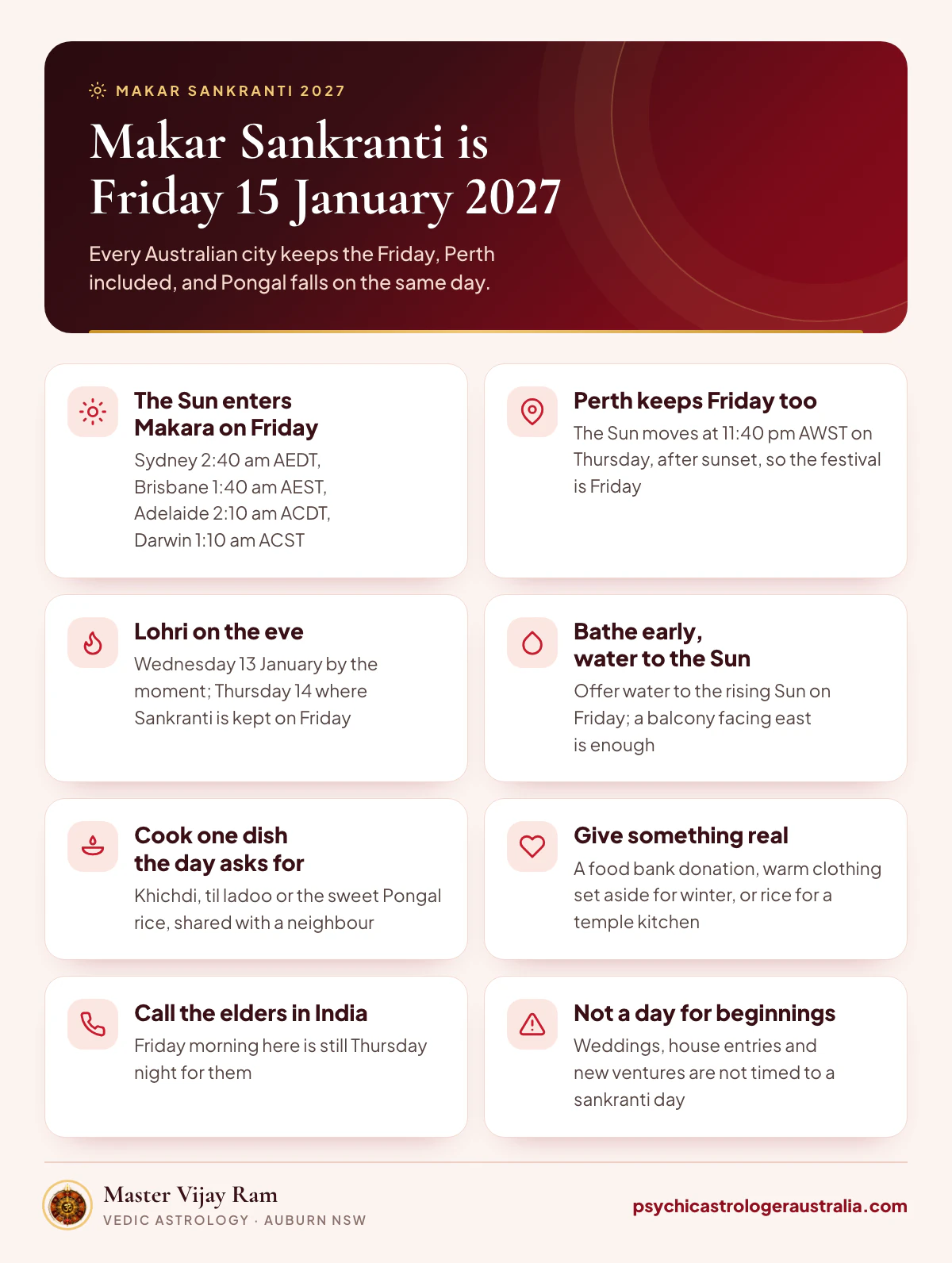
In Australia Makar Sankranti 2027 falls on Friday 15 January: the Sun enters sidereal Capricorn (Makara) at 2:40 am AEDT, which is 11:40 pm on Thursday 14 January in Perth and 9:10 pm IST in India. Because the Indian moment is after sunset, most panchangs there also keep the festival on Friday 15 January. Lohri is the evening before, Pongal the same day.
Makar Sankranti and Lohri 2027 at a glance
Makar Sankranti is the day the Sun enters sidereal Capricorn (Makara), and it is one of the few Hindu festivals set by the Sun rather than the Moon. That is why it sits in the same week every year while Diwali and Holi wander across the calendar. In 2027 the Makar Sankranti date for Australia is Friday 15 January, with Lohri kept the evening before and Pongal on the same day.
The moment itself is 15:40 Universal Time on Thursday 14 January. Everything that follows comes from reading that one instant on different clocks: the early hours of Friday in the east, late Thursday night in Perth, and 9:10 pm in India.
When is Makar Sankranti 2027 in Australia?
The Sun crosses from Dhanu into Makara at 2:40 am AEDT on Friday 15 January 2027 in Sydney, Melbourne, Canberra and Hobart. In Brisbane that is 1:40 am AEST, in Adelaide 2:10 am ACDT, in Darwin 1:10 am ACST, and in Perth 11:40 pm AWST on Thursday 14 January. The table below sets the moment beside the day each city keeps.
| City | Sun enters Makara | Festival day |
|---|---|---|
| Sydney, Melbourne, Canberra, Hobart | Fri 15 Jan, 2:40 am AEDT | Friday 15 January |
| Brisbane, Gold Coast, Cairns, Townsville | Fri 15 Jan, 1:40 am AEST | Friday 15 January |
| Adelaide | Fri 15 Jan, 2:10 am ACDT | Friday 15 January |
| Darwin | Fri 15 Jan, 1:10 am ACST | Friday 15 January |
| Perth | Thu 14 Jan, 11:40 pm AWST | Friday 15 January (the moment is after sunset) |
| India (reference) | Thu 14 Jan, 9:10 pm IST | Friday 15 January in most panchangs; 14 January by the moment |
Because the crossing happens in the small hours, every Australian city wakes up on Friday with the Sun already in Makara. There is no split-date problem of the kind Diwali or Karva Chauth can produce, and the whole of Friday is the day for bathing, giving and the til-gud.
Why do Indian panchangs say 15 January when the Sun moves on the 14th?
Indian panchangs follow a rule about sunset. When a sankranti happens after sunset, the punya kaal, the window for the holy bath and for giving, is taken on the following morning, so the festival is kept the next day. In 2027 the Sun enters Makara at 9:10 pm IST on Thursday 14 January, well after dark, which is why most Indian calendars list Makar Sankranti on Friday 15 January.
You will still see 14 January on some sites, because that is the date of the moment itself. Both are describing the same event. For families in Australia the question answers itself, since the moment and the morning both fall on Friday.
Why is the date not the same every year?
The sidereal year, the time the Sun takes to return to the same star, is about twenty minutes longer than the calendar year. Over a lifetime that adds up to roughly a day every seventy years, which is why your grandparents kept Makar Sankranti on 13 January and your grandchildren will keep it on 15 and then 16 January. In 2028 the Sun enters Makara on Saturday 15 January at 8:54 am AEDT.
The dates on this page use the Lahiri ayanamsa, the standard in Indian government almanacs, which stood at 24°14′ on 1 January 2027. A different ayanamsa moves every sankranti by a few hours, and occasionally across midnight. The Vedic and Western sign dates for 2027 set out all twelve crossings and why they differ from the star signs in a newspaper.
What is Lohri, and when is it in 2027?
Lohri is the Punjabi bonfire festival kept on the last night of the month of Poh, the eve of the Sun's entry into Makara. Families gather around the fire after dark, throw in sesame, jaggery, popcorn and peanuts, sing the Dulla Bhatti songs and walk around the flames. A first Lohri after a wedding or a birth is a big one, with the new couple or the baby at the centre of it.
The Lohri 2027 date depends on which rule your panchang follows. Calendars that go by the moment the Sun moves, late on Thursday 14 January in India, place Lohri on the evening of Wednesday 13 January; calendars that keep Sankranti on Friday place Lohri on Thursday 14 January. Australian gurdwaras and Punjabi associations announce their own evening, often the nearest Saturday for the big community bonfires in western Sydney and Melbourne's west, and the family fire at home is kept whenever the family can be together.
Pongal, Uttarayan, Maghi and Magh Bihu: one Sun, many festivals
The same crossing is kept under different names across India, and Australia's Indian communities have brought all of them. Thai Pongal, the Tamil harvest festival, falls on the first day of the month of Thai, which in 2027 is Friday 15 January in India and in Australia alike, with the pot boiled over at sunrise and the cry of "Pongalo Pongal" as the milk rises. Pongal 2027 is therefore the same Friday as Makar Sankranti here.
- Uttarayan in Gujarat is the kite day; expect strings over the parks of Harris Park and Point Cook on the weekend nearest the 15th.
- Maghi is the Sikh observance of the same day, remembered for the forty martyrs of Muktsar, with kirtan at the gurdwara and kheer at home.
- Magh Bihu in Assam and Makara Vilakku at Sabarimala are kept by smaller communities with the same Sun behind them.
- Khichdi in Bihar and eastern Uttar Pradesh names the dish and the day together, and many Sydney households cook it on Friday night.
Is Makar Sankranti really the start of Uttarayan?
In the old astronomy, Uttarayan was the Sun's northward turn, the day after the shortest day, and in the first centuries of the common era the Sun's entry into sidereal Capricorn did fall close to the December solstice. The slow slippage of the equinoxes has since pulled the two apart by about 24 days, which is the same gap that separates the Vedic and Western zodiacs. In 2027 the solstice is on 22 December and the Makara entry is on 15 January.
Most families keep the festival on the sidereal date and are untroubled by the astronomy, and that is reasonable; a festival is a shared custom before it is a measurement. Vijay Ram ji simply says so when asked, rather than pretending the two dates still coincide.
How do you keep the punya kaal in Australia?
The punya kaal is the stretch after the sankranti during which bathing, prayer and giving are held to carry special merit. With the crossing in the small hours of Friday, the whole of Friday's daylight serves, and the traditional pattern is simple: a bath before sunrise or soon after, a prayer to Surya facing east, then til and gud, khichdi, and something given to someone who needs it. In Sydney the Sun rises close to 6 am and sets close to 8 pm in mid-January, so there is no shortage of daylight.
In Perth the moment falls at 11:40 pm on Thursday. The after-sunset rule gives the punya kaal to Friday morning, so Perth keeps the same Friday as the rest of the country, and families who like to be exact can read the local sunrise from the Geoscience Australia sunrise calculator linked below.
Every sankranti of 2027, for the calendar on the fridge
Makar Sankranti is the famous one, but the Sun changes sign twelve times a year and several of the others carry their own observances: Mesha Sankranti in April is the solar new year for Tamil, Malayali, Bengali and Punjabi families, and Karka Sankranti in July begins Dakshinayan. The table gives the moment in Sydney and Perth time and the date in India.
| Sign | Dates (Sydney) | Sun enters (Sydney) | Sun enters (Perth) | Sankranti in India |
|---|---|---|---|---|
| Sagittarius (Dhanu) | 16 Dec 2026 – 14 Jan 2027 | Wed 16 Dec, 3:55 pm AEDT | Wed 16 Dec, 12:55 pm AWST | Wed 16 Dec, 10:25 am IST |
| Capricorn (Makara) | 15 Jan 2027 – 12 Feb 2027 | Fri 15 Jan, 2:40 am AEDT | Thu 14 Jan, 11:40 pm AWST | Thu 14 Jan, 9:10 pm IST |
| Aquarius (Kumbha) | 13 Feb 2027 – 14 Mar 2027 | Sat 13 Feb, 3:39 pm AEDT | Sat 13 Feb, 12:39 pm AWST | Sat 13 Feb, 10:09 am IST |
| Pisces (Meena) | 15 Mar 2027 – 13 Apr 2027 | Mon 15 Mar, 12:30 pm AEDT | Mon 15 Mar, 9:30 am AWST | Mon 15 Mar, 7:00 am IST |
| Aries (Mesha) | 14 Apr 2027 – 14 May 2027 | Wed 14 Apr, 7:58 pm AEST | Wed 14 Apr, 5:58 pm AWST | Wed 14 Apr, 3:28 pm IST |
| Taurus (Vrishabha) | 15 May 2027 – 14 Jun 2027 | Sat 15 May, 4:50 pm AEST | Sat 15 May, 2:50 pm AWST | Sat 15 May, 12:20 pm IST |
| Gemini (Mithuna) | 15 Jun 2027 – 16 Jul 2027 | Tue 15 Jun, 11:26 pm AEST | Tue 15 Jun, 9:26 pm AWST | Tue 15 Jun, 6:56 pm IST |
| Cancer (Karka) | 17 Jul 2027 – 16 Aug 2027 | Sat 17 Jul, 10:19 am AEST | Sat 17 Jul, 8:19 am AWST | Sat 17 Jul, 5:49 am IST |
| Leo (Simha) | 17 Aug 2027 – 16 Sep 2027 | Tue 17 Aug, 6:44 pm AEST | Tue 17 Aug, 4:44 pm AWST | Tue 17 Aug, 2:14 pm IST |
| Virgo (Kanya) | 17 Sep 2027 – 17 Oct 2027 | Fri 17 Sep, 6:41 pm AEST | Fri 17 Sep, 4:41 pm AWST | Fri 17 Sep, 2:11 pm IST |
| Libra (Tula) | 18 Oct 2027 – 16 Nov 2027 | Mon 18 Oct, 7:39 am AEDT | Mon 18 Oct, 4:39 am AWST | Mon 18 Oct, 2:09 am IST |
| Scorpio (Vrishchika) | 17 Nov 2027 – 15 Dec 2027 | Wed 17 Nov, 7:29 am AEDT | Wed 17 Nov, 4:29 am AWST | Wed 17 Nov, 1:59 am IST |
| Sagittarius (Dhanu) | 16 Dec 2027 – 14 Jan 2028 | Thu 16 Dec, 10:09 pm AEDT | Thu 16 Dec, 7:09 pm AWST | Thu 16 Dec, 4:39 pm IST |
Computed with the Swiss Ephemeris (Lahiri ayanamsa for Vedic positions) and checked against US Naval Observatory data. Times are rounded to the minute.
Notice that only one of the twelve crossings, Makara itself, falls on different calendar days in Perth and Sydney, and that the Indian date can differ again. Whenever a family in Australia and a family in Ludhiana are comparing notes, that is usually the whole explanation.
What does Makar Sankranti mean in a Vedic reading?
Makara is Saturn's sign, and the Sun's entry into it is the meeting of father and son in the old stories, the two planets that do not get on. Jyotish treats a sankranti day itself as unsuitable for beginnings: weddings, house entries and new ventures are not timed to it, though giving and bathing are especially favoured. The month that follows, with the Sun in Makara until 12 February, closes the Kharmas pause that began when the Sun entered Dhanu on 16 December 2026, and that is why the wedding season in India resumes after Sankranti.
Vijay Ram ji reads the Sun's position for the month ahead the way he reads any transit: from the house it occupies counted from your Moon sign, weighed against the dasha you are running. For someone with a Makara Moon the Sun is now in the first house, a month for the body and for being seen; for a Karka Moon it is the seventh, a month that turns on partners. A muhurat consultation is where those placements become a usable date rather than a general remark.
Simple ways to keep the day far from Punjab or Tamil Nadu
- Bathe early on Friday and offer water to the rising Sun; a balcony facing east is enough.
- Cook one dish the day asks for: khichdi, til ladoo, or the sweet Pongal rice, and share it with a neighbour.
- Give something real: a donation to a food bank, warm clothing set aside for winter, or a bag of rice to a temple kitchen.
- Call the elders in India on Friday morning your time, which is still Thursday night for them; they will be lighting the Lohri fire or finishing the sankranti puja.
- Fly a kite if the weather allows; the summer sea breeze on Melbourne's bay beaches and the Adelaide coast does the work.
- If the family has a first Lohri this year, keep it on the night you can all be together rather than fretting over the 13th or the 14th.
None of this needs a priest, and none of it needs an astrologer. Where a family wants a Surya puja performed on the day, a puja performed personally in Auburn can be arranged, from $250 and agreed beforehand, with the family joining by video; the consultation that comes first is $50.
How does Master Vijay Ram use the Sun's sankrantis?
Master Vijay Ram has read charts for more than forty years, and the Sun's crossings are his calendar for two things. The first is the Varshphal, the solar-return chart cast for the moment the Sun returns to its natal degree each year, which is the engine of the yearly forecast he prepares for clients. The second is the monthly rhythm of the Sun through the houses, a modest influence beside Saturn and Jupiter but a reliable one for timing letters, applications and conversations with authority.
He consults by phone, video and WhatsApp in English, Hindi and Punjabi, which matters at Lohri and Maghi when half the questions arrive in Punjabi; consultations in Hindi and Punjabi are explained separately. Clients ring from Melbourne and Adelaide as readily as from Sydney, and the only place he practises in person is Auburn, by appointment.
What the date cannot tell you
A sankranti date is a fact of astronomy, and the customs around it are a matter of faith and family rather than medicine, law or money. The Sun's move into Makara will not settle a visa, cure an illness or decide a court case, and nobody should delay a doctor, a lawyer or an accountant for a festival. What the day offers is simpler: a shared morning, a reason to give, and a fixed point in the year that the whole diaspora keeps at once.
For the rest of the year's observances in Australian time, the full 2027 festival calendar lists every date by city, and the Diwali timings show how a Moon-based festival can split across the country in a way this Sun-based one does not.
Read next
- Dussehra 2027 in Australia: Date and Vijay MuhuratDussehra 2027 is Saturday 9 October in Australia and India. Vijay muhurat times for Sydney, Melbourne, Brisbane, Adel…
- Holi 2027 in Australia: Date and Holika Dahan TimingHolika Dahan is Monday 22 March 2027 in every Australian city and Rangwali Holi is Tuesday 23 March; India is a day e…
- 11 Signs of Negative Energy in Your Life (and How to Clear It)Eleven signs of negative energy, the ordinary causes to rule out first, and the three-doors test that tells you wheth…
Frequently asked questions
What date is Makar Sankranti in 2027 in Australia?
Friday 15 January 2027 in every Australian city. The Sun enters sidereal Capricorn at 2:40 am AEDT in Sydney, Melbourne, Canberra and Hobart, 1:40 am in Brisbane, 2:10 am in Adelaide, 1:10 am in Darwin, and 11:40 pm on Thursday 14 January in Perth. Since the crossing is in the small hours, the whole of Friday is the festival day everywhere, including Perth under the after-sunset rule.
Is Makar Sankranti 2027 on 14 or 15 January in India?
The Sun moves into Makara at 9:10 pm IST on Thursday 14 January 2027. Because that is after sunset, the punya kaal for bathing and giving falls the next morning, so most Indian panchangs list the festival on Friday 15 January. Sites that quote 14 January are giving the date of the moment itself. Both describe the same event, and Australia keeps Friday either way.
When is Lohri in 2027?
Lohri is kept on the evening before the Sun enters Makara. In 2027 that gives Wednesday 13 January for panchangs that go by the moment, late on Thursday in India, and Thursday 14 January for those that keep Sankranti on Friday. Punjabi families and gurdwaras in Australia announce their own evening, and the large community bonfires are often held on the nearest Saturday night.
When is Pongal 2027?
Thai Pongal falls on the first day of the Tamil month of Thai, which begins with the Sun's entry into Makara. Under the Tamil rule a crossing after sunset starts the new month the next day, so Thai 1 is Friday 15 January 2027 in India, and it is the same Friday in Australia, where the crossing itself falls in the early hours. Bhogi is the day before and Mattu Pongal the day after.
Why is Makar Sankranti sometimes 14 January and sometimes 15?
The sidereal year is about twenty minutes longer than the calendar year, so the Sun's entry into Makara drifts later by roughly one day every seventy years. In the mid-twentieth century it was usually 13 or 14 January; by the 2020s it falls on 14 or 15 January depending on the hour of the crossing and your time zone. In 2028 the Sun enters Makara on Saturday 15 January at 8:54 am AEDT.
Is Makar Sankranti the same as the winter solstice or Uttarayan?
Not any more. Uttarayan originally meant the Sun's northward turn at the December solstice, and some two thousand years ago the entry into sidereal Capricorn fell near that day. The precession of the equinoxes has since separated them by about 24 days, the same gap that separates Vedic and Western zodiac dates. In 2027 the solstice is 22 December and Makar Sankranti is 15 January; most families keep the sidereal date.
What should you do on Makar Sankranti?
The traditional pattern is a bath early in the day, a prayer to the Sun facing east, sesame and jaggery sweets, khichdi or Pongal rice, and something given away: food, clothing or a donation. Kites are flown in Gujarat and in Australian parks on the nearest weekend. A sankranti day is held to favour giving and bathing rather than beginnings, so weddings, house entries and launches are not timed to it.
Can Makar Sankranti be celebrated on the weekend instead?
The bath, prayer and giving belong to the punya kaal on the day itself, and in 2027 that is a Friday, so many families keep the morning at home and gather on Saturday or Sunday for the community kites, the Lohri bonfire or the Pongal pot. Nothing in the tradition forbids the gathering moving to a convenient day; it is the giving on the day that carries the special merit.
Does Makar Sankranti affect my horoscope?
The Sun's move into Makara starts a month in which the Sun occupies a particular house counted from your Moon sign, a modest influence compared with Saturn and Jupiter. For a Makara Moon it is the first house, for a Karka Moon the seventh, and so on around the wheel. A reading weighs that against your running dasha; on its own the date tells you when the month begins, not how it will go for you.
People also ask
What time is Makar Sankranti 2027?
The Sun enters sidereal Makara at 15:40 Universal Time on Thursday 14 January 2027. That is 2:40 am AEDT on Friday 15 January in Sydney, 1:40 am AEST in Brisbane, 2:10 am ACDT in Adelaide, 1:10 am ACST in Darwin, 11:40 pm AWST on Thursday in Perth, and 9:10 pm IST on Thursday in India.
Why is Lohri celebrated the night before Makar Sankranti?
Lohri marks the last night of the month of Poh in the Punjabi calendar, the end of the coldest stretch of winter, with the Sun entering Makara and the days lengthening from the next morning. The bonfire, the sesame and jaggery thrown into it, and the songs of Dulla Bhatti all belong to that turning of the season, which is why it is kept on the eve rather than the day.
Is Makar Sankranti a good day for a wedding or a new business?
No. A sankranti day is traditionally set aside for bathing and charity and is avoided for weddings, griha pravesh and launches. The month that follows is a different matter: with the Sun in Makara the Kharmas pause ends and the wedding season resumes, so dates in the weeks after 15 January 2027 are chosen in the usual way from the tithi, nakshatra and lagna.
Which ayanamsa are these dates based on?
The Lahiri ayanamsa, used by Indian government almanacs and most panchangs, which measured 24°14′ on 1 January 2027. A different ayanamsa shifts each sankranti by a few hours and occasionally across a midnight. The underlying astronomy is the same for everyone; only the chosen starting point of the sidereal zodiac differs.
Do Perth and Sydney keep Makar Sankranti on different days in 2027?
No. Perth's moment is 11:40 pm on Thursday 14 January, after sunset, so the punya kaal and the festival move to Friday morning, the same Friday 15 January that the eastern states keep because their moment falls after midnight. The other eleven 2027 sankrantis fall on the same calendar day in Perth and Sydney, as the table in this article shows.
References & further reading
Serving clients across Australia
Confidential consultations by phone, video & WhatsApp — including: