
Quick answer
Holika Dahan 2027 is Monday 22 March in every Australian city, lit after local sunset while the Phalguna Purnima runs until 9:44 pm Sydney time, and Rangwali Holi is Tuesday 23 March. India is a day earlier, with the bonfire on Sunday 21 March and colours on Monday 22 March, because the Purnima begins at 6:22 pm Delhi time, which is 11:52 pm in Sydney.
Holi 2027 in Australia at a glance
Holi is the spring festival of colours that begins with Holika Dahan, the bonfire lit on the evening of the Phalguna Purnima, and ends the next morning with Rangwali Holi, the play of colours. In 2027 the bonfire falls on Monday 22 March in every Australian city, from Cairns to Perth, and the colours on Tuesday 23 March.
India keeps both a day earlier, Sunday 21 March and Monday 22 March, and that difference is not a mistake in anyone's calendar. The Purnima is a single moment on the Moon's journey, and it begins in the gap between an Indian sunset and an Australian one, so the two countries read the same sky on different evenings.
| City | Date | Phalguna Purnima (local time) | Rule applied |
|---|---|---|---|
| Sydney | Mon 22 Mar 2027 | Sun 21 Mar 2027, 11:52 PM AEDT – Mon 22 Mar 2027, 9:44 PM AEDT | tithi present after sunset (pradosh) |
| Melbourne | Mon 22 Mar 2027 | Sun 21 Mar 2027, 11:52 PM AEDT – Mon 22 Mar 2027, 9:44 PM AEDT | tithi present after sunset (pradosh) |
| Brisbane | Mon 22 Mar 2027 | Sun 21 Mar 2027, 10:52 PM AEST – Mon 22 Mar 2027, 8:44 PM AEST | tithi present after sunset (pradosh) |
| Perth | Mon 22 Mar 2027 | Sun 21 Mar 2027, 8:52 PM AWST – Mon 22 Mar 2027, 6:44 PM AWST | tithi present after sunset (pradosh) |
| Adelaide | Mon 22 Mar 2027 | Sun 21 Mar 2027, 11:22 PM ACDT – Mon 22 Mar 2027, 9:14 PM ACDT | tithi present after sunset (pradosh) |
| Canberra | Mon 22 Mar 2027 | Sun 21 Mar 2027, 11:52 PM AEDT – Mon 22 Mar 2027, 9:44 PM AEDT | tithi present after sunset (pradosh) |
| Hobart | Mon 22 Mar 2027 | Sun 21 Mar 2027, 11:52 PM AEDT – Mon 22 Mar 2027, 9:44 PM AEDT | tithi present after sunset (pradosh) |
| Darwin | Mon 22 Mar 2027 | Sun 21 Mar 2027, 10:22 PM ACST – Mon 22 Mar 2027, 8:14 PM ACST | tithi present after sunset (pradosh) |
| New Delhi (reference) | Sun 21 Mar 2027 | Sun 21 Mar 2027, 6:22 PM IST – Mon 22 Mar 2027, 4:14 PM IST | tithi present after sunset (pradosh) |
The tithi is one moment everywhere; only the clock and the sunrise differ, which is why a city can fall a day apart from India. Computed with the Swiss Ephemeris (Lahiri ayanamsa for Vedic positions) and checked against US Naval Observatory data. Times are rounded to the minute.
Everything below is computed for the city centre with the Swiss Ephemeris and the Lahiri ayanamsa, and checked against the Indian panchangs for the Delhi date. Temples and families follow their own panchang, and a community Holi held on the nearest weekend is a celebration, not a correction.
Why Australia lights the bonfire on Monday and India on Sunday
Holika Dahan belongs to Pradosh, the hours after sunset, and the rule is that the Purnima must be present then. In 2027 the Phalguna Purnima runs from 11:52 pm on Sunday 21 March to 9:44 pm on Monday 22 March, Sydney time. Sunday evening in Australia is therefore too early, because the Purnima has not begun when the Sun goes down, and Monday evening is right.
Translate those same instants to India and they become 6:22 pm on Sunday and 4:14 pm on Monday. Sunday evening in Delhi is inside the Purnima and Monday evening is after it, so India lights Holika on Sunday 21 March, with the published Delhi muhurat of 6:33 to 8:55 pm, and plays colours on Monday 22 March.
That is the whole of the Holi date 2027 question: one tithi, two clocks. It is why a family in Sydney ringing relatives in Ludhiana on the Monday evening will find the colours already washed off, and why an Australian temple that follows a printed Indian calendar will be a day early.
Holika Dahan times by city
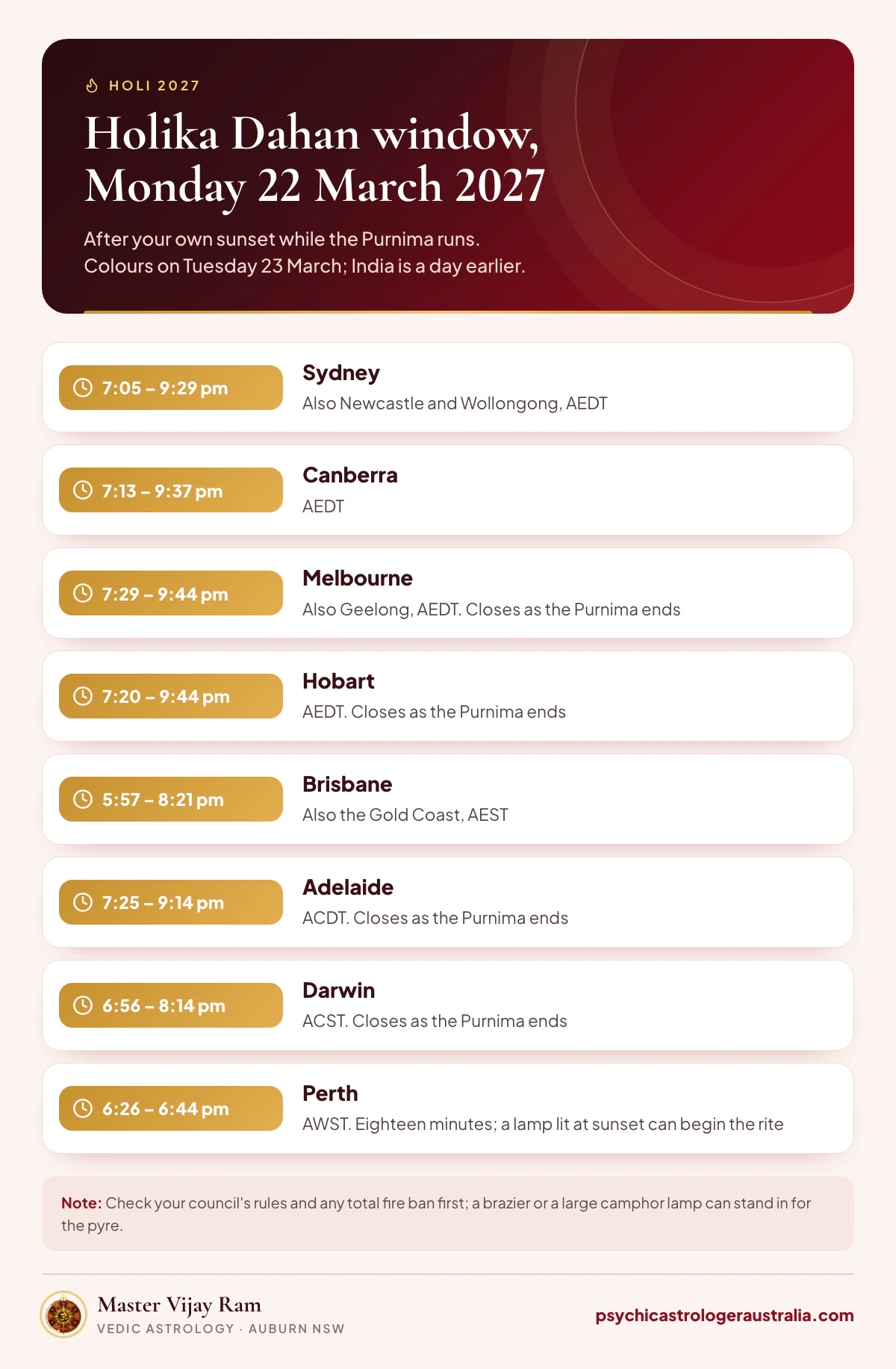
The bonfire is lit after sunset while the Purnima still runs. In the eastern cities, Adelaide and Darwin that leaves the whole of Pradosh open on the Monday; in Melbourne and Hobart the window closes when the Purnima ends at 9:44 pm; in Perth it is tight, because the Purnima ends at 6:44 pm AWST, eighteen minutes after the Sun sets.
| City | Sunset, Monday 22 March 2027 | Window for Holika Dahan |
|---|---|---|
| Sydney, Newcastle, Wollongong | 7:05 pm AEDT | 7:05 pm – 9:29 pm |
| Canberra | 7:13 pm AEDT | 7:13 pm – 9:37 pm |
| Melbourne, Geelong | 7:29 pm AEDT | 7:29 pm – 9:44 pm (Purnima ends) |
| Hobart | 7:20 pm AEDT | 7:20 pm – 9:44 pm (Purnima ends) |
| Brisbane, Gold Coast | 5:57 pm AEST | 5:57 pm – 8:21 pm |
| Adelaide | 7:25 pm ACDT | 7:25 pm – 9:14 pm (Purnima ends) |
| Darwin | 6:56 pm ACST | 6:56 pm – 8:14 pm (Purnima ends) |
| Perth | 6:26 pm AWST | 6:26 pm – 6:44 pm (Purnima ends) |
| New Delhi (reference) | 6:33 pm IST, Sunday 21 March | 6:33 pm – 8:55 pm |
Sunset here is the astronomical moment for a flat horizon; hills and buildings bring the visible sunset a few minutes earlier, and the tradition does not ask for that precision. A Perth family that cannot gather by 6:26 pm can light a lamp at sunset to begin the rite and complete the fire a little later, which is what Master Vijay Ram advises rather than skipping the night.
What is Bhadra, and does it block the bonfire in 2027?
Bhadra is the Vishti karana, a half-tithi the tradition avoids for auspicious work, and it occupies the first half of every Purnima. Holika is not lit while Bhadra runs, which is the rule that most often shifts the bonfire in India from one evening to the next.
In 2027 the Purnima begins at 11:52 pm Sydney time on the Sunday, so Bhadra ends around the middle of Monday morning, about 10:48 am in the east and 7:48 am in Perth. Every Australian evening is therefore clear of it, and the Monday windows above stand without qualification; the only constraint here is the Purnima's end, not Bhadra's.
Rangwali Holi on Tuesday 23 March
The colours are played the morning after the bonfire, on the Pratipada of Chaitra's dark fortnight, which in 2027 runs from 9:44 pm on Monday to 7:59 pm on Tuesday, Sydney time. Rangwali Holi is simply the day after Holika Dahan wherever you stand, so it is Tuesday 23 March across Australia and Monday 22 March in India.
| City | Date | Phalguna Krishna Pratipada (local time) | Rule applied |
|---|---|---|---|
| Sydney | Tue 23 Mar 2027 | Mon 22 Mar 2027, 9:44 PM AEDT – Tue 23 Mar 2027, 7:59 PM AEDT | the day after Holika Dahan |
| Melbourne | Tue 23 Mar 2027 | Mon 22 Mar 2027, 9:44 PM AEDT – Tue 23 Mar 2027, 7:59 PM AEDT | the day after Holika Dahan |
| Brisbane | Tue 23 Mar 2027 | Mon 22 Mar 2027, 8:44 PM AEST – Tue 23 Mar 2027, 6:59 PM AEST | the day after Holika Dahan |
| Perth | Tue 23 Mar 2027 | Mon 22 Mar 2027, 6:44 PM AWST – Tue 23 Mar 2027, 4:59 PM AWST | the day after Holika Dahan |
| Adelaide | Tue 23 Mar 2027 | Mon 22 Mar 2027, 9:14 PM ACDT – Tue 23 Mar 2027, 7:29 PM ACDT | the day after Holika Dahan |
| Canberra | Tue 23 Mar 2027 | Mon 22 Mar 2027, 9:44 PM AEDT – Tue 23 Mar 2027, 7:59 PM AEDT | the day after Holika Dahan |
| Hobart | Tue 23 Mar 2027 | Mon 22 Mar 2027, 9:44 PM AEDT – Tue 23 Mar 2027, 7:59 PM AEDT | the day after Holika Dahan |
| Darwin | Tue 23 Mar 2027 | Mon 22 Mar 2027, 8:14 PM ACST – Tue 23 Mar 2027, 6:29 PM ACST | the day after Holika Dahan |
| New Delhi (reference) | Mon 22 Mar 2027 | Mon 22 Mar 2027, 4:14 PM IST – Tue 23 Mar 2027, 2:29 PM IST | the day after Holika Dahan |
The tithi is one moment everywhere; only the clock and the sunrise differ, which is why a city can fall a day apart from India. Computed with the Swiss Ephemeris (Lahiri ayanamsa for Vedic positions) and checked against US Naval Observatory data. Times are rounded to the minute.
A Tuesday is a working day, and most Australian families play colours at home in the morning before work and school, then join the community Holi on the following weekend. Both are proper: the morning keeps the tithi, and the weekend keeps the community, and the tradition has never required that the two be the same day.
The moon of Holi: Purva Phalguni and the end of the lunar year
At the moment the Purnima begins, the Moon stands in Leo, in the nakshatra Purva Phalguni, which is where the month of Phalguna takes its name. Phalguna is the last month of the lunar year, so Holi 2027 in Australia closes the year that began at Chaitra Navratri in 2026, and the new one opens on Thursday 8 April 2027 with Ugadi, Gudi Padwa and the first night of Chaitra Navratri.
The Sun has been in sidereal Pisces, Meena, since 15 March, the last sign of the zodiac, which is why the tradition reads Holi as a burning of the old before the year turns. Nothing in this requires a chart; it is the shape of the calendar, and families keep it without knowing the astronomy behind it.
Mercury's shadow and the Holi week
Mercury turned direct on Wednesday 3 March 2027 after a retrograde that began on 10 February, and its post-retrograde shadow lasts until 24 March, the day after Rangwali Holi. The festival itself is untouched by any of this, because a puja, a bonfire and a morning of colours are acts of devotion, not contracts.
What the shadow does ask for is a second reading of anything signed in the Holi week, from a lease to a car. The Mercury retrograde 2027 calendar gives the three periods of the year in every Australian time zone, and the muhurat for any purchase planned around the festival is a matter for a muhurat consultation against your own chart.
A Holika Dahan at home in Australia
Most Australian councils restrict open fires in residential streets, and in March parts of Victoria and South Australia are still inside the fire danger period, so the first step is to check your council's rules and any total fire ban for the day. Where a backyard fire is not allowed, a small fire pit, a brazier or even a single large lamp with camphor stands in for the pyre, and the rite is not lessened by its size.
- Set the fire or the lamp in an open spot after sunset, within the window for your city, and keep water beside it.
- Offer a few grains of wheat or barley, a coconut, a little ghee and dried cow-dung cakes where you have them, and remember Prahlad, whose faith the fire could not touch.
- Circle the fire three, five or seven times with the family, and let each person name silently the one thing they are leaving in it.
- Carry a little of the ash home for the doorway the next morning, and begin the colours after sunrise on the Tuesday.
A child who forgets the order spoils nothing. The essentials are a lit fire or lamp inside the Purnima, a family present, and the intention to burn what has been heavy.
What the Holika fire is for
The Prahlad story is a story about protection: a boy kept safe inside a fire that was meant to destroy him. Families who have had a hard year often treat Holika Dahan as the night to let it go, and the custom of naming what goes into the fire is older than any modern language of release. For a house that has felt heavy since the summer, a negative energy consultation looks at the ordinary causes first and the spiritual ones second, which is the honest order.
Where a family wants a Holika or Satyanarayan puja performed for them on the Purnima, it can be performed personally on request at his own place of practice in Auburn, with the family watching by video. A consultation is $50; a puja performed on request starts from $250, and the figure is agreed before anything is performed. This is faith-based guidance, not medical, legal or financial advice.
Holi in Sydney, Perth and the regions
The big public festivals in Sydney fall around Parramatta and Harris Park and on the nearest weekend, and the Monday-night bonfire is a home affair, often a shared one in a Blacktown or Castle Hill backyard. Canberra and Wollongong keep Sydney's clock exactly, and Cairns, at the tail of the wet season, keeps Brisbane's, with its Hindu Samaj gathering in halls and parks.
Perth has the hardest timetable of 2027, with eighteen minutes between sunset and the end of the Purnima, and a Perth family that lights the lamp at 6:26 pm has kept the rite in full. Darwin, in the last weeks of the wet, has a comfortable window of an hour and a quarter. Wherever you are, use your own city's row and nobody else's.
What Holi can and cannot do for your year
A bonfire on the right evening is a devotion, not a remedy, and it does not change a Saturn period or a dasha. What it does is mark the turn of the year with the family together, which in a scattered Australian life is worth a great deal on its own. Holika Dahan 2027 is also a traditional night for beginning a protective sadhana, and Vijay Ram ji is often asked which mantra suits a particular chart for the year ahead.
That question has an honest answer only after a reading, and the 2027 forecast for the twelve moon signs is the place to start before booking one. The full festival calendar for 2027 sets Holi beside every other date of the year, city by city.
What this page cannot do
It cannot tell you what your temple will decide, and it does not try to. Many Australian temples hold Holika Dahan on the evening their panchang prints, some on the Sunday with India and some on the Monday with the local sky, and both congregations stand inside a tradition that has always allowed the local sunset to decide.
It also cannot make a windy Monday safe for a backyard fire. If the day brings a fire ban, the lamp and the camphor are the fire, and the colours on Tuesday will be no less bright.
Read next
- Ganesh Chaturthi 2027 in Australia: Date and Sthapana TimingGanesh Chaturthi 2027 is Saturday 4 September in Australia and India. Midday sthapana windows for Sydney, Melbourne, …
- Dussehra 2027 in Australia: Date and Vijay MuhuratDussehra 2027 is Saturday 9 October in Australia and India. Vijay muhurat times for Sydney, Melbourne, Brisbane, Adel…
- 11 Signs of Negative Energy in Your Life (and How to Clear It)Eleven signs of negative energy, the ordinary causes to rule out first, and the three-doors test that tells you wheth…
Frequently asked questions
What is the date of Holi 2027 in Australia?
Rangwali Holi, the day of colours, is Tuesday 23 March 2027 in every Australian city, and Holika Dahan, the bonfire, is the evening before, Monday 22 March. The dates come from the Phalguna Purnima, which runs from 11:52 pm on Sunday 21 March to 9:44 pm on Monday 22 March in Sydney time, so the Monday evening is the one inside it and the colours follow the next morning.
Why is Holi 2027 on a different day in India?
The same Purnima begins at 6:22 pm Delhi time on Sunday 21 March and ends at 4:14 pm on Monday 22 March. Sunday evening in India is inside the Purnima and Monday evening is not, so India lights Holika on the Sunday, within the published Delhi window of 6:33 to 8:55 pm, and plays colours on Monday 22 March. In Australia the Purnima has not begun when the Sun sets on Sunday, so the bonfire moves to Monday.
What time is Holika Dahan in Sydney and Melbourne?
In Sydney the Sun sets at 7:05 pm AEDT on Monday 22 March 2027 and the Pradosh window runs to 9:29 pm, all of it inside the Purnima. Melbourne's sunset is 7:29 pm and the window runs until the Purnima ends at 9:44 pm. Newcastle and Wollongong are within minutes of Sydney, Geelong of Melbourne, Canberra lights at 7:13 pm and Hobart at 7:20 pm, both running to 9:44 pm.
What time is Holika Dahan in Brisbane, Adelaide and Darwin?
Brisbane and the Gold Coast, without daylight saving, see sunset at 5:57 pm AEST on Monday 22 March and the window runs to 8:21 pm, comfortably inside a Purnima that ends there at 8:44 pm. Adelaide's sunset is 7:25 pm ACDT and the window runs until the Purnima ends at 9:14 pm. Darwin's sunset is 6:56 pm ACST and the window runs until 8:14 pm, when the Purnima ends on the Darwin clock.
What time is Holika Dahan in Perth?
Perth has the shortest window in the country in 2027. The Sun sets at 6:26 pm AWST on Monday 22 March and the Purnima ends at 6:44 pm, leaving eighteen minutes. Light the lamp or the fire at sunset and begin the offerings at once; a family that cannot gather until later should still light the lamp at 6:26 pm and complete the rite afterwards, which keeps the Purnima rather than abandoning the night.
Does Bhadra affect Holika Dahan in Australia in 2027?
No. Bhadra, the Vishti karana, occupies the first half of every Purnima and Holika is not lit while it runs. In 2027 the Purnima begins at 11:52 pm Sydney time on the Sunday, so Bhadra ends about the middle of Monday morning, around 10:48 am in the east and 7:48 am in Perth. Every Australian evening is clear of it, and the only limit on the Monday windows is the moment the Purnima itself ends.
Can I light the Holika fire on Sunday 21 March with my family in India?
You can share the evening by video, but the Purnima has not begun in Australia on the Sunday evening; it starts at 11:52 pm Sydney time, 8:52 pm in Perth, after every Australian sunset. A fire lit on Sunday here falls outside the tithi, while Monday's is inside it. Many families call India on the Sunday for their bonfire and light their own on the Monday, and nothing in the tradition objects.
Are backyard Holika fires allowed in Australia?
It depends on your council and the day. Most urban councils restrict open fires in residential areas, and in March parts of Victoria and South Australia can still be in the fire danger period, with total fire bans declared at short notice. A fire pit, a brazier or a single large lamp with camphor is an accepted substitute, and the rite is complete with any of them, so check the rules before Monday and have water at hand.
Is Holi connected to Mercury retrograde in 2027?
Only at the edges. Mercury was retrograde from 10 February to 3 March 2027 and its post-retrograde shadow runs until 24 March, the day after Rangwali Holi. The bonfire, the puja and the colours are not affected, because none of them is a contract. Purchases and agreements made in the Holi week are the things that deserve a careful second look, which is the ordinary advice for any Mercury shadow.
People also ask
When is Holika Dahan 2027?
Holika Dahan is Monday 22 March 2027 in Australia, lit after local sunset while the Phalguna Purnima is present, and Sunday 21 March 2027 in India, where the same Purnima is present on the Sunday evening. The difference comes from the four-and-a-half to five-and-a-half-hour gap between the two countries' clocks, not from different calendars.
What is the Holika Dahan muhurat?
It is the part of Pradosh, the hours after sunset, during which the Purnima is present and Bhadra has ended. In Australia in 2027 that means from your city's sunset on Monday 22 March until the Purnima ends, 9:44 pm in Sydney and Melbourne, 8:44 pm in Brisbane, 9:14 pm in Adelaide, 8:14 pm in Darwin and 6:44 pm in Perth, with Bhadra already over since the morning.
Why is Holi celebrated the day after Holika Dahan?
The bonfire belongs to the Purnima evening and the colours to the morning after, on the first day of the dark fortnight. The tradition reads the fire as the burning of Holika and the colours as the joy that follows Prahlad's survival, so the two are a single festival across one night. That is why Rangwali Holi has no tithi rule of its own and is always the morning after the fire.
Can Holi be celebrated on the weekend instead?
The community celebration can, and in Australia it usually is, with public Holi events held on the nearest Saturday or Sunday. The home rite is different: the bonfire belongs to the Purnima evening and the colours to the morning after, and those fall on Monday 22 and Tuesday 23 March in 2027. Families keep the tithi at home and join the weekend festival as well, which the tradition has never discouraged.
Which nakshatra is the Moon in on Holi 2027?
When the Phalguna Purnima begins, the Moon is in Leo in the nakshatra Purva Phalguni, from which the month of Phalguna takes its name, with the Sun in sidereal Pisces. Phalguna is the last month of the lunar year, so Holi marks its close, and the new year begins on Thursday 8 April 2027 with Chaitra Navratri, Ugadi and Gudi Padwa in Australia.
References & further reading
Serving clients across Australia
Confidential consultations by phone, video & WhatsApp — including: