

Quick answer
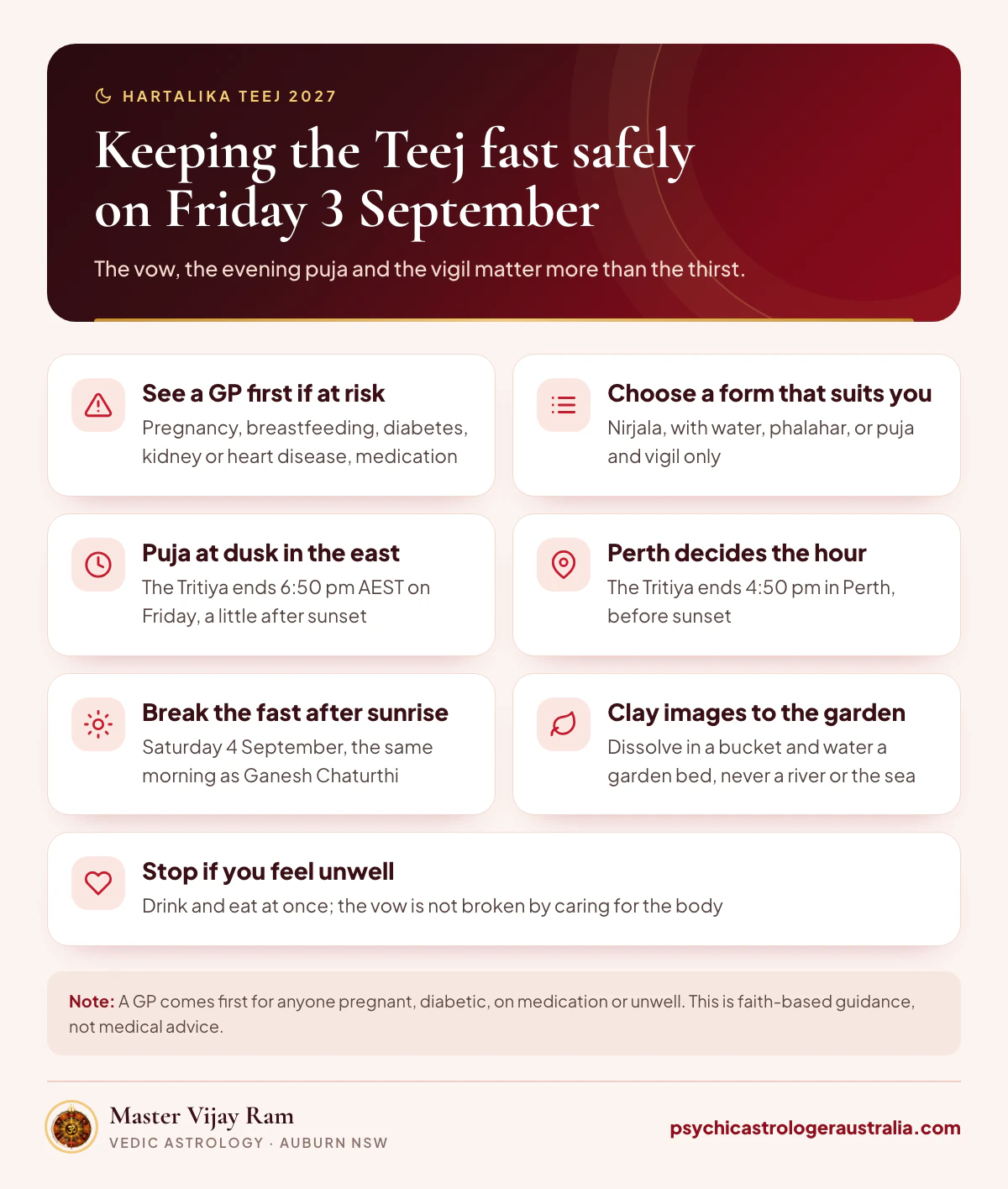
Hartalika Teej 2027 falls on Friday 3 September in every Australian city and in India. The Bhadrapada Shukla Tritiya runs from 9:21 pm AEST on Thursday to 6:50 pm on Friday. Many women keep a fast without water from Friday's sunrise to Saturday's; anyone pregnant, diabetic or on medication should speak to a GP first.
When is Hartalika Teej 2027?
Hartalika Teej is a women's fast and vigil for Shiva and Parvati, kept on the third lunar day of Bhadrapada's bright fortnight by families from Bihar, Uttar Pradesh, Jharkhand, Rajasthan, Madhya Pradesh, Maharashtra and above all Nepal. In 2027 Hartalika Teej 2027 falls on Friday 3 September in every Australian city and in India, so a mother in Kathmandu or Patna and a daughter in Melbourne fast on the same day.
The Tritiya begins at 9:21 pm AEST on Thursday 2 September and ends at 6:50 pm on Friday, Sydney time. Friday's sunrise falls inside it in every city, and that dawn rule decides the day.
| City | Date | Bhadrapada Shukla Tritiya (local time) | Rule applied |
|---|---|---|---|
| Sydney | Fri 3 Sep 2027 | Thu 02 Sep 2027, 9:21 PM AEST – Fri 03 Sep 2027, 6:50 PM AEST | tithi present at sunrise (udaya tithi) |
| Melbourne | Fri 3 Sep 2027 | Thu 02 Sep 2027, 9:21 PM AEST – Fri 03 Sep 2027, 6:50 PM AEST | tithi present at sunrise (udaya tithi) |
| Brisbane | Fri 3 Sep 2027 | Thu 02 Sep 2027, 9:21 PM AEST – Fri 03 Sep 2027, 6:50 PM AEST | tithi present at sunrise (udaya tithi) |
| Perth | Fri 3 Sep 2027 | Thu 02 Sep 2027, 7:21 PM AWST – Fri 03 Sep 2027, 4:50 PM AWST | tithi present at sunrise (udaya tithi) |
| Adelaide | Fri 3 Sep 2027 | Thu 02 Sep 2027, 8:51 PM ACST – Fri 03 Sep 2027, 6:20 PM ACST | tithi present at sunrise (udaya tithi) |
| Canberra | Fri 3 Sep 2027 | Thu 02 Sep 2027, 9:21 PM AEST – Fri 03 Sep 2027, 6:50 PM AEST | tithi present at sunrise (udaya tithi) |
| Hobart | Fri 3 Sep 2027 | Thu 02 Sep 2027, 9:21 PM AEST – Fri 03 Sep 2027, 6:50 PM AEST | tithi present at sunrise (udaya tithi) |
| Darwin | Fri 3 Sep 2027 | Thu 02 Sep 2027, 8:51 PM ACST – Fri 03 Sep 2027, 6:20 PM ACST | tithi present at sunrise (udaya tithi) |
| New Delhi (reference) | Fri 3 Sep 2027 | Thu 02 Sep 2027, 4:51 PM IST – Fri 03 Sep 2027, 2:20 PM IST | tithi present at sunrise (udaya tithi) |
The tithi is one moment everywhere; only the clock and the sunrise differ, which is why a city can fall a day apart from India. Computed with the Swiss Ephemeris (Lahiri ayanamsa for Vedic positions) and checked against US Naval Observatory data. Times are rounded to the minute.
The next morning, Saturday 4 September, is Ganesh Chaturthi everywhere, which gives the weekend an unusual shape for families who keep both. Where a family wants the puja hour fixed for its own city, a festival muhurat consultation can work it out.
What is the story behind Hartalika?
The name joins two words, harat, carried off, and aalika, a woman friend. In the story Parvati's father had promised her to Vishnu, though she had set her heart on Shiva, and her friends carried her away to a forest so that the match could not go ahead.
There she made a linga of sand on the riverbank, worshipped it through the day and night without food or water, and kept vigil until Shiva, moved by her resolve, accepted her. The fast re-enacts that night: a vow kept with the whole body, for a marriage chosen with the whole heart.
The story gives the day a slightly different flavour from Karva Chauth. It is less about waiting for the Moon and more about steadfastness, which is why many unmarried women keep it as well, praying for a partner as devoted as Shiva.
Who keeps the fast, and why?
Married women traditionally keep Hartalika Teej for the long life and wellbeing of their husbands and for harmony in the marriage, and unmarried women keep it for a good match. In Nepal it is one of the great festivals of the year, with women in red saris singing and dancing on the way to Shiva temples, and Nepali families in Australia bring that colour to halls in Sydney, Melbourne and Perth.
The fast is a vow, not a test of love. A woman who cannot keep it this year, or who keeps a gentler form, has not failed her marriage, and no tradition the Master knows says otherwise. Many husbands now fast alongside their wives, which older relatives sometimes find surprising and usually end up liking.
A marriage under real strain needs more than a vow, and Relationships Australia and, where there is fear or control, 1800RESPECT are the first calls. Where a couple wants the timing of their marriage read from both charts, a love and marriage timing reading looks at it.
What does a nirjala fast involve, and who should not keep one?
The strictest form of the Hartalika Teej fast is nirjala, without food or water, from Friday's sunrise until after Saturday's, often with a night of wakefulness in between. That is more than twenty-four hours without water, and for some bodies it is genuinely risky.
Anyone who is pregnant or breastfeeding, has diabetes, kidney or heart disease, low blood pressure, a history of fainting or an eating disorder, or takes regular medication should speak to a GP before fasting at all. Older women and anyone working a physical shift on the Friday should be especially careful; early September is spring in the south, but Darwin and the Queensland north are already warm.
Traditions allow for this. Many families keep a phalahar fast of fruit and milk, or a fast with water, and the puja and the vigil are the heart of the day, not the thirst. A woman who drinks water because her doctor said so has kept Teej.
| Form | What it involves | Who it may suit |
|---|---|---|
| Nirjala | No food or water from Friday's sunrise to Saturday's | Healthy adults whose GP has no concerns; never in pregnancy |
| With water | No food, water allowed through the day and night | Many who want to keep the vow strictly but safely |
| Phalahar | Fruit, milk and nuts, no grains | Older women, those on medication with their GP's agreement |
| Puja and vigil only | Normal meals, full evening puja and night prayer | Pregnancy, diabetes, illness, heavy work shifts |
How is the evening puja done?
The main Hartalika Teej puja is kept in the evening. Women bathe, dress in green or red, apply mehndi in the days before if they wish, and make small images of Shiva, Parvati and often Ganesha from clay or sand, echoing the sand linga of the story.
The images sit on a decorated stand with a lamp, flowers, bel leaves, a coconut and the shringar items of a married woman: bangles, sindoor, a bindi and a red cloth for Parvati. The Hartalika katha is read or listened to, usually in a group, and the women sing through part of the night in the vigil called ratri jagran.
The puja items afterwards go to the compost, the garden or a temple collection, not into a river or the sea; clay images can be dissolved in a bucket of water and the water poured on a garden bed. Many Australian councils treat items left in waterways as littering.
Does the tithi end before the evening puja?
In most of Australia only just. The Tritiya ends at 6:50 pm on Friday on the eastern clock, which in early spring is a little after sunset, so families in Sydney, Melbourne and Brisbane who want the puja inside the tithi begin promptly at dusk. Adelaide and Darwin are on Central time, where the Tritiya ends at 6:20 pm.
Perth is the clear outlier. On the western clock the Tritiya ends at 4:50 pm, well before Perth's sunset, so a Perth family either holds the puja in the late afternoon while the tithi lasts or keeps the traditional evening hour after it, and both are defended by respected priests. The day itself is not in doubt; only the hour.
Geoscience Australia's sunrise calculator gives the exact local sunset for any suburb, which is all a family needs to place the puja.
How do Teej and Ganesh Chaturthi share a weekend?
Ganesh Chaturthi follows on Saturday 4 September 2027, the next tithi, with its midday sthapana. A woman who has kept a nirjala fast through Friday night breaks it after Saturday's sunrise, which means the parana and the arrival of Ganesha fall on the same morning.
Families manage it by sharing the work: the women who fasted rest after the parana, and the household's Ganesh preparations are done by others or the night before. The Ganesh Chaturthi 2027 page has the midday sthapana details, and nobody needs to rush from a fast into a heavy day of cooking.
How does Teej differ from Karva Chauth?
Both are fasts kept by married women for their husbands, and both draw comparisons in families that keep one and not the other. Karva Chauth, in October, ends with the moonrise and is mostly kept by Punjabi and north-western families; Hartalika Teej ends at the next sunrise and is strongest in Bihar, eastern Uttar Pradesh, Rajasthan and Nepal.
The Karva Chauth fast is broken on the same night; the Teej fast runs through a vigil and is broken the next morning, which makes it the longer and harder of the two. The Karva Chauth 2027 moonrise times cover October's fast, and in 2027 its date is the one the panchangs disagree on.
What do fasts do in Vedic astrology?
In the astrological reading of a vrat, the discipline itself is the remedy: a fast for Shiva and Parvati is traditionally read as strengthening the bond signified by the seventh house and Venus, and steadying the Moon through prayer. It describes intention and devotion, not a mechanism that changes another person's health or choices.
Fasting as a regular practice has its own rhythm, and the weekday vrat for each planet is one form of it, while the guide to Ekadashi fasting explains how families keep a fortnightly vrat safely. For a festival fast once a year, the guidance on health above is the part that matters most.
How do Nepali and Bihari families in Australia keep the day?
For Teej 2027 in Australia, Nepali community groups in Sydney's west, Melbourne and Perth commonly hire a hall for Teej, with music, dancing and a shared puja, often on the nearest weekend so that working women can attend. Bihari and Purvanchali families keep a home puja more often, with neighbours joining in the evening.
Consultations with Master Vijay Ram are in English, Hindi or Punjabi; for Nepali-speaking families a relative can interpret, and many prefer Hindi anyway. Melbourne readings by phone or video work the same way as anywhere else in Australia.
When might a puja on request help?
A woman who is ill, travelling or in hospital on the day sometimes asks for the Shiva-Parvati puja to be done on her behalf. The puja is then performed personally on request at Master Vijay Ram's place of practice in Auburn, with the family joining by video if they wish. A consultation is $50; a puja starts from $250, and the figure is agreed before anything is performed.
What can a fast not do?
A fast is a vow of love and steadiness; it does not guarantee a husband's health, a proposal or a happy marriage, and no honest reading would suggest it does. Vedic astrology reads tendencies and timing, never fixed outcomes.
It is also not medical advice. If you feel faint, confused or unwell while fasting, drink water and eat; a vow made to Parvati is not broken by looking after the body she gave you, and a GP or healthdirect on 1800 022 222 is the right call if symptoms continue.
Read next
- Chhath Puja in Australia: How Families Keep It at Beaches and LakesChhath Puja in Australia: the four days, the sunset and sunrise arghya at beaches and lakes, water safety, council ru…
- Janmashtami 2027 in Australia: Date and Nishita TimingJanmashtami 2027 is Wednesday 25 August in eastern Australia and Tuesday 24 August in Perth and India. Nishita puja t…
- Diwali 2026 House & Aura Cleansing: Clear the Year's Heavy EnergyDiwali 2026 house and aura cleansing done honestly: clean first, use the Five-Lamp Check, and learn when heaviness is…
Frequently asked questions
What is the date of Hartalika Teej 2027 in Australia?
Friday 3 September 2027, in every Australian city and in India. The Bhadrapada Shukla Tritiya begins at 9:21 pm AEST on Thursday 2 September and ends at 6:50 pm on Friday 3 September. Friday's sunrise falls inside it everywhere, so Friday is the day of the fast and the evening puja.
Is a nirjala fast safe on Teej?
For a healthy adult it is a hard but traditional practice. It means more than twenty-four hours without water, which is risky for anyone pregnant or breastfeeding, diabetic, with kidney or heart disease, low blood pressure or a history of fainting, or on regular medication. Those women should speak to a GP first and keep a gentler form.
Can I drink water during the Hartalika Teej fast?
Yes, if you need to. Many families keep the fast with water or as a phalahar fast of fruit and milk, and the evening puja and the night vigil are the heart of the observance. A woman who drinks water on her doctor's advice has still kept Teej, and no tradition the Master knows holds otherwise.
When should the Teej puja be done in Perth?
On Perth's clock the Tritiya ends at 4:50 pm on Friday 3 September, before sunset. Some families therefore hold the puja in the late afternoon while the tithi lasts; others keep the customary evening hour after it. Priests defend both, and the day itself, Friday, is not in doubt.
When do I break the Hartalika Teej fast?
After sunrise on Saturday 4 September 2027, following a morning prayer and the parana, usually with a light meal. That same morning is Ganesh Chaturthi, so families share the work and let the women who fasted rest. Anyone who feels unwell during the fast should drink and eat at once rather than wait for the morning.
Can unmarried women keep Hartalika Teej?
Yes. Many unmarried women keep it for a good match, following Parvati, who in the story fasted for Shiva before their marriage. They keep the same puja and may choose any form of the fast. As with every vow, the health cautions apply equally, and a gentler form is no lesser observance.
What is the difference between Hartalika Teej and Karva Chauth?
Both are fasts married women keep for their husbands. Karva Chauth in October ends at moonrise the same night and is strongest among Punjabi families; Hartalika Teej ends after the next sunrise, includes a night vigil and is strongest in Bihar, eastern Uttar Pradesh, Rajasthan and Nepal. Teej is the longer of the two fasts.
Can someone perform the Teej puja on my behalf?
Yes, if you are ill, travelling or in hospital. Master Vijay Ram performs the Shiva-Parvati puja personally at his place of practice in Auburn, and the family can join by video. A consultation is $50; a puja starts from $250, agreed before it is performed. It is offered as devotion, not as a promise about any outcome.
What should I do with the clay images after Teej?
Dissolve clay images in a bucket of water and pour the water on a garden bed, and put flowers and leaves in the compost or the council green bin. Some temples collect puja items. Nothing should go into a river, lake or the sea, which can count as littering under Australian council rules.
People also ask
Is Hartalika Teej on 3 September 2027?
Yes. Friday 3 September 2027 is Hartalika Teej in every Australian city and in India. The Tritiya is present at Friday's sunrise everywhere, and it ends at 6:50 pm AEST that evening. Ganesh Chaturthi follows the next day, Saturday 4 September 2027.
Why is Hartalika Teej kept?
It remembers Parvati, whose friends carried her to a forest so she would not be married against her wish; there she worshipped a sand linga and fasted until Shiva accepted her. Married women keep it for their husbands' wellbeing and harmony, and unmarried women for a devoted partner.
Who should not fast on Hartalika Teej?
Anyone pregnant or breastfeeding, with diabetes, kidney or heart disease, low blood pressure, a history of fainting or an eating disorder, or on regular medication should speak to a GP before fasting. Many keep a gentler form or the puja and vigil alone, which tradition fully accepts.
What colour is worn on Hartalika Teej?
Green and red are the customary colours, with red especially strong among Nepali women, who often wear red saris to the temple. Women commonly apply mehndi in the days before and wear bangles and sindoor. Customs differ by region, and nothing about the colour affects the vow itself.
References & further reading
Serving clients across Australia
Confidential consultations by phone, video & WhatsApp — including: