
Quick answer
Ekadashi is the eleventh lunar day of each fortnight, kept by many Hindus as a fast for Vishnu, giving twenty-four Ekadashis a year. The usual rule is no grains or beans from sunrise, with fruit, milk, nuts and permitted flours. The fast is broken on Dwadashi after sunrise. Anyone with a health condition, pregnancy or medication sees a GP first.
What is Ekadashi?
Ekadashi is the eleventh tithi, or lunar day, of each fortnight, a day that Vaishnava tradition sets aside for fasting and prayer to Vishnu. There are two in every lunar month, one in the waxing fortnight and one in the waning, so twenty-four in an ordinary year and twenty-six in a year with a leap month. Each has its own name and story in the Puranas, and many families keep every one of them.
Ekadashi fasting is probably the most widely kept regular fast in Hinduism, observed by grandparents in Punjab, ISKCON devotees in Melbourne and Tamil families in Sydney alike. Its emphasis is restraint and remembrance rather than hardship. For families who want to mark it with a formal puja, a Vishnu puja performed on your behalf is one option, though most keep it entirely at home.
What are the twenty-four Ekadashis called?
The table lists the Ekadashis by lunar month as they are named in calendars that begin the month at the new moon. Calendars used in much of north India begin the month at the full moon, so each waning-fortnight Ekadashi carries the next month's name there. Spellings and some names vary by region; this is the commonest list.
| Lunar month | Shukla (waxing) Ekadashi | Krishna (waning) Ekadashi |
|---|---|---|
| Chaitra | Kamada | Varuthini |
| Vaishakha | Mohini | Apara |
| Jyeshtha | Nirjala | Yogini |
| Ashadha | Devshayani | Kamika |
| Shravana | Putrada (Pavitra) | Aja |
| Bhadrapada | Parsva (Parivartini) | Indira |
| Ashwin | Papankusha | Rama |
| Kartika | Prabodhini (Dev Uthani) | Utpanna |
| Margashirsha | Mokshada | Saphala |
| Pausha | Putrada (Pausha) | Shattila |
| Magha | Jaya | Vijaya |
| Phalguna | Amalaki | Papmochani |
A leap month, when one occurs, adds two more, Padmini and Parama. There is no leap month in 2027, so the year holds the ordinary twenty-four.
Where does the Ekadashi fast come from?
The story most families tell comes from the Padma Purana. Vishnu, resting in a cave after a long battle with the demon Mura, was about to be attacked in his sleep when a goddess emerged from his body and destroyed the demon. Pleased, Vishnu named her Ekadashi after the lunar day and granted that anyone who fasted on her day would be freed from wrongdoing.
That is why Utpanna Ekadashi, the one in the waning fortnight of Kartika in the table above, is often called the day Ekadashi was born, and why some devotees choose it to begin keeping the fast. Other Puranas attach a separate story to each of the twenty-four, and many families read the day's katha aloud before breaking the fast.
Whatever one makes of the stories, the practical teaching is consistent across them. Eat less, speak less, remember Vishnu more, and do it twice a month, every month, so that restraint becomes ordinary rather than heroic.
Which Ekadashis matter most to families?
Four stand out in most households. Nirjala Ekadashi, in Jyeshtha, is the strictest, traditionally kept without even water by those able to, and said to carry the merit of all the others. Devshayani Ekadashi, in Ashadha, marks Vishnu's four months of sleep, the chaturmas, when many families avoid weddings.
Prabodhini or Dev Uthani Ekadashi, in Kartika, marks his waking and reopens the wedding season, and Tulsi Vivah follows it in many homes. Vaikuntha Ekadashi, the Shukla Ekadashi of Margashirsha or Pausha depending on the region, is a major day in south Indian Vishnu temples. Dev Uthani Ekadashi and the wedding season covers that day in detail.
When is Ekadashi in Australia?
Ekadashi is counted by the tithi present at local sunrise, so the day in Sydney, Perth and India can differ. An Ekadashi that begins in the afternoon in India may already cover an Australian sunrise, or miss one entirely. Your local temple's panchang is the reliable guide, and this page does not type Ekadashi dates for that reason.
Of the 2027 Ekadashis, this site has computed only Dev Uthani Ekadashi city by city. It falls on Wed 10 Nov 2027 everywhere, with the tithi running from Tue 9 Nov 1:05 pm to Wed 10 Nov 2:42 pm AEDT.
| City | Date | Kartika Shukla Ekadashi (local time) | Rule applied |
|---|---|---|---|
| Sydney | Wed 10 Nov 2027 | Tue 09 Nov 2027, 1:05 PM AEDT – Wed 10 Nov 2027, 2:42 PM AEDT | tithi present at sunrise (udaya tithi) |
| Melbourne | Wed 10 Nov 2027 | Tue 09 Nov 2027, 1:05 PM AEDT – Wed 10 Nov 2027, 2:42 PM AEDT | tithi present at sunrise (udaya tithi) |
| Brisbane | Wed 10 Nov 2027 | Tue 09 Nov 2027, 12:05 PM AEST – Wed 10 Nov 2027, 1:42 PM AEST | tithi present at sunrise (udaya tithi) |
| Perth | Wed 10 Nov 2027 | Tue 09 Nov 2027, 10:05 AM AWST – Wed 10 Nov 2027, 11:42 AM AWST | tithi present at sunrise (udaya tithi) |
| Adelaide | Wed 10 Nov 2027 | Tue 09 Nov 2027, 12:35 PM ACDT – Wed 10 Nov 2027, 2:12 PM ACDT | tithi present at sunrise (udaya tithi) |
| Canberra | Wed 10 Nov 2027 | Tue 09 Nov 2027, 1:05 PM AEDT – Wed 10 Nov 2027, 2:42 PM AEDT | tithi present at sunrise (udaya tithi) |
| Hobart | Wed 10 Nov 2027 | Tue 09 Nov 2027, 1:05 PM AEDT – Wed 10 Nov 2027, 2:42 PM AEDT | tithi present at sunrise (udaya tithi) |
| Darwin | Wed 10 Nov 2027 | Tue 09 Nov 2027, 11:35 AM ACST – Wed 10 Nov 2027, 1:12 PM ACST | tithi present at sunrise (udaya tithi) |
| New Delhi (reference) | Wed 10 Nov 2027 | Tue 09 Nov 2027, 7:35 AM IST – Wed 10 Nov 2027, 9:12 AM IST | tithi present at sunrise (udaya tithi) |
The tithi is one moment everywhere; only the clock and the sunrise differ, which is why a city can fall a day apart from India. Computed with the Swiss Ephemeris (Lahiri ayanamsa for Vedic positions) and checked against US Naval Observatory data. Times are rounded to the minute.
Smarta and Vaishnava calendars sometimes list an Ekadashi a day apart, because Vaishnava traditions apply a stricter rule about the preceding tithi. ISKCON temples follow the Vaishnava date. If your family follows a particular temple or sampradaya, use its calendar.
What are the Ekadashi vrat rules?
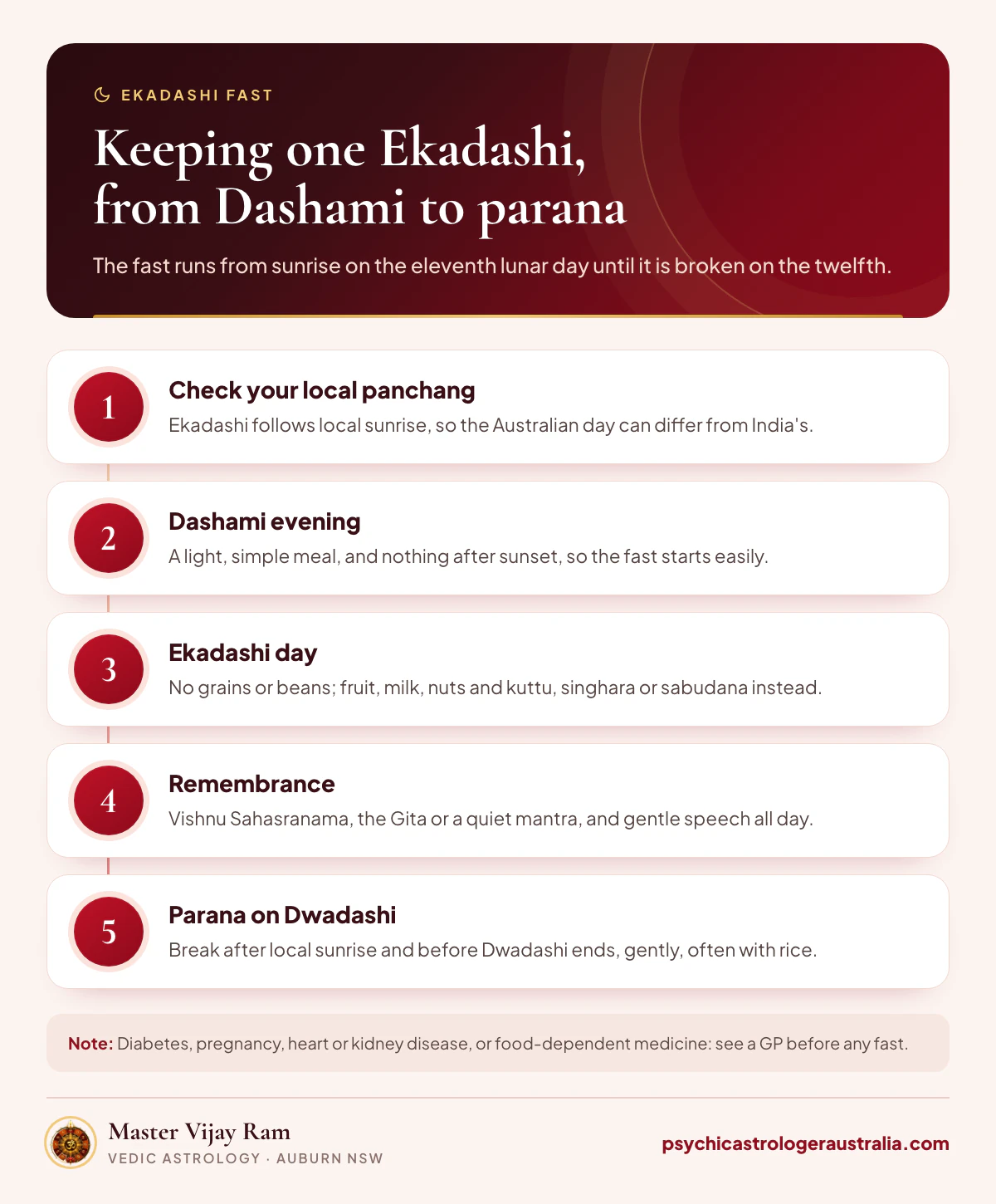
The core rule is simple: no grains and no beans from sunrise on Ekadashi until the fast is broken the next morning. That means no rice, wheat, barley, millet, dal, lentils or chickpeas, and in many families no corn either. Some households also avoid onion, garlic, and certain spices.
Beyond that, the Ekadashi vrat rules come in degrees. The strictest take nothing, or only water; many take fruit and milk; others take one meal of permitted foods. The evening before, on Dashami, many families eat a light, simple meal and nothing after sunset, so the fast begins on an easy stomach.
Alongside the food rules, the day is meant for remembrance: reading the Vishnu Sahasranama or the Bhagavad Gita, chanting, visiting a temple, and keeping speech gentle. A fast kept in irritation and argument misses most of its point.
What can you eat on Ekadashi?
Ekadashi food is built from what is not a grain or a bean. Fruit, milk, yoghurt, paneer, nuts and seeds are common. Potatoes, sweet potatoes, pumpkin, cucumber and most vegetables are widely allowed, though some families limit vegetables too.
For flours, families use buckwheat (kuttu), water chestnut (singhara), amaranth (rajgira) or tapioca (sabudana). Rock salt (sendha namak) usually replaces table salt. Every Indian grocer in Australia stocks these before major fasts, and sabudana khichdi, kuttu puris and potato with peanuts are the usual fasting meals.
How is the fast broken?
The fast is broken on Dwadashi, the twelfth tithi, after local sunrise and before Dwadashi ends. This breaking is called parana, and many panchangs give a parana window for each city. Many traditions avoid breaking the fast in the first quarter of Dwadashi, called Hari Vasara, so the window often starts a little after sunrise.
Break gently: water or a little fruit first, then a normal meal with rice, which many families eat specifically to mark the end of the fast. Do not break with a heavy, fried meal after a long fast. If Dwadashi ends early in the morning, the window can be short, which is why checking the panchang the night before helps.
Who should see a GP before an Ekadashi fast?
See your GP first if you have diabetes, kidney disease, low blood pressure, a heart condition or a past eating disorder, if you are pregnant or breastfeeding, or if any medicine has to be taken with food. Nirjala, without water, is a particular risk for older people and anyone on diuretics or blood pressure tablets. Shift workers whose sleep is already disrupted should ask too.
The tradition has always allowed for this. Children, elders, the sick and pregnant women are traditionally exempt from strict fasting, and a person who cannot fast can keep Ekadashi by avoiding grains at ordinary mealtimes, or simply by prayer and reading. Weekday fasts and which planet they serve gives the gentler forms of vrat in more detail.
If fasting has become a way of controlling food, or you feel unwell during one, stop and speak to a GP. The Butterfly Foundation and healthdirect are also places to start.
How do you keep Ekadashi in an Australian working week?
Most Ekadashis fall on working days, and there is no need to take leave. Pack fruit, nuts, yoghurt or a container of sabudana khichdi, drink water through the day unless you are keeping a waterless fast with your GP's blessing, and keep the remembrance quietly: a mantra on the train, a few verses at lunch. Quiet practices for a working day has more ideas.
Nirjala Ekadashi falls in Jyeshtha, which arrives in the Australian winter rather than the Indian summer it was made for, so a waterless fast is milder here than in Delhi. It is still not for everyone. Families in Adelaide, Canberra or Hobart often keep a fruit fast on the working Ekadashis and a stricter one on the few that fall on weekends.
Is Ekadashi a remedy in astrology?
Ekadashi is first a devotional fast, not a planetary remedy. Because it is a Vishnu day it is sometimes suggested alongside remedies for Jupiter, and because it is a lunar day some astrologers suggest it when the Moon is under strain. Whether that suits you depends on your chart and the period you are running.
Families who want a larger observance on a special Ekadashi sometimes ask for a Vishnu puja or Satyanarayana katha. Master Vijay Ram performs these personally at his place of practice in Auburn, starting from $250, with the figure agreed before anything is performed. A muhurat consultation can confirm the right day for your city, and a consultation is $50, in English, Hindi or Punjabi, for clients from Wollongong to Adelaide.
What can an Ekadashi fast not do?
It cannot cure an illness, settle a family problem or substitute for medical care. It is a discipline of restraint and prayer, offered here as faith-based guidance, not medical or dietary advice. A dietitian or GP is the right person to ask about fasting and your health.
What families describe is the rhythm it gives a month: two days that are a little quieter, a little simpler and turned towards Vishnu. Keeping a tulsi plant and offering it water on Ekadashi is part of that rhythm in many homes, and tulsi care in an Australian winter explains how to keep one alive here.
Read next
- Pradosh Vrat and Evening Shiva WorshipPradosh vrat explained: the Trayodashi evening fast for Shiva, how pradosh kaal is set by local sunset in Australia, …
- Sun Sign, Moon Sign or Rising Sign: Which One Is You?Sun sign, Moon sign or rising sign: what each is, why your Vedic signs differ from the Western ones, how to find all …
- Best Vashikaran Specialist in Australia: Spotting a Genuine OneHow to tell a genuine vashikaran specialist from a well-marketed one: the Four Refusals, the green and red flags, and…
Frequently asked questions
How many Ekadashis are there in a year?
There are two Ekadashis in every lunar month, one in the waxing and one in the waning fortnight, so twenty-four in an ordinary year. In a year with an adhik or leap month there are twenty-six, the extra two being Padmini and Parama. There is no leap month in 2027, so it holds the ordinary twenty-four.
What foods are not allowed on Ekadashi?
Grains and beans are the main foods avoided: rice, wheat, barley, millet, dal, lentils and chickpeas, and in many families corn as well. Some households also avoid onion, garlic and certain spices. Fruit, milk, nuts, potatoes and fasting flours such as kuttu, singhara, rajgira and sabudana are commonly allowed.
When should I break the Ekadashi fast?
On Dwadashi, the next lunar day, after local sunrise and before Dwadashi ends. Many panchangs give a parana window for each city and avoid the first quarter of Dwadashi, called Hari Vasara. Break gently with water or fruit, then a normal meal, often including rice to mark the end of the fast.
Why are Ekadashi dates different in Australia and India?
Ekadashi is counted by the tithi present at local sunrise, and Australian sunrises come hours before India's. A tithi that starts in the afternoon in India may already cover an Australian sunrise, or miss one. Use your local temple's panchang rather than an Indian calendar for the day in your city.
Can I drink water on Ekadashi?
Yes, on almost every Ekadashi. Only Nirjala Ekadashi is traditionally kept without water, and even then only by those able to do it safely. Older people, anyone on blood pressure tablets or diuretics, and anyone with kidney or heart disease should not attempt a waterless fast without their GP's approval.
Can diabetics keep an Ekadashi fast?
Only after speaking with their GP, because skipping meals with some diabetes medicines can be dangerous. The tradition itself exempts the sick from strict fasting. A person with diabetes can keep Ekadashi by avoiding grains at normal mealtimes with foods their doctor approves, or by prayer and reading without fasting at all.
Why do ISKCON and other calendars sometimes show different Ekadashi days?
Smarta and Vaishnava calendars apply different rules about the tithi before Ekadashi. Vaishnava traditions, including ISKCON, use a stricter rule, so sometimes they fast a day later than Smarta calendars. Follow the calendar of the temple or tradition your family belongs to.
Can I keep Ekadashi while working full time?
Yes. Most people keep it on working days by packing fruit, nuts, yoghurt or sabudana khichdi, drinking water, and keeping a short prayer or mantra during the day. Many keep a fruit fast on weekday Ekadashis and a stricter one when the day falls on a weekend. No leave is needed.
People also ask
What is the most important Ekadashi?
Nirjala Ekadashi is often called the most important because it is the strictest and is said to carry the merit of all twenty-four. Devshayani and Dev Uthani Ekadashi, which begin and end Vishnu's four months of rest, and Vaikuntha Ekadashi in south Indian temples are also major days.
Is rice not eaten on Ekadashi?
Yes, rice is avoided on Ekadashi along with all other grains and beans. A popular story says the sins of the world take refuge in grains on that day. Many families then eat rice deliberately when they break the fast on Dwadashi to mark its end.
Can children fast on Ekadashi?
Children are traditionally exempt from strict fasting. They can join the observance by eating fasting foods without grains alongside the family, listening to the Ekadashi story or offering water to tulsi. A GP should be asked before any child keeps a longer or stricter fast.
What is Ekadashi parana time?
Parana is the time to break the Ekadashi fast, on Dwadashi after local sunrise and before Dwadashi ends. Panchangs usually give a parana window for each city, often starting slightly after sunrise to avoid Hari Vasara, the first quarter of Dwadashi.
References & further reading
Serving clients across Australia
Confidential consultations by phone, video & WhatsApp — including: