
Quick answer
Janmashtami 2027 is Wednesday 25 August in Sydney, Melbourne, Brisbane, Canberra, Hobart, Adelaide and Darwin, and Tuesday 24 August in Perth and in India, where the Ashtami is present at midnight. In the east the tithi runs from 12:55 am to 11:50 pm on the Wednesday and spans no local midnight, so the day it fills is used; India's ISKCON calendar also gives Wednesday 25 August.
Janmashtami 2027 in Australia at a glance
Krishna Janmashtami is the birthday of Krishna, kept on the Ashtami of Shravana's dark fortnight at the midnight hour of his birth. In 2027 the Ashtami runs from 12:55 am to 11:50 pm on Wednesday 25 August in Sydney time, which gives the eastern and central cities a Wednesday vigil, while Perth and India, where the same tithi is present at Tuesday's midnight, keep Tuesday 24 August.
No other festival of 2027 divides Australia like this one, and the division is not a disagreement between panchangs. It is a single tithi that happens to begin fifty-five minutes after midnight on the east coast, and the pages below set out what that means for every city and for the family calling home to India.
| City | Date | Shravana Krishna Ashtami (local time) | Rule applied |
|---|---|---|---|
| Sydney | Wed 25 Aug 2027 | Wed 25 Aug 2027, 12:55 AM AEST – Wed 25 Aug 2027, 11:50 PM AEST | tithi present at sunrise — no local midnight falls inside it |
| Melbourne | Wed 25 Aug 2027 | Wed 25 Aug 2027, 12:55 AM AEST – Wed 25 Aug 2027, 11:50 PM AEST | tithi present at sunrise — no local midnight falls inside it |
| Brisbane | Wed 25 Aug 2027 | Wed 25 Aug 2027, 12:55 AM AEST – Wed 25 Aug 2027, 11:50 PM AEST | tithi present at sunrise — no local midnight falls inside it |
| Perth | Tue 24 Aug 2027 | Tue 24 Aug 2027, 10:55 PM AWST – Wed 25 Aug 2027, 9:50 PM AWST | tithi present at midnight (nishita) |
| Adelaide | Wed 25 Aug 2027 | Wed 25 Aug 2027, 12:25 AM ACST – Wed 25 Aug 2027, 11:20 PM ACST | tithi present at sunrise — no local midnight falls inside it |
| Canberra | Wed 25 Aug 2027 | Wed 25 Aug 2027, 12:55 AM AEST – Wed 25 Aug 2027, 11:50 PM AEST | tithi present at sunrise — no local midnight falls inside it |
| Hobart | Wed 25 Aug 2027 | Wed 25 Aug 2027, 12:55 AM AEST – Wed 25 Aug 2027, 11:50 PM AEST | tithi present at sunrise — no local midnight falls inside it |
| Darwin | Wed 25 Aug 2027 | Wed 25 Aug 2027, 12:25 AM ACST – Wed 25 Aug 2027, 11:20 PM ACST | tithi present at sunrise — no local midnight falls inside it |
| New Delhi (reference) | Tue 24 Aug 2027 | Tue 24 Aug 2027, 8:25 PM IST – Wed 25 Aug 2027, 7:20 PM IST | tithi present at midnight (nishita) |
The tithi is one moment everywhere; only the clock and the sunrise differ, which is why a city can fall a day apart from India. Computed with the Swiss Ephemeris (Lahiri ayanamsa for Vedic positions) and checked against US Naval Observatory data. Times are rounded to the minute.
Every time on this page was computed for the city centre with the Swiss Ephemeris and the Lahiri ayanamsa. Janmashtami 2027 in Australia will be kept on two nights in some cities, Tuesday with the temple and Wednesday at home, and nothing in the tradition forbids a family from keeping both.
The nishita rule: a midnight festival on a tithi that spans no midnight
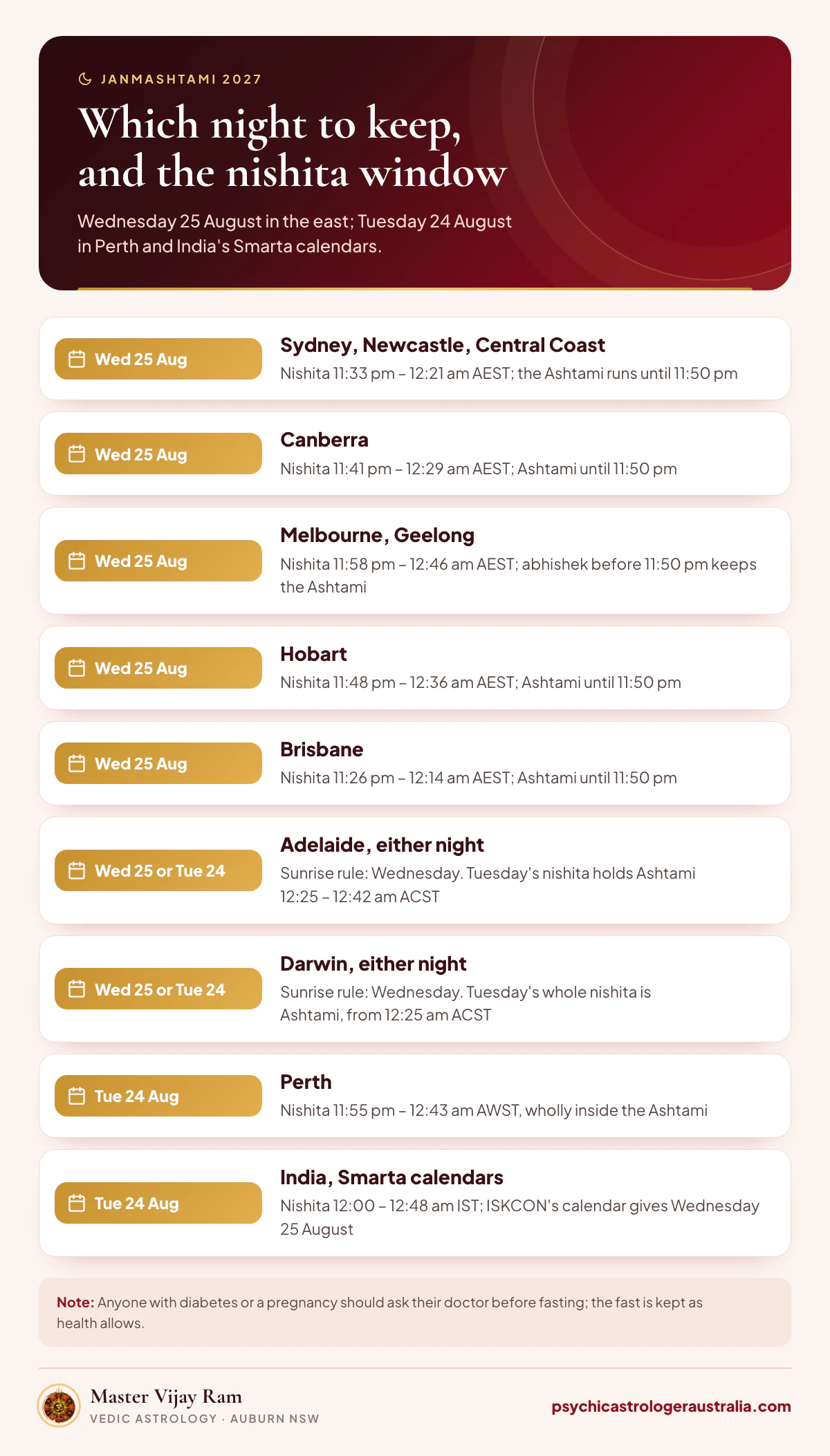
Janmashtami's rule is nishita, the dead of night: the festival belongs to the civil day whose midnight falls inside the Ashtami. The traditional nishita window is the middle of the night, from sunset to the next sunrise, with a ghati of twenty-four minutes on either side, which in late August in Sydney runs from 11:33 pm to 12:21 am.
In 2027 the Ashtami ends at 11:50 pm on the Wednesday in Sydney and Brisbane, so Wednesday's nishita window has the Ashtami for its first minutes only, and Tuesday's window has none of it, because the tithi has not begun. Where a tithi touches neither midnight, the tradition falls back on the sunrise rule, and the Ashtami is present at Wednesday's sunrise everywhere in Australia; that is why the table above gives Wednesday 25 August for the eastern and central cities.
Why Perth and India keep Tuesday and the east keeps Wednesday
On Perth's clock the Ashtami runs from 10:55 pm on Tuesday 24 August to 9:50 pm on Wednesday 25 August. Tuesday's midnight sits squarely inside it, so Perth's vigil is Tuesday night, and no second test is needed.
India's clock reads 8:25 pm on Tuesday to 7:20 pm on Wednesday, and Tuesday's midnight is inside the tithi there too, which is the Smarta date of 24 August that most Indian calendars print. The eastern Australian cities are simply too far ahead: by the time Sydney's Tuesday midnight arrives, the Ashtami is still fifty-five minutes away, and by Wednesday's midnight it has been over for ten.
Nishita kaal by city
The table gives each city's vigil night, its traditional nishita window and how much of that window the Ashtami covers. Where the cover is only a few minutes, the puja is begun at the start of the window so that the abhishek falls inside the tithi.
| City | Vigil night | Nishita window | Ashtami present during it |
|---|---|---|---|
| Sydney, Newcastle, Central Coast | Wed 25 Aug 2027 | 11:33 pm – 12:21 am AEST | 11:33 pm – 11:50 pm |
| Canberra | Wed 25 Aug | 11:41 pm – 12:29 am AEST | 11:41 pm – 11:50 pm |
| Melbourne, Geelong | Wed 25 Aug | 11:58 pm – 12:46 am AEST | none; the Ashtami ends eight minutes earlier, so the sunrise rule decides |
| Hobart | Wed 25 Aug | 11:48 pm – 12:36 am AEST | 11:48 pm – 11:50 pm |
| Brisbane | Wed 25 Aug | 11:26 pm – 12:14 am AEST | 11:26 pm – 11:50 pm |
| Gold Coast, Sunshine Coast | Wed 25 Aug | 11:24 pm – 12:12 am AEST | 11:24 pm – 11:50 pm |
| Adelaide | Wed 25 Aug (see below) | 11:53 pm – 12:41 am ACST | none on the Wednesday; 12:25 am – 12:42 am on the Tuesday night |
| Darwin | Wed 25 Aug (see below) | 12:25 am – 1:13 am ACST | none on the Wednesday; the whole window on the Tuesday night |
| Perth | Tue 24 Aug | 11:55 pm – 12:43 am AWST | the whole window |
| New Delhi (reference) | Tue 24 Aug | 12:00 am – 12:48 am IST | the whole window |
Melbourne's case is the plainest example of the fallback: its window opens eight minutes after the tithi has gone, so the Ashtami at Wednesday's sunrise settles the date, and Melbourne families keep the Wednesday vigil as the Vaishnava calendars do. A Melbourne household that wants the abhishek inside the tithi performs it before 11:50 pm.
Adelaide and Darwin: the marginal cases
The table above applies the midnight test at the clock's midnight and then the sunrise rule, which gives Wednesday for Adelaide and Darwin. The traditional nishita window, centred on the middle of the night rather than on twelve o'clock, tells a slightly different story in both cities, and honesty requires setting it out.
In Darwin the Ashtami begins at 12:25 am on the Wednesday, the very minute the Tuesday-night nishita window opens, so a Darwin family keeping the Tuesday vigil with Perth and India is inside the tithi for the whole of the window. In Adelaide the Tuesday-night window runs from 11:54 pm to 12:42 am and the Ashtami arrives at 12:25 am, giving seventeen minutes inside it. Either night is defensible in those two cities: Wednesday by the sunrise rule and the Rohini pairing below, Tuesday by the nishita window, and the temple's choice is the family's answer.
Rohini nakshatra and the Jayanti yoga
Krishna was born with the Moon in Rohini, and the pairing of Ashtami with Rohini is the combination the tradition calls Jayanti. In 2027 the Moon enters Rohini at 4:59 pm AEST on Wednesday 25 August, 2:59 pm in Perth and 12:29 pm in Delhi, and stays there until 4:59 pm on the Thursday.
That gives the eastern Australian cities a Wednesday evening on which Ashtami and Rohini run together until the tithi ends at 11:50 pm, a Krishna Janmashtami of the fuller kind. Perth's Tuesday vigil and India's Smarta Tuesday have the Moon in Krittika; India's Vaishnava Wednesday has Rohini from midday with the Ashtami present until 7:20 pm. The two countries end up keeping the same sky from different sides.
Smarta and Vaishnava: why ISKCON gives 25 August in India too
The Smarta calendars that most Indian households follow take the midnight rule and give Tuesday 24 August 2027. The Vaishnava calendars, including ISKCON's, prefer a day on which the Ashtami is present at sunrise and weigh the Rohini pairing, which in 2027 gives Wednesday 25 August in India as well as in Australia's east.
The practical result is that a Sydney family and their ISKCON temple agree on Wednesday, while their parents in Delhi following a Smarta calendar keep Tuesday, and a Perth family keeps Tuesday with the parents. All four are inside a tradition that has argued this point for centuries and settled it by lineage rather than by astronomy.
The fast, the midnight abhishek and the parana
The fast is kept from the morning of the vigil day, lighter or stricter by family custom, and the puja is held at the nishita window with an abhishek of the infant Krishna in milk, curd, honey, ghee and water, a cradle rocked, and the bhajans that go through the night. In the eastern cities begin the abhishek at the start of the window so that it falls before 11:50 pm; in Perth the whole window is open.
- Bathe and set the cradle or the image on a clean cloth, with tulsi, butter and a lamp, before sunset.
- Keep the fast through the evening with water, fruit or a light sattvic meal if health requires it.
- At the nishita window perform the abhishek, dress the image, offer the makhan and the fifty-six dishes where the family keeps that custom, and sing the aarti.
- Break the fast after the puja, or at sunrise on Thursday 26 August; families who wait for Rohini to pass break it after 4:59 pm AEST on the Thursday.
A nurse on nights, a student in exams or a parent with a baby keeps the fast as health allows; the tradition has never asked anyone to faint for it, and anyone with diabetes or a pregnancy should ask their doctor first.
Dahi Handi and the day after
Dahi Handi, the breaking of the hung pot, belongs to the Navami, the day after the birth. In Australia the Navami runs from 11:50 pm on the Wednesday to 10:09 pm on Thursday 26 August, so the pots come down on the Thursday in the east and central cities, while India keeps its Dahi Handi on the Wednesday after the Smarta Tuesday.
Public Dahi Handi events in Australia are usually held on the following weekend, and that is a community timetable rather than a tithi. A school or a temple that hangs the pot on the Saturday is celebrating, not miscalculating.
Janmashtami at Australian temples and on working nights
Wednesday 25 August 2027 is a working night, and most Australian temples will keep the midnight aarti on it regardless, with the Vaishnava temples certainly on the Wednesday and some Smarta temples on the Tuesday. The Central Coast community holds Janmashtami through its own temple association, Brisbane's temples keep the eastern Wednesday, and the Gold Coast, the Sunshine Coast and Newcastle follow their capitals' clocks within a couple of minutes.
Darwin is the city with a real choice, as the section above explains, and the Darwin temple's decision is the one to follow. For a family split between a Tuesday temple and a Wednesday home puja, keeping both is the oldest solution there is.
Krishna, the Moon and your chart
Rohini is the nakshatra the Moon loves best, in Taurus, the sign of the Moon's exaltation, and the Janmashtami vigil is the night Vedic astrologers most often recommend for beginning a Krishna mantra sadhana for a troubled Moon, for restless sleep, anxiety and a mind that will not settle. Whether a particular chart needs that, or needs nothing, is what a reading decides; the Janmashtami 2027 date is the same for everyone, and the remedy is not.
Couples hoping for a child have long kept the Santan Gopal puja on this night, and where a family cannot perform it, it is performed personally on request at his own place of practice in Auburn on the vigil night, with the family joining by video; the santan prapti page and the guide for couples trying to conceive explain what that puja can and cannot do, and why fertility medicine comes first. A consultation is $50; a puja performed on request starts from $250, and the figure is agreed before anything is performed. This is faith-based guidance, not medical, legal or financial advice.
What this page cannot do
It cannot choose between the Smarta and Vaishnava traditions for you, and it does not try. The full 2027 festival calendar shows where else the two countries part company this year, and the 2027 moon-phase calendar gives the new moon of 2 August from which this Ashtami is counted.
It also cannot time a wedding, a naming or a griha pravesh in the Janmashtami week, which depends on the particular chart; that is the work of a muhurat consultation. What it can do is tell a family in Townsville or Tarneit, without a phone call to India, which night to rock the cradle.
Read next
- Maha Shivratri 2027 in Australia: Date and Night TimingMaha Shivratri 2027 is Saturday 6 March in Australia and India. Nishita kaal and four-prahar puja times for Sydney, M…
- Ram Navami 2027 in Australia: Date and Midday TimingRam Navami 2027 is Thursday 15 April in every Australian city and India: the Navami tithi, the midday (madhyahna) rul…
- Diwali 2026 House & Aura Cleansing: Clear the Year's Heavy EnergyDiwali 2026 house and aura cleansing done honestly: clean first, use the Five-Lamp Check, and learn when heaviness is…
Frequently asked questions
What is the date of Janmashtami 2027 in Australia?
Wednesday 25 August 2027 in Sydney, Melbourne, Brisbane, Canberra, Hobart, Adelaide and Darwin, and Tuesday 24 August 2027 in Perth. The Shravana Krishna Ashtami runs from 12:55 am to 11:50 pm on the Wednesday in eastern time, spanning no local midnight, so the sunrise rule gives Wednesday; on Perth's clock the same tithi runs from 10:55 pm Tuesday to 9:50 pm Wednesday, so Tuesday's midnight is inside it.
What is the date of Janmashtami 2027 in India?
Tuesday 24 August 2027 in the Smarta calendars most households follow, because the Ashtami runs from 8:25 pm on the Tuesday to 7:20 pm on the Wednesday and Tuesday's midnight falls inside it. The Vaishnava calendars, ISKCON's among them, give Wednesday 25 August, preferring the day on which the Ashtami is present at sunrise and the Moon enters Rohini. Both dates are traditional, and families follow their lineage.
What time is the Janmashtami puja in Sydney and Melbourne?
In Sydney the nishita window on Wednesday 25 August 2027 is 11:33 pm to 12:21 am AEST, and the Ashtami is present for its first seventeen minutes, until 11:50 pm, so the abhishek is begun at 11:33 pm. Melbourne's window is 11:58 pm to 12:46 am, which opens after the tithi has ended, so Melbourne families perform the abhishek before 11:50 pm or keep the ISKCON timing; the Wednesday date itself rests on the Ashtami at sunrise.
What time is the Janmashtami puja in Brisbane and Perth?
Brisbane's nishita window is 11:26 pm to 12:14 am AEST on Wednesday 25 August 2027, with the Ashtami present until 11:50 pm; the Gold Coast and the Sunshine Coast are two minutes earlier. Perth keeps Tuesday 24 August, with a nishita window of 11:55 pm to 12:43 am AWST that lies entirely inside the Ashtami, which runs from 10:55 pm on the Tuesday to 9:50 pm on the Wednesday on Perth's clock.
Why is Darwin listed as Wednesday when its midnight window is inside the Ashtami on Tuesday night?
Because the table applies the midnight test at the clock's twelve o'clock, which falls twenty-five minutes before the Ashtami begins in Darwin, and then uses the sunrise rule, which gives Wednesday 25 August. Darwin's traditional nishita window runs from 12:25 am to 1:13 am, the Ashtami arriving at 12:25 am, so a Tuesday vigil is wholly inside the tithi. Either night is defensible, and the Darwin temple's choice is the one to follow.
Is the Moon in Rohini on Janmashtami 2027?
On the eastern Australian vigil, yes. The Moon enters Rohini at 4:59 pm AEST on Wednesday 25 August 2027 and leaves it at 4:59 pm on the Thursday, so the Wednesday evening carries Ashtami and Rohini together until the tithi ends at 11:50 pm, the pairing the tradition calls Jayanti. On Perth's Tuesday vigil and India's Smarta Tuesday the Moon is still in Krittika; in India Rohini arrives at 12:29 pm on the Wednesday.
When is the fast broken after Janmashtami 2027?
After the midnight puja, or at sunrise on Thursday 26 August in the eastern and central cities, where the Ashtami ended at 11:50 pm on the Wednesday; Perth breaks the fast after its Tuesday-night puja or at Wednesday's sunrise. Families who follow the stricter rule and wait for both the Ashtami and Rohini to pass break it after 4:59 pm AEST on the Thursday. Anyone with a medical condition keeps the fast only as their doctor allows.
When is Dahi Handi 2027 in Australia?
Thursday 26 August 2027 in the eastern and central cities, because the Navami, the day after the birth, runs from 11:50 pm on the Wednesday to 10:09 pm on the Thursday in Sydney time. India keeps Dahi Handi on Wednesday 25 August after its Smarta Tuesday. Public Dahi Handi events in Australia are usually held on the following weekend, which is a community timetable rather than a tithi.
Can we keep Janmashtami on both Tuesday and Wednesday?
Yes, and many Australian families do: Tuesday night with the temple or on a video call with parents in India, and Wednesday night at home with the cradle. Nothing in the tradition forbids a second vigil, and the fast is simply kept on the night the family chooses as its own. What matters is that the abhishek on the Wednesday falls before 11:50 pm in the east, while the tithi is still present.
People also ask
When is Janmashtami 2027?
Wednesday 25 August 2027 in eastern and central Australia, Tuesday 24 August 2027 in Perth and in India's Smarta calendars, and Wednesday 25 August in India's Vaishnava calendars, including ISKCON's. The Ashtami is one tithi beginning at one instant; it is present at Tuesday's midnight in Perth and Delhi and only from 12:55 am Wednesday in Sydney, which is the whole of the difference.
What is nishita kaal?
The dead of night: the middle of the period from sunset to the next sunrise, with a ghati of twenty-four minutes on either side, about forty-eight minutes in all. In late August it runs from 11:33 pm to 12:21 am in Sydney and from 11:55 pm to 12:43 am in Perth. Janmashtami belongs to the night whose nishita falls inside the Ashtami, and where no night qualifies, the day on which the Ashtami is present at sunrise is used.
Why do Smarta and Vaishnava Janmashtami dates differ?
The Smarta rule takes the midnight test and accepts an Ashtami mixed with the Saptami before it; the Vaishnava rule prefers an Ashtami present at sunrise, unmixed, and weighs the Moon in Rohini. In 2027 the two rules give Tuesday 24 and Wednesday 25 August in India. Australia's eastern cities fall on the Wednesday by both the sunrise rule and the Rohini pairing, which is why they agree with ISKCON.
What is Jayanti yoga on Janmashtami?
The coincidence of the Ashtami with the Moon in Rohini, the nakshatra of Krishna's birth. In 2027 the Moon enters Rohini at 4:59 pm AEST on Wednesday 25 August, so the eastern Australian vigil carries both until the tithi ends at 11:50 pm. The tradition regards a Jayanti as a fuller observance, though an Ashtami without Rohini is still Janmashtami, which is what Perth and Smarta India keep on the Tuesday.
What should be done at the Janmashtami midnight puja?
An abhishek of the infant Krishna in milk, curd, honey, ghee and water, the image dressed and placed in a cradle, offerings of butter, tulsi and sweets, and the aarti sung with the family. In the eastern cities begin at the start of the nishita window so that the abhishek falls before 11:50 pm, while the Ashtami is present. The fast is broken after the puja or at Thursday's sunrise, as health allows.
References & further reading
Serving clients across Australia
Confidential consultations by phone, video & WhatsApp — including: