
Quick answer
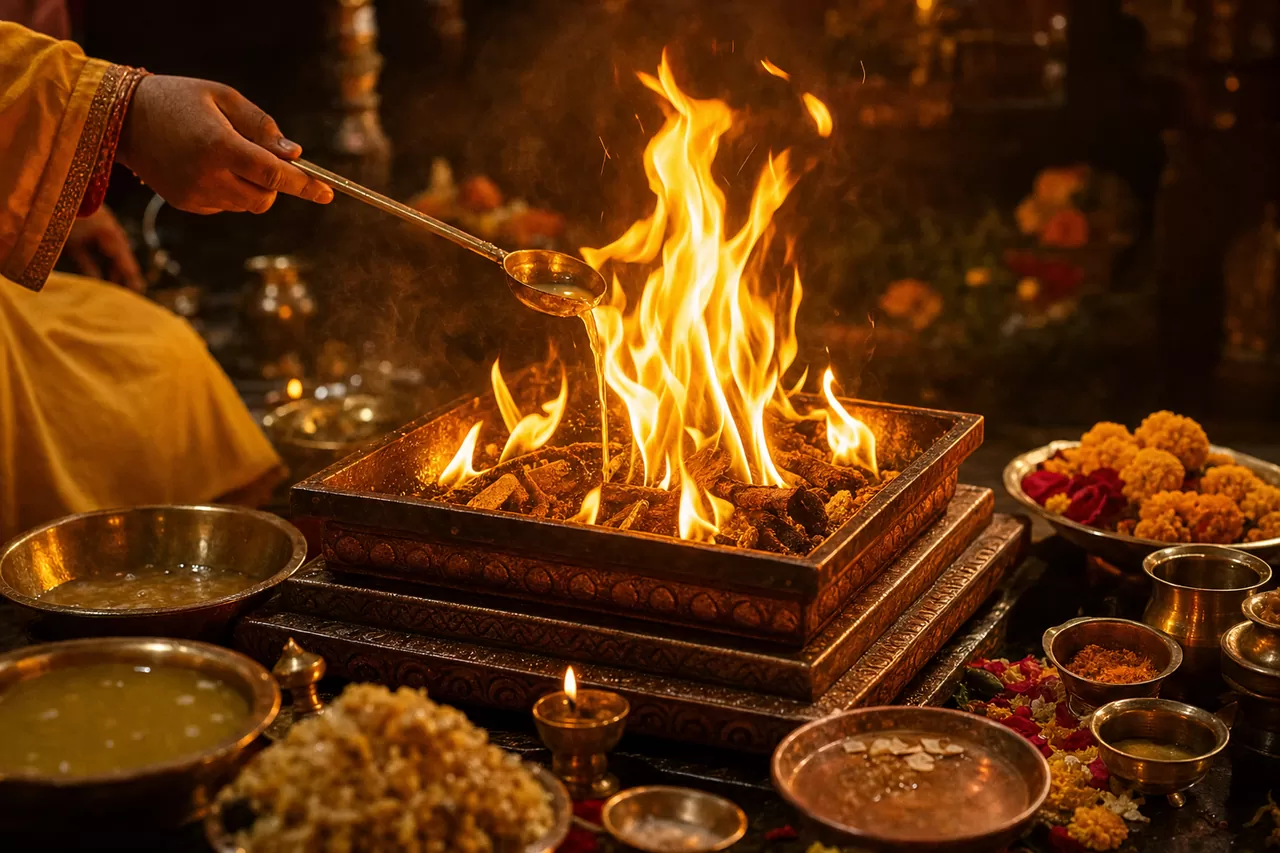
Chhath Puja is kept on Kartika Shukla Shashthi, about six days after Diwali, over four days ending with offerings to the setting and rising Sun while standing in water. Australian families gather at beaches, lakes and backyard pools; take the date from your temple panchang, swim only where it is safe, and carry every offering home.
What is Chhath Puja?
Chhath Puja is a four-day festival of the Sun and of Chhathi Maiya, kept by families from Bihar, Jharkhand, eastern Uttar Pradesh and the Terai of Nepal, that ends with offerings to the setting and the rising Sun made while standing in water. It is one of the most demanding observances in the Hindu year, with a fast of about a day and a half without water, and one of the most moving to watch, as whole families gather at a riverbank in the last light.
In Australia the riverbank has become a beach, a lake, a lagoon or, for many families, the backyard pool. Chhath Puja in Australia has grown as the Bihari and Purvanchali community has grown, and with it a set of practical questions the villages of the Ganga never had to answer: rips, patrol flags, council permits and what to do with the offerings afterwards.
When is Chhath Puja, and why is no date given here?
The Chhath Puja date is the Shashthi, the sixth lunar day, of Kartika's bright fortnight, about six days after Diwali; a smaller Chaiti Chhath is kept in the bright half of Chaitra in spring. The four days run from the Chaturthi to the dawn of the Saptami.
This site computes many festival dates for Australian cities, but not Chhath, so this page deliberately gives no calendar date. Communities follow their own panchang, often the Mithila or Banarasi calendar, and the date your temple or association announces is the one to keep; for planning a gathering around it, a muhurat and festival-date consultation can help read the panchang for your city.
What can be said is that in 2027 Diwali's Lakshmi Puja falls on Friday 29 October everywhere, so the Chhath days follow in the first week of November, and the community notice will give the exact evening and morning.
What happens on each of the four days?
Each day has its own name and its own discipline. The vrati, the person keeping the vow, is often the mother of the house, though men keep it too, and the rest of the family serves and supports.
| Day | Name | What is done |
|---|---|---|
| First, Chaturthi | Nahay Khay | A purifying bath, the house cleaned, one simple meal of rice, chana dal and bottle gourd cooked without onion or garlic |
| Second, Panchami | Kharna | A fast through the day, broken at evening with kheer made with jaggery and roti; the long waterless fast begins after this meal |
| Third, Shashthi | Sandhya Arghya | The family goes to the water; the vrati stands in it and offers arghya to the setting Sun with baskets of thekua and fruit |
| Fourth, Saptami | Usha Arghya | Back to the water before dawn; arghya to the rising Sun, then the fast is broken with prasad |
The offerings are carried in soop, flat winnowing baskets of bamboo, and daura, deeper baskets: thekua, the fried wheat-and-jaggery sweet, sugarcane, coconut, banana, citrus and whatever seasonal fruit the family can find. In Australia that may mean a Lebanese grocer's sugarcane and a supermarket's coconuts, and nobody minds.
Why the setting Sun first?
Chhath is unusual in honouring the Sun as it sets as well as when it rises, and the evening arghya to the Sun comes first. Many devotees read it as gratitude for the whole cycle: thanks to the Sun at the end of a day's labour, and a prayer as it returns. Chhathi Maiya, often described as the Sun's sister or as a mother goddess who protects children, is invoked for the health of the family and especially of children.
In Vedic astrology the Sun signifies vitality, the father, authority and the soul's purpose, and families with a weak or troubled Sun in a chart often feel drawn to Chhath. The festival does not need a chart to justify it, though; it is devotion first, and the astrological link is a side note. For other festivals of the Sun, Vaisakhi and the solar new year and Makar Sankranti and Lohri cover the Sun's sign crossings.
Which way does the Sun set over an Australian beach?
This is the first practical surprise for families on the east coast. On the beaches of the Gold Coast, Sydney and the New South Wales coast the sea faces east, so the rising Sun comes up over the water, beautifully, for the dawn arghya, but the setting Sun goes down behind the land, behind the dunes and the apartment towers.
In Perth and on Adelaide's metropolitan beaches the opposite is true: the sea faces west, and the evening arghya is offered to a Sun sinking into the ocean, which looks very like the riverbank pictures from home, while the dawn comes up behind the city. Many east-coast families therefore use a lake or lagoon with a clear western view for the evening and the beach for the morning, or keep both at one lake.
Sunrise and sunset times vary by suburb, and Geoscience Australia's calculator gives them for any location. Arriving half an hour early on both days avoids the anxiety of a late car park.
How do you stay safe in the water?
The arghya is offered standing in water, traditionally waist-deep, sometimes for a long time while the family prays. In Australian surf that is the riskiest moment of the whole festival, and it deserves plain words: rip currents are common, they can be hard to see, and they can carry an adult out of their depth in seconds.
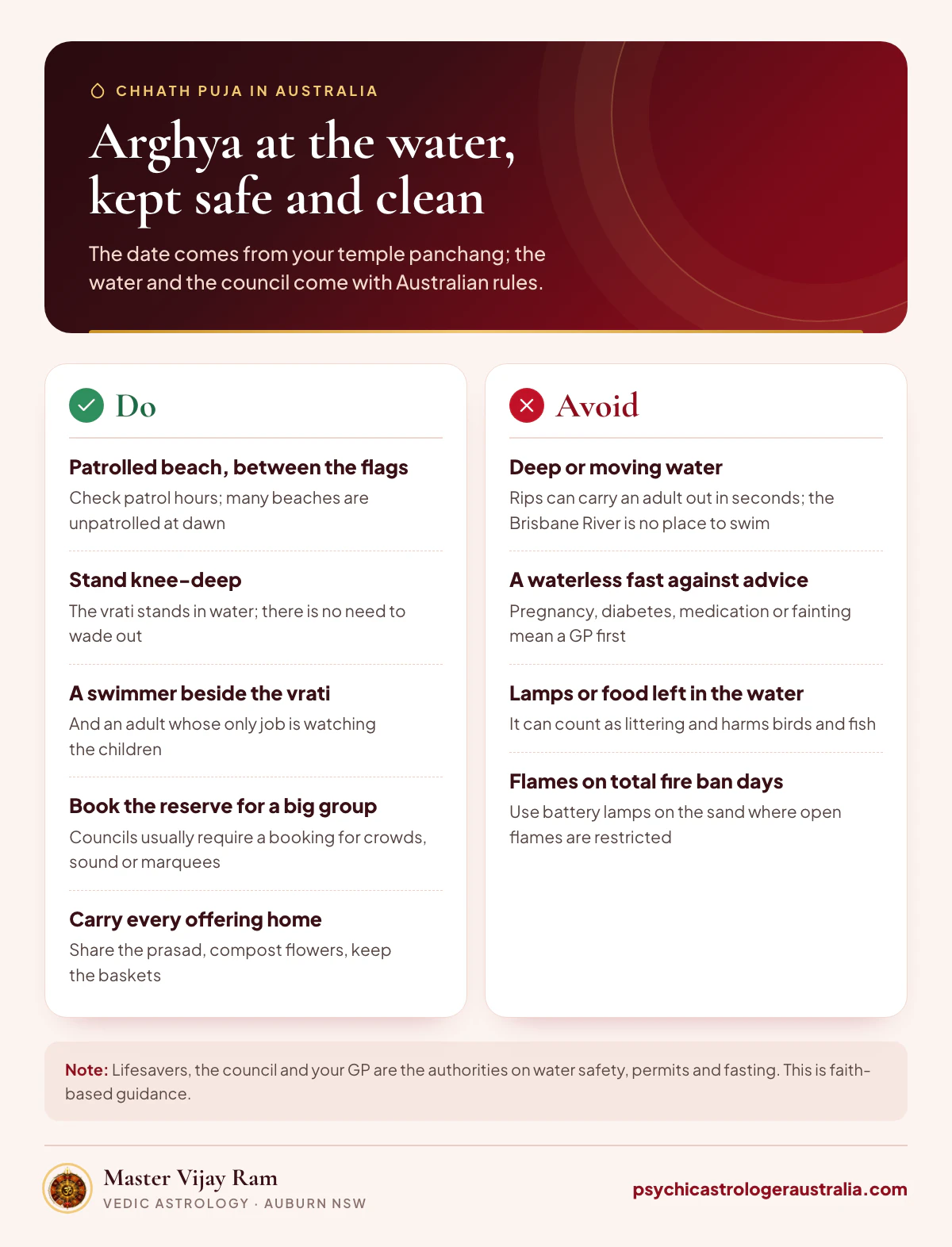
At a beach, choose a patrolled one and stay between the red and yellow flags; patrol hours vary, and many beaches are not patrolled at dawn or after the evening patrol ends, so check before you go. Knee-deep is enough for the arghya; the tradition asks for the vrati to stand in water, not to wade out. Someone who can swim should stand nearby, children should be held or watched by an adult who is doing nothing else, and nobody who has fasted for a day and a half should be in deep or moving water.
Lakes and rivers bring their own risks: sudden drop-offs, cold water, mud and, in some places, closures for blue-green algae. Rivers such as the Brisbane River are not swimming places at all. Check the council's or the state government's water-quality notices for the lake you plan to use, and never enter water where swimming is signposted as prohibited.
Is the fast safe?
The traditional Chhath vrat runs from the Kharna meal on the second evening until after the dawn arghya, about thirty-six hours without food or water, and it comes on the warm side of spring, when Brisbane, Perth and the north can be hot. That is a real strain on the body, especially for older women, who are often the most devoted vratis.
Anyone pregnant, diabetic, on regular medication, with kidney or heart disease or prone to fainting should speak to a GP before keeping a waterless fast, and many families now have the vrati sip water or keep a fruit fast with the GP's blessing. Fasting and standing in water is a particular risk; if the vrati feels faint, she comes out of the water and sits down, and the family completes the arghya on her behalf.
Do you need council permission for a gathering?
For a family of six at a quiet lake, usually not. For a community Chhath with dozens or hundreds of people, a sound system, a marquee and a barbecue, most councils require a booking or event permit for the park or beach reserve, and many associations now apply months ahead.
Rules commonly cover open flames on beaches and in parks, which are restricted and banned outright on total fire ban days; amplified sound, especially before dawn; parking and access for emergency vehicles; and leaving the site clean. Lamps are best kept to battery-powered ones on the sand, or real diyas only where the council allows and well away from dry grass.
Asking first earns goodwill. A council that has seen a well-run, clean Chhath one year is usually glad to see it back the next.
Where do the offerings go afterwards?
Home, every one of them. In India it was the custom to leave flowers, lamps and some offerings in the river, and that habit does not travel. In Australia anything left in the sea, a lake, a creek or on the sand can count as littering or illegal dumping under state law, and floating lamps and food harm birds and fish.
The prasad, thekua and fruit are eaten and shared, as they always were. Flowers and leaves go to the home compost or the council green bin, bamboo baskets are kept for next year, and anything that cannot be reused goes in the right household bin. The guide to lighting a diya has notes on keeping lamps safe, which applies to a beach as much as a balcony.
What about families who keep Chhath at home?
Many do, and for good reasons: a parent too frail for the beach, a work shift, a long drive, or a council that has said no. A backyard pool, a large tub of water or a clean garden pond can hold the vrati for the arghya, facing the setting and rising Sun across the garden.
The rite is complete wherever it is done with devotion. A Hobart family on the Derwent foreshore, a Canberra family on the edge of a lake and an apartment family in Parramatta offering arghya from a bucket on the balcony are all keeping Chhath.
How do families in Perth, Adelaide and Brisbane keep it?
For Chhath Puja in Perth, the west-facing beaches give the evening arghya a sea sunset, and the Indian Ocean's swell is a reason to choose a calm, patrolled stretch or the river shore. Perth families seeking a reading consult by phone or video, in English, Hindi or Punjabi.
Adelaide's gulf beaches are calmer than the open ocean and face west too. In Brisbane and on the Gold Coast, community groups often use lakes and lagoons for the evening and the surf beaches for the dawn, with the Queensland clock steady because there is no daylight saving.
When might a Surya puja on request help?
A vrati who is ill or travelling sometimes asks for a Surya puja to be offered on her behalf during Chhath, or a family with a reading that points to the Sun asks for a graha shanti for the Sun. The puja is then performed personally on request at Master Vijay Ram's place of practice in Auburn, with the family joining by video.
A consultation is $50; a puja starts from $250, and the figure is agreed before anything is performed. It supports the festival; it does not replace the family's own arghya.
What can this page not tell you?
It does not give the Chhath dates for any year, because they come from your community's panchang, and it cannot speak for any council's rules, which change and should be checked directly. It is faith-based guidance, not medical, legal or water-safety advice; lifesavers, the council and your GP are the authorities on those.
Nor does a rite promise an outcome. Vedic astrology reads tendencies and timing, and Chhath is gratitude to the Sun for another year of light. Stand in shallow water, keep the children close, take everything home, and let the last light and the first be the festival.
Read next
- Hartalika Teej 2027 in Australia: Date and the FastHartalika Teej 2027 is Friday 3 September in every Australian city and India. The story, the evening puja, the nirjal…
- Nag Panchami 2027 in Australia: Date and What Families OfferNag Panchami 2027 is Friday 6 August in every Australian city and India. What families offer, why milk is not for rea…
- Black Magic Signs in the Family Home: A Household ChecklistA calm household checklist for black magic signs in the family home: what to rule out first, the shared-roof test, an…
Frequently asked questions
When is Chhath Puja in Australia?
Chhath falls on the Shashthi of Kartika's bright fortnight, about six days after Diwali, with the four days running from the Chaturthi to the Saptami dawn. This site does not compute its date, so families follow the panchang their community uses and the date their temple or association announces. In 2027 Diwali is Friday 29 October, so Chhath follows in early November.
Where do families keep Chhath Puja in Sydney and Melbourne?
Beaches, lakes, lagoons and backyard pools all serve. On the east coast the Sun sets behind the land, so many families choose a lake with a western view for the evening arghya and a patrolled beach for the dawn. Community groups often book a council reserve; check local water-quality and swimming notices first.
Is it safe to stand in the sea for the Chhath arghya?
Only with care. Choose a patrolled beach, stay between the red and yellow flags, check patrol hours because many beaches are unpatrolled at dawn, and stand knee-deep rather than waist-deep. Keep a swimmer nearby, hold or closely watch children, and keep a fasting vrati out of deep or moving water. Rips can carry adults out in seconds.
Can the Chhath fast be kept with water?
Yes, where health requires it. The traditional fast is about thirty-six hours without food or water, which is risky for anyone pregnant, diabetic, on medication, with kidney or heart disease or prone to fainting. Those vratis should speak to a GP, and many families now accept sips of water or a fruit fast as a full observance.
Can I leave Chhath offerings in the water?
No. In Australia anything left in the sea, a lake, a creek or on the sand can count as littering or illegal dumping, and floating lamps and food harm wildlife. Eat and share the prasad, compost flowers and leaves or use the council green bin, keep the bamboo baskets for next year, and take everything else home.
Do we need a council permit for a community Chhath?
For a small family group usually not, but a gathering of many people with a sound system, marquee or barbecue generally needs a booking or event permit from the council that manages the park or beach. Rules commonly cover open flames, total fire ban days, amplified sound before dawn, parking and cleaning up. Ask the council well ahead.
Can Chhath be kept at home?
Yes. A backyard pool, a clean garden pond or a large tub of water can hold the vrati for the arghya, facing the setting and rising Sun. Families with a frail parent, a work shift or no suitable water nearby keep the full four days at home, and the rite is complete wherever it is done with devotion.
Can Master Vijay Ram perform a Surya puja during Chhath?
Yes, on request, for example when the vrati is ill or travelling. He performs it personally at his place of practice in Auburn, and the family can join by video. A consultation is $50; a puja starts from $250, agreed before anything is performed. It supports the festival rather than replacing the family's own arghya.
People also ask
What are the four days of Chhath Puja?
Nahay Khay on the Chaturthi, a purifying bath and one simple meal; Kharna on the Panchami, a day fast broken with jaggery kheer, after which the long fast begins; Sandhya Arghya on the Shashthi, offerings to the setting Sun in water; and Usha Arghya on the Saptami dawn, offerings to the rising Sun before the fast is broken.
Why is Chhath not given a date on this site?
The site computes many festival dates for Australian cities from the ephemeris, but Chhath is not among them. Communities follow their own panchang, often the Mithila or Banarasi calendar, so the date announced by your temple or association is the one to follow each year.
Which Australian beaches face the sunset for Chhath?
Beaches facing west, such as Perth's Indian Ocean coast and Adelaide's metropolitan gulf beaches, give a sunset over the water for the evening arghya. East-coast beaches face the sunrise instead, so many families there use a lake or lagoon with a clear western view for the evening.
Who is Chhathi Maiya?
Chhathi Maiya is the goddess honoured alongside the Sun at Chhath, often described as the Sun's sister or as a mother goddess who protects children. Families pray to her for the health and long life of their children and household during the four days of the festival.
References & further reading
Serving clients across Australia
Confidential consultations by phone, video & WhatsApp — including: