

Quick answer
Karva Chauth 2027 falls on Monday 18 October by the moonrise rule and Tuesday 19 October by the sunrise rule, because the Chaturthi tithi runs from 5:52 pm IST on the Monday to 4:43 pm IST on the Tuesday. In Perth the moon rises inside the tithi on Monday at 9:31 pm AWST; in the eastern states neither evening's moonrise does, so families follow their temple's panchang.
Karva Chauth 2027 at a glance
Karva Chauth is a one-day fast kept by married women, and increasingly by their husbands alongside them, from before sunrise until the moon is sighted on the fourth night after the Ashwin full moon, the Krishna Chaturthi of Kartika in the north Indian calendar. The fast is broken only after the moon has been seen through a sieve and the husband has offered the first sip of water, which is why, for Karva Chauth 2027, the moonrise time in your own city matters more than any other number in the festival.
In 2027 the date itself is contested, and honestly so. The Chaturthi tithi begins at 5:52 pm IST on Monday 18 October and ends at 4:43 pm IST on Tuesday 19 October, which is 11:22 pm Monday to 10:13 pm Tuesday in Sydney, Melbourne, Canberra and Hobart. Two traditional rules give two different days, and the table below gives the moonrise for both evenings in every Australian capital and the main regional centres, so that your family can follow whichever day its panchang names.
| City | Krishna Chaturthi (local time) | Moonrise Mon 18 Oct | Moonrise Tue 19 Oct |
|---|---|---|---|
| Sydney | Mon 18 Oct 2027, 11:22 PM AEDT to Tue 19 Oct 2027, 10:13 PM AEDT | 10:09 pm | 11:14 pm |
| Melbourne | Mon 18 Oct 2027, 11:22 PM AEDT to Tue 19 Oct 2027, 10:13 PM AEDT | 10:47 pm | 11:53 pm |
| Brisbane | Mon 18 Oct 2027, 10:22 PM AEST to Tue 19 Oct 2027, 9:13 PM AEST | 8:44 pm | 9:47 pm |
| Perth | Mon 18 Oct 2027, 8:22 PM AWST to Tue 19 Oct 2027, 7:13 PM AWST | 9:31 pm ✓ | 10:35 pm |
| Adelaide | Mon 18 Oct 2027, 10:52 PM ACDT to Tue 19 Oct 2027, 9:43 PM ACDT | 10:35 pm | 11:40 pm |
| Canberra | Mon 18 Oct 2027, 11:22 PM AEDT to Tue 19 Oct 2027, 10:13 PM AEDT | 10:22 pm | 11:27 pm |
| Hobart | Mon 18 Oct 2027, 11:22 PM AEDT to Tue 19 Oct 2027, 10:13 PM AEDT | 10:56 pm | 12:04 am (after midnight) |
| Darwin | Mon 18 Oct 2027, 9:52 PM ACST to Tue 19 Oct 2027, 8:43 PM ACST | 9:13 pm | 10:13 pm |
| Gold Coast | Mon 18 Oct 2027, 10:22 PM AEST to Tue 19 Oct 2027, 9:13 PM AEST | 8:44 pm | 9:47 pm |
| Newcastle | Mon 18 Oct 2027, 11:22 PM AEDT to Tue 19 Oct 2027, 10:13 PM AEDT | 10:04 pm | 11:08 pm |
| Wollongong | Mon 18 Oct 2027, 11:22 PM AEDT to Tue 19 Oct 2027, 10:13 PM AEDT | 10:12 pm | 11:17 pm |
| Geelong | Mon 18 Oct 2027, 11:22 PM AEDT to Tue 19 Oct 2027, 10:13 PM AEDT | 10:51 pm | 11:57 pm |
| Sunshine Coast | Mon 18 Oct 2027, 10:22 PM AEST to Tue 19 Oct 2027, 9:13 PM AEST | 8:42 pm | 9:45 pm |
| Cairns | Mon 18 Oct 2027, 10:22 PM AEST to Tue 19 Oct 2027, 9:13 PM AEST | 8:50 pm | 9:51 pm |
| Townsville | Mon 18 Oct 2027, 10:22 PM AEST to Tue 19 Oct 2027, 9:13 PM AEST | 8:51 pm | 9:52 pm |
| Central Coast | Mon 18 Oct 2027, 11:22 PM AEDT to Tue 19 Oct 2027, 10:13 PM AEDT | 10:07 pm | 11:12 pm |
| New Delhi (reference) | Mon 18 Oct 2027, 5:52 PM IST to Tue 19 Oct 2027, 4:43 PM IST | 7:30 pm ✓ | 8:24 pm |
✓ marks a moonrise that falls inside the Chaturthi tithi. Moonrise is for the city centre and a flat horizon; hills and buildings can delay the first sighting by several minutes. Computed with the Swiss Ephemeris (Lahiri ayanamsa for Vedic positions) and checked against US Naval Observatory data. Times are rounded to the minute.
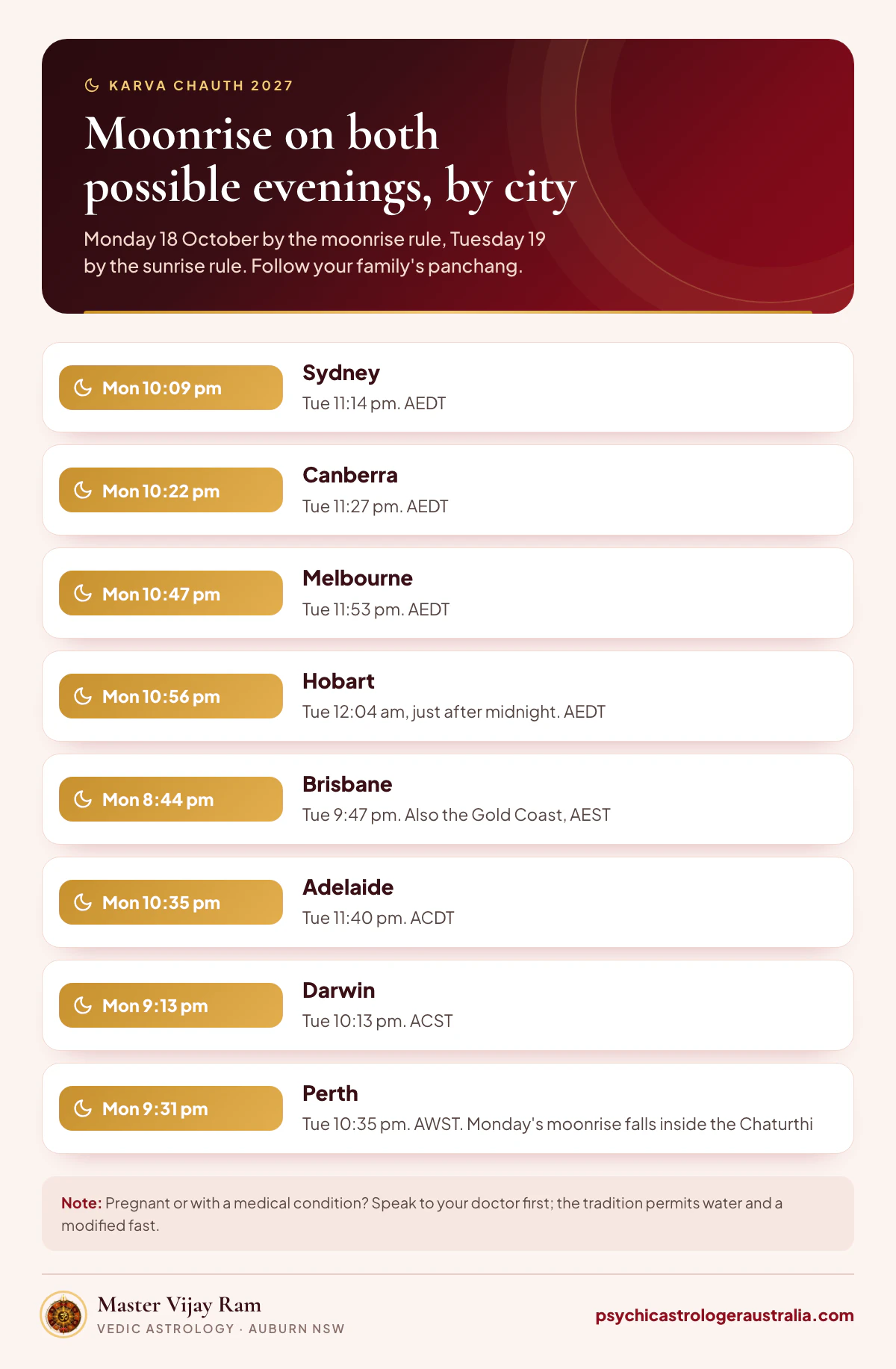
Why do panchangs disagree about the 2027 date?
Two rules are in use. The moonrise rule says the fast belongs to the evening on which the Chaturthi tithi is running when the moon rises, because that is the moment the fast is broken. The sunrise rule, used for most vrats, says a tithi belongs to the day on which it is running at sunrise.
In 2027 the two rules part company. In Delhi the moon rises at 7:30 pm on Monday 18 October, an hour and a half after the tithi has begun, so the moonrise rule gives Monday. But the tithi is still running at sunrise on Tuesday 19 October and has ended by Tuesday's moonrise at 8:24 pm, so the sunrise rule gives Tuesday. Published panchangs have taken both positions, and neither is a mistake; they are applying different rules to the same sky.
Which day should an Australian family keep?
Follow the panchang your family or temple already uses, because a fast kept on the day one's mother-in-law keeps it is the fast that fits the household. If no one has a settled view, the moonrise rule has the stronger claim for Karva Chauth specifically, since the whole observance is built around sighting the moon, and it gives Monday 18 October in India and in Perth.
Perth is the one Australian city where the question is clean. The tithi begins there at 8:22 pm AWST on the Monday and the moon rises at 9:31 pm, inside it, so Monday 18 October is Karva Chauth in Perth by the same rule that gives Monday in India.
In Sydney, Melbourne, Brisbane, Adelaide, Canberra, Hobart and Darwin the situation is different and worth understanding. The tithi begins after Monday's moonrise, by just over an hour in Sydney and by only seventeen minutes in Adelaide, and ends before Tuesday's moonrise. Neither evening's moonrise falls inside the Chaturthi, so the moonrise rule gives no answer at all in the east, and families there have always, in practice, followed the Indian date or their temple's announcement. Both evenings are in the table for that reason.
Moonrise on Monday 18 October 2027
On the Monday the moon, three days past full, rises in the east about three hours after sunset. In the eastern states daylight saving began on 3 October, so the clock reads late: 10:09 pm in Sydney, 10:22 pm in Canberra, 10:47 pm in Melbourne and 10:56 pm in Hobart, all AEDT. Brisbane and the Gold Coast, on standard time, see it at 8:44 pm AEST; Adelaide at 10:35 pm ACDT; Darwin at 9:13 pm ACST; Perth at 9:31 pm AWST.
For a woman who has fasted since before dawn, a Melbourne moonrise approaching 11 pm is a long day, and that is one reason many eastern families prefer the Monday to the Tuesday: Tuesday's moon is later still.
Moonrise on Tuesday 19 October 2027
Each night the moon rises roughly an hour later than the night before. On the Tuesday it rises at 11:14 pm in Sydney, 11:27 pm in Canberra, 11:53 pm in Melbourne and four minutes after midnight in Hobart, which is technically Wednesday by the clock. Brisbane sees it at 9:47 pm AEST, Adelaide at 11:40 pm ACDT, Darwin at 10:13 pm ACST and Perth at 10:35 pm AWST.
A family keeping the Tuesday in Melbourne or Hobart should plan for a moon close to midnight and a working day on either side of it. There is no shame in choosing the Monday for that reason alone; the tradition has never asked anyone to harm their health for a clock.
Why does the moon rise so late on Karva Chauth in Australia?
Karva Chauth always falls three to four days after a full moon, and a waning gibbous moon rises a few hours after sunset wherever you are. What makes the eastern states feel later than India is the clock, not the sky. Daylight saving adds an hour to every reading in October, and Melbourne and Adelaide sit well west of the central meridian of their zone, which adds more. Delhi's 7:30 pm moonrise and Sydney's 10:09 pm are the same lunar event seen from different longitudes under different clock rules.
Brisbane, with no daylight saving and a position near the eastern edge of its zone, is the earliest of the capitals at 8:44 pm, which is why Queensland families often have the easiest evening of anyone in the country.
How the fast is kept
The observance is simple and has not changed much in a century. Before sunrise the fasting woman eats sargi, the meal her mother-in-law traditionally prepares or sends, often fruit, sweets, fenugreek seeds and a little bread, and from then until moonrise she takes neither food nor water in the strict form of the vrat. In the afternoon or early evening the women gather in their wedding finery, listen to the Karva Chauth katha, pass the karva, the small clay pot, around the circle and sing.
At moonrise the woman looks at the moon through a sieve, then at her husband through the same sieve, offers water to the moon from the karva and prays for his long life. He then offers her the first sip of water and the first morsel of food, and the fast ends with the family meal. Many couples now fast together, which the tradition does not forbid and to which Vijay Ram ji sees no objection.
Clock times for sargi are not given here, because dawn times are not part of the moonrise table. Sargi is eaten before the first light; the exact minute is a family matter, not an astronomical one.
Keeping the fast on a working day
Both candidate days in 2027 are weekdays, and most Australian women keeping the fast will do so between a morning meeting and a late moonrise. The practical habits that help are modest ones.
- Eat the sargi properly, with protein and water, rather than a token bite.
- Book the afternoon off if you can; if not, lay out the puja clothes and the karva the night before so the evening is not a scramble.
- Tell your workplace you are fasting. Most Australian employers have met Ramadan and will understand a one-day vrat.
- Agree the moonrise time with the family in advance from the table, so no one is checking three apps at 10 pm.
- If you have a medical condition or are pregnant, speak to your doctor first; the tradition permits water and a modified fast, and no priest will say otherwise.
Finding the moon over buildings and hills
The moonrise times in the table are for a flat horizon at the city centre. A waning gibbous moon rises a little north of due east in an Australian October, and in a street of apartment blocks or against the ranges behind Hobart and Cairns it may not clear the skyline until ten or twenty minutes after the tabled time. The tradition only asks that the moon be seen; it does not ask that it be seen on the minute.
Balconies facing east, a beach, a park or an upper-floor window all help. Families in the inner suburbs of Melbourne and Sydney often drive ten minutes to a hill or an oval rather than wait for the moon to appear between towers.
What if clouds hide the moon?
Spring evenings in Sydney and on the Queensland coast can be cloudy, and the question comes up every year. The traditional answer is to wait a reasonable time, then break the fast after the tabled moonrise with the puja done facing the moon's direction, since the moon has risen whether or not it is visible. Some families use a reflection in water or a photograph; elders differ, and the elders' view is the one to follow. What nobody should do is extend a dry fast into the small hours because the sky stayed grey.
Karva Chauth, marriage and the chart
Around Karva Chauth, many of the women who write to Master Vijay Ram are not asking about moonrise. They are asking about a marriage that has gone quiet, a husband who is away, in-laws who are hard, or a wedding that has not happened yet. The fast is a sincere act of devotion and he honours it as such; he is equally clear that it is not a remedy for a marriage in trouble, and that a vrat cannot do the work of a conversation.
Where the difficulty has a pattern, a Vedic reading can show it: a seventh house under Saturn's gaze, a Venus period that has run its course, or a Sade Sati that is pressing on both partners at once. Marriage problem guidance is where he reads that for couples; a love and marriage prediction is for the woman who keeps the fast in hope of a wedding still to come; and relationship compatibility is for families weighing a match before one. None of these replaces the fast, and the fast does not replace them.
Karva Chauth, Diwali and the moon in 2027
The whole festival fortnight is laid out by the moon. The Ashwin full moon, Sharad Purnima, falls at 12:47 am AEDT on Saturday 16 October 2027; Karva Chauth comes three or four days later on the Krishna Chaturthi; and Diwali's Lakshmi Puja is on Friday 29 October, with the new moon itself at 12:37 am AEDT on the Saturday. The Lakshmi Puja times for every city are published separately, and the full and new moon dates for 2027 give the rest of the year's tithi calendar.
Families in Melbourne, with the latest moonrise of the mainland capitals, and in Perth, with the clearest date, will find both pages useful for the same reason: the sky is the same, and only the clock differs.
What a moonrise table cannot do
It cannot settle a disagreement between two panchangs, because that is a question of rule rather than of astronomy, and it cannot see your horizon. The times were computed with the Swiss Ephemeris and checked to the minute against United States Naval Observatory data for the city centres, and they will hold for any suburb within thirty kilometres; beyond that, or in the hills, allow a few minutes. The tithi boundaries do not depend on the zodiac used, so every panchang should agree on them to within a minute or two; where calendars differ by a day, it is the rule being applied, not the sky.
Within those limits it does one useful thing: it lets a woman in Brisbane, Darwin or Hobart know, before the day begins, exactly when the fast can end. That is enough.
Read next
- Diwali 2026 and 2027 in Australia: Dates and Lakshmi Puja Times by CityDiwali falls on Sun 8 Nov 2026 and Fri 29 Oct 2027 across Australia. Lakshmi Puja sunset, Pradosh Kaal and Vrishabha …
- Raksha Bandhan 2027: Date and the Best Time to Tie the RakhiRaksha Bandhan 2027 is Tuesday 17 August in Australia and India. Rakhi windows by city, why Bhadra rules out Monday, …
- How Long Does Black Magic Removal Take to Show Results?Black magic removal rarely runs to a fixed date. Here is the honest arc, what tends to shift first, what stretches it…
Frequently asked questions
When is Karva Chauth in 2027?
Either Monday 18 October or Tuesday 19 October 2027, depending on the rule your panchang applies. The Krishna Chaturthi tithi runs from 5:52 pm IST on the Monday to 4:43 pm IST on the Tuesday. By the moonrise rule the fast is on Monday, because the moon rises inside the tithi in India and in Perth; by the sunrise rule it is on Tuesday. Follow your family's or temple's calendar.
What time does the moon rise on Karva Chauth 2027 in Sydney?
At 10:09 pm AEDT on Monday 18 October and 11:14 pm AEDT on Tuesday 19 October. The Chaturthi tithi in Sydney runs from 11:22 pm on the Monday to 10:13 pm on the Tuesday, so neither moonrise falls inside it, which is why Sydney families usually follow the Indian date or their temple's announcement. Newcastle, Wollongong and the Central Coast are within a few minutes of Sydney.
What time does the moon rise on Karva Chauth 2027 in Melbourne?
At 10:47 pm AEDT on Monday 18 October and 11:53 pm AEDT on Tuesday 19 October, the latest of the mainland capitals, because Melbourne sits far west in its time zone and is on daylight saving. Geelong is four to five minutes later still. Families keeping the Tuesday should plan for a moon close to midnight; many choose the Monday for that reason alone.
What time does the moon rise on Karva Chauth 2027 in Brisbane and on the Gold Coast?
At 8:44 pm AEST on Monday 18 October and 9:47 pm AEST on Tuesday 19 October, in both Brisbane and the Gold Coast. Queensland has no daylight saving, so its evening is the earliest of the capitals. The tithi there runs from 10:22 pm on the Monday to 9:13 pm on the Tuesday, so again neither moonrise is inside it and the family or temple calendar decides the day.
What time does the moon rise on Karva Chauth 2027 in Perth?
At 9:31 pm AWST on Monday 18 October, which is inside the Chaturthi tithi (8:22 pm Monday to 7:13 pm Tuesday in Perth time), and at 10:35 pm AWST on Tuesday 19 October, which is after it has ended. Perth is the one Australian city where the moonrise rule gives a clean answer, Monday, the same day it gives in India.
What are the moonrise times in Adelaide, Canberra, Hobart and Darwin?
Monday 18 October: Adelaide 10:35 pm ACDT, Canberra 10:22 pm AEDT, Hobart 10:56 pm AEDT, Darwin 9:13 pm ACST. Tuesday 19 October: Adelaide 11:40 pm, Canberra 11:27 pm, Hobart 12:04 am (after midnight, early Wednesday), Darwin 10:13 pm. In Adelaide the tithi begins at 10:52 pm on the Monday, just seventeen minutes after moonrise, which is the closest call in the country.
Why is Karva Chauth 2027 listed as 18 October on some calendars and 19 October on others?
Because two rules exist. The moonrise rule assigns the fast to the evening on which the Chaturthi is running at moonrise, which in 2027 is Monday 18 October in India. The sunrise rule assigns a tithi to the day on which it is running at sunrise, which is Tuesday 19 October. Both are traditional, both are applied by reputable panchangs, and the astronomy behind them is identical.
Can the fast be broken if the moon cannot be seen?
Yes, after a reasonable wait. The moon has risen at the tabled time whether or not cloud hides it, so the traditional fallback is to perform the puja facing the direction of the moon and break the fast after that time. Some families accept a reflection in water or a photograph; elders differ on this, and their view is the one to follow. Nobody should extend a dry fast past midnight because the sky was grey.
Can unmarried or engaged women keep Karva Chauth?
Many do. Engaged women often keep the fast for their future husband, and in some families unmarried women keep it in hope of a good match. Nothing in the vrat forbids it. What the fast cannot do is produce a marriage on its own; where a wedding is delayed, the honest step is to look at the seventh house and the running dasha in the birth chart rather than to add more fasts.
Does Karva Chauth help a troubled marriage?
As devotion, it is real and it is honoured. As a remedy for a marriage in difficulty, it is not enough on its own, and no honest astrologer will say otherwise. A quiet, strained or distant marriage usually has causes that show in the chart, such as Saturn's influence on the seventh house or a difficult dasha period, and in life, such as money, in-laws or distance. Those are addressed in a consultation, not by a single night's fast.
Do husbands fast on Karva Chauth too?
Increasingly, yes. The traditional observance is the wife's, and the husband's part is to offer her the first water and food at moonrise. Many couples in Australia now keep the fast together, and nothing in the tradition forbids it. Master Vijay Ram sees no objection; a fast shared is a conversation shared, and the marriage is usually the better for it.
People also ask
What is the moonrise rule for Karva Chauth?
The fast is assigned to the evening on which the Krishna Chaturthi tithi is running at the moment the moon rises, because sighting the moon is what ends the fast. In 2027 that gives Monday 18 October in India, where the Delhi moon rises at 7:30 pm with the tithi running, and in Perth. In the Australian east neither evening qualifies, so the family calendar decides.
How many days after the full moon is Karva Chauth?
Three to four. It falls on the fourth tithi of the waning fortnight after the Ashwin full moon, Sharad Purnima, which in 2027 is at 12:47 am AEDT on Saturday 16 October. Diwali follows eleven days after Karva Chauth, on Friday 29 October 2027, at the new moon that closes the fortnight. The three dates move together each year because all three are set by the moon.
What is sargi?
Sargi is the meal eaten before sunrise on Karva Chauth, traditionally prepared or sent by the mother-in-law: fruit, sweets, dry fruit, fenugreek seeds and a little bread or paratha. After sargi the strict fast takes no food or water until moonrise. There is no fixed clock time for it; it is eaten before first light, and a sensible sargi with protein and water makes the long Australian evening far easier.
Can I drink water during Karva Chauth?
In the strict nirjala form, no, from sargi until moonrise. The tradition has always allowed a modified fast with water or fruit for women who are pregnant, unwell, breastfeeding or on medication, and no priest will say otherwise. In Australia, where the moon can rise close to 11 pm in Melbourne, anyone with a medical condition should speak to their doctor first and keep the fast in the form their health allows.
What time is Karva Chauth moonrise in India in 2027?
In Delhi the moon rises at 7:30 pm IST on Monday 18 October 2027, inside the Chaturthi tithi that began at 5:52 pm, and at 8:24 pm IST on Tuesday 19 October, after the tithi ended at 4:43 pm. Other Indian cities differ by up to half an hour either way. For Australian families, the Indian time is useful mainly for calling relatives; the local moonrise in the table is the one that ends the fast here.
References & further reading
Serving clients across Australia
Confidential consultations by phone, video & WhatsApp — including: