
Quick answer
Folk belief holds that a likeness of a person, or something that touched them, can stand in for them. In practice your photograph is already everywhere, salon hair goes in a bin, and a worn shirt is just a shirt. Tighten your privacy settings, keep your own prayer, and never take anyone's belongings to reverse anything.
Can someone really do black magic with your photo, hair or clothes?
Sympathetic magic is the folk idea that a likeness of a person, or something that once touched them, can stand in for the person, so that whatever is done to it is felt by them. Two strands run through it: like affects like, which is the logic of the image, and what was once connected stays connected, which is the logic of hair, nails and worn cloth. Both are very old, and both turn up in Indian folk belief as they do almost everywhere else.
The fear that follows is specific. A student in Wollongong hears from an aunt that a photograph from her engagement was "taken for a purpose"; a man in Newcastle notices a shirt missing from the line; a grandmother in Hobart will not leave the hairdresser without her clippings. This page takes each of those fears in turn, says what the tradition holds and what is actually likely, and explains where black magic removal, done honestly fits and where it does not.
What does the folk tradition actually hold?
In the stories families tell, things from the body count for more than pictures. A lock of hair, a nail paring or a cloth worn against the skin is described as carrying something of the person, which is why grandmothers swept up combings and burnt them, clipped nails over a sheet of paper, and never left a child's hair lying about after a haircut. The fear of nails and hair in the wrong hands is one of the most widespread versions of the idea.
Those customs have a plain root as well as a spiritual one: hair and nails left about are unhygienic, and a household that tidies them away is a clean household. Which days families cut hair and nails on is a separate set of customs, explained in hair and nail cutting days.
What the same tradition says far more often is that the person is protected by their own conduct and prayer, not by guarding every hair. What the Vedic tradition says about symbolic harm explains that reading of the image fear in detail, and it is worth reading before anyone spends money on it.
Is your photograph a special risk?
Consider how many places it already sits. Your face is on a driver licence, a passport, a work pass and a staff page; it is in school newsletters, wedding albums forwarded round three countries on WhatsApp, and every group photo anyone has posted. If a photograph were enough for someone to curse you with a photo, every person with a phone would already be exposed, and nobody's life would be steady.
The fear of black magic with a photo is mostly a modern one, and it is usually planted by someone who wants to sell a removal. A Vedic chart is cast from the moment and place of birth, and a face adds nothing to it, which is why vashikaran by photo is refused on this site, and why a practitioner who asks for pictures of other people should be treated with suspicion.
What about hair from a salon or a hairbrush?
A salon in Geelong or on the Sunshine Coast sweeps the floor into a bin many times a day, and your hair goes out with everyone else's. A hairbrush at home, a drain, a pillowcase all shed hair constantly, and none of it is collected by anyone. The idea that a stranger is gathering it for a working asks far more effort of the world than the world usually makes.
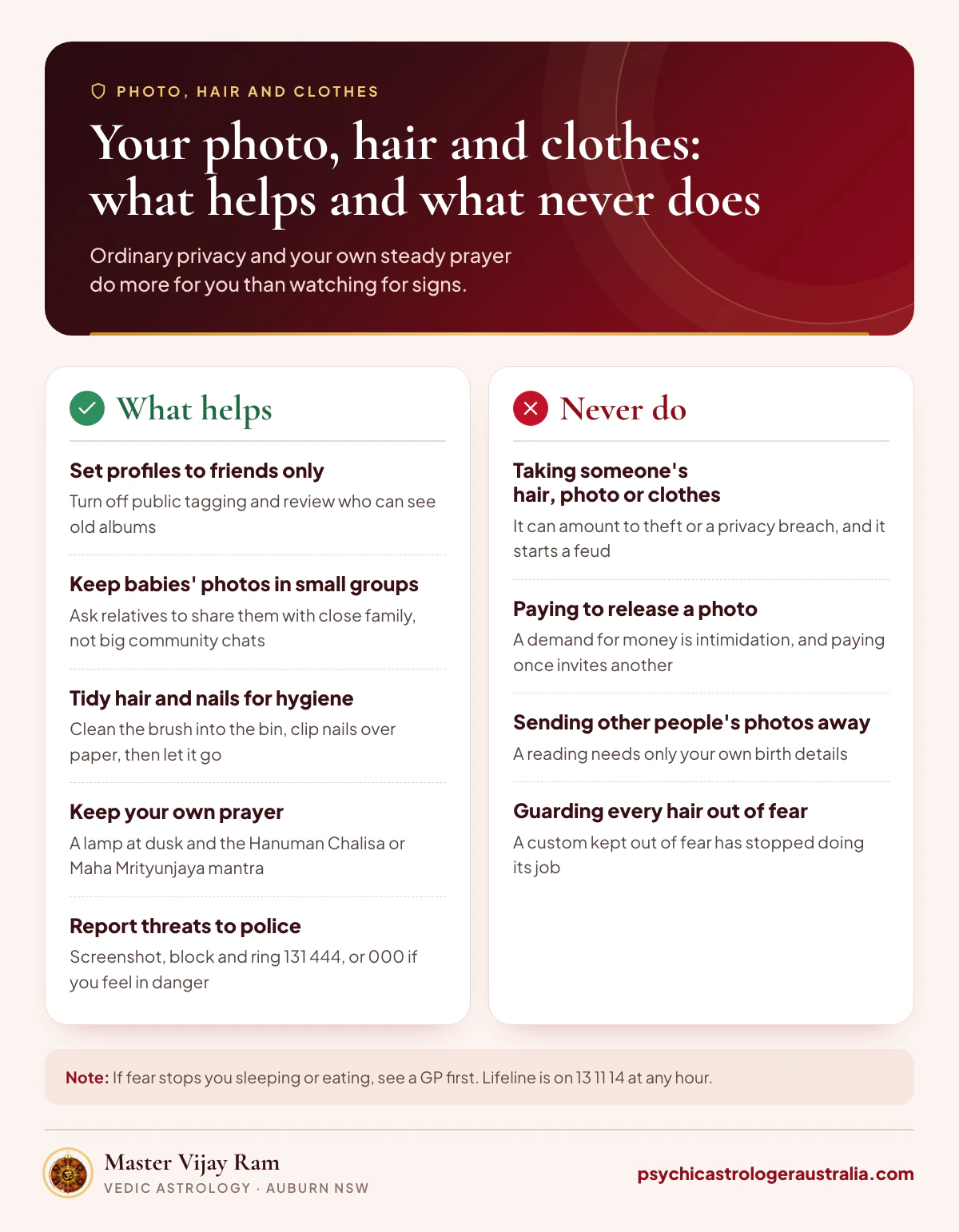
If the custom of tidying hair away gives you peace, keep it: clean the brush into the bin, clip nails over paper, and let it go at that. If it has become a worry you check every day, that is the thing to look at, because a custom kept out of fear has stopped doing its job.
Can worn clothes be used against you?
The fear of black magic with clothes usually starts with something missing. Garments leave washing lines in wind, are dragged off by dogs, fall behind machines in shared laundries, and are occasionally stolen because they were good clothes. A sock that vanishes in a unit block's dryer has met the dryer, not a practitioner.
Giving clothes away is a long tradition of its own, and donating to an op shop or a charity bin is a good act; wash things first, which is simple courtesy. Many families keep the old caution about not handing worn, unwashed clothing to strangers, and there is no harm in keeping it, provided it does not turn into suspicion of a cousin who borrowed a kurta.
What is likely, set against what is feared?
The table puts each personal item beside the folk belief, the ordinary likelihood and one sensible step. None of the steps needs a practitioner.
| What you worry about | What folk belief says | What is actually likely | One sensible step |
|---|---|---|---|
| A photo posted online | An image can stand in for the person | It sits with millions of others and is never used | Set profiles to friends only |
| A photo forwarded in a family group | Someone took it "for a purpose" | Relatives forwarding happy news | Ask that babies' photos stay in small groups |
| Hair at the salon or in a brush | Hair carries something of you | Swept into a bin with everyone else's | Clean the brush into the bin; nothing more |
| Nail clippings | Nails are a link to the body | Lost in the carpet or the vacuum | Clip over paper and bin it, for hygiene |
| A shirt missing from the line | Worn cloth was taken for a working | Wind, a dog, a shared laundry, plain theft | Check the yard and the laundry; report theft |
| Someone says they have your photo or hair | A threat backed by a working | Intimidation, sometimes to extract money | Screenshot, do not pay, tell police |
What privacy steps actually help?
Practical privacy does more for peace of mind than any amount of watching for signs. Set social media profiles to friends only, turn off public tagging, review who can see old albums, and leave location tags off photographs of children. Ask relatives to share babies' pictures in small family groups rather than large community ones, which happens to suit the old nazar custom of not showing a new baby off too widely.
Your rights over personal information held by businesses and agencies are explained by the Office of the Australian Information Commissioner, linked below. An intimate image shared without consent, or online threats, can be reported to the eSafety Commissioner and to police.
What if someone says they have your photo or your hair?
Then the harm is the message, and the message is intimidation. Screenshot it, do not reply in anger, block the sender, and give it to police through 131 444, or ring 000 if you feel in immediate danger. Anyone who asks for money to "release" a photograph or to stop a working is trying to frighten money out of you, and paying once only teaches them to ask again.
If the fear has stopped you sleeping or eating, see a GP first, and ring Lifeline on 13 11 14 if it is overwhelming at any hour. Being frightened by a threat is a normal response, and it deserves care before it deserves a ritual.
What protects you, in the Vedic view?
Your own practice, kept steadily. A lamp at dusk, the Hanuman Chalisa, whose forty chaupais by Tulsidas many families say each evening, or the Maha Mrityunjaya mantra from the Rigveda, said with attention rather than in a panic. Nobody needs to retrieve the photograph or the hair for any of it to work as the tradition intends.
Where a consultation finds that a protective object would genuinely help, a kavach can be prepared for the person who is most frightened; kavach and taweez protection explains what one is and what it is not. Most callers do not need one.
Should you take something of theirs to reverse it?
Never. Taking a relative's hair from a brush, copying a photo from someone's phone, or lifting a garment from a neighbour's line so that a practitioner can "reverse" or "bind" them can amount to theft or a breach of someone's privacy, and it starts the kind of feud that outlasts every other trouble. The tradition does not send harm back, and why harm is never sent back sets out the reasons in full.
A practitioner who asks you to bring someone else's belongings has told you what kind of work they do. Walk away from it, however frightened you are.
What does Master Vijay Ram ask for, and what does it cost?
Three things: your own birth details, the dates when things changed, and your account of what happened, told in English, Hindi or Punjabi over the phone, on video or by WhatsApp. He does not ask for photographs of anyone, hair, nails, clothing or personal items belonging to another person, and he will not accept them if they are offered. The consultation is $50, and most calls about a photo or a missing shirt end with reassurance and no remedy.
Should the chart show a genuine pattern, he names the fee for a removal before anything happens, from $250, and carries the work out himself at Auburn; puja and havan performed on request explains how a family joins by video.
Where does a reading stop when the fear is a photograph?
It cannot find out who has your photograph, track down a stolen shirt or stop someone posting about you. There is no guarantee attached to it, and it belongs to faith rather than to law, medicine or psychology.
Callers from Canberra, Hobart and Wollongong by phone or video are read in exactly the way a Sydney caller is; Auburn, by appointment, is the one place to meet him in person.
What it can do is tell you whether your own chart carries anything in the season that frightened you. Usually it does not, and the most useful advice is the plainest: lock down your settings, keep your prayer, and stop guarding your hairbrush.
Read next
- Black Magic Removal in Sydney: 7 Signs and What a Session InvolvesBlack magic removal in Sydney: the seven signs callers describe, what to rule out first, and what a session with Mast…
- Curse Removal vs Black Magic Removal: What Is the Difference?Curse vs black magic removal: a curse is a spoken or inherited ill-wish, black magic is deliberate ritual work, and t…
- Black Magic vs Bad Luck: How to Tell the DifferenceBlack magic or a plain bad run? Use the three-S test of spread, start line and stall, and rule out the ordinary medic…
Frequently asked questions
Can someone do black magic with my photo?
Folk belief says an image can stand in for a person, but your photograph is already on licences, work pages and countless shared albums, and nothing in a Vedic chart reading turns on a picture. The fear is most often planted by someone selling a removal. Tighten your privacy settings, keep your own prayer, and judge any practitioner who asks for photos with care.
Can black magic be done with hair?
Folk accounts give hair more weight than pictures, which is why grandmothers swept up combings and burnt them. In ordinary life your hair goes into salon bins, drains and vacuum bags with everyone else's, and nobody collects it. If tidying hair away gives you peace, keep the habit as hygiene. If you are checking for lost hair every day, the worry itself deserves attention.
Is it true nail clippings can be used against you?
It is a widespread folk belief, and the household custom it produced, clipping nails over paper and binning them, is good hygiene anyway. Nail clippings lost in a carpet or a vacuum bag are not gathered by anyone. Keep the custom if it suits you, cut on the days your family prefers, and do not let it become a source of daily fear.
A shirt went missing from my washing line. Should I be worried?
Almost certainly not. Wind, dogs, shared laundries and ordinary theft account for missing washing in every suburb. Check the yard, the neighbours' side of the fence and the laundry, and report a theft if valuables keep disappearing. A single missing garment is not a sign of a working, and suspecting a neighbour or relative over it does real harm.
Someone told me they have my photo and will use it against me. What should I do?
Treat it as intimidation. Screenshot the message, do not argue or pay, block the sender and report it to police on 131 444, or 000 if you feel in immediate danger. Anyone demanding money to release a photo or stop a working is threatening you for gain. If the fear is stopping you sleeping, see a GP, and ring Lifeline on 13 11 14 if it feels overwhelming.
Should I take back something of theirs to reverse the magic?
No. Taking someone's hair, photo or clothing so that a practitioner can reverse or bind them is theft or a privacy breach, and it turns suspicion into a feud. The Vedic tradition does not send harm back, and Master Vijay Ram refuses any work aimed at another person. Protection is done in your own name, with your own prayer, and nothing belonging to anyone else.
How do I protect my photos and personal information?
Set social media profiles to friends only, switch off public tagging, review who can see old albums and leave location tags off children's photos. Ask relatives to share babies' pictures in small family groups. The Office of the Australian Information Commissioner explains your rights over personal information held by organisations, and intimate images shared without consent can be reported to the eSafety Commissioner.
What does Master Vijay Ram need for a reading about this?
Only your own birth details, the dates when things changed and your account of what happened. He does not ask for or accept photographs of other people, hair, nails or clothing. A $50 consultation by phone, video or WhatsApp is usually enough, and most such calls end with reassurance. If the chart does show a pattern, removal work begins at $250, with the price agreed before it is performed.
People also ask
Can someone curse you with a photo?
Folk belief holds that a likeness can stand in for a person, and the fear is common. Yet photographs of nearly everyone already circulate on licences, websites and family chats, and lives are not upended by them. The fear is usually raised by a practitioner who wants to sell something. Privacy settings and your own steady prayer are the sensible response, not a paid removal.
What personal items are used in black magic?
Folk accounts mention hair, nail parings, worn clothing and photographs, on the idea that what touched a person stays connected to them. In daily life these items are shed, binned and lost constantly without consequence. The useful response is ordinary tidiness and privacy, not watchfulness, and never taking anyone else's belongings to a practitioner in return.
How do you protect yourself if someone has your hair or photo?
Keep your own practice: a lamp at dusk, the Hanuman Chalisa or the Maha Mrityunjaya mantra said with attention. Lock down your social media, and report any threat to police on 131 444. Nobody needs to retrieve the photo or the hair. A kavach is made only when a consultation shows it would genuinely help, and most people never need one.
Is it bad to give away old clothes in Hinduism?
No. Giving clothes is a long-standing form of charity, and donating to an op shop or a charity bin is a good act. Many families keep an old caution about not handing worn, unwashed clothing to strangers, so wash things first, which is simple courtesy anyway. Lending a kurta to a cousin is not a risk.
References & further reading
Serving clients across Australia
Confidential consultations by phone, video & WhatsApp — including: