
Quick answer
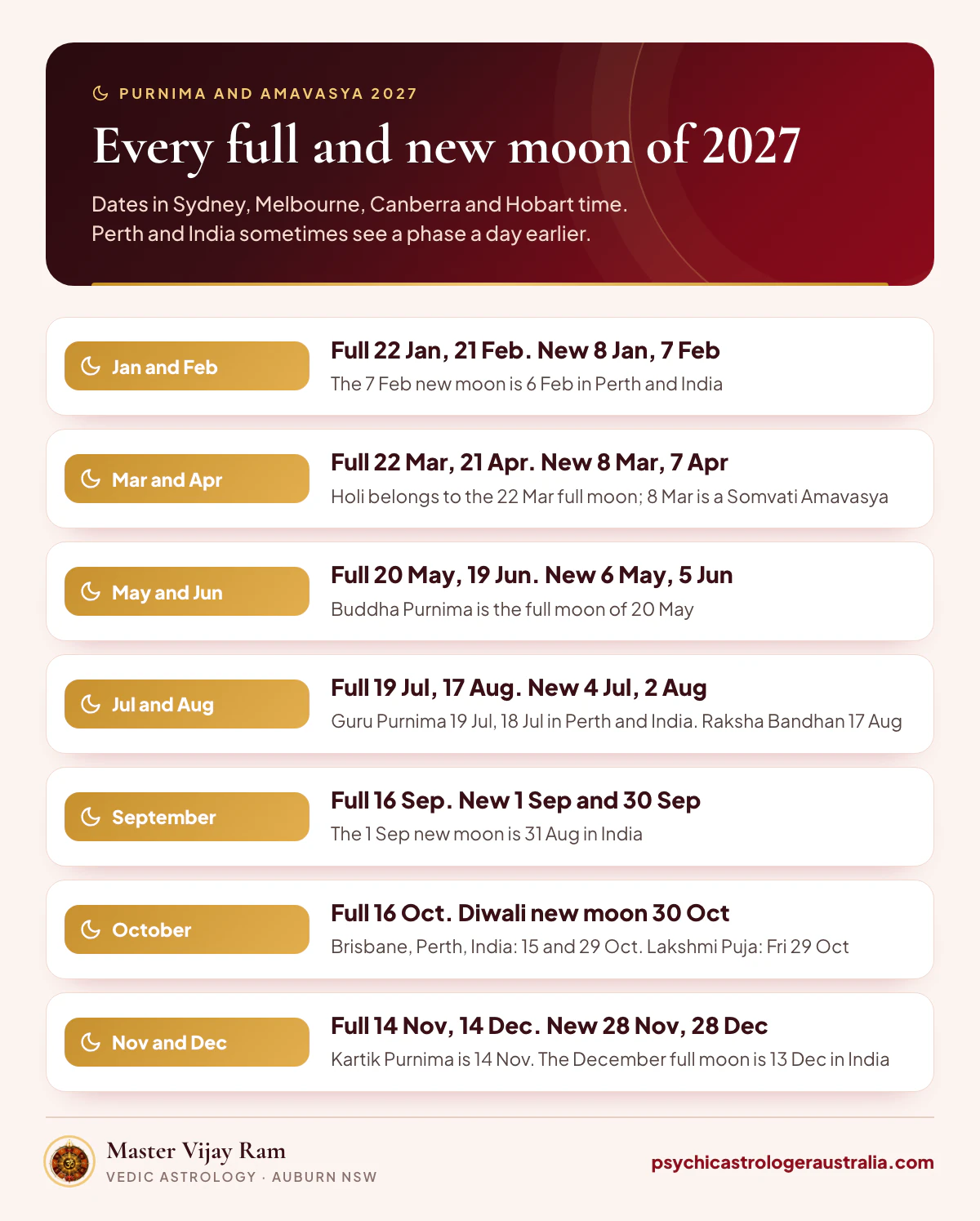
There are 12 full moons and 13 new moons in 2027. In Sydney time the full moons fall on 22 January, 21 February, 22 March, 21 April, 20 May, 19 June, 19 July, 17 August, 16 September, 16 October, 14 November and 14 December. The new moons run from 8 January to 28 December, with Diwali's Amavasya ending at 12:37 am on 30 October. Perth and India sometimes see a phase a day earlier.
Full moon and new moon dates 2027: the short version
A full moon, called Purnima in the Hindu calendar, is the moment the Moon stands exactly opposite the Sun in the sky, and a new moon, Amavasya, is the moment it lines up between us and the Sun. Both are single instants, the same everywhere on Earth, which is why a calendar can give them to the minute years in advance. The full moon and new moon dates for 2027 in Australia run to 12 full moons and 13 new moons.
The two tables below give every one in the time of Sydney, Melbourne, Canberra and Hobart, with the Perth time, the date in India and the Hindu month each phase belongs to. Brisbane and the rest of Queensland share the Sydney date and time from early April to early October and are one hour behind for the rest of the year; Adelaide is always 30 minutes behind Sydney.
The vrat or tarpan day can differ from the date of the instant, city by city: the guides to Purnima 2027 vrat days by city and Amavasya 2027 tarpan days by city work through each one.
Full moon (Purnima) dates 2027 in Australian time
| Date (Sydney) | Exact time (Sydney) | Perth | Date in India | Hindu month name | Moon’s Vedic sign · nakshatra |
|---|---|---|---|---|---|
| Fri 22 Jan | 11:17 pm AEDT | Fri 22 Jan, 8:17 pm | 22 Jan | Pausha Purnima | Karka · Pushya |
| Sun 21 Feb | 10:24 am AEDT | Sun 21 Feb, 7:24 am | 21 Feb | Magha Purnima | Simha · Magha |
| Mon 22 Mar | 9:44 pm AEDT | Mon 22 Mar, 6:44 pm | 22 Mar | Phalguna Purnima | Kanya · Uttara Phalguni |
| Wed 21 Apr | 8:27 am AEST | Wed 21 Apr, 6:27 am | 21 Apr | Chaitra Purnima | Tula · Chitra |
| Thu 20 May | 8:59 pm AEST | Thu 20 May, 6:59 pm | 20 May | Vaishakha Purnima | Vrishchika · Anuradha |
| Sat 19 Jun | 10:44 am AEST | Sat 19 Jun, 8:44 am | 19 Jun | Jyeshtha Purnima | Dhanu · Mula |
| Mon 19 Jul | 1:45 am AEST | Sun 18 Jul, 11:45 pm | 18 Jul | Ashadha Purnima | Makara · Uttara Ashadha |
| Tue 17 Aug | 5:29 pm AEST | Tue 17 Aug, 3:29 pm | 17 Aug | Shravana Purnima | Makara · Dhanishta |
| Thu 16 Sep | 9:04 am AEST | Thu 16 Sep, 7:04 am | 16 Sep | Bhadrapada Purnima | Kumbha · Purva Bhadrapada |
| Sat 16 Oct | 12:47 am AEDT | Fri 15 Oct, 9:47 pm | 15 Oct | Ashwin Purnima | Meena · Revati |
| Sun 14 Nov | 2:26 pm AEDT | Sun 14 Nov, 11:26 am | 14 Nov | Kartika Purnima | Mesha · Krittika |
| Tue 14 Dec | 3:09 am AEDT | Tue 14 Dec, 12:09 am | 13 Dec | Margashirsha Purnima | Vrishabha · Mrigashira |
Brisbane and Queensland: subtract one hour from Sydney time between January and 4 April and from 3 October; otherwise the same. Adelaide is always 30 minutes behind Sydney. Computed with the Swiss Ephemeris (Lahiri ayanamsa for Vedic positions) and checked against US Naval Observatory data. Times are rounded to the minute.
Two full moons deserve a second look. The July full moon falls at 1:45 am on 19 July in the east but late on 18 July in Perth and in India. The October full moon, Sharad Purnima, is at 12:47 am on 16 October in Sydney and on the evening of 15 October in Brisbane, Perth and India. Everything else lands on the same calendar day across Australia, though the December full moon is still 13 December in India.
New moon (Amavasya) dates 2027 in Australian time
| Date (Sydney) | Exact time (Sydney) | Perth | Date in India | Hindu month name | Moon’s Vedic sign · nakshatra |
|---|---|---|---|---|---|
| Fri 8 Jan | 7:24 am AEDT | Fri 8 Jan, 4:24 am | 8 Jan | Margashirsha Amavasya (Pausha in the north Indian calendar) | Dhanu · Purva Ashadha |
| Sun 7 Feb | 2:56 am AEDT | Sat 6 Feb, 11:56 pm | 6 Feb | Pausha Amavasya (Magha in the north Indian calendar) | Makara · Dhanishta |
| Mon 8 Mar | 8:29 pm AEDT | Mon 8 Mar, 5:29 pm | 8 Mar | Magha Amavasya (Phalguna in the north Indian calendar) | Kumbha · Purva Bhadrapada |
| Wed 7 Apr | 9:51 am AEST | Wed 7 Apr, 7:51 am | 7 Apr | Phalguna Amavasya (Chaitra in the north Indian calendar) | Meena · Revati |
| Thu 6 May | 8:59 pm AEST | Thu 6 May, 6:59 pm | 6 May | Chaitra Amavasya (Vaishakha in the north Indian calendar) | Mesha · Bharani |
| Sat 5 Jun | 5:40 am AEST | Sat 5 Jun, 3:40 am | 5 Jun | Vaishakha Amavasya (Jyeshtha in the north Indian calendar) | Vrishabha · Rohini |
| Sun 4 Jul | 1:02 pm AEST | Sun 4 Jul, 11:02 am | 4 Jul | Jyeshtha Amavasya (Ashadha in the north Indian calendar) | Mithuna · Ardra |
| Mon 2 Aug | 8:05 pm AEST | Mon 2 Aug, 6:05 pm | 2 Aug | Ashadha Amavasya (Shravana in the north Indian calendar) | Karka · Pushya |
| Wed 1 Sep | 3:41 am AEST | Wed 1 Sep, 1:41 am | 31 Aug | Shravana Amavasya (Bhadrapada in the north Indian calendar) | Simha · Purva Phalguni |
| Thu 30 Sep | 12:36 pm AEST | Thu 30 Sep, 10:36 am | 30 Sep | Bhadrapada Amavasya (Ashwin in the north Indian calendar) | Kanya · Hasta |
| Sat 30 Oct | 12:37 am AEDT | Fri 29 Oct, 9:37 pm | 29 Oct | Ashwin Amavasya (Kartika in the north Indian calendar) | Tula · Swati |
| Sun 28 Nov | 2:24 pm AEDT | Sun 28 Nov, 11:24 am | 28 Nov | Kartika Amavasya (Margashirsha in the north Indian calendar) | Vrishchika · Anuradha |
| Tue 28 Dec | 7:12 am AEDT | Tue 28 Dec, 4:12 am | 28 Dec | Margashirsha Amavasya (Pausha in the north Indian calendar) | Dhanu · Mula |
Brisbane and Queensland: subtract one hour from Sydney time between January and 4 April and from 3 October; otherwise the same. Adelaide is always 30 minutes behind Sydney. Computed with the Swiss Ephemeris (Lahiri ayanamsa for Vedic positions) and checked against US Naval Observatory data. Times are rounded to the minute.
Because a lunar month is about 29½ days, a year of 365 days has room for a thirteenth new moon when the first one falls early, as it does in 2027 with a new moon on 8 January and the last on 28 December. Three of them shift across a date line somewhere: the February new moon is 7 February here but 6 February in Perth and India, the September one is 1 September here and 31 August in India, and the Diwali new moon is 30 October in Sydney, Melbourne and Adelaide but 29 October in Brisbane, Perth and India.
The extra new moon does not create a leap month. An adhik maas occurs only when two consecutive new moons fall with the Sun in the same sidereal sign, and that does not happen anywhere in 2027.
What exactly are Purnima and Amavasya?
The Hindu calendar divides each lunar month into 30 tithis, and a tithi is the time the Moon takes to move 12 degrees further from the Sun. The bright half, Shukla Paksha, runs from the new moon to the full moon; the dark half, Krishna Paksha, runs back to the next new moon. Purnima is the fifteenth tithi of the bright half and Amavasya the fifteenth of the dark half.
A tithi is not a day. It lasts anywhere from about 19 to 26 hours because the Moon's speed varies, so a Purnima can begin one afternoon and end the next. The times in the tables are the moments each tithi ends, which is the instant of full or new moon itself. Festival observance then follows rules about which part of the tithi matters: sunrise, midday or the evening Pradosh period.
Why can the same full moon fall on different dates in Perth, Sydney and India?
The Moon reaches fullness at one instant. What changes is the clock on the wall. The July full moon happens at 15:45 Universal Time on 18 July, which is 1:45 am on 19 July in Sydney, 11:45 pm on 18 July in Perth and 9:15 pm on 18 July in India.
The same shift sends the new moon of Diwali to 12:37 am on 30 October in Sydney while Brisbane, Perth and India record it on 29 October, and the Sharad Purnima to 16 October in Sydney but 15 October in those three places. When a family in Adelaide rings relatives in Ludhiana to compare a date, both are right; they are reading the same instant from different time zones.
The practical rule: for anything timed to the Moon, use the time for where you physically are. A fast broken at moonrise in Perth is broken at Perth's moonrise, and the Karva Chauth moonrise times for every Australian city show how much that can differ.
Amanta and purnimanta: why one new moon has two month names
South and west India, and most Australian temples with a Tamil, Telugu, Kannada, Marathi or Gujarati congregation, use the amanta calendar, in which a month ends at the new moon. North India, Punjab included, uses the purnimanta calendar, in which a month ends at the full moon. The full moons carry the same names in both systems; the new moons do not.
That is why the Diwali new moon is Ashwin Amavasya for an amanta family and Kartik Amavasya for a purnimanta one. In the new-moon table above the main name follows amanta reckoning and the bracketed note gives the north Indian name. Neither is wrong, and the observance date is identical, because the festival is fixed by the tithi rather than by the month label.
Which festivals fall on a full moon in 2027?
These are the Purnima festivals whose dates follow directly from the table. Dates are for eastern Australia; Perth and India differ only where noted.
- Holi belongs to the Phalguna Purnima of 22 March. Holika Dahan is lit on the Purnima evening and the colours follow the next morning; because the tithi ends in the afternoon in India and late in the evening in Australia, your temple's panchang decides the exact evening.
- Buddha Purnima is the Vaishakha full moon of 20 May.
- Guru Purnima is the Ashadha full moon: 19 July in eastern Australia, 18 July in Perth and India.
- Raksha Bandhan falls on the Shravana Purnima of 17 August.
- Sharad Purnima, the Kojagiri full moon of Ashwin, is 16 October in Sydney, Melbourne and Adelaide and 15 October in Brisbane, Perth and India.
- Kartik Purnima, with Dev Deepawali, is 14 November.
Festivals tied to other tithis, such as Navratri, Janmashtami or Mahashivratri, are not fixed by a full or new moon and need their own panchang entry, so they are left out here rather than guessed.
Which festivals fall on a new moon in 2027?
The great one is Diwali. The Amavasya tithi runs from 2:19 am on Friday 29 October to 12:37 am on Saturday 30 October in Sydney time, and from 8:49 pm on 28 October to 7:07 pm on 29 October in India, so Lakshmi Puja is on the evening of Friday 29 October in every Australian city and in India alike. The Lakshmi Puja times for each city, with sunset and the Pradosh window, are set out separately.
Every other Amavasya of the year has a quieter role: it is the day for remembering ancestors, for tarpan, and traditionally for pausing rather than starting. The fortnight of Pitru Paksha ends on an Amavasya, and a Somvati Amavasya, a new moon that falls on a Monday, is kept with particular care by many families. There are two in 2027, on 8 March and 2 August, in Australia and in India alike.
Eclipses in 2027: which ones can Australia actually see?
An eclipse can only happen at a full moon (lunar) or a new moon (solar), and 2027 has five, but Australia gets very little of them. The table says which.
| Date (Sydney) | Eclipse | Greatest eclipse (Sydney) | From Australia | Notes |
|---|---|---|---|---|
| Sun 7 Feb 2027 | Annular solar eclipse | 3:00 am AEDT | Not visible from Australia | |
| Sun 21 Feb 2027 | Penumbral lunar eclipse | 10:13 am AEDT | Visible from Perth | Penumbral magnitude 0.93 |
| Mon 19 Jul 2027 | Penumbral lunar eclipse | 2:03 am AEST | Visible from Sydney, Brisbane, Adelaide, Darwin, Perth, Hobart | Penumbral magnitude 0.00 — too faint to notice |
| Mon 2 Aug 2027 | Total solar eclipse | 8:07 pm AEST | Not visible from Australia | |
| Tue 17 Aug 2027 | Penumbral lunar eclipse | 5:14 pm AEST | Visible from Sydney, Brisbane, Adelaide, Hobart | Penumbral magnitude 0.55 |
Computed with the Swiss Ephemeris (Lahiri ayanamsa for Vedic positions) and checked against US Naval Observatory data. Times are rounded to the minute.
In plain terms: the annular solar eclipse of 7 February and the long total solar eclipse of 2 August, which crosses Spain, North Africa and the Arabian Peninsula, are both invisible from anywhere in Australia. The penumbral lunar eclipse of 21 February is visible only from Perth and Western Australia, low in the western sky in the early morning; the Moon has already set for the eastern states. The penumbral eclipse of 19 July has a magnitude of 0.001, which means the Moon barely grazes the outer shadow; it is listed for completeness and nobody will notice it with the eye. The 17 August eclipse is the one eastern Australians can watch: a faint shading on the rising Moon in the early evening from Sydney, Brisbane, Adelaide and Hobart.
Vedic custom observes sutak, the period of restraint before and during an eclipse, only for an eclipse that is visible where you live. On that rule most Australians have no solar sutak at all in 2027, Western Australians have one lunar eclipse to observe in February, and the eastern states have one in August. Vijay Ram ji's advice is the traditional one: no new undertakings during a visible eclipse, a bath and a quiet mantra afterwards, and no fear about the ones you cannot see.
What Vijay Ram ji suggests doing on Purnima
None of this needs anything bought. Purnima is a day of fullness, and the traditional practices are about gratitude and steadiness.
- Light a lamp at dusk and, if your family keeps it, read or listen to the Satyanarayan katha at home.
- Eat lightly or fast until moonrise if your health allows; the point is attention, not hardship.
- Spend a few minutes outside with the Moon in view. A mala of Om Namah Shivaya, or simply quiet, is enough.
- Give something away: food, time or money to someone who needs it more.
- Avoid arguments and large financial decisions; the mind is said to run high on a full moon.
What Vijay Ram ji suggests doing on Amavasya
- Remember your ancestors. Offer water with black sesame, or simply speak their names and cook a dish they loved.
- Light a lamp of sesame oil at dusk, facing south if you can.
- Keep the day quiet. Tradition advises against beginning a new venture, a journey or a purchase on Amavasya, and Vijay Ram ji keeps to that in muhurta work.
- On a Somvati Amavasya, the Monday new moons of 8 March and 2 August, many families fast and visit a Shiva temple.
- If the day coincides with a visible eclipse, which no Amavasya does anywhere in Australia in 2027, follow the eclipse rules instead.
Does the full moon really affect sleep and mood?
Honestly, the evidence is mixed. A few sleep studies have reported people sleeping a little less around the full moon, others have found nothing, and hospital admissions do not rise in any consistent way. Jyotish does not rest its case on those studies. It treats the Moon as the significator of the mind and the full and new moons as the two points when that mind is at its most expansive and its most withdrawn, which is a description of a rhythm to work with rather than a medical claim.
If low mood, broken sleep or anxiety persist regardless of the Moon, that is a reason to speak with a doctor, and Master Vijay Ram will say so plainly rather than offer a remedy for something a remedy cannot touch.
How Master Vijay Ram uses the lunar calendar
In 40+ years of practice the tithi has been the first thing Vijay Ram ji checks for any muhurta, before the weekday and before the planets. A wedding, a griha pravesh or a business opening is placed on a tithi suited to it, away from Amavasya, away from an eclipse, and with the Moon in a nakshatra that is friendly to the person's own birth star. Your Moon sign and nakshatra are the reference points for that.
The same calendar runs through a yearly reading: the new and full moons mark the months of a Varshphal, the Vedic yearly forecast, and the Moon's position on each one is read against the chart. For the planetary side of 2027, the Mercury retrograde dates sit alongside this list.
What a moon calendar cannot tell you
A list of dates is the same for everyone. It cannot say whether a particular full moon is favourable for you, because that depends on where the Moon falls from your own Moon sign, on the dasha you are running and on the strength of the Moon in your birth chart. For that, a kundli reading is the honest next step, and it is available by phone, video or WhatsApp anywhere in the country, from Darwin to Hobart.
Use the tables above for what they are good for: knowing in advance when the lamp goes on, when the fast is kept and when the family in India will be celebrating a day before you do.
Read next
- Moon Sign (Rashi) Explained: How to Find Yours and Why It MattersYour Moon sign (rashi): what it is, why Vedic astrology reads from it rather than the Sun sign, the 12 rashis and the…
- Zodiac Sign Dates 2027: Western and Vedic Dates ComparedEvery 2027 zodiac sign date in Australian time, Western and Vedic side by side, with Sankranti times for Sydney, Pert…
- What to Expect From a Vashikaran Specialist: A Full WalkthroughA plain walkthrough of a vashikaran consultation in Australia: what you are asked, what is read, what gets refused, a…
Frequently asked questions
How many full moons are there in 2027?
Twelve, one each month: 22 January, 21 February, 22 March, 21 April, 20 May, 19 June, 19 July, 17 August, 16 September, 16 October, 14 November and 14 December in Sydney time. The July and October full moons fall a day earlier in Perth and India, October's in Brisbane too, and December's is a day earlier in India. There is no blue moon in 2027, because no calendar month contains two full moons.
How many new moons are there in 2027?
Thirteen in Australian time: 8 January, 7 February, 8 March, 7 April, 6 May, 5 June, 4 July, 2 August, 1 September, 30 September, 30 October, 28 November and 28 December. September has two because the first falls on the 1st and the second on the 30th. In Perth and India the February new moon is recorded on 6 February, and in Brisbane, Perth and India the October one on 29 October.
When is Diwali 2027 in Australia?
Friday 29 October 2027, in every Australian city and in India. The Amavasya tithi runs from 2:19 am on 29 October to 12:37 am on 30 October in Sydney time, so the evening of the 29th falls inside it everywhere in the country. Lakshmi Puja is performed in the Pradosh period after local sunset, and the exact window for each city is published in the Diwali guide on this site.
What is the difference between Purnima and a full moon?
Nothing in the instant: Purnima ends at the exact moment of full moon. The difference is that Purnima is a tithi, a span of roughly a day during which the Moon covers the final 12 degrees before it stands opposite the Sun, while a Western almanac's full moon names only the moment. Festival rules refer to the tithi, which is why a Purnima observance can fall on the day before the almanac's date.
Why does the Indian calendar show a different date for the same Purnima or Amavasya?
Because India is 4½ to 5½ hours behind eastern Australia. A full moon at 1:45 am on 19 July in Sydney is still the evening of 18 July in India. Most of the year the dates match; in 2027 they differ for the full moons of July, October and December and for the new moons of February, September and October. Both calendars describe the same instant.
Is there an adhik maas (leap month) in 2027?
No. An adhik month is inserted when two consecutive new moons fall while the Sun is in the same sidereal sign, which happens roughly every 32 months. Each of the 13 new moons of 2027 sees the Sun in a different sign, so the amanta months run from Pausha, which begins after the 8 January new moon, to Margashirsha, which ends on 28 December, with no extra month between them.
Which eclipses can I see from Australia in 2027?
Two, both lunar and both penumbral, meaning a faint shading rather than a bite out of the Moon. On the morning of 21 February Western Australia can see one low in the west before moonset; on the early evening of 17 August the eastern states and Adelaide can see one on the rising Moon. The solar eclipses of 7 February and 2 August are not visible from Australia, and the 19 July lunar eclipse is too slight to notice anywhere.
Do I need to observe sutak for an eclipse that is not visible in Australia?
By the traditional rule, no. Sutak and its restrictions on eating, temple visits and new work apply only to an eclipse visible from where you stand. For the eastern states that leaves one lunar eclipse in 2027, on 17 August; Perth has the faint February event; Darwin has none at all. Pregnant women and the unwell are traditionally the most careful, and a bath and a short prayer afterwards close the observance.
What should I do on a full moon day?
Keep it simple and buy nothing. Light a lamp at dusk, eat lightly or fast until moonrise if your health allows, spend a few quiet minutes with the Moon in view, chant if that is your practice, and give something away. Families who keep the Satyanarayan katha read it at home. Avoid arguments and large financial decisions, since the mind is traditionally said to run high on Purnima.
Can I start a new business or move house on Amavasya?
Tradition advises against beginning things on Amavasya, and Vijay Ram ji avoids it when choosing a muhurta, along with eclipse days and a few other tithis. It is not a day of harm, only of pause: ancestor remembrance, cleaning, closing accounts and quiet all suit it. If a settlement or a signing cannot be moved, he will choose the best available hour on the day rather than refuse it.
Why does the table give the Moon's nakshatra for each phase?
Because the lunar months take their names from the nakshatra the full moon falls in or near: the Chaitra full moon of 21 April sits in Chitra itself, and Shravana is named for the star near its full moon, even in a year when the Moon is in the neighbouring Dhanishta. In a muhurta the nakshatra on the day is weighed against your own birth star, so the same Purnima can suit one person and not another.
Where do these times come from, and how reliable are they?
They are computed with the Swiss Ephemeris, the planetary model most professional panchang software uses, converted to each time zone including daylight saving, and checked against the US Naval Observatory's published phase times, which agree to within a minute. The Vedic sign and nakshatra use the Lahiri ayanamsa, the standard for Indian government panchangs. Festival observance rules can still vary between temples.
People also ask
When is the first full moon of 2027?
Friday 22 January at 11:17 pm in Sydney, 8:17 pm in Perth, with the Moon in Cancer (Karka) and the nakshatra Pushya. That makes it the Pausha Purnima. It is a late-evening full moon on the east coast, so the Moon is well up by the time it reaches fullness, which suits the traditional practice of a lamp and a few minutes outside.
When is the next new moon after Diwali 2027?
Sunday 28 November at 2:24 pm Sydney time, 11:24 am in Perth, with the Moon in Scorpio (Vrishchika) and the nakshatra Anuradha. In amanta reckoning it is the Kartika Amavasya; north Indian calendars call it Margashirsha. The year's final new moon follows on Tuesday 28 December at 7:12 am in Sydney.
Is the 2 August 2027 solar eclipse visible in Australia?
No. The total eclipse of 2 August 2027 crosses Spain, North Africa and the Arabian Peninsula, and its greatest point comes at 8:07 pm AEST, when the Sun is below the horizon everywhere in Australia. No part of the country sees even a partial phase, so by the traditional rule no sutak applies here for it.
What is Somvati Amavasya and when is it in 2027?
A new moon that falls on a Monday, considered especially auspicious for a fast and a visit to a Shiva temple; married women traditionally circle a peepal tree. In 2027 there are two, on 8 March and 2 August, and both are Mondays in Australia and in India alike, because the new moon occurs in the afternoon in India and the evening here.
Why are there 13 new moons but only 12 full moons in 2027?
The lunar cycle is 29.53 days, so about 12.4 cycles fit in a year, and which phase gets the extra one depends on where the year begins. In 2027 the first new moon arrives on 8 January and the last on 28 December, leaving room for thirteen, while the full moons start on 22 January and finish on 14 December with no room for another.
References & further reading
Serving clients across Australia
Confidential consultations by phone, video & WhatsApp — including: