
Quick answer
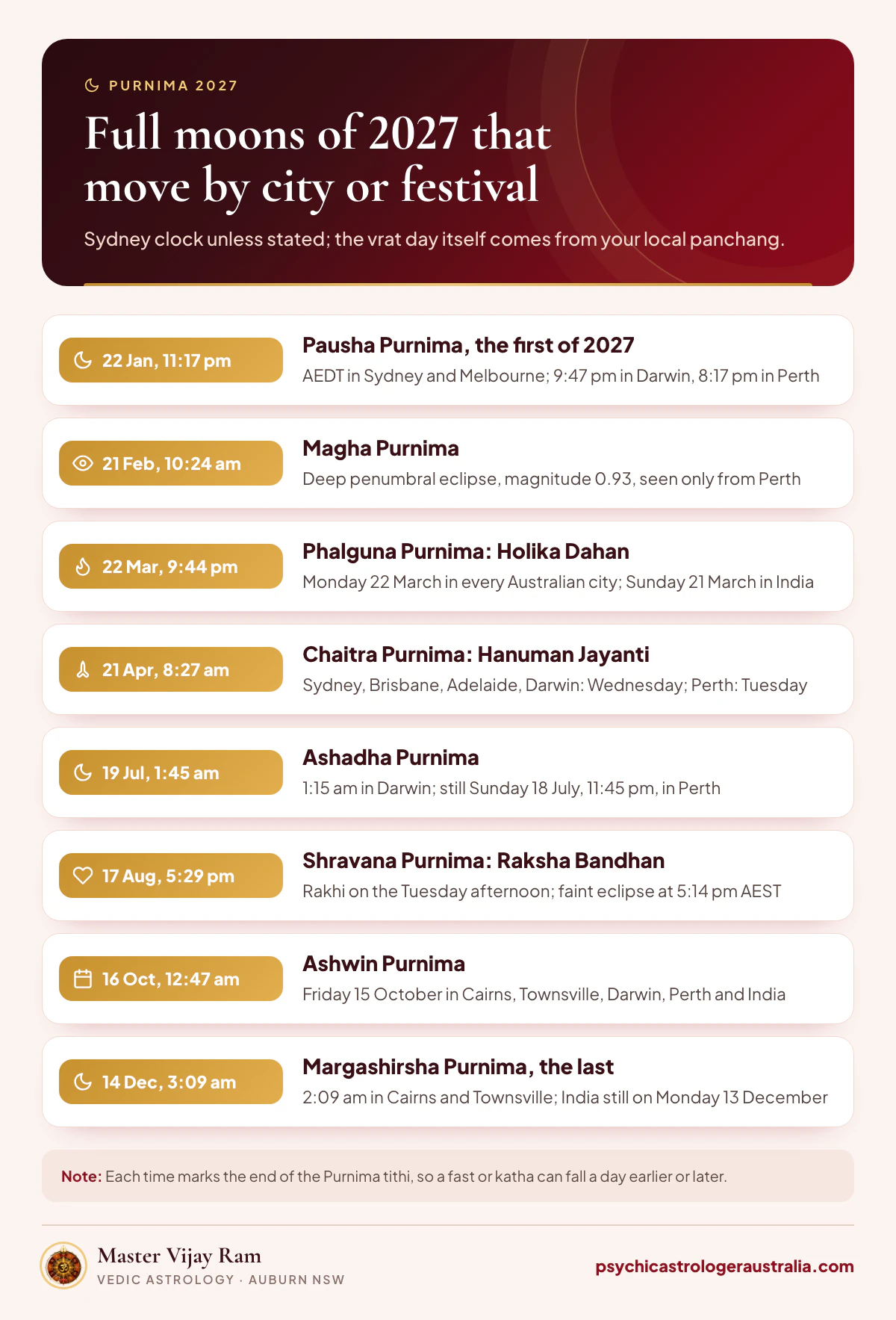
Australia has twelve full moons in 2027, from Friday 22 January to Tuesday 14 December on the Sydney clock. Cairns and Townsville run an hour behind Sydney in summer and Darwin up to ninety minutes, so October's full moon falls on Friday 15 October there. The instant is not always the vrat day: your local panchang decides that.
What is Purnima, and why does your city change the time?
Purnima is the full-moon tithi, the fifteenth lunar day of the bright fortnight, that ends at the exact moment the Moon stands opposite the Sun. That moment is shared by the whole planet, but the hour on your kitchen clock is not, so Purnima 2027 reads a little differently in Darwin, Townsville and Melbourne.
This guide gives the Purnima dates for 2027 on the Sydney clock, shows how each city converts them, and explains why the day a family keeps its fast is sometimes not the date in the table. Picking a good day for something larger, such as a wedding, a griha pravesh or a shop opening, belongs to a muhurat consultation for auspicious dates.
Both the full and the new moons of 2027 sit side by side in the 2027 full and new moon dates; this guide stays with Purnima and the day to keep it in your city.
When are the twelve full moons of 2027?
| Date (Sydney) | Exact time (Sydney) | Perth | Date in India | Hindu month name | Moon’s Vedic sign · nakshatra |
|---|---|---|---|---|---|
| Fri 22 Jan | 11:17 pm AEDT | Fri 22 Jan, 8:17 pm | 22 Jan | Pausha Purnima | Karka · Pushya |
| Sun 21 Feb | 10:24 am AEDT | Sun 21 Feb, 7:24 am | 21 Feb | Magha Purnima | Simha · Magha |
| Mon 22 Mar | 9:44 pm AEDT | Mon 22 Mar, 6:44 pm | 22 Mar | Phalguna Purnima | Kanya · Uttara Phalguni |
| Wed 21 Apr | 8:27 am AEST | Wed 21 Apr, 6:27 am | 21 Apr | Chaitra Purnima | Tula · Chitra |
| Thu 20 May | 8:59 pm AEST | Thu 20 May, 6:59 pm | 20 May | Vaishakha Purnima | Vrishchika · Anuradha |
| Sat 19 Jun | 10:44 am AEST | Sat 19 Jun, 8:44 am | 19 Jun | Jyeshtha Purnima | Dhanu · Mula |
| Mon 19 Jul | 1:45 am AEST | Sun 18 Jul, 11:45 pm | 18 Jul | Ashadha Purnima | Makara · Uttara Ashadha |
| Tue 17 Aug | 5:29 pm AEST | Tue 17 Aug, 3:29 pm | 17 Aug | Shravana Purnima | Makara · Dhanishta |
| Thu 16 Sep | 9:04 am AEST | Thu 16 Sep, 7:04 am | 16 Sep | Bhadrapada Purnima | Kumbha · Purva Bhadrapada |
| Sat 16 Oct | 12:47 am AEDT | Fri 15 Oct, 9:47 pm | 15 Oct | Ashwin Purnima | Meena · Revati |
| Sun 14 Nov | 2:26 pm AEDT | Sun 14 Nov, 11:26 am | 14 Nov | Kartika Purnima | Mesha · Krittika |
| Tue 14 Dec | 3:09 am AEDT | Tue 14 Dec, 12:09 am | 13 Dec | Margashirsha Purnima | Vrishabha · Mrigashira |
Brisbane and Queensland: subtract one hour from Sydney time between January and 4 April and from 3 October; otherwise the same. Adelaide is always 30 minutes behind Sydney. Computed with the Swiss Ephemeris (Lahiri ayanamsa for Vedic positions) and checked against US Naval Observatory data. Times are rounded to the minute.
The year opens with the Pausha Purnima late on Friday 22 January, at 11:17 pm AEDT, with the Moon in Karka and the nakshatra Pushya. It closes with the Margashirsha Purnima at 3:09 am AEDT on Tuesday 14 December, in the small hours after a Monday night.
No adhik month is inserted in 2027, so every Purnima keeps its ordinary month name and none is doubled. Sydney, Melbourne and the Central Coast can use the table exactly as printed, because New South Wales and Victoria move their clocks together.
How do Cairns, Townsville and Darwin read the Sydney times?
| Where you are | Standard time | Daylight saving | Compared with Sydney |
|---|---|---|---|
| NSW (incl. Central Coast), Victoria (incl. Geelong), ACT, Tasmania | AEST, UTC+10 | AEDT, UTC+11 | Same as Sydney all year |
| Queensland (Brisbane, Gold Coast, Sunshine Coast, Townsville, Cairns) | AEST, UTC+10 | None | Same April–October; 1 hour behind October–April |
| South Australia (Adelaide) | ACST, UTC+9:30 | ACDT, UTC+10:30 | 30 minutes behind all year |
| Northern Territory (Darwin) | ACST, UTC+9:30 | None | 30 minutes behind April–October; 1½ hours behind October–April |
| Western Australia (Perth) | AWST, UTC+8 | None | 2 hours behind April–October; 3 hours behind October–April |
In 2027 daylight saving ends on Sunday 4 April and begins on Sunday 3 October.
Queensland stays on Australian Eastern Standard Time all year. Between the end of daylight saving on Sunday 4 April and its return on Sunday 3 October, Cairns and Townsville share Sydney's clock and need no arithmetic; outside that span, take one hour off, so the Kartika full moon on Sunday 14 November comes at 1:26 pm in the north instead of 2:26 pm.
Darwin also keeps one clock all year, half an hour west of Queensland's. Subtract 30 minutes from the Sydney figure from April to early October and 90 minutes for the rest of the year: the Shravana full moon lands at 4:59 pm in Darwin against 5:29 pm in Sydney, and the January one at 9:47 pm.
Perth has a column of its own in the full-moon table. Adelaide is the easiest conversion in the country, half an hour behind Sydney in every month.
Which full moons fall on a different date in the north and west?
For ten of the twelve, the calendar date holds from Cairns to Perth. July and October land close enough to midnight that the date itself shifts inside Australia, and December shifts only for relatives in India; those three are worth writing on the fridge calendar.
- July, the Ashadha Purnima: 1:45 am on Monday 19 July in Sydney, Melbourne, the Central Coast, Cairns and Townsville, and 1:15 am that Monday in Darwin, but 11:45 pm on Sunday 18 July in Perth, with India also on 18 July.
- October, the Ashwin Purnima: 12:47 am on Saturday 16 October in Sydney, Melbourne and the Central Coast, yet 11:47 pm on Friday 15 October in Cairns and Townsville, 11:17 pm that Friday in Darwin and 9:47 pm in Perth; India records 15 October.
- December, the Margashirsha Purnima: 3:09 am on Tuesday 14 December in Sydney, 2:09 am in Cairns and Townsville, 1:39 am in Darwin and 12:09 am in Perth, while India is still on Monday 13 December.
October is the one that catches families out. A household in Townsville comparing notes with cousins in Melbourne will find the same full moon a calendar day apart, and both of their calendars are correct.
Is the full-moon instant the same day as the Purnima vrat?
Not always, and most printed lists skip this. A tithi is a stretch of the Moon's journey lasting roughly a day, and the time in the table marks the instant the Purnima tithi ends, not the day it covers.
When that instant falls after midnight, as it does in July, October and December on the east coast, the Purnima has already filled most of the previous day, and the bright Moon you step outside to see is the one that rose the evening before. A panchang may then list the Purnima, and the fast, against the day before the date printed here.
Family custom matters too. Some households keep the Purnima vrat on the day whose sunrise falls inside the tithi, others on the day whose evening and moonrise do, so the observance can sit a day earlier or later than the instant; how a panchang's five limbs are reckoned explains why a calendar calculated for your own city is the one to follow.
What does keeping a Purnima fast involve?
In form it is simple. Many families avoid grain from sunrise, take fruit and milk if they need them, offer water to the Moon once it has risen and break the fast after the evening puja.
A vrat can be one meal, or a changed diet rather than an empty stomach. Pregnancy, diabetes, an eating disorder, regular medication or night shifts mean a word with your GP comes first, and no tradition asks anyone to fast against medical advice.
For a nurse coming off nights at Townsville University Hospital, a Purnima might be a single plain meal and a lamp at moonrise. The intention carries the practice; hunger is not the point.
Why is the Satyanarayan katha read at the full moon?
The Satyanarayan katha is a household puja to Vishnu as the lord of truth, read in five short chapters and closed with a shared prasad, and the Purnima evening is its customary time. Some families read it every month; others keep it for a new house, an anniversary or a child's exam results.
It needs no priest. A clean corner, a picture of Vishnu, a lamp, tulsi leaves, fruit and a sweet offering such as sheera or panjiri are enough, and the story can be read in Hindi, Punjabi or English so that the children follow it.
Where a family would like the puja performed for them, perhaps after a reading has shown a heavy period, Master Vijay Ram performs it personally at his place of practice in Auburn on a chosen muhurat, and the family may join by video. Puja or havan performed on request starts from $250, and the figure is agreed before anything is performed.
Why is Holika Dahan on Monday 22 March across Australia?
The Holi bonfire follows the pradosh rule, which wants the Purnima present after local sunset. In 2027 the Phalguna Purnima begins at 11:52 pm AEDT on the Sunday night and ends with the full moon at 9:44 pm AEDT on the Monday, so Monday 22 March is the evening in every Australian city, Darwin and the north included.
India lights its fires on Sunday 21 March, because there the tithi starts at 6:22 pm IST, inside the Indian evening, and the colours follow on Monday 22 March. Australian families play Rangwali Holi on Tuesday 23 March; Holika Dahan windows for each city give the hour.
Why does Perth keep Hanuman Jayanti a day before Darwin?
Hanuman Jayanti belongs to the Chaitra Purnima and to the sunrise rule. The tithi runs from 9:22 am AEST on Tuesday 20 April to the full moon at 8:27 am AEST on Wednesday 21 April, so Sydney, Melbourne, Brisbane, Adelaide and Darwin all meet it at Wednesday's sunrise and keep Wednesday 21 April.
On Perth's clock the same tithi begins after Tuesday's sunrise and is gone before Wednesday's, so it greets no Perth sunrise at all, and the day it fills is used instead: Tuesday 20 April, the same day as India. One instant, two festival dates, inside a single country.
When is the rakhi tied at the Shravana full moon?
Raksha Bandhan falls on Tuesday 17 August in every Australian city and in India. The Shravana Purnima begins at 2:59 pm AEST on Monday 16 August, but Bhadra occupies the first half of the tithi, right through Monday afternoon and evening, so the thread waits for Tuesday.
On the Tuesday the Purnima lasts until the full moon at 5:29 pm AEST, which puts the Australian rakhi in the afternoon, while India ties in the morning, before its Purnima closes at 12:58 pm IST. Raksha Bandhan timing by city sets out each window.
That same afternoon brings a faint penumbral lunar eclipse, greatest at 5:14 pm AEST and listed for Sydney, Brisbane, Adelaide and Hobart, with a magnitude of 0.55. A family that keeps eclipse customs strictly can tie the thread earlier in the afternoon.
Which 2027 full moons bring an eclipse?
| Date (Sydney) | Eclipse | Greatest eclipse (Sydney) | From Australia | Notes |
|---|---|---|---|---|
| Sun 7 Feb 2027 | Annular solar eclipse | 3:00 am AEDT | Not visible from Australia | |
| Sun 21 Feb 2027 | Penumbral lunar eclipse | 10:13 am AEDT | Visible from Perth | Penumbral magnitude 0.93 |
| Mon 19 Jul 2027 | Penumbral lunar eclipse | 2:03 am AEST | Visible from Sydney, Brisbane, Adelaide, Darwin, Perth, Hobart | Penumbral magnitude 0.00 — too faint to notice |
| Mon 2 Aug 2027 | Total solar eclipse | 8:07 pm AEST | Not visible from Australia | |
| Tue 17 Aug 2027 | Penumbral lunar eclipse | 5:14 pm AEST | Visible from Sydney, Brisbane, Adelaide, Hobart | Penumbral magnitude 0.55 |
Computed with the Swiss Ephemeris (Lahiri ayanamsa for Vedic positions) and checked against US Naval Observatory data. Times are rounded to the minute.
A lunar eclipse can only happen at a full moon, and three of the year's five eclipses do. The Magha Purnima of Sunday 21 February brings a deep penumbral eclipse, magnitude 0.93, visible only from Perth; the Ashadha Purnima's eclipse in July has a magnitude of 0.001, too faint for any eye; and the Shravana Purnima's eclipse on 17 August is the pale shading described above.
For Cairns, Townsville, Darwin, Sydney and Melbourne, then, the February eclipse is out of sight and the July one unnoticeable. The two solar eclipses belong to new moons and are covered in the Amavasya 2027 dates by city.
How do families in Cairns, Townsville and Darwin keep Purnima?
Mostly at home, with a community calendar on the wall. In Cairns the Cairns Hindu Samaj, founded in 2019 and raising funds for a temple, and GOPIO Cairns hold festivals in community halls and parks; in Townsville the North Queensland Hindu Community Inc. has begun building the Shree Durga Mahalakshmi Temple, and a BAPS mandir meets in Railway Estate.
Darwin has its temple already: the Sri Sithy Vinayakar Temple at Malak, home of the Hindu Society of the Northern Territory for more than four decades. On the Central Coast, Hindu Temple Central Coast Inc. holds festivals such as Janmashtami and Ganesh Chaturthi, and Auburn is close enough for an in-person appointment.
The habit that matters is the same everywhere: take the day from a panchang worked out for your own city rather than a printed Indian calendar. Darwin is four hours ahead of India all year, so a katha begun at 7 pm in Nightcliff lets grandparents in Delhi join at 3 pm their time.
How does Vijay Ram ji use the full moon in readings?
In muhurat work a Purnima counts as a strong tithi, but it is never chosen on the phase alone. The Moon's nakshatra that day, the weekday, the rising sign and the chart of the person concerned decide whether a particular full moon suits a house-warming or a business opening.
In a yearly reading the full moons mark the high points of each lunar month, and the sign each one falls in is read against your own Moon. A Varshphal yearly forecast sets those months out for one person rather than for everyone at once.
What can a table of full moons not tell you?
A table is identical for every reader. It cannot say whether a given Purnima favours your plans, since that rests on your own Moon, the dasha you are running and the Moon's strength in your chart, and it cannot stand in for a doctor, a counsellor or a lawyer when life needs one.
A consultation is $50 by phone, video or WhatsApp, in English, Hindi or Punjabi. There is no office in Darwin or anywhere in the north; Master Vijay Ram sees people in person only at Auburn, by appointment, and readings for Darwin and the Top End explain how the clock is handled from there.
Read next
- Amavasya 2027 in Australia: Tarpan Days and New Moon Times by CityAmavasya 2027 in Australia: 13 new moon dates and times by city, the Diwali Amavasya, pitru tarpan, Shani Amavasya an…
- Satyanarayan Katha After a Move or a Hard YearSatyanarayan katha at home after a move or a hard year: the five chapters, why Purnima, the 2027 full moons, the pras…
- What to Expect From a Vashikaran Specialist: A Full WalkthroughA plain walkthrough of a vashikaran consultation in Australia: what you are asked, what is read, what gets refused, a…
Frequently asked questions
How many full moons does Australia have in 2027?
Twelve, one in each month, beginning with the Pausha Purnima at 11:17 pm AEDT on Friday 22 January and ending with the Margashirsha Purnima at 3:09 am AEDT on Tuesday 14 December. No adhik month falls in 2027, so none of the month names repeats. Queensland, Darwin and Perth read the same twelve instants on their own clocks, which moves three of them across midnight.
What time is the full moon in Darwin in 2027?
Take the Sydney time and subtract 30 minutes from April to early October, or 90 minutes for the rest of the year, because Darwin keeps ACST without daylight saving. The July full moon is 1:15 am on Monday 19 July in Darwin, the October one 11:17 pm on Friday 15 October, and the December one 1:39 am on Tuesday 14 December.
Are Cairns and Townsville on Sydney time for the full moons?
From early April to early October, yes, because Queensland keeps AEST all year and Sydney is on AEST then too. In the daylight-saving months Cairns and Townsville sit an hour behind, which moves the October full moon back to 11:47 pm on Friday 15 October and the December one to 2:09 am on Tuesday 14 December.
Is the Purnima vrat always on the date of the full moon?
No. The full-moon time marks the end of the Purnima tithi, which lasts about a day, so the fast often belongs to the day before an instant that falls after midnight. Families also follow different rules, the tithi at sunrise or at moonrise, so the vrat can fall a day earlier or later than the table. Take the day from a panchang calculated for your own city.
When is Holika Dahan in Australia in 2027?
On Monday 22 March in every Australian city, because the Phalguna Purnima is present after sunset that evening and ends at 9:44 pm AEDT. India lights its fires on Sunday 21 March, since the tithi begins there at 6:22 pm IST, and plays colours on the Monday. Australian families play Rangwali Holi on Tuesday 23 March.
Why is Raksha Bandhan on the Tuesday and not the Monday in 2027?
Because Bhadra fills the first half of the Shravana Purnima, from 2:59 pm AEST on Monday 16 August through that evening, and the rakhi is never tied in Bhadra. On Tuesday 17 August the Purnima lasts until 5:29 pm AEST, so Australian sisters tie the thread in the afternoon. India keeps the same Tuesday and ties in the morning, before 12:58 pm IST.
Can I see a lunar eclipse at any 2027 full moon?
From Perth, a deep penumbral eclipse of magnitude 0.93 on 21 February. From Sydney, Brisbane, Adelaide and Hobart, a faint penumbral shading on 17 August, greatest at 5:14 pm AEST. The July eclipse has a magnitude of 0.001 and nobody will notice it. None of the three is a partial or total eclipse, so the Moon dims rather than darkens.
Do I need a priest for the Satyanarayan katha?
No. The katha is a household puja that any member of the family can read, with a lamp, a picture of Vishnu, tulsi, fruit and a sweet prasad, on the Purnima evening or another good day. A family that wants it performed for them can ask Master Vijay Ram, who performs puja personally in Auburn; that work starts from $250, agreed before it is performed.
Does Master Vijay Ram have an office in Cairns, Townsville or Darwin?
No. His only place of practice is Auburn in Sydney, and readings for Queensland and the Northern Territory are held by phone, video or WhatsApp on the client's own clock. A consultation is $50. Families on the Central Coast are close enough to visit Auburn by appointment; everyone else is served at the same fee from home.
People also ask
Which full moon opens 2027, and at what time?
The Pausha Purnima, on Friday 22 January: 11:17 pm AEDT in Sydney and Melbourne, 10:17 pm in Cairns and Townsville, 9:47 pm in Darwin and 8:17 pm in Perth. The Moon stands in Karka, in the nakshatra Pushya, and India records the same date, 22 January, for the same instant.
Does Purnima mean exactly the same as full moon?
They finish together but are not the same thing. The full moon is a single instant; Purnima is the tithi that ends at that instant, the last stretch the Moon covers before it stands opposite the Sun. Because a tithi lasts about a day, a Purnima observance can belong to the day before a full moon that falls after midnight.
Why do Indian calendars show some 2027 full moons a day earlier?
India runs four and a half to five and a half hours behind eastern Australia, so a full moon in the small hours in Sydney is still the previous evening there. That is why India records 18 July, 15 October and 13 December for the full moons Sydney dates 19 July, 16 October and 14 December. Both calendars describe the same moment.
What is traditionally done on a full moon day?
A lamp at dusk, a light fast where health allows, the Satyanarayan katha or a few minutes of mantra, and a gift of food or time to someone who needs it. Nothing has to be bought. Pregnancy, diabetes or regular medication mean asking your GP before any fast, and the practice can be a single plain meal.
Is Purnima a good day to start something new?
Often, but never on the phase alone. In muhurat practice the full moon is a strong tithi, yet the nakshatra, weekday, rising sign and your own chart decide whether a particular Purnima suits a wedding, a house-warming or a launch. A muhurat consultation weighs those together, and a consultation is $50.
References & further reading
Serving clients across Australia
Confidential consultations by phone, video & WhatsApp — including: