

Quick answer
In 2027 the Western (tropical) star-sign dates run from Aquarius on 20 January to Capricorn on 22 December, Sydney time, while the Vedic (sidereal) Sun signs begin about 24 days later, from Makara Sankranti on 15 January to Dhanu on 16 December. The gap is the ayanamsa, 24°14′ in 2027, and the exact changeover moments shift by a calendar day between Perth, Sydney and India.
Zodiac sign dates 2027 at a glance
A zodiac sign date is the day on which the Sun enters one of the twelve 30-degree divisions of its yearly path, and because that entry is a single moment rather than a whole day, the date depends on the year, the time zone and the zodiac being used. Western astrology measures from the March equinox; Vedic astrology measures from the fixed stars. In 2027 the two systems disagree by about 24 days, so the zodiac sign dates for 2027 are set out below in both forms.
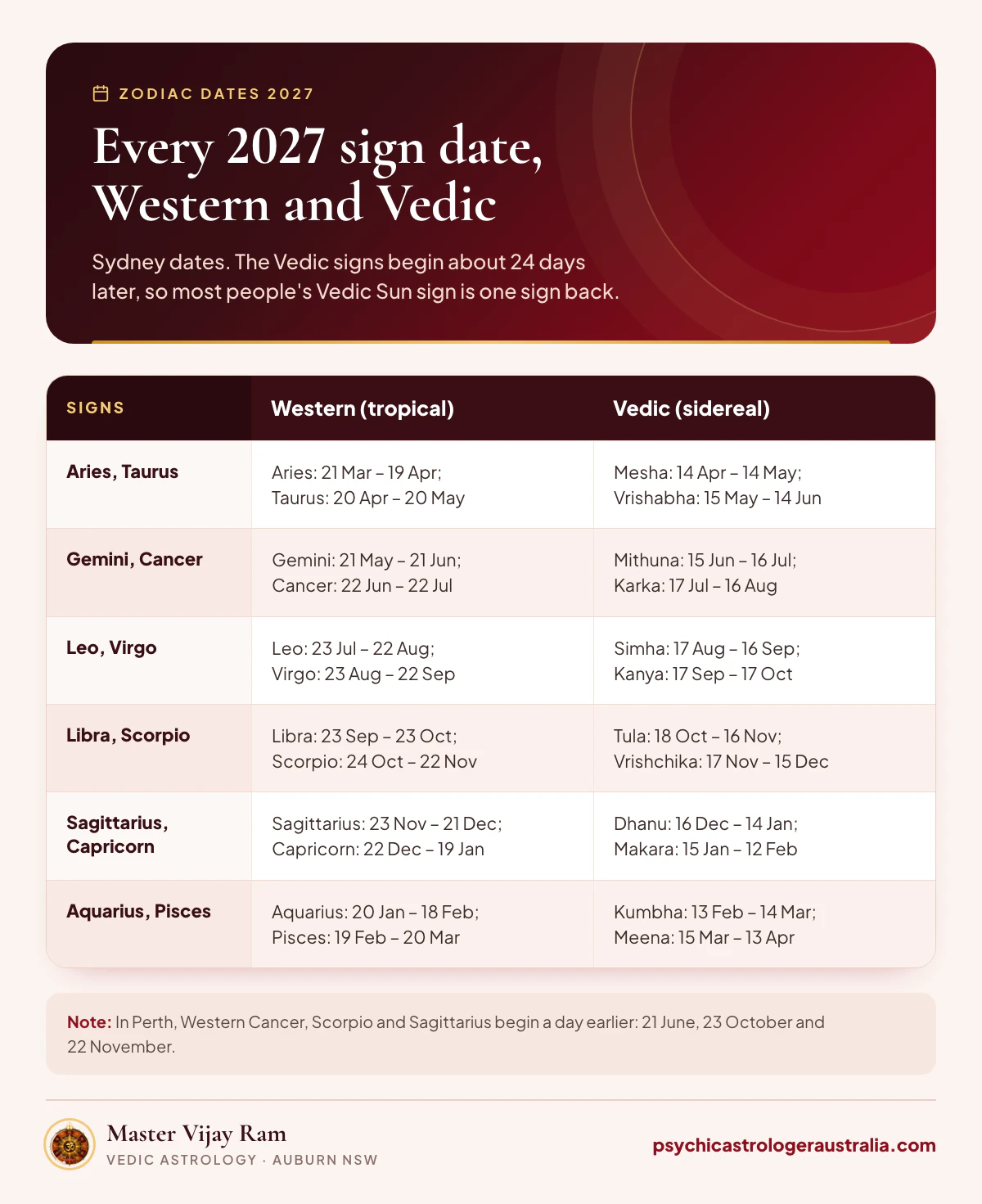
The comparison below gives both sets of dates in Sydney time. Perth, Adelaide, Darwin and India are converted in the full tables further down, because three of the Western changeovers fall on the previous calendar day in Perth.
| Sign | Western (tropical) | Vedic (sidereal) |
|---|---|---|
| Aries / Mesha | 21 Mar – 19 Apr | 14 Apr – 14 May |
| Taurus / Vrishabha | 20 Apr – 20 May | 15 May – 14 Jun |
| Gemini / Mithuna | 21 May – 21 Jun | 15 Jun – 16 Jul |
| Cancer / Karka | 22 Jun – 22 Jul | 17 Jul – 16 Aug |
| Leo / Simha | 23 Jul – 22 Aug | 17 Aug – 16 Sep |
| Virgo / Kanya | 23 Aug – 22 Sep | 17 Sep – 17 Oct |
| Libra / Tula | 23 Sep – 23 Oct | 18 Oct – 16 Nov |
| Scorpio / Vrishchika | 24 Oct – 22 Nov | 17 Nov – 15 Dec |
| Sagittarius / Dhanu | 23 Nov – 21 Dec | 16 Dec – 14 Jan |
| Capricorn / Makara | 22 Dec – 19 Jan | 15 Jan – 12 Feb |
| Aquarius / Kumbha | 20 Jan – 18 Feb | 13 Feb – 14 Mar |
| Pisces / Meena | 19 Feb – 20 Mar | 15 Mar – 13 Apr |
Capricorn and Sagittarius run across the new year, so their ranges start in December 2026 or end in January 2028. Computed with the Swiss Ephemeris (Lahiri ayanamsa for Vedic positions) and checked against US Naval Observatory data. Times are rounded to the minute.
If you were born under a Western Sun sign and a Vedic astrologer tells you a different one, nothing is wrong with either of them. They are reading the same Sun against two different rulers, and the rest of this article explains how the rulers are laid out.
Why do the dates move by a day from year to year?
The Sun returns to the same point of the zodiac every 365.2422 days, not every 365. Each year the moment of a given ingress therefore slips later by just under six hours, and every leap year pulls it back by a day. The Sun enters Aries at 7:25 am on Sunday 21 March 2027 in Sydney; a year earlier or later the same ingress sits at a different hour and sometimes on a different date.
That is why a printed list of cusp dates is only ever approximately right. Someone born on 20 or 21 March, 22 or 23 June, 22 or 23 September or 21 or 22 December needs the exact year and the exact time to know which side of the line they fall on. Vijay Ram ji sees a steady trickle of people who have spent decades believing they were one sign because a magazine printed a generic date.
Which time zone are these dates in?
All the dates in this article are given for Sydney, Melbourne, Canberra and Hobart first. Daylight saving in those cities ends on Sunday 4 April 2027 and begins again on Sunday 3 October 2027, which is why the autumn and winter ingresses carry AEST and the rest carry AEDT. Brisbane is on AEST all year, so it matches Sydney's dates from April to October and is an hour behind otherwise, though in 2027 that hour never pushes an ingress across midnight.
Perth is a different matter. It is two hours behind the east coast in winter and three in summer, so three of the Western ingresses move back a day there: the Sun enters Cancer on 21 June, Scorpio on 23 October and Sagittarius on 22 November in Perth, against 22 June, 24 October and 23 November in Sydney. The tables carry both columns for exactly this reason.
Western star-sign dates for 2027
The tropical zodiac begins at 0° Aries at the moment of the March equinox, so its sign dates are tied to the seasons rather than to the stars. In 2027 the four season markers fall at the Aries ingress on 21 March, the Cancer ingress on 22 June (the June solstice, the shortest day in Australia), the Libra ingress on 23 September and the Capricorn ingress on 22 December, all in Sydney time.
| Sign | Dates (Sydney) | Sun enters (Sydney) | Sun enters (Perth) |
|---|---|---|---|
| Capricorn | 22 Dec 2026 – 19 Jan 2027 | Tue 22 Dec, 7:50 am AEDT | Tue 22 Dec, 4:50 am AWST |
| Aquarius | 20 Jan 2027 – 18 Feb 2027 | Wed 20 Jan, 6:30 pm AEDT | Wed 20 Jan, 3:30 pm AWST |
| Pisces | 19 Feb 2027 – 20 Mar 2027 | Fri 19 Feb, 8:33 am AEDT | Fri 19 Feb, 5:33 am AWST |
| Aries | 21 Mar 2027 – 19 Apr 2027 | Sun 21 Mar, 7:25 am AEDT | Sun 21 Mar, 4:25 am AWST |
| Taurus | 20 Apr 2027 – 20 May 2027 | Tue 20 Apr, 5:18 pm AEST | Tue 20 Apr, 3:18 pm AWST |
| Gemini | 21 May 2027 – 21 Jun 2027 | Fri 21 May, 4:18 pm AEST | Fri 21 May, 2:18 pm AWST |
| Cancer | 22 Jun 2027 – 22 Jul 2027 | Tue 22 Jun, 12:11 am AEST | Mon 21 Jun, 10:11 pm AWST |
| Leo | 23 Jul 2027 – 22 Aug 2027 | Fri 23 Jul, 11:05 am AEST | Fri 23 Jul, 9:05 am AWST |
| Virgo | 23 Aug 2027 – 22 Sep 2027 | Mon 23 Aug, 6:14 pm AEST | Mon 23 Aug, 4:14 pm AWST |
| Libra | 23 Sep 2027 – 23 Oct 2027 | Thu 23 Sep, 4:02 pm AEST | Thu 23 Sep, 2:02 pm AWST |
| Scorpio | 24 Oct 2027 – 22 Nov 2027 | Sun 24 Oct, 2:33 am AEDT | Sat 23 Oct, 11:33 pm AWST |
| Sagittarius | 23 Nov 2027 – 21 Dec 2027 | Tue 23 Nov, 12:16 am AEDT | Mon 22 Nov, 9:16 pm AWST |
| Capricorn | 22 Dec 2027 – 20 Jan 2028 | Wed 22 Dec, 1:42 pm AEDT | Wed 22 Dec, 10:42 am AWST |
Computed with the Swiss Ephemeris (Lahiri ayanamsa for Vedic positions) and checked against US Naval Observatory data. Times are rounded to the minute.
Two signs straddle the new year. Capricorn runs from 22 December 2026 to 19 January 2027 and again from 22 December 2027 into January 2028, and Aquarius, the first new sign of the year, begins at 6:30 pm AEDT on 20 January 2027.
Vedic Sun-sign dates and Sankranti times for 2027
The sidereal zodiac used in jyotish begins its Aries at a fixed point among the stars, the point exactly opposite the star Spica (Chitra) in the Lahiri reckoning that Indian government panchangs and Master Vijay Ram both use. Because the equinox has drifted backwards through the stars for two thousand years, the sidereal signs now start about 24 days after the tropical ones.
| Sign | Dates (Sydney) | Sun enters (Sydney) | Sun enters (Perth) | Sankranti in India |
|---|---|---|---|---|
| Sagittarius (Dhanu) | 16 Dec 2026 – 14 Jan 2027 | Wed 16 Dec, 3:55 pm AEDT | Wed 16 Dec, 12:55 pm AWST | Wed 16 Dec, 10:25 am IST |
| Capricorn (Makara) | 15 Jan 2027 – 12 Feb 2027 | Fri 15 Jan, 2:40 am AEDT | Thu 14 Jan, 11:40 pm AWST | Thu 14 Jan, 9:10 pm IST |
| Aquarius (Kumbha) | 13 Feb 2027 – 14 Mar 2027 | Sat 13 Feb, 3:39 pm AEDT | Sat 13 Feb, 12:39 pm AWST | Sat 13 Feb, 10:09 am IST |
| Pisces (Meena) | 15 Mar 2027 – 13 Apr 2027 | Mon 15 Mar, 12:30 pm AEDT | Mon 15 Mar, 9:30 am AWST | Mon 15 Mar, 7:00 am IST |
| Aries (Mesha) | 14 Apr 2027 – 14 May 2027 | Wed 14 Apr, 7:58 pm AEST | Wed 14 Apr, 5:58 pm AWST | Wed 14 Apr, 3:28 pm IST |
| Taurus (Vrishabha) | 15 May 2027 – 14 Jun 2027 | Sat 15 May, 4:50 pm AEST | Sat 15 May, 2:50 pm AWST | Sat 15 May, 12:20 pm IST |
| Gemini (Mithuna) | 15 Jun 2027 – 16 Jul 2027 | Tue 15 Jun, 11:26 pm AEST | Tue 15 Jun, 9:26 pm AWST | Tue 15 Jun, 6:56 pm IST |
| Cancer (Karka) | 17 Jul 2027 – 16 Aug 2027 | Sat 17 Jul, 10:19 am AEST | Sat 17 Jul, 8:19 am AWST | Sat 17 Jul, 5:49 am IST |
| Leo (Simha) | 17 Aug 2027 – 16 Sep 2027 | Tue 17 Aug, 6:44 pm AEST | Tue 17 Aug, 4:44 pm AWST | Tue 17 Aug, 2:14 pm IST |
| Virgo (Kanya) | 17 Sep 2027 – 17 Oct 2027 | Fri 17 Sep, 6:41 pm AEST | Fri 17 Sep, 4:41 pm AWST | Fri 17 Sep, 2:11 pm IST |
| Libra (Tula) | 18 Oct 2027 – 16 Nov 2027 | Mon 18 Oct, 7:39 am AEDT | Mon 18 Oct, 4:39 am AWST | Mon 18 Oct, 2:09 am IST |
| Scorpio (Vrishchika) | 17 Nov 2027 – 15 Dec 2027 | Wed 17 Nov, 7:29 am AEDT | Wed 17 Nov, 4:29 am AWST | Wed 17 Nov, 1:59 am IST |
| Sagittarius (Dhanu) | 16 Dec 2027 – 14 Jan 2028 | Thu 16 Dec, 10:09 pm AEDT | Thu 16 Dec, 7:09 pm AWST | Thu 16 Dec, 4:39 pm IST |
Computed with the Swiss Ephemeris (Lahiri ayanamsa for Vedic positions) and checked against US Naval Observatory data. Times are rounded to the minute.
Each entry in this table is a Sankranti, the Sun's transit into a new rashi, and the Indian column is the one that matters for festivals, because most Hindu calendars are published for India even when the family reading them lives in Melbourne or Perth.
What is a Sankranti?
Sankranti is the Sanskrit word for the Sun's passage from one sign to the next, and there are twelve each year. Makar Sankranti, the entry into Capricorn (Makara), is the one most Australians of Indian background will know, because it is celebrated as Pongal in the Tamil tradition, Uttarayan in Gujarat and Magh Bihu in Assam, with Lohri lit in Punjabi homes the evening before.
In 2027 the Sun enters Makara at 9:10 pm IST on Thursday 14 January, which is 2:40 am on Friday 15 January in Sydney and 11:40 pm on Thursday 14 January in Perth. Indian calendars therefore say 14 January while a strictly local Sydney calculation says 15 January. Families in the eastern states usually keep the Indian day, which is also the day the temple will hold its programme, and nothing is lost by doing so.
The other Sankranti that marks a festival is the entry into Mesha (Aries) on 14 April 2027, the solar new year that Punjabi, Malayali and Tamil families keep as Vaisakhi, Vishu and Puthandu. In Sydney that moment is 7:58 pm AEST on Wednesday 14 April; in India it is 3:28 pm the same afternoon.
Why are the Vedic dates about 24 days later?
The gap is the ayanamsa, the angular distance between the two zodiacs' starting points. On 1 January 2027 the Lahiri ayanamsa is 24°14′, and because the Sun moves roughly one degree a day, 24 degrees becomes about 24 days. The gap grows by about 50 seconds of arc a year, which is a day every 72 years, so in a long lifetime the Vedic dates slip one further day behind the Western ones.
The cause is precession: the slow wobble of the Earth's axis that drags the equinox point backwards through the constellations once every 25,800 years or so. Western astrology chose to follow the equinox; Vedic astrology chose to follow the stars. Vedic versus Western astrology is the longer version of that story.
Am I a different sign in Vedic astrology?
Usually, yes. Because the Vedic signs begin about 24 days later, roughly four people in five have a Vedic Sun sign one step back from their Western one. A Western Leo born in early August is a Vedic Cancer (Karka); only those born in the last week of a Western sign keep the same name under both systems. In 2027 the overlap for Leo, for example, is 17 to 22 August inclusive.
The more important point is that a Vedic reading does not start with the Sun sign at all. Jyotish reads the Moon sign (rashi) first, because the Moon governs the mind and sets the dasha clock, and the ascendant (lagna) second, because it anchors the twelve houses. Finding your Moon sign will tell you more about yourself than any Sun-sign date in this article.
January to March 2027
The year opens with the Sun in tropical Capricorn and sidereal Sagittarius (Dhanu). Makar Sankranti on 14 January in India (15 January in Sydney) ends Kharmas, the month in which most communities pause weddings and housewarmings, and the season of auspicious work resumes. The Sun enters Aquarius on 20 January and Kumbha on 13 February; Mercury is retrograde from 10 February to 3 March, which falls almost entirely within the Kumbha month.
The March equinox on 21 March opens Western Aries, while the Vedic solar new year is still three weeks away. Pisces runs from 19 February; Meena, its Vedic equivalent, from 15 March.
April to June 2027
Daylight saving ends on Sunday 4 April in the south-east, so the clock times for the rest of autumn and winter read an hour earlier than they otherwise would. Mesha Sankranti on 14 April is the solar new year; the Sun enters tropical Taurus on 20 April and Vrishabha on 15 May, then Gemini on 21 May and Mithuna on 15 June.
Two planetary events sit in this quarter and matter more than any Sun-sign change. Saturn enters sidereal Aries on 3 June, for the first time in nearly three decades, and Mercury turns retrograde on 11 June for the longest of its three 2027 spells. The June solstice, the Cancer ingress, arrives at 12:11 am AEST on 22 June, a few minutes into the day in the east and still 21 June in Perth.
July to September 2027
The Sun moves through Cancer, Leo and Virgo in the Western zodiac from 22 June, 23 July and 23 August, and through Karka, Simha and Kanya from 17 July, 17 August and 17 September. Saturn turns retrograde on 10 August at 27°53′ Aries, beginning the slow slide that will carry it back into Pisces in October. The September equinox, the Libra ingress, falls at 4:02 pm AEST on Thursday 23 September.
In the Vedic calendar the Shravana and Bhadrapada months bring the monsoon festivals. Raksha Bandhan, Janmashtami and Ganesh Chaturthi follow the Moon rather than the Sun, so their dates are set by the full and new moons of 2027 rather than by any table on this page.
October to December 2027
Daylight saving returns on Sunday 3 October, and from there the eastern dates run an hour ahead of Brisbane again. The Sun enters Tula on 18 October, tropical Scorpio at 2:33 am on 24 October (23 October in Perth) and Vrishchika on 17 November; Diwali falls on Friday 29 October with Mercury freshly direct that morning. Jupiter moves into sidereal Virgo on 27 November, the Sun into tropical Sagittarius at 12:16 am on 23 November (22 November in Perth) and into Dhanu on 16 December, opening the Kharmas month again.
The December solstice, the Capricorn ingress, is at 1:42 pm AEDT on Wednesday 22 December, the longest day of the year in Australia. From there the cycle repeats, with Makar Sankranti due again on 15 January 2028 in Sydney and Western Aquarius on 21 January 2028.
Does the Sun sign matter in a Vedic reading?
It matters, but modestly. In a kundli the Sun describes vitality, the father, authority and the soul's direction, and its house and dignity are read like any other planet's. What jyotish does not do is divide humanity into twelve Sun-sign types. Two people born a day apart with the same Sun sign can have different Moon signs, different ascendants and different dashas, and will be living visibly different lives.
That is the honest limit of this article. The dates are exact, computed with the Swiss Ephemeris and checked against United States Naval Observatory data, and they will tell you which sign the Sun occupied. They will not tell you what that means for you. A full kundli reading is where the Sun, Moon and ascendant are read together.
How does Master Vijay Ram use Sankranti dates?
In 40+ years of practice Master Vijay Ram has used the Sankranti calendar for two things. The first is the choice of muhurta: the day of a Sankranti itself is traditionally avoided for weddings, housewarmings and new ventures, while the hours around it are prized for charity, bathing in holy rivers and prayers for ancestors. The second is Varshphal, the solar return, which uses the exact moment the Sun returns to its natal degree each year to cast a chart for the twelve months ahead; a yearly forecast reading is built on that moment, not on a calendar date.
For a family in Darwin, where the clocks never change, the Sankranti times are an hour and a half behind Sydney's in summer and half an hour behind in winter, and he converts them before any consultation. No one needs to do that arithmetic themselves.
What a sign date cannot tell you
A sign date cannot tell you whether 2027 will be a good year, whether a marriage will happen or when a job will come. Those questions belong to the dasha system and to the transits of Saturn, Jupiter, Rahu and Ketu read against a birth chart, and anyone who answers them from a Sun sign alone is offering entertainment rather than jyotish. Nor can a date fix a destiny: the chart shows the weather, and the sail is still yours to set.
What a correct date can do is spare you the small, persistent error of the wrong sign, and give you the exact Sankranti moments for a festival calendar that is honest about which time zone it lives in. That is the modest service this page sets out to provide.
Read next
- Vedic vs Western Astrology: Sidereal and Tropical Zodiacs ExplainedVedic vs Western astrology: why the sidereal and tropical zodiacs sit 24° apart, what the Lahiri ayanamsa is, and why…
- 2027 Vedic Horoscope: Forecast for All 12 Moon Signs2027 Vedic horoscope for all 12 Moon signs: Saturn into Aries on 3 June, Sade Sati for Aquarius, Pisces, Aries and Ta…
- Sihr Removal in Australia: Signs of Sihr and How Ruqyah HelpsSihr removal in Australia explained: the signs worth taking seriously, what to rule out first, how ruqyah actually wo…
Frequently asked questions
What are the zodiac sign dates for 2027 in Australia?
In Sydney time the Western dates are Aquarius from 20 January, Pisces 19 February, Aries 21 March, Taurus 20 April, Gemini 21 May, Cancer 22 June, Leo 23 July, Virgo 23 August, Libra 23 September, Scorpio 24 October, Sagittarius 23 November and Capricorn 22 December. Perth sees the Cancer, Scorpio and Sagittarius changes a day earlier, on 21 June, 23 October and 22 November, because the ingress moment falls before midnight there.
What are the Vedic (sidereal) sign dates for 2027?
The Sun enters Makara on 15 January in Sydney (14 January in India), Kumbha on 13 February, Meena 15 March, Mesha 14 April, Vrishabha 15 May, Mithuna 15 June, Karka 17 July, Simha 17 August, Kanya 17 September, Tula 18 October, Vrishchika 17 November and Dhanu 16 December. Each entry is a Sankranti, and the Indian calendar date is the one temples and family panchangs follow.
Why is my Vedic sign different from my Western sign?
Because the two zodiacs start from different points. Western signs begin at the March equinox; Vedic signs begin at a fixed point among the stars, which now sits 24°14′ further along. The Sun takes about 24 days to cover that gap, so most people born in the first three and a half weeks of a Western sign have the previous sign in Vedic astrology. Neither result is a mistake.
Why do cusp dates change from one year to the next?
The Sun's return to any point of the zodiac takes 365.2422 days, so each ingress arrives almost six hours later each year until a leap year pulls it back by a day. Add time zones, and the same ingress can be 20 March in Universal Time and 21 March in Sydney. Anyone born within a day of a sign change needs the exact year, time and place to be sure of their sign.
What is Makar Sankranti and when is it in 2027?
Makar Sankranti is the Sun's entry into sidereal Capricorn (Makara), celebrated as Pongal, Uttarayan and Magh Bihu, with Lohri the evening before. In 2027 it falls at 9:10 pm IST on Thursday 14 January, which is 2:40 am on Friday 15 January in Sydney and 11:40 pm on the Thursday in Perth. Most Australian families keep the Indian date, which is also when temples hold their programmes.
Are the equinoxes and solstices the same as the sign dates?
In the Western zodiac, yes: the March equinox is the Aries ingress, the June solstice the Cancer ingress, the September equinox the Libra ingress and the December solstice the Capricorn ingress. In 2027 those fall on 21 March, 22 June, 23 September and 22 December in Sydney time. The Vedic signs are not tied to the seasons, so they do not line up with the equinoxes at all.
Does the Sun sign matter in Vedic astrology?
It matters as one planet among nine. The Sun shows vitality, the father, authority and the direction of the soul, and its house and strength are read carefully. But jyotish does not sort people into twelve Sun-sign types; it begins with the Moon sign, which sets the dasha periods, and the ascendant, which fixes the houses. Two people with the same Sun sign can have very different charts and very different years.
Which ayanamsa do these Vedic dates use?
The Lahiri (Chitrapaksha) ayanamsa, the standard adopted for India's national calendar and used by most panchangs and by Master Vijay Ram. Its value on 1 January 2027 is 24°14′. Other ayanamsas, such as Raman or Krishnamurti, differ by up to a degree, which can move a Sankranti by a day; every table on this page is consistent with Lahiri throughout.
Why do some Vedic calendars give a Sankranti a day earlier than this page?
Usually because they are printed for India, which is four and a half to five and a half hours behind the Australian east coast. A Sankranti late in the Indian evening is already the next morning in Sydney. Occasionally the difference comes from a different ayanamsa. The tables above show the Indian time alongside the Sydney and Perth times so you can see which one applies to you.
Is the day of a Sankranti auspicious for starting something new?
Traditionally no. The Sankranti day itself is avoided for weddings, housewarmings and new ventures, while the hours around it are prized for charity, bathing and prayers for ancestors. The exceptions are the festival Sankrantis, Makar and Mesha, which are joyful days in their own right. For a specific start date, a muhurta is chosen from the Moon's position and the ascendant rather than from the Sun alone.
People also ask
What zodiac sign is 21 March 2027?
In the Western zodiac the Sun enters Aries at 7:25 am AEDT on Sunday 21 March 2027, so a Sydney birth that morning before 7:25 is Pisces and after it is Aries. In Perth the ingress is at 4:25 am. In the Vedic zodiac the Sun is in Meena (Pisces) for the whole of that day and does not reach Mesha until 14 April.
Did the zodiac dates change in 2027?
No new sign was added and the signs were not redrawn. The small changes people notice are the normal yearly drift of a few hours in each ingress, plus the difference between the Western and Vedic zodiacs, which has existed for centuries. The thirteenth-sign stories that circulate online refer to constellations, which neither tropical nor sidereal astrology uses as signs.
What is the difference between a star sign and a rashi?
A star sign usually means the Western tropical Sun sign, fixed to the seasons. A rashi is a sidereal sign in Vedic astrology, fixed to the stars, and when people say their rashi they almost always mean their Moon sign, not their Sun sign. So a person can be a Leo star sign, a Karka Sun rashi and a Tula Moon rashi all at once, with no contradiction between the three.
Which time zone should I use for a birth near a cusp?
The time zone in force at the place and time of birth, including any daylight saving that applied in that year. A Perth birth is calculated in Western Australian time, not in Sydney's, and an Indian birth in IST. For births within a day of a sign change the exact clock time decides the sign, which is why a reading always begins with the birth certificate rather than with a date.
When does Kharmas end in 2027?
Kharmas, the month when the Sun sits in sidereal Sagittarius and most communities pause weddings and housewarmings, ends at Makar Sankranti: 9:10 pm IST on 14 January 2027, which is the early morning of 15 January in Sydney. It begins again at Dhanu Sankranti on 16 December 2027. Those are the two Sankrantis that most affect wedding planning in an Indian family.
References & further reading
Serving clients across Australia
Confidential consultations by phone, video & WhatsApp — including: