

Quick answer
Thirteen new moons fall in 2027 by Sydney time, from Friday 8 January to Tuesday 28 December, two of them in September. Queensland skips daylight saving, so in summer Brisbane and the Gold Coast trail Sydney by an hour and the Diwali new moon comes at 11:37 pm on Friday 29 October there. Observance follows your local panchang, a day either side.
What is Amavasya, and why does it need a city beside it?
Amavasya is the new-moon tithi, the last lunar day of the dark fortnight, that ends when the Moon passes between the Earth and the Sun and turns no lit face towards us. The instant is identical in Hobart and Perth, but the clock that reads it is not, which is why Amavasya 2027 needs a city written beside every date.
Below are the thirteen new moons of the year, converted for Brisbane, the Gold Coast, Adelaide, Perth, Canberra and Hobart, with what each one asks of a household. Anything that needs an auspicious start works the other way round, keeping the no-moon day out of the diary, which is the job of choosing a muhurat for important dates.
For the full moons alongside these, see the 2027 full and new moon overview; this guide stays with Amavasya and the day each city keeps it.
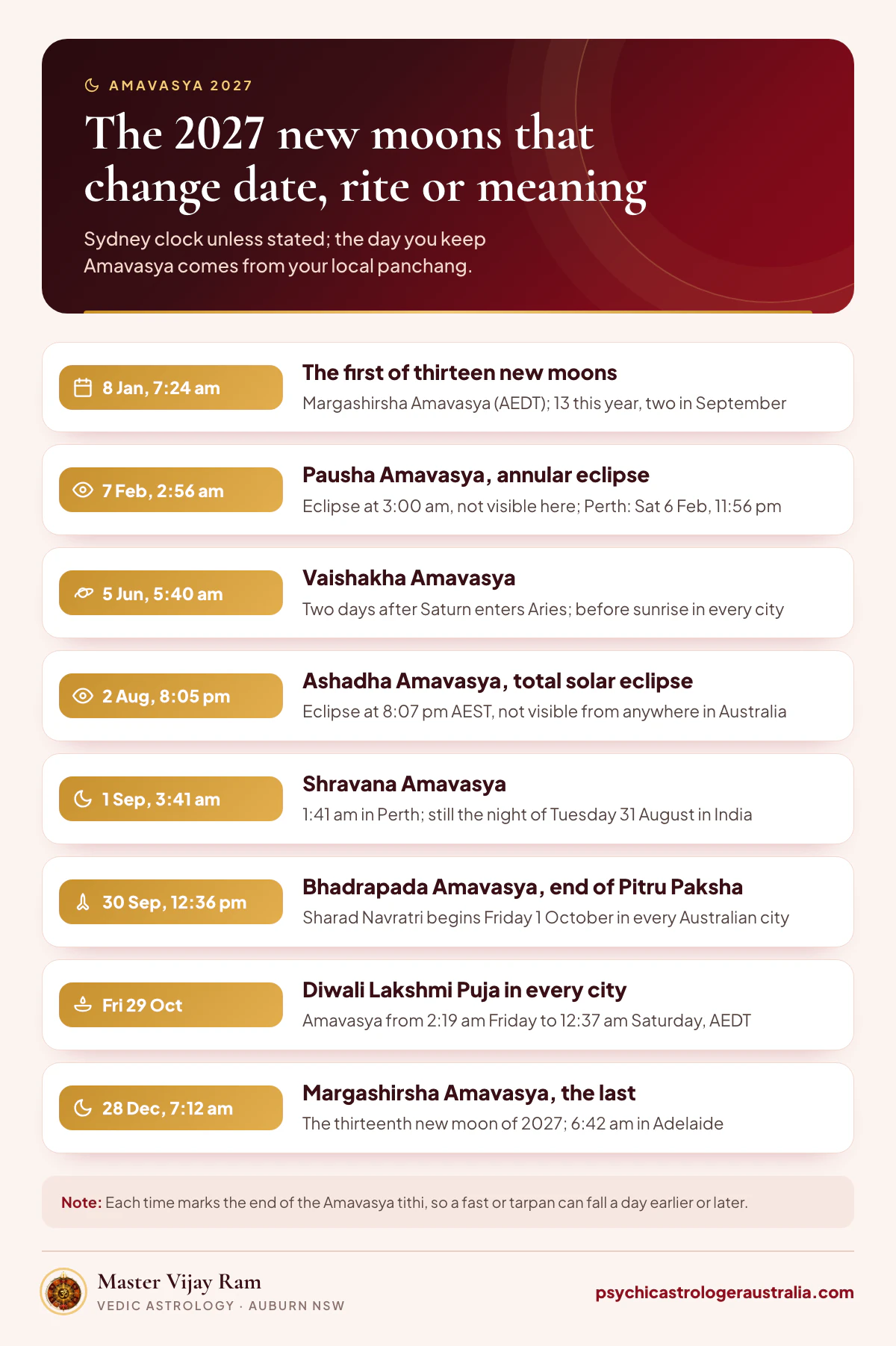
When are the thirteen new moons of 2027?
| Date (Sydney) | Exact time (Sydney) | Perth | Date in India | Hindu month name | Moon’s Vedic sign · nakshatra |
|---|---|---|---|---|---|
| Fri 8 Jan | 7:24 am AEDT | Fri 8 Jan, 4:24 am | 8 Jan | Margashirsha Amavasya (Pausha in the north Indian calendar) | Dhanu · Purva Ashadha |
| Sun 7 Feb | 2:56 am AEDT | Sat 6 Feb, 11:56 pm | 6 Feb | Pausha Amavasya (Magha in the north Indian calendar) | Makara · Dhanishta |
| Mon 8 Mar | 8:29 pm AEDT | Mon 8 Mar, 5:29 pm | 8 Mar | Magha Amavasya (Phalguna in the north Indian calendar) | Kumbha · Purva Bhadrapada |
| Wed 7 Apr | 9:51 am AEST | Wed 7 Apr, 7:51 am | 7 Apr | Phalguna Amavasya (Chaitra in the north Indian calendar) | Meena · Revati |
| Thu 6 May | 8:59 pm AEST | Thu 6 May, 6:59 pm | 6 May | Chaitra Amavasya (Vaishakha in the north Indian calendar) | Mesha · Bharani |
| Sat 5 Jun | 5:40 am AEST | Sat 5 Jun, 3:40 am | 5 Jun | Vaishakha Amavasya (Jyeshtha in the north Indian calendar) | Vrishabha · Rohini |
| Sun 4 Jul | 1:02 pm AEST | Sun 4 Jul, 11:02 am | 4 Jul | Jyeshtha Amavasya (Ashadha in the north Indian calendar) | Mithuna · Ardra |
| Mon 2 Aug | 8:05 pm AEST | Mon 2 Aug, 6:05 pm | 2 Aug | Ashadha Amavasya (Shravana in the north Indian calendar) | Karka · Pushya |
| Wed 1 Sep | 3:41 am AEST | Wed 1 Sep, 1:41 am | 31 Aug | Shravana Amavasya (Bhadrapada in the north Indian calendar) | Simha · Purva Phalguni |
| Thu 30 Sep | 12:36 pm AEST | Thu 30 Sep, 10:36 am | 30 Sep | Bhadrapada Amavasya (Ashwin in the north Indian calendar) | Kanya · Hasta |
| Sat 30 Oct | 12:37 am AEDT | Fri 29 Oct, 9:37 pm | 29 Oct | Ashwin Amavasya (Kartika in the north Indian calendar) | Tula · Swati |
| Sun 28 Nov | 2:24 pm AEDT | Sun 28 Nov, 11:24 am | 28 Nov | Kartika Amavasya (Margashirsha in the north Indian calendar) | Vrishchika · Anuradha |
| Tue 28 Dec | 7:12 am AEDT | Tue 28 Dec, 4:12 am | 28 Dec | Margashirsha Amavasya (Pausha in the north Indian calendar) | Dhanu · Mula |
Brisbane and Queensland: subtract one hour from Sydney time between January and 4 April and from 3 October; otherwise the same. Adelaide is always 30 minutes behind Sydney. Computed with the Swiss Ephemeris (Lahiri ayanamsa for Vedic positions) and checked against US Naval Observatory data. Times are rounded to the minute.
A lunar month runs a little under thirty days, so a year whose first new moon comes early, at 7:24 am AEDT on Friday 8 January, has room for a thirteenth before 31 December. September holds two of them, on the 1st and the 30th, and the last arrives at 7:12 am AEDT on Tuesday 28 December.
The year still has no adhik month, so the names keep their usual order. The bracketed name in each row is the north Indian, purnimanta, label for the same new moon; the instant does not change with the name.
How do Brisbane, the Gold Coast, Adelaide and Perth read the table?
| Where you are | Standard time | Daylight saving | Compared with Sydney |
|---|---|---|---|
| NSW (incl. Central Coast), Victoria (incl. Geelong), ACT, Tasmania | AEST, UTC+10 | AEDT, UTC+11 | Same as Sydney all year |
| Queensland (Brisbane, Gold Coast, Sunshine Coast, Townsville, Cairns) | AEST, UTC+10 | None | Same April–October; 1 hour behind October–April |
| South Australia (Adelaide) | ACST, UTC+9:30 | ACDT, UTC+10:30 | 30 minutes behind all year |
| Northern Territory (Darwin) | ACST, UTC+9:30 | None | 30 minutes behind April–October; 1½ hours behind October–April |
| Western Australia (Perth) | AWST, UTC+8 | None | 2 hours behind April–October; 3 hours behind October–April |
In 2027 daylight saving ends on Sunday 4 April and begins on Sunday 3 October.
Canberra and Hobart use the Sydney column untouched. Brisbane and the Gold Coast stay on AEST through the year, so they agree with Sydney from Sunday 4 April, when daylight saving ends, until Sunday 3 October, when it returns, and sit an hour behind it outside those months.
Adelaide moves its clocks on the same Sundays as Sydney and stays thirty minutes behind it on every row: the March new moon, 8:29 pm AEDT in Sydney, is 7:59 pm in Adelaide. Perth gets a column to itself, two hours behind Sydney from April to early October and three outside it.
Which 2027 new moons change date from city to city?
- February, the Pausha Amavasya: 2:56 am on Sunday 7 February in Canberra and Hobart, 2:26 am in Adelaide and 1:56 am in Brisbane and on the Gold Coast, but 11:56 pm on Saturday 6 February in Perth, the same date India records.
- September, the Shravana Amavasya: 3:41 am on Wednesday 1 September in Brisbane, Canberra and Hobart, 3:11 am in Adelaide and 1:41 am in Perth, whereas in India it is still the night of Tuesday 31 August.
- October, the Diwali Amavasya: 12:37 am on Saturday 30 October in Canberra and Hobart and 12:07 am in Adelaide, but 11:37 pm on Friday 29 October in Brisbane and on the Gold Coast and 9:37 pm that Friday in Perth; India also has 29 October.
So in late October a Gold Coast family and a Hobart family read one new moon on two different dates. Neither date is the festival, which falls on Friday 29 October everywhere, for reasons explained further down.
Is the new-moon instant the day you keep Amavasya?
Often it is not. The table records the moment the Amavasya tithi closes; the tithi itself covers roughly the day before, so an instant at 2:56 am on a Sunday means the Amavasya filled most of the Saturday.
Separate observances then lean on separate parts of the tithi. A fast usually follows the tithi at sunrise, rites for the ancestors are traditionally timed to the middle of the day, and Lakshmi Puja wants it after dark, so a household's observance can move to the day before or after the printed date.
That is why this guide gives instants, not observance days, except where the festival calculations already fix one. A panchang computed for the city you live in is the source to trust, and the five limbs of the panchang show how tithi, weekday and local sunrise combine.
Why is Amavasya the day for the ancestors?
Tradition holds that the Pitris, the family's ancestors, are closest on the no-moon day, and Amavasya tarpan is the simplest way of remembering them. Water is poured from cupped hands with black sesame and a blade of kusha grass, facing south, while each name is spoken aloud.
A son traditionally makes the offering, though many families now include daughters, and no priest is needed. When a chart, or a long run of family trouble, raises the question of ancestral karma, the signs of pitra dosh are checked in the kundli before anything else is suggested.
Where a family would rather have a tarpan, shanti or havan done on its behalf, Master Vijay Ram performs it himself in Auburn at a muhurat chosen for the purpose, and the family can watch by video. A puja or havan on request is priced from $250, with the amount agreed before the rite begins.
Which Amavasya closes Pitru Paksha in 2027?
Pitru Paksha, the fortnight set aside for shraddha and offerings to the ancestors, ends on the Amavasya of Bhadrapada in the southern reckoning, called Ashwin in the north. In 2027 that new moon falls at 12:36 pm AEST on Thursday 30 September, and Sharad Navratri begins the next morning, Friday 1 October, in every Australian city.
Because that instant comes around midday on the east coast, a panchang that times the ancestral rite to the afternoon may set the last day of the fortnight a day earlier. Your temple's notice settles it; the difference is one of rule, not of error.
What is Shani Amavasya, and does 2027 have one?
Shani Amavasya is an Amavasya whose day, by the local panchang, is a Saturday, and it is kept for Saturn: a sesame-oil lamp after sunset, the Shani or Hanuman mantra, and black sesame, urad dal, mustard oil or warm clothing given to someone in need. It matters most to people in Sade Sati, which in 2027 touches Aquarius, Pisces and Aries Moons while Saturn is in Pisces, and Pisces, Aries and Taurus Moons while it is in Aries, from 3 June to 19 October.
The table cannot settle the question, because its weekday belongs to the instant rather than the tithi. Two instants fall on a Saturday by the clock, 5:40 am AEST on 5 June, two days after Saturn enters Aries, and 12:37 am AEDT on 30 October, and both come before that Saturday's sunrise in every Australian city, so the Saturday already belongs to the next tithi.
Whether a Shani Amavasya appears anywhere in your 2027 calendar is therefore a question for a local panchang, and in Perth the February new moon, at 11:56 pm on a Saturday, is worth checking. Sade Sati and Shani remedies are read from the chart, never from the weekday alone.
Why does the tradition avoid new beginnings on Amavasya?
On the no-moon day the Moon, the significator of the mind, has no light to lend, and muhurat practice treats it as a day for finishing, remembering and resting rather than starting. Weddings, griha pravesh, a naming ceremony, a car purchase, the first day of a business and a long journey are all kept off it, along with the Chaturdashi before it and any eclipse.
That is a rule for choosing dates, not a curse on the day. Shopping, work and ordinary life carry on, and a family that moved house on an Amavasya years ago has nothing to fear from it.
The great exception is Diwali, the one Amavasya on which Lakshmi is welcomed into the house and many trading families open new account books.
Why is Diwali on Friday 29 October everywhere when the new moon is not?
Lakshmi Puja needs the Amavasya to be running once the sun has set. This year the tithi runs from 2:19 am AEDT on Friday 29 October until the new moon at 12:37 am AEDT on Saturday 30 October, so the Friday evening sits inside it in every Australian city, Brisbane and Perth included, even though their clocks put the instant itself late on the Friday night.
India reaches the same Friday, its tithi running from 8:49 pm IST on Thursday 28 October to 7:07 pm IST on the Friday. In Sydney the Pradosh window opens at the 7:20 pm sunset and closes at 9:44 pm, and Lakshmi Puja windows for every Australian city give each local hour.
The days around it follow the same arithmetic: Dhanteras on Wednesday 27 October, Govardhan Puja on Saturday 30 October and Bhai Dooj on Sunday 31 October, everywhere. Mercury also turns direct on Diwali morning in eastern Australia, at 1:11 am AEDT.
Which new moons carry a solar eclipse in 2027?
| Date (Sydney) | Eclipse | Greatest eclipse (Sydney) | From Australia | Notes |
|---|---|---|---|---|
| Sun 7 Feb 2027 | Annular solar eclipse | 3:00 am AEDT | Not visible from Australia | |
| Sun 21 Feb 2027 | Penumbral lunar eclipse | 10:13 am AEDT | Visible from Perth | Penumbral magnitude 0.93 |
| Mon 19 Jul 2027 | Penumbral lunar eclipse | 2:03 am AEST | Visible from Sydney, Brisbane, Adelaide, Darwin, Perth, Hobart | Penumbral magnitude 0.00 — too faint to notice |
| Mon 2 Aug 2027 | Total solar eclipse | 8:07 pm AEST | Not visible from Australia | |
| Tue 17 Aug 2027 | Penumbral lunar eclipse | 5:14 pm AEST | Visible from Sydney, Brisbane, Adelaide, Hobart | Penumbral magnitude 0.55 |
Computed with the Swiss Ephemeris (Lahiri ayanamsa for Vedic positions) and checked against US Naval Observatory data. Times are rounded to the minute.
A solar eclipse needs a new moon, and two Amavasyas of 2027 carry one. The annular eclipse of Sunday 7 February peaks at 3:00 am AEDT and the total eclipse of Monday 2 August at 8:07 pm AEST, and neither is visible from Brisbane, Perth, Adelaide, the Gold Coast, Canberra, Hobart or anywhere else in Australia.
By the usual rule an eclipse that cannot be seen where you live is not observed there, though relatives in India follow their own panchang for theirs. The year's three lunar eclipses fall at full moons, and the Purnima 2027 dates by city deal with them.
What else do the 2027 new moons mark?
- Monday 8 March, 8:29 pm AEDT: the Magha Amavasya, two days after Maha Shivratri, which falls on Saturday 6 March everywhere.
- Wednesday 7 April, 9:51 am AEST: the Phalguna Amavasya that closes the lunar year; Chaitra Navratri, Ugadi and Gudi Padwa begin on Thursday 8 April in Australia and Wednesday 7 April in India.
- Saturday 5 June, 5:40 am AEST: the first new moon with Saturn in Aries.
- Thursday 30 September, 12:36 pm AEST: the close of Pitru Paksha, with Navratri the next day.
- Tuesday 28 December, 7:12 am AEDT: the thirteenth and last, the Margashirsha Amavasya.
How do families in Perth, Adelaide, Brisbane and Hobart keep Amavasya?
Mostly at home, early in the day and on their own clock. A tarpan takes ten minutes after the morning bath, a sesame-oil lamp goes on at dusk, and the evening meal is kept simple, with a portion set aside for someone who needs it.
Perth has the easiest call home: India is two and a half hours behind it in every season, which makes a lamp lit at 7 pm in Canning Vale 4:30 pm in Delhi. Brisbane and the Gold Coast are four and a half hours ahead of India, Adelaide four or five, and Canberra and Hobart four and a half or five and a half, depending on daylight saving.
Many Perth families follow the Perth Hindu Temple at Canning Vale, and on Brisbane's southside the Shree Laxmi Narayan Mandir at Burbank. The habit worth dropping is reading a printed Indian calendar unconverted, since three of 2027's new moons carry a different date in India from the one on the Sydney clock.
What can a new-moon table not tell you?
It cannot say which Amavasya matters most for your family, whether a given new moon sits badly with your chart, or what to do about grief, debt or a health worry; those need a reading, a counsellor or a doctor. It cannot fix an observance date either, which is the panchang's work.
A consultation is $50, and spell or prayer work, where it is warranted, starts from $250.
Read next
- Purnima 2027 in Australia: Vrat Days and Full Moon Times by CityPurnima 2027 in Australia: all 12 full moon dates and times, how Cairns, Townsville, Darwin and Perth convert them, a…
- Diwali 2026 and 2027 in Australia: Dates and Lakshmi Puja Times by CityDiwali falls on Sun 8 Nov 2026 and Fri 29 Oct 2027 across Australia. Lakshmi Puja sunset, Pradosh Kaal and Vrishabha …
- 11 Signs of Negative Energy in Your Life (and How to Clear It)Eleven signs of negative energy, the ordinary causes to rule out first, and the three-doors test that tells you wheth…
Frequently asked questions
How many Amavasya days are there in 2027?
The 2027 calendar holds thirteen new moons in Sydney time, opening at 7:24 am AEDT on Friday 8 January and closing at 7:12 am AEDT on Tuesday 28 December, with two in September. How the observances sit in your calendar depends on your panchang, since an Amavasya is often kept the day before an early-morning new moon, but the count itself is fixed.
What time is the new moon in Brisbane and on the Gold Coast?
The same as Sydney from early April to early October, and one hour earlier from October to early April, since Queensland keeps no daylight saving. The Diwali new moon is therefore 11:37 pm on Friday 29 October in Brisbane and on the Gold Coast, against 12:37 am on Saturday 30 October in Sydney, Canberra and Hobart.
What time is the new moon in Adelaide?
Always thirty minutes before Sydney, because South Australia starts and ends daylight saving on the same Sundays as New South Wales. The March new moon is 7:59 pm on Monday 8 March in Adelaide, the Diwali one 12:07 am on Saturday 30 October, and the last of the year 6:42 am on Tuesday 28 December.
Why is the February new moon on a different date in Perth?
It falls at 2:56 am AEDT on Sunday 7 February in Sydney, which is still 11:56 pm on Saturday 6 February in Perth, and India also records 6 February. The same moment brings an annular solar eclipse, greatest at 3:00 am AEDT, which cannot be seen from Australia, so it changes nothing for an Australian household.
Can I do pitru tarpan at home in Australia?
Yes. Tarpan needs water, black sesame, a blade of kusha grass if you have it, and the names of the ancestors you are remembering, offered facing south after a bath. A panchang for your own city gives the day. Where a family wants a fuller rite done on its behalf, Vijay Ram ji performs it himself in Auburn; that work is priced from $250 and the amount is agreed first.
Is there a Shani Amavasya in 2027?
The table alone cannot say, because it shows the weekday of the instant, not of the tithi. The two new moons that fall on a Saturday by the clock, 5 June and 30 October, both arrive before that Saturday's sunrise in every Australian city, so the Saturday belongs to the next tithi. A panchang for your city shows whether any Saturday carries the Amavasya.
Should I avoid starting anything on Amavasya?
Muhurat practice keeps weddings, griha pravesh, naming ceremonies, business openings and long journeys off the Amavasya, while ordinary work and shopping carry on as usual. Diwali is the exception, when Lakshmi is welcomed and many traders open new account books. If you need a date for something important, a muhurat consultation chooses it from your own chart.
When is Diwali 2027 in Australia?
Friday 29 October 2027, in every Australian city and in India. The Amavasya runs from 2:19 am AEDT on the Friday to 12:37 am AEDT on Saturday 30 October, so the evening is covered everywhere. In Sydney the sun sets at 7:20 pm and Pradosh runs until 9:44 pm; each other city has its own window.
Can I see Master Vijay Ram in person in Perth, Brisbane or Adelaide?
No. Auburn, in Sydney, is the one place he practises, and families in Perth, Brisbane, the Gold Coast, Adelaide, Canberra and Hobart reach him by phone, video or WhatsApp at an hour that suits their clock. The fee for a consultation is $50, and any puja or tarpan is performed by him in Auburn at a chosen muhurat, which the family can watch by video.
People also ask
Is Amavasya the same as the astronomical new moon?
They end together. The new moon is the instant the Moon passes between the Earth and the Sun; Amavasya is the whole tithi leading up to it, about a day long. That is why an Amavasya observance can sit on the calendar day before a new moon that arrives in the small hours, as several do on the east coast in 2027.
Why is the Diwali new moon on 29 October in Brisbane but 30 October in Sydney?
Because Queensland has no daylight saving. The instant is 12:37 am AEDT on Saturday 30 October in Sydney, which is still 11:37 pm on Friday 29 October on Brisbane's clock. Diwali itself is Friday 29 October in both cities, since the Amavasya covers the Friday evening everywhere in Australia.
What should you not do on Amavasya?
By tradition, nothing new: no wedding, house-warming, naming, business launch, vehicle purchase or long journey, and many families also skip haircuts, meat and alcohol that day. These are customs rather than laws, and ordinary work carries on. The rule matters most when a date for something new is being chosen.
Which Amavasya in 2027 ends Pitru Paksha?
The Bhadrapada Amavasya of the southern calendar, called Ashwin in the north, whose new moon falls at 12:36 pm AEST on Thursday 30 September. Because that instant comes around midday in the east, a panchang may set the last ancestral rite a day earlier. Sharad Navratri then begins on Friday 1 October in every Australian city.
Do Australian families keep eclipse customs for the 2027 solar eclipses?
Neither 2027 solar eclipse can be seen from Australia: the annular one peaks at 3:00 am AEDT on 7 February and the total one at 8:07 pm AEST on 2 August. By the usual rule an eclipse not visible where you live is not observed there, though relatives in India follow their own panchang.
References & further reading
Serving clients across Australia
Confidential consultations by phone, video & WhatsApp — including: