

Quick answer
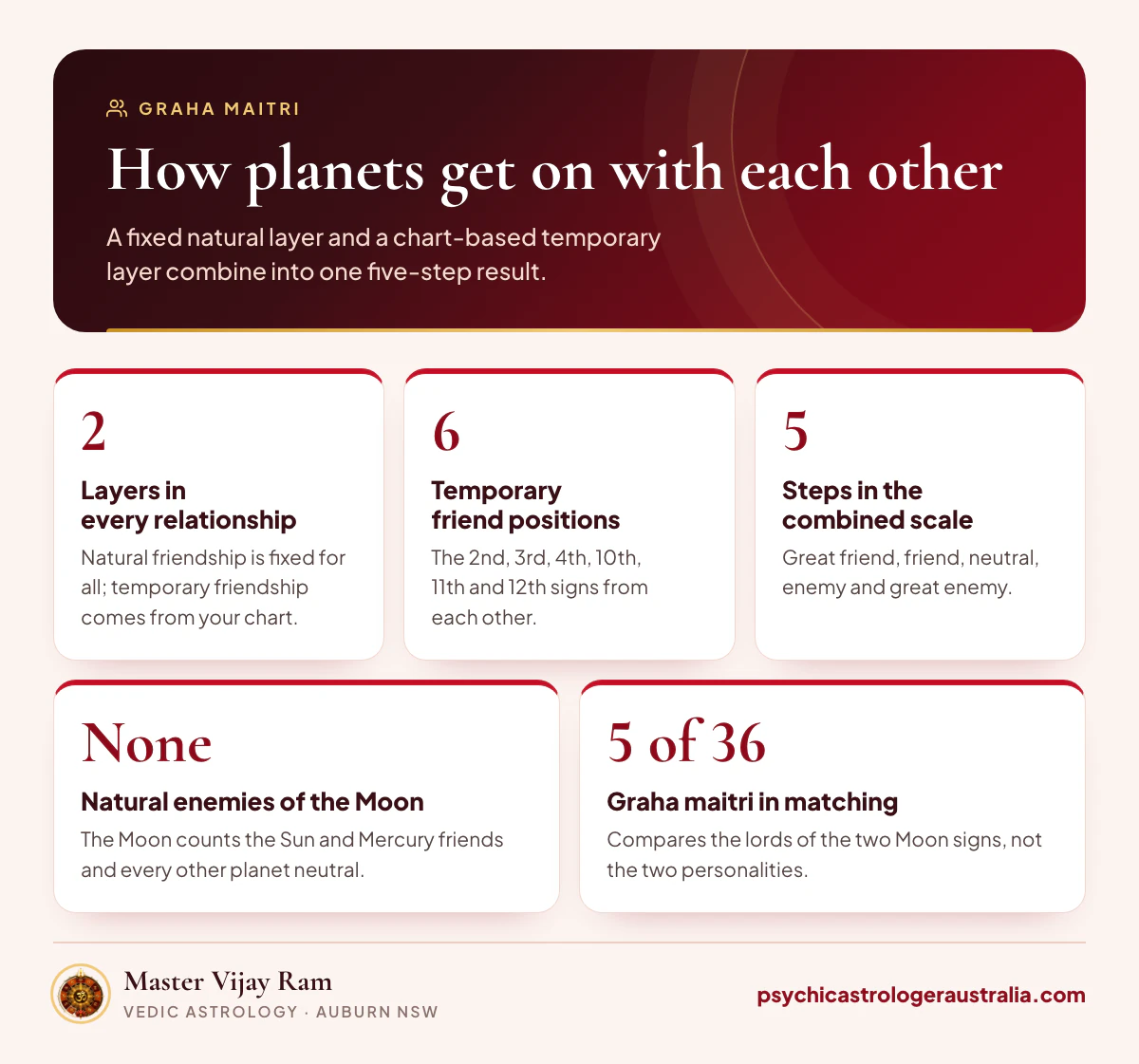
Planetary friendship, or graha maitri, is the Vedic rule set that says how comfortable one planet is with another. Each planet has natural friends, neutrals and enemies; a second, temporary relationship comes from where they sit in your chart. Combined, they give a five-fold result used to judge a planet's sign, a dasha's smoothness and the graha maitri score in matching.
What is planetary friendship in Vedic astrology?
Planetary friendship is a system that describes how well each planet works with each of the others, from close ally to open rival. The Sanskrit term graha maitri covers two layers: a permanent, natural relationship that every planet has with every other, and a temporary one that depends on where the two sit in a particular chart. Put the layers together and you get a five-step scale, from great friend to great enemy.
It sounds like a curiosity, but it runs quietly underneath a great deal of everyday chart reading. It decides whether a planet is comfortable in the sign it occupies, whether two planets ruling a dasha and its sub-period pull together, and how many points a couple score in one part of horoscope matching. A kundli reading of your full chart uses it constantly, usually without naming it.
Who are each planet's natural friends and enemies?
The natural relationship, called naisargika, is fixed for everyone. It comes from the classical texts and does not change with the chart. The table gives the standard Parashari version.
| Planet | Friends | Neutral | Enemies |
|---|---|---|---|
| Sun | Moon, Mars, Jupiter | Mercury | Venus, Saturn |
| Moon | Sun, Mercury | Mars, Jupiter, Venus, Saturn | None |
| Mars | Sun, Moon, Jupiter | Venus, Saturn | Mercury |
| Mercury | Sun, Venus | Mars, Jupiter, Saturn | Moon |
| Jupiter | Sun, Moon, Mars | Saturn | Mercury, Venus |
| Venus | Mercury, Saturn | Mars, Jupiter | Sun, Moon |
| Saturn | Mercury, Venus | Jupiter | Sun, Moon, Mars |
Rahu and Ketu are left out of the classical scheme, and later traditions give them differing friends; a careful reading says which version it is using rather than presenting one as settled.
Why is the friendship not always mutual?
Read the table across and then down, and you find several one-sided relationships. The Moon counts Mercury a friend, but Mercury counts the Moon an enemy. The Sun is neutral towards Mercury, while Mercury calls the Sun a friend. Jupiter treats Venus as an enemy, yet Venus is only neutral towards Jupiter.
The tradition does not apologise for this, and it is one of the more human touches in the system. The Moon, which has no enemies at all, is often described as the mother who welcomes everyone; Mercury, the clever child, is not always as warm in return. In practice the direction matters: what counts is how the planet whose sign is occupied, or whose period is running, regards the other.
What is temporary friendship, and how is it counted?
The temporary relationship, called tatkalika, comes from the chart itself. Count from one planet to the other. If the second planet sits in the 2nd, 3rd, 4th, 10th, 11th or 12th sign from the first, they are temporary friends. If it sits in the same sign, or in the 5th, 6th, 7th, 8th or 9th, they are temporary enemies.
Because the friendly positions pair up neatly, 2nd with 12th, 3rd with 11th and 4th with 10th, a temporary friendship always runs both ways. The idea behind it is practical: planets close on either side of each other in the zodiac are read as able to support one another, while planets sharing a sign, opposite each other or in awkward angles are read as competing for space.
How do the two layers combine into five?
The five-fold relationship, panchadha maitri, simply adds the natural and the temporary. Two friendly layers make a great friend; two hostile layers make a great enemy; mixed layers land in between.
| Natural relationship | Temporary friend | Temporary enemy |
|---|---|---|
| Friend | Great friend (adhimitra) | Neutral (sama) |
| Neutral | Friend (mitra) | Enemy (shatru) |
| Enemy | Neutral (sama) | Great enemy (adhishatru) |
An illustration: the Sun and Saturn are natural enemies. In a chart where Saturn sits in the 3rd sign from the Sun, they are temporary friends, and the five-fold result softens to neutral. In a chart where Saturn is in the 7th from the Sun, the two layers agree and the result is great enemy. The same pair can be comfortable in one chart and tense in another.
A worked illustration: three pairs in one chart
Take an imaginary chart with the Sun in Taurus, Mercury in Gemini, the Moon in Cancer, Venus in Aries and Saturn in Libra. Nobody in particular was born with it; it simply shows the counting at work, one pair at a time.
Mercury sits in the 2nd sign from the Sun, so the two are temporary friends. The Sun's natural view of Mercury is neutral, which lifts to friend; Mercury's natural view of the Sun is friendly, which lifts to great friend. The pairing that so many charts share is, in this one, a comfortable working partnership.
Saturn in Libra is the 6th sign from the Sun, and the Sun is the 8th from Saturn, so they are temporary enemies as well as natural ones. Each now regards the other as a great enemy. A reader would expect friction whenever both are active together, for instance in a Sun sub-period inside a Saturn mahadasha, and would look for what in the chart eases it.
Venus in Aries is the 10th sign from the Moon in Cancer. That makes them temporary friends. The Moon, naturally neutral to Venus, becomes a friend; Venus, naturally hostile to the Moon, softens to neutral. One side warmer than the other is a very ordinary result, and it is exactly the kind of nuance a single word like enemy hides.
How does friendship change the way a planet behaves in a sign?
Every sign has a lord, and a planet sitting in that sign is a guest in the lord's house. A guest in a great friend's house is treated generously and acts with confidence; in a great enemy's house it is uneasy and gives its results with more friction. This sits between the strongest dignities, exaltation and own sign, and the weakest, debilitation, which the guide to exalted and debilitated planets sets out.
For example, Jupiter in Leo is a guest of its friend the Sun, while Jupiter in Taurus is a guest of Venus, its natural enemy. Neither placement is a verdict on its own, but the reading will expect Jupiter's wisdom to flow more readily in the first.
Why does it matter when a dasha runs?
A mahadasha and its antardasha are ruled by two planets at once, and their relationship colours the sub-period. When the two are friends and placed well from each other, the stretch tends to run smoothly. When they are enemies, and especially when they sit in the 6th and 8th from each other, the sub-period is traditionally read as one of mixed signals, where the main theme of the period meets resistance.
This is part of why the order of the two planets matters. Saturn regards the Sun as an enemy, but the Sun's view of Saturn is what counts when the Sun rules the main period. The Saturn mahadasha with Rahu antardasha is one sub-period where this reasoning is used in detail.
What is graha maitri in kundli matching?
In ashtakoot matching, the eight-part points system used for marriage, one part is called graha maitri and is worth 5 of the 36 points. It looks at the lords of the bride's and groom's Moon signs and asks how they regard each other. Full marks go when the two lords are mutual friends, and the score falls as the relationship cools towards enmity.
The idea is that the Moon describes the mind, so friendly Moon-sign lords suggest two temperaments that settle easily together. It is one strand of a larger picture; gun milan and what a low score means explains the whole points system. A full compatibility check through relationship compatibility readings looks well beyond the score.
Can a planetary enmity be fixed with a remedy?
There is nothing to fix. An enmity between two planets in your chart is a description of a tension, not a fault, and many successful lives run on exactly such tensions. A reading may suggest steady practices for the planet that is under more strain, such as its weekday prayer or mantra, during a difficult sub-period.
A formal shanti is rare for this alone. When the whole chart does call for one, Master Vijay Ram performs it personally at his place of practice in Auburn; the cost starts from $250 and is agreed before the rite, as explained on puja and havan performed on request. A consultation is $50.
What friendship tables cannot tell you
They cannot tell you whether two people will get on. Graha maitri in matching compares two Moon-sign lords, not two personalities, and a low score has been followed by long, happy marriages as often as a high one by trouble. For relationship difficulty, Relationships Australia and a counsellor are the practical first step, and this is faith-based guidance rather than psychological advice.
Nor does the friendship scheme stand alone in a chart. It is weighed with dignity, house, aspect and dasha before it means anything.
How do you see this worked through for your own chart?
Send your birth date, time and place, and if the question is about a marriage, your partner's as well. Master Vijay Ram works out the five-fold relationships that actually matter for your question, rather than all twenty-one pairs, and explains them in plain words. Consultations are by phone, video or WhatsApp in English, Hindi or Punjabi, or in person at Auburn; families on the Illawarra coast can read more on astrology for Wollongong clients.
Read next
- Graha Shanti Puja: Which Planet Needs Pacifying and HowGraha shanti puja: how the birth chart shows which planet needs pacifying, Shani and Rahu shanti, what the rite invol…
- The Eleventh House in Vedic Astrology: Gains, Friends and Fulfilled WishesThe eleventh house in Vedic astrology: gains, income, friends, elder siblings and wishes, the eleventh lord in each h…
- Kundli Reading Explained: What Your Birth Chart RevealsWhat a Kundli reading reveals about your life, personality, career and destiny. Master Vijay Ram explains Vedic astro…
Frequently asked questions
Which planets are natural friends of the Sun?
In the standard Parashari scheme the Sun's natural friends are the Moon, Mars and Jupiter. Mercury is neutral to it, and Venus and Saturn are its natural enemies. These relationships are fixed for every chart. What changes from chart to chart is the temporary relationship, which depends on where the planets are placed from each other.
Why does the Moon have no enemies?
The classical texts give the Moon friends in the Sun and Mercury and treat every other planet as neutral, so it has no enemies at all. The tradition often explains this through the Moon's nature as nurturing and receptive, like a mother who welcomes everyone. Other planets do not all return that warmth; Mercury, for instance, counts the Moon an enemy.
How is temporary friendship worked out?
Count the signs from one planet to the other. If the second is in the 2nd, 3rd, 4th, 10th, 11th or 12th sign, they are temporary friends. If it is in the same sign or the 5th to 9th, they are temporary enemies. Because the friendly positions pair up, temporary friendship always runs in both directions, unlike natural friendship.
What is panchadha maitri?
It is the five-fold relationship that results from combining natural and temporary friendship. A natural friend that is also a temporary friend becomes a great friend; a natural enemy that is also a temporary enemy becomes a great enemy. Mixed combinations give friend, neutral or enemy. Astrologers use it to judge how comfortable a planet is in another planet's sign.
How many points is graha maitri worth in kundli matching?
Graha maitri is worth 5 of the 36 points in ashtakoot matching. It compares the lords of the two Moon signs and gives full marks when they are mutual friends, with the score falling as their relationship cools. It is only one of eight parts, and a full compatibility reading looks at both charts in detail rather than relying on the number.
Do Rahu and Ketu have friends and enemies?
The classical Parashari scheme lists natural friendships only for the seven visible planets. Later traditions assign friends and enemies to Rahu and Ketu, but they do not all agree, so different books and programs give different answers. A careful astrologer tells you which version is being used and does not lean heavily on it.
Does an enemy planet in my chart mean bad luck?
No. An enmity describes a tension between two planets' themes, which may show as friction or as a productive push between two parts of life. Many capable people have important planets in enemy signs. The relationship is weighed with dignity, house, aspect and the running dasha, and it never decides anything about a life by itself.
Why does it matter which planet rules the main dasha?
Because friendship can be one-sided, the direction counts. When one planet rules the mahadasha and another the antardasha, the main period's lord sets the tone, so its view of the sub-period lord matters most, along with how the two are placed from each other. That is one reason Saturn with Rahu is read differently from Rahu with Saturn.
People also ask
What does graha maitri mean?
Graha maitri means friendship of the planets. In chart reading it refers to the natural and temporary relationships between planets, which together show how comfortably they work with each other. In marriage matching, it is also the name of the 5-point section that compares the lords of the two partners' Moon signs.
Which planets are enemies of Saturn?
In the natural scheme Saturn counts the Sun, the Moon and Mars as its enemies, Mercury and Venus as its friends and Jupiter as neutral. In a particular chart, Saturn's temporary relationship with each of them, based on placement, can soften or harden that natural enmity.
Are Jupiter and Venus enemies?
Jupiter regards Venus as a natural enemy, but Venus regards Jupiter only as neutral, so the relationship is one-sided. The two are often described as teachers of different schools: Jupiter of dharma and restraint, Venus of pleasure and refinement. In a chart their temporary relationship may soften the tension.
What is a temporary friend in astrology?
A temporary, or tatkalika, friend is a planet placed in the 2nd, 3rd, 4th, 10th, 11th or 12th sign from another in a particular chart. The relationship exists only in that chart and is combined with the fixed natural relationship to give the five-fold result.
References & further reading
Serving clients across Australia
Confidential consultations by phone, video & WhatsApp — including: