
Quick answer
When you plan a wedding in India from Australia, the muhurat is calculated for the Indian venue and read in Indian time, not Sydney or Perth time. Start with a date range that suits leave and travel, have it narrowed by panchang and both charts, then book. A marriage valid in India is generally recognised in Australia, but check paperwork with a lawyer.
What does planning a wedding in India from Australia involve?
A wedding in India planned from Australia is a long-distance project that has to satisfy three calendars at once: the Hindu calendar that sets the muhurat, the Australian work and school year that sets when you can travel, and the Indian season that sets the weather and the venues. Most couples who ring Master Vijay Ram about a wedding in India from Australia have the first two pulling in opposite directions. Sorting that out early saves money and arguments.
The families are usually split too. A couple in Perth may have parents in Chandigarh and Kochi, each with a family priest and an opinion. The plan works best when one person is agreed as the coordinator for dates, and everyone knows which panchang is being followed.
Why is the muhurat calculated for the Indian venue?
Because every element of a muhurat is local. The tithi changes at a fixed instant, but the day it belongs to depends on local sunrise; the lagna for the pheras rises at a different clock time in Jaipur than in Chennai; Rahu kaal is one eighth of the local daylight. A muhurat worked out for your home in Brisbane would be wrong at a venue in Udaipur, sometimes by a day.
So a vivah muhurat in India is never borrowed from an Australian calendar.
A wedding muhurat consultation is done for the venue city instead, and the windows are given in Indian Standard Time. If you are choosing between two venues in different regions, each is checked separately. The method itself is explained in the 2027 vivah muhurat guide; this post is about fitting it around a life in Australia.
How do you read Indian times from Australia?
India keeps one clock all year, UTC+5:30, while most of eastern Australia moves its clocks in summer. The gap between Sydney and Delhi is therefore larger in the Australian summer than in winter, and Perth, which never changes, sits closest to India. The table below shows the offsets the site uses.
| Where you are | Standard time | Daylight saving | Compared with Sydney |
|---|---|---|---|
| NSW (incl. Central Coast), Victoria (incl. Geelong), ACT, Tasmania | AEST, UTC+10 | AEDT, UTC+11 | Same as Sydney all year |
| Queensland (Brisbane, Gold Coast, Sunshine Coast, Townsville, Cairns) | AEST, UTC+10 | None | Same April–October; 1 hour behind October–April |
| South Australia (Adelaide) | ACST, UTC+9:30 | ACDT, UTC+10:30 | 30 minutes behind all year |
| Northern Territory (Darwin) | ACST, UTC+9:30 | None | 30 minutes behind April–October; 1½ hours behind October–April |
| Western Australia (Perth) | AWST, UTC+8 | None | 2 hours behind April–October; 3 hours behind October–April |
In 2027 daylight saving ends on Sunday 4 April and begins on Sunday 3 October.
When the muhurat is given, write it down in Indian time and leave it there. Converting a phera window to Australian time only matters for relatives watching a livestream, and they can do that arithmetic once, on the day.
When is the wedding season, and does it fit Australian leave?
In most north Indian traditions the season reopens at Dev Uthani Ekadashi, which falls on Wed 10 Nov 2027 in Australia, and runs into the cooler months. It pauses for Kharmas, when the Sun is in Dhanu from 16 Dec until Makara Sankranti, which is 15 Jan in Australia and 14 Jan in India. That pause is the clash: it sits squarely on the Australian summer holidays, when most families can travel most easily.
Many couples doing NRI wedding planning resolve it by choosing late November or early December, or late January and February, and taking leave around that.
Others accept a date just after Makara Sankranti and return to work a little later. Dev Uthani Ekadashi and the wedding season explains why the season opens where it does. Families from south India often follow different restrictions, so ask your own priest which they keep.
What should be decided first, the date or the venue?
When you are planning an Indian wedding abroad, the date range comes first, then the venue, then the exact muhurat. Give the astrologer a window of a few weeks that suits leave and travel, and ask for the strongest days inside it for the venue’s city. Then approach venues with two or three candidate days rather than one, because popular muhurat days fill quickly in India.
If you book the venue before checking the muhurat, the reading can still find the best window on the booked day. It cannot move the stars to your deposit.
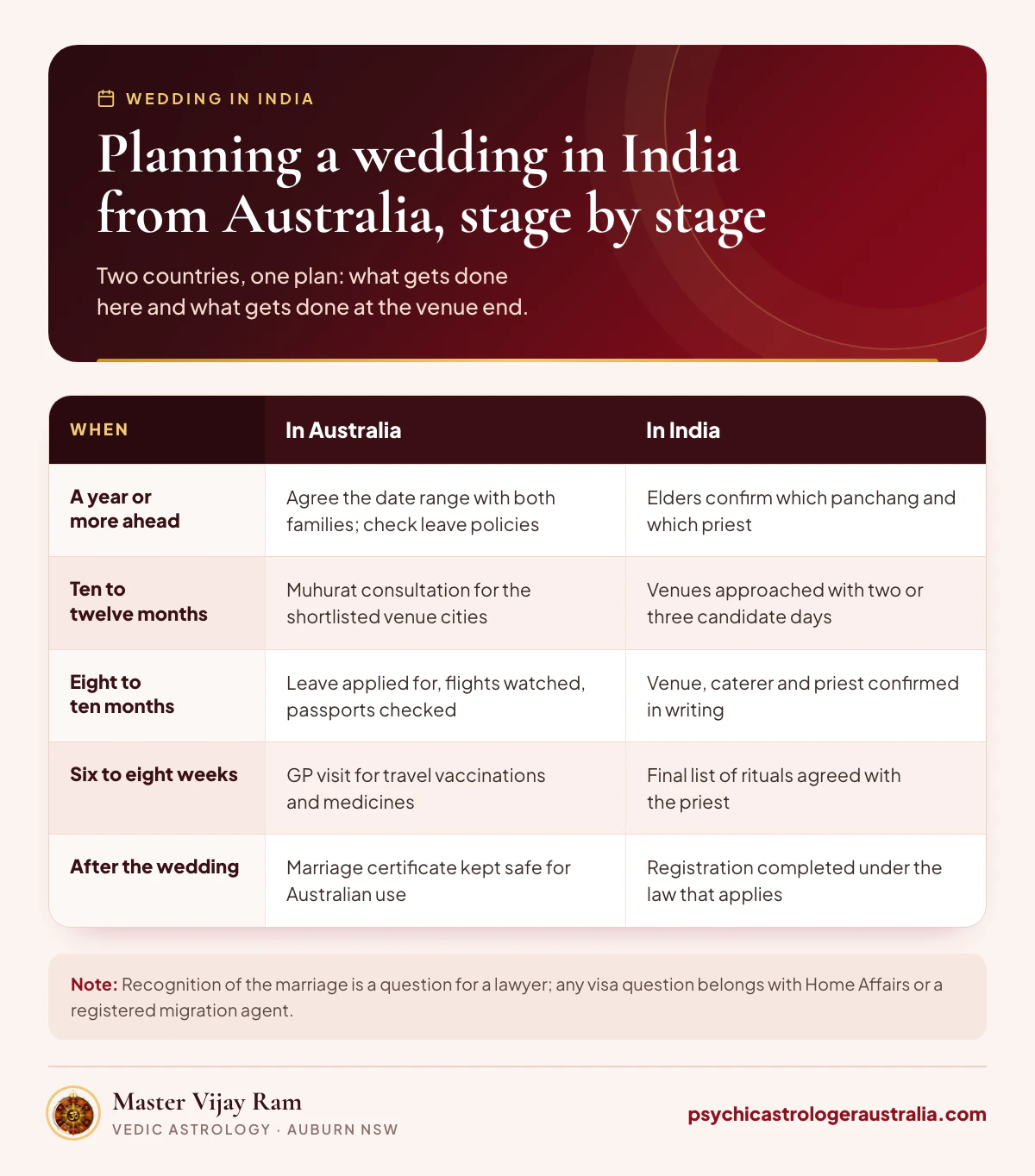
| When | Task in Australia | Task in India |
|---|---|---|
| A year or more ahead | Agree the date range with both families; check leave policies | Elders confirm which panchang and which priest |
| Ten to twelve months | Muhurat consultation for the shortlisted venue cities | Venues approached with two or three candidate days |
| Eight to ten months | Leave applied for; flights watched; passports checked | Venue, caterer and priest confirmed in writing |
| Three to six months | Guests told about entry documents for India | Decorators, mehndi, music and accommodation booked |
| Six to eight weeks | GP visit for travel vaccinations and medicines | Final rituals list agreed with the priest |
| After the wedding | Marriage certificate kept safe for Australian use | Registration completed under the law that applies |
Do both partners’ charts matter for the date?
Yes. A good muhurat is a supportive day for the place, and it should not sit on a difficult transit for the bride or the groom.
Moon-sign strength (tarabala and chandrabala) is checked for both, and many astrologers avoid a day when either partner’s Moon is under heavy pressure. If the charts have not been compared yet, a relationship compatibility reading can be done at the same time.
Where the bride’s and groom’s families each bring a priest’s recommendation, the two often differ by a day or two because of regional panchang conventions. That is normal; a neutral reading can explain why and help the families choose without either feeling overruled.
How do leave, travel and health fit in?
Australian annual leave and any extra unpaid leave are agreed with your employer, and the Fair Work Ombudsman explains general entitlements. Ask early: many workplaces cap leave over summer. A wedding in India is rarely a one-week trip once you count the mehndi, sangeet, travel days and a few days of rest afterwards.
See a GP six to eight weeks before you fly about travel vaccinations and any regular medicines, and take a letter for prescription medicines. Relatives travelling with you who hold Australian passports need the right entry documents for India; the Indian High Commission or consulate is where to check, not a wedding planner.
Some couples also ask for a separate travel muhurat for leaving Australia. Muhurat for travel and long journeys covers that tradition; most families keep it simple and do not let it override the flight that suits everyone.
Is a marriage in India recognised in Australia?
In general terms, Australia recognises a marriage that was validly made under the law of the country where it took place, and a Hindu wedding in India is normally registered there under the law that applies to the couple. That is the general principle only. Whether your particular marriage is recognised, what documents you need, and how a translation should be certified are questions for a lawyer.
If either partner’s visa depends on the marriage, the only people who can advise are Home Affairs and a registered migration agent. A chart cannot say whether a visa will be granted, and Master Vijay Ram does not give visa advice. Keep the original marriage certificate safe and carry a certified copy.
Should we also marry in Australia?
Some couples hold a small civil ceremony in Australia before or after the wedding in India, usually for practical reasons. If you do, ask a lawyer how the two ceremonies relate legally, because the answer depends on the order and the paperwork. A civil ceremony does not need a muhurat, though some families like to choose a good day for it anyway.
The Hindu wedding in India then carries the ritual weight, and the families usually treat it as the marriage. Marrying someone from India while living in Australia looks at the wider questions of distance, family and settling here.
What if the roka or sagai is in Australia and the wedding in India?
That is a common pattern, and each ceremony takes a muhurat for its own city. A sagai in Adelaide is timed by Adelaide’s sunrise; the wedding in Lucknow by Lucknow’s. Roka and sagai and their muhurat covers the engagement steps and how split families handle them.
Do we need a puja before leaving for India?
Many families hold a small Ganesh puja at home before departure, and that is enough. Where a chart shows a strained period for one partner and the family wants a shanti before the wedding, Master Vijay Ram performs it personally at his place of practice in Auburn, with the couple joining by video if they are interstate. A puja or havan on request starts from $250, and the amount is agreed before anything is performed.
It is never required for a muhurat reading, and he does not travel to India or to a venue to perform the wedding itself; your family priest does that.
What can a muhurat reading not do?
It chooses a supportive time for the ritual. It cannot guarantee the weather, the flights, the caterer or the harmony between two large families, and it is not legal, migration or travel advice. Faith-based guidance sits beside practical planning; it does not replace it.
How does a consultation work from Australia?
A consultation is $50, by phone, video or WhatsApp, in English, Hindi or Punjabi, and parents in India can join the call. Bring the shortlisted venue cities, your date range and both partners’ birth details. Couples in Western Australia often prefer an evening call that suits India too; the astrologer in Perth page explains how that is arranged.
Read next
- Wedding Date Astrology: How a Vivah Muhurat Is ChosenWedding date astrology for Australian families: how a vivah muhurat is chosen from the panchang, the lagna, both char…
- Marrying Someone From India While Living in AustraliaMarrying someone from India while living in Australia: what to settle first, kundli matching across time zones, the w…
- Black Magic Removal for NRIs & the Indian DiasporaBlack magic removal for NRIs and Indian diaspora families: how remote assessment works, what usually explains the tro…
Frequently asked questions
Is the wedding muhurat calculated for India or for Australia?
For the Indian venue. Sunrise, the lagna for the pheras and Rahu kaal are all local, so a muhurat calculated for your home city in Australia would be wrong at a venue in India, sometimes by a whole day. The windows are given in Indian Standard Time. If you are considering two venues in different regions, each one is checked separately.
Why do Indian wedding dates clash with Australian summer holidays?
Because many north Indian families avoid Kharmas, the month when the Sun is in Dhanu, from 16 Dec until Makara Sankranti in mid-January. That is exactly when Australian schools and many workplaces break for summer. Couples often choose a date in late November, early December, late January or February and plan leave around it.
How far ahead should we plan a wedding in India from Australia?
A year or more is comfortable. Agree a date range with both families first, have the muhurat checked for the shortlisted venue cities ten to twelve months ahead, then approach venues with two or three candidate days. Apply for leave early, because many Australian workplaces limit leave over summer, and see a GP about travel vaccinations six to eight weeks before flying.
Will Australia recognise our Hindu wedding in India?
In general, Australia recognises a marriage validly made under the law of the country where it took place, and a Hindu wedding in India is normally registered there. That is only the general principle. Whether your marriage is recognised, which documents you need and how translations should be certified are questions for a lawyer. Visa questions go to Home Affairs or a registered migration agent.
Do both our charts matter when choosing the wedding date?
Yes. The day should be supportive for the venue city and should not fall on a difficult transit for either partner. Moon-sign strength is checked for both, and many astrologers avoid a day when either Moon is under heavy pressure. If the families’ priests suggest different days, a neutral reading can explain why and help everyone agree.
Can our parents in India join the muhurat consultation?
Yes. Consultations are by phone, video or WhatsApp, in English, Hindi or Punjabi, and parents in India often join. Choose a time that suits both countries, which is usually an Australian evening. The consultation is $50. Bring the venue cities, your date range and both partners’ birth details so the windows can be worked out for each venue.
Should we have a civil ceremony in Australia as well?
Some couples do, usually for practical reasons, holding it before or after the wedding in India. How the two ceremonies relate legally depends on the order and the paperwork, so ask a lawyer before you plan it. A civil ceremony does not need a muhurat, although some families like to choose a good day for it as well.
Does Master Vijay Ram perform weddings in India?
No. Your family priest performs the wedding at the venue. Master Vijay Ram chooses the muhurat by consultation for $50 and, if a chart shows a strained period, can perform a shanti or puja personally at his place of practice in Auburn before you leave, starting from $250 and agreed before it is performed. Neither is a condition of the other.
People also ask
How do I plan an Indian wedding from overseas?
Agree a date range with both families, then have the muhurat worked out for the shortlisted venue cities and approach venues with two or three candidate days. Appoint one coordinator for dates and one in India for local bookings. Allow for leave, travel documents and a GP visit for vaccinations, and keep the marriage certificate safe for use back home.
What is the best time of year for a wedding in India?
In many north Indian traditions the season reopens at Dev Uthani Ekadashi in November and runs through the cooler months, pausing for Kharmas from mid-December to mid-January. Regional customs differ, and the weather at the venue matters too. A muhurat reading for the venue city gives the strongest days within the range your family can travel.
Is an Indian marriage valid in Australia?
Generally, Australia recognises a marriage validly made under the law of the place where it happened. That is a general principle, not advice on any particular marriage. A lawyer can confirm recognition and the documents needed, and Home Affairs or a registered migration agent must be asked about any visa that depends on the marriage.
Do I need a muhurat for a destination wedding?
Most Hindu families choose one, and for a destination wedding it must be calculated for the venue, not for where you live. The tithi, the lagna for the pheras and Rahu kaal all depend on local sunrise and sunset. The windows are then given in local Indian time and passed to the priest and the venue.
References & further reading
Serving clients across Australia
Confidential consultations by phone, video & WhatsApp — including: