

Quick answer
Vashikaran for marriage approval works on the heat around a family decision, the anger and gossip that stop a fair hearing, not on a parent's right to say no. Families usually soften in stages across weeks and months, and many enquiries need a plain conversation rather than a remedy.
What people actually mean by vashikaran for marriage approval
Most people who use this phrase are not asking for control over anyone. They are asking for one thing. They want their parents to listen without shouting, and they want the subject of marriage to stop being a fight every time it is raised. The relationship itself is usually settled between the two people. What is not settled is the family: a mother who has stopped speaking, a father who no longer answers the phone, an uncle who repeats the same objection at every gathering.
Vashikaran in its classical sense means attraction, a drawing towards. Applied to family approval, the work is aimed at the heat around the subject. That means the anger, the fear of shame, and the gossip that keeps a family locked into a position it took months ago and cannot now step back from without losing face.
The four reasons families usually say no
Objections sound personal, but they rarely are. Four reasons cover most of them. The first is community and reputation, which is really a fear of what relatives will say. The second is money and stability, dressed up as a comment about the partner's job. The third is an astrological objection, often a kundli mismatch or a manglik reading someone half remembers. The fourth is timing, usually an older sibling who is not yet married.
Underneath all four sits a fifth that is almost never said aloud. A parent is afraid of losing their child to another family.
By the time most couples ask for help, they have also been arguing with each other for months. That strain is its own matter, and work on a relationship that keeps stalling usually has to come before any fresh approach to the parents.
What the work addresses: the atmosphere, not a parent's free will
In these cases ethical vashikaran is directed at the atmosphere around a decision, not at the person making it. Master Vijay Ram works with mantra and havan timed to the charts involved, and the aim is narrow. Cool the anger. Lift the fog of repeated gossip. Steady the speech of the person who has to sit in that room and make the case.
A parent who is calm may still say no. That has to be said plainly, because it is the difference between honest work and a sales pitch. What changes is the quality of the hearing, not the outcome of it. A family that can hear you without heat will usually reach a better decision than a family that cannot, and sometimes that better decision is still not the one you wanted.
The line that is not crossed, whatever is offered
Some requests are refused outright. Work is not done to force a person to marry against their will. It is not done to break an existing marriage so a second relationship can proceed. It is not done on a partner who has already said no, however gently. And it is not done to make one named individual obedient to another, which is what people usually mean when they ask for something to be done to a father-in-law.
Anyone who promises a guaranteed yes, quotes a fixed date for consent, or asks for money to stop a curse they only just discovered, is selling fear. Those warning signs are set out in more detail in Is Vashikaran Real or Fake? How to Spot a Scam, and they are worth knowing before you pay anybody anything.
The reading comes first, and most enquiries end there
Every case starts with a reading of the charts, not with a remedy. Most enquiries about family resistance end at that point, and the person is told so plainly. A marriage that keeps being delayed often shows up as an ordinary planetary period rather than as interference, and a period ends on its own.
What follows is usually advice rather than ritual. Wait eight weeks. Stop raising the subject at dinner. Ask one respected relative to speak first. Put the practical objection in writing so it can be answered.
That judgement comes from more than forty years of practice, and the page about Master Vijay Ram sets out how Vijay Ram ji works. Consultations happen by phone, video or WhatsApp; the consultation is $50, and spell or prayer work, where it is warranted, starts from $250, agreed before anything is performed.
The three-fortnight ledger: recording change honestly
Memory is a poor witness when you are hoping. The three-fortnight ledger is a simple discipline Vijay Ram ji gives to couples so they can tell real movement from wishful reading.
On day fourteen, day twenty-eight and day forty-two, write three lines. What was said. What was actually done. What could explain it without any remedy at all.
The rule of thumb is this. If by the third fortnight every entry in the third column has a perfectly ordinary explanation, the resistance is practical rather than energetic. Stop spending on remedies and start negotiating terms instead.
It is a deliberately unflattering exercise. It also protects you from anyone who wants to sell you a fourth round. What to Expect From a Vashikaran Specialist: A Full Walkthrough covers the rest of the sequence.
When the relationship has already ended under the pressure
Family resistance does not always end in a wedding or a refusal. Very often it ends in a break-up that neither person wanted. One of them gives in to keep the peace at home. Six months later, nothing has improved and both are quietly miserable.
Enquiries about the reunion work done for Liverpool households often come from couples who separated for exactly that reason.
These cases are handled differently. The first question is not how to soften the parents. It is whether the two people still want the same thing, honestly, without the pressure in the room. If one of them has genuinely moved on, no remedy should be attempted, and Vijay Ram ji will say so.
A realistic arc of softening, stage by stage
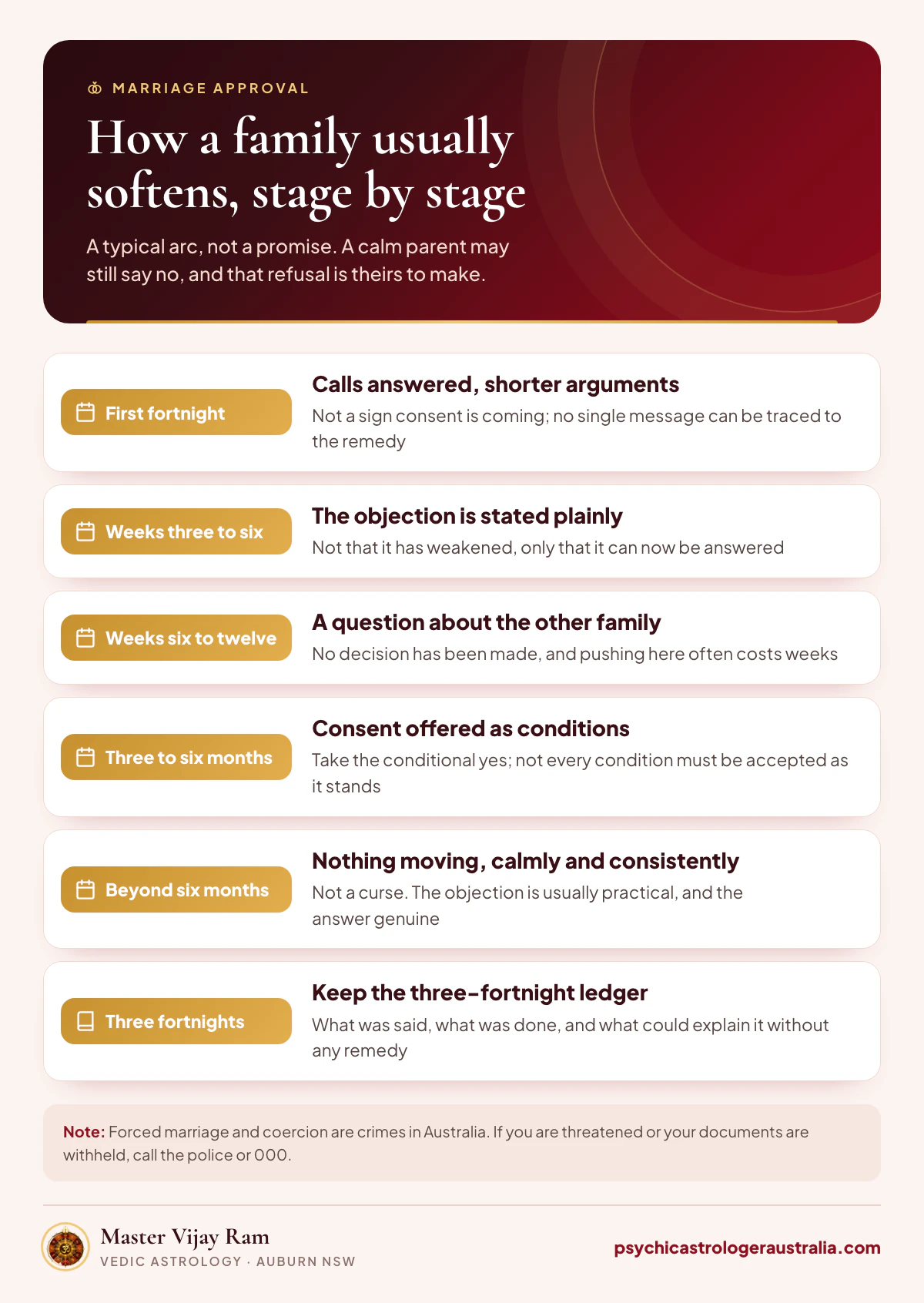
Change in families is slow and uneven. It rarely looks like a dramatic reversal, and when it does, it usually reverses again within a month. Work directed at winning family approval for a marriage tends to follow the arc below rather than a single decisive moment.
| Period | What is typically noticed | What it does not mean |
|---|---|---|
| First fortnight | Calls answered again, shorter arguments, a relative who had stopped speaking sends a short message | It does not mean consent is coming, and no single message can be traced to the remedy |
| Weeks three to six | The objection is stated plainly and with less anger, often for the first time | It does not mean the objection has weakened, only that it can now be answered |
| Weeks six to twelve | A question about the other family, or a suggestion that the two households might meet | It does not mean a decision has been made, and pushing here often costs weeks |
| Three to six months | Consent offered as a set of conditions rather than as a refusal | It does not mean every condition must be accepted as it stands |
| Beyond six months, nothing moving | The position holds, calmly and consistently | It does not mean a curse. It usually means the objection is practical and the answer is genuine |
The first fortnight: what tends to move first
The first thing that changes is almost never the parent. It is you. Sleep settles. The rehearsed arguments you carry around all day get quieter. You stop checking your phone for a message that is not coming.
That matters more than it sounds, because a calmer person speaks differently, and families respond to tone long before they respond to reasoning.
Whether you live in Brisbane or ring from a farm three hours from the nearest town, the first fortnight looks much the same. Small doors, easily missed. A short reply to a text. A question about your health.
Resist the urge to read meaning into everything. A parent answering the phone once is a parent answering the phone once, and the ledger exists to keep you honest about that.
Weeks three to six: when the tone of the conversation changes
This is the window that most often produces something useful. The objection gets stated properly instead of shouted. You finally hear the real one, which is frequently not the one that has been repeated for months.
When that happens, answer the objection rather than the person. If it is money, bring numbers. If it is community, bring the relative who is already on side. If it is a chart concern, offer to have both charts read by someone the family trusts.
Across the wider South East Queensland corridor, questions about what this looks like for people near Logan often arrive at exactly this point, six weeks after a separation the family caused and now quietly regrets.
Three months on: a conditional yes is still a yes
Consent rarely arrives clean. It arrives with conditions attached. A temple ceremony before anything else. A wait until a younger sister is married. A meeting between the two sets of parents before anyone announces anything.
Someone searching for an astrologer in Perth hears the same advice as someone calling from a country town in Victoria. Take the conditional yes. Negotiate the conditions afterwards, slowly, one at a time.
Couples lose ground here more often than at any other stage, usually by treating conditions as an insult and reopening the argument.
One caution. If the partner has drifted during the long wait, reuniting with a former partner becomes the first piece of work, and the family approach waits until the two of you are steady again.
When this is not the answer
Some situations are not spiritual matters at all, and treating them as such is dangerous. Forced marriage and coercion are criminal offences in Australia. If you are being threatened, having your passport or documents withheld, being pressured into a marriage you do not want, or being taken overseas against your will, that is a matter for the police, a lawyer or a family violence service. In an emergency, call 000. Nothing described here replaces that, and no remedy should be sold to you instead of it.
A parent who has become suddenly aggressive, suspicious or confused may be unwell. Dementia, a stroke, depression, alcohol misuse and medication changes all present that way, and a doctor comes first.
Long family pressure also causes real anxiety and depression in couples. A psychologist helps with that. Visa and residency questions belong with a registered migration agent. Spiritual work sits alongside all of it, never in place of it.
After consent: keeping the peace once the yes arrives
The fragile period is not the wait. It is the three months after approval, when wedding planning reopens every old wound. Money, guest lists and who sits where will drag the original objection back into the room.
Keep the ledger running for one more month. Do not relitigate the refusal. Give the resistant parent a defined role in the arrangements, because a person with a job to do rarely returns to the argument.
Couples in Mandurah and the Peel region south of Perth sometimes ring a year later about getting back together, after a wedding was called off during the planning and the two of them drifted apart in the silence that followed. That is preventable, and it is mostly prevented in these three months.
Questions worth asking yourself before you ask anyone else
Five questions settle most cases before a practitioner is involved. Has your partner clearly and freely said yes, in their own words. Has anyone actually asked your parents directly, or has this all been conducted through relatives. Is the objection about the person, or about money, timing or reputation. Is anybody in the situation unsafe. And is there one respected elder who could do more in a single afternoon than any remedy.
If those answers point to an ordinary family negotiation, that is what it is, and you should not pay anyone to call it something else.
Weighing prayer, counselling and remedy side by side is set out in Love Spell vs Prayer vs Counselling: Choosing the Right Help, and for many families it is the more useful starting point.
Read next
- Vashikaran for Wife: Rebuild Trust in Your MarriageVashikaran for a wife explained honestly: what softening can and cannot do, when the real cause is medical or legal, …
- Love Spell Specialist in Sydney and Melbourne: What a Consultation InvolvesLove spell specialist in Sydney and Melbourne: what a consultation with Master Vijay Ram involves, which requests he …
- Vashikaran for In-Laws and Family Harmony: What Is EthicalVashikaran for in-laws, explained honestly: what the work can address in a tense household, the requests Master Vijay…
Frequently asked questions
Does a remedy for marriage approval force my parents to agree?
No. The work is aimed at the atmosphere around the decision, not at the decision itself. It cools anger, quietens gossip and steadies the way you speak when you sit down with them. A calm parent may still refuse, and that refusal is theirs to make. Anyone who promises you a guaranteed yes is not being honest with you.
My partner agrees but their family does not. Whose side is the work actually done for?
For the couple, and only with both people willing. Master Vijay Ram will not act for one person against a partner who has doubts. If your partner is uncertain, that is the real matter, and no amount of work on their parents will settle it. The family approach is only useful once the two of you genuinely agree.
My family objects because of a kundli mismatch. Is that a real reason or an excuse?
Sometimes it is real and sometimes it is cover for something harder to say. A proper reading of both charts settles which. Where a genuine mismatch exists, there are recognised remedies for it. Where the objection is being used to avoid a conversation about money or community, the reading usually makes that visible within a single sitting.
Should I tell my family that I have consulted an astrologer?
That is your decision and there is no obligation either way. Every consultation is strictly confidential, and nobody in your family or community is contacted. Some clients find that mentioning a chart reading actually helps, because older relatives take it seriously. Others keep it entirely private. Neither choice changes how the work itself is carried out.
How do I tell whether my mother is genuinely softening or I am imagining it?
Use the three-fortnight ledger. On day fourteen, day twenty-eight and day forty-two, write what was said, what was actually done, and what could explain it without any remedy. Hope inflates small things. Writing them down deflates them again. If ordinary explanations cover everything by the third entry, treat the resistance as practical and negotiate instead.
Is it wrong to seek a remedy while my parents are still saying no?
Not in itself, provided the aim is a fair hearing rather than obedience. The ethical line is simple. Removing the heat, fear and gossip that stop people listening properly is legitimate. Overriding a parent's right to reach their own conclusion is not. If your intention is the second one, you will be told no and given other advice.
What if the family agrees but attaches conditions I cannot accept?
Take the yes and leave the conditions for later. Consent almost never arrives clean, and conditions are usually opening positions rather than final ones. Reopening the whole argument over a wedding date or a ceremony order is how couples lose ground they have already gained. Negotiate one condition at a time, slowly, once the mood has settled.
Can this be done without my partner knowing?
No. Work aimed at a person who has not agreed to it is exactly the kind of request that gets refused here. If you cannot tell your partner you have asked for help, that is worth examining before anything else. The one exception is a reading of your own chart, which concerns you alone and involves nobody else.
My father has become angry and forgetful since all this began. Is that a spiritual sign?
Treat it as a medical question first. Sudden changes in temper, memory or judgement can come from dementia, a stroke, depression, alcohol misuse or a change in medication. A doctor should see him before anyone reads a chart. Spiritual work sits alongside medical care and never replaces it, and no honest practitioner would tell you otherwise.
How long is it reasonable to keep trying before accepting that the answer is no?
Six months of steady, calm effort with nothing moving is usually the honest marker. At that point the position is generally genuine rather than energetic, and continuing to pay for remedies stops being reasonable. That is not the same as never. Families do change with births, illnesses and time, but you should not spend money waiting for it.
What should a genuine practitioner charge for in a case like this, and what should never be charged?
A reading, and any remedy actually performed, are fair to charge for. Repeat payments to lift a curse that appeared only after you rang, escalating urgent fees, and charges to prevent a disaster you were never warned about beforehand are not. Here the reading is a $50 consultation, and spell or prayer work, where it is warranted, starts from $250 and is agreed before it is performed, so nobody is asked to pay for a promise.
We already tried another practitioner and nothing happened. Does that make this harder?
Not usually, though it does change the first conversation. What gets checked is what was actually performed, what you were told at the time, and whether anything was left unfinished. Sometimes a previous attempt did no harm at all and simply achieved nothing. Sometimes the earlier reading was sound and the timing was wrong. Both are common.
Our objection at home is about community and reputation rather than the person. Does that change the approach?
It changes what is worked on. Reputation objections are driven by fear of what relatives will say, so the pressure sits outside the household rather than inside it. The practical answer is usually one respected elder who speaks first, and the remedy work is aimed at quietening the gossip that keeps that fear alive.
How should I behave at family gatherings while this is going on?
Say less about the marriage, not more. Gatherings are where positions harden, because people repeat themselves in front of an audience and then cannot retreat without embarrassment. Be present, be useful, ask after people's health, and let the subject rest. If someone raises it, answer once, calmly, and move on. Persuasion in a crowded room rarely works.
What if the two of us start doubting each other during the long wait?
That is common and it deserves attention rather than embarrassment. Long resistance wears couples down, and the arguments start being about the waiting rather than about the family. Talk about it directly, and consider counselling. If the doubt is genuine rather than exhaustion, no remedy should be attempted until the two of you know your own minds.
People also ask
Can vashikaran change a parent's mind about marriage?
It can change the conditions in which a parent thinks. The work is directed at anger, fear of shame and gossip, all of which make a fair hearing impossible. Once those settle, families often reconsider on their own. A parent who stays calm and still refuses has given a genuine answer, and that answer is respected.
Why do some families soften over time while others never do?
Because objections differ in kind. Where the resistance is emotional heat, shame or rumour, it tends to fade once those cool. Where it rests on something practical, such as money, an existing commitment or a firmly held belief, calm does not remove it. The second kind needs negotiation rather than remedies, and pretending otherwise wastes years.
Is a remedy for marriage approval a way of overriding free will?
It should not be, and honest practice draws that line clearly. Work aimed at making a named person obedient is refused. Work aimed at removing the heat that stops people listening is not the same thing. The test is simple. If the goal is a fair hearing it is legitimate, and if the goal is control it is not.
What is the difference between a marriage-approval remedy and a love spell?
The target is different. A love spell is aimed at feeling between two people. A remedy for marriage approval is aimed at the atmosphere in a family, where the couple is already committed and the block sits with parents or relatives. The second involves far more practical advice than ritual, because most family objections turn out to be negotiable.
What should someone do if their family threatens them over a relationship?
Treat it as a safety matter immediately. Forced marriage and coercion are criminal offences in Australia. Threats, withheld passports or plans to send someone overseas against their will are matters for the police, a lawyer or a family violence service, and in an emergency for 000. Spiritual work belongs alongside that help, never in place of it.
References & further reading
Serving clients across Australia
Confidential consultations by phone, video & WhatsApp — including: