

Quick answer
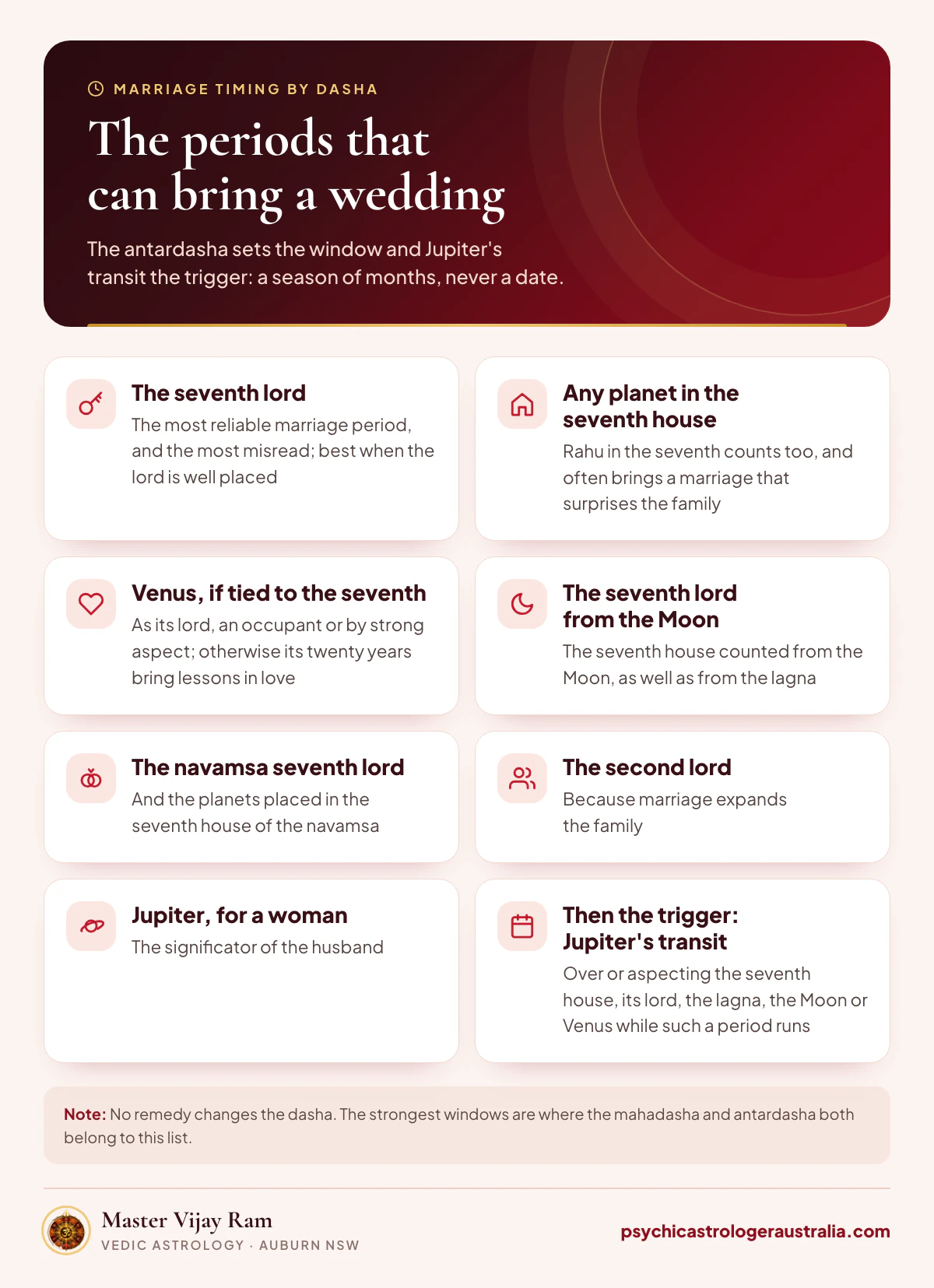
Marriage timing by dasha reads which planetary periods carry the promise of the seventh house: the dashas of the seventh lord, of planets in the seventh, of Venus, of the navamsa seventh lord and, for a woman, Jupiter. The antardasha sets the window, Jupiter's transit supplies the trigger, and the honest answer is a season of months, never a date.
What is marriage timing by dasha?
Marriage timing by dasha is the Vedic method of reading when a wedding is likely by finding the planetary periods in which the promise of the seventh house is kept. A birth chart says whether and what kind; the dasha, the running sequence of planetary periods that begins at birth, says when; and the transit of Jupiter supplies the trigger. Together they give a window, usually of months, never a date.
This page goes inside the mechanism: how the Vimshottari system is built, which periods are marriage-giving, what the difference between a mahadasha and an antardasha means in practice, and why the Venus period is not always the one that brings the wedding. A love and marriage prediction reading runs the method on your own chart; the broader timing question is covered on its own page.
The Vimshottari dasha in two minutes
Vimshottari means one hundred and twenty, the number of years the full cycle takes. Nine planets take turns ruling your life in a fixed order, each for a fixed span, and the planet that rules at birth is set by the nakshatra the Moon occupied when you were born. The balance of that first period is what makes two people born on the same day run on different clocks.
| Planet | Mahadasha length | Starts the cycle for a Moon in |
|---|---|---|
| Ketu | 7 years | Ashwini, Magha, Mula |
| Venus | 20 years | Bharani, Purva Phalguni, Purva Ashadha |
| Sun | 6 years | Krittika, Uttara Phalguni, Uttara Ashadha |
| Moon | 10 years | Rohini, Hasta, Shravana |
| Mars | 7 years | Mrigashira, Chitra, Dhanishta |
| Rahu | 18 years | Ardra, Swati, Shatabhisha |
| Jupiter | 16 years | Punarvasu, Vishakha, Purva Bhadrapada |
| Saturn | 19 years | Pushya, Anuradha, Uttara Bhadrapada |
| Mercury | 17 years | Ashlesha, Jyeshtha, Revati |
Inside each mahadasha the same nine planets take turns again as antardashas, in the same order, beginning with the mahadasha lord itself, and inside each antardasha there is a third level, the pratyantar. Marriage is usually timed to the antardasha, which is why a reading can say 'between late next year and the winter after' rather than 'in your Venus period', which could be twenty years long. A Vimshottari dasha marriage reading is built on this table, and the dasha system explained goes through the arithmetic.
Which dashas are marriage-giving?
The tradition lists the planets whose periods tend to bring marriage, and the list is longer than Venus alone. The lord of the seventh house from the lagna; any planet placed in the seventh house; Venus, the natural significator of the spouse; the lord of the seventh house counted from the Moon; the lord of the seventh house of the navamsa and the planets placed there; the lord of the second house, because marriage expands the family; and, for a woman, Jupiter, the significator of the husband. Rahu placed in the seventh is counted too, and often brings a marriage that surprises the family.
A period belongs to one of these planets in its mahadasha or its antardasha, and the strongest windows are the ones where both levels are marriage-giving: the seventh lord's antardasha inside the Venus mahadasha, for example, or Venus's antardasha inside the dasha of a planet sitting in the seventh house. A dasha for marriage is therefore a combination, not a single name.
Mahadasha and antardasha: the period inside the period
The mahadasha sets the theme of a stretch of years; the antardasha sets what happens in it. A Saturn mahadasha that is not itself marriage-giving can still contain a Venus antardasha of three years and two months in which the wedding comes, and most marriages he has timed fell in an antardasha of this kind rather than in a mahadasha famous for weddings. The reverse is also true: a Venus mahadasha with a Ketu or Saturn antardasha running can be the quietest stretch of a love life.
The practical rule is to list the marriage-giving planets for the chart, then scan the next ten years of antardashas for the ones that belong to that list, then weigh each against the mahadasha it sits inside and the transits that will be running. That scan is most of what a timing reading is.
The Venus dasha and marriage
People arrive certain that the Venus dasha will bring their wedding, and sometimes it does. When Venus is the seventh lord, or sits in the seventh house, or is strong and connected to it by aspect, its mahadasha of twenty years is a long season of love in which the antardashas of the seventh lord and of Jupiter are the likely windows. When Venus rules the sixth, eighth or twelfth house for the lagna, or is combust or debilitated without cancellation, its period brings comfort, spending, pleasure and lessons in love rather than a marriage, and the wedding waits for a different lord.
This is the most common correction he makes in a timing reading: Venus is the significator of marriage for everyone, but it is marriage-giving by dasha only when the chart ties it to the seventh house. Venus in your birth chart explains how that tie is judged.
The seventh-lord dasha
The 7th lord dasha is the most reliable marriage period in the system, and the most misread. Its mahadasha or antardasha carries the business of the seventh house into the life, and if the lord is well placed, in a kendra or trikona, in a good sign, with Jupiter's aspect, the wedding tends to fall in it. If the lord is in the sixth, eighth or twelfth, or debilitated, the same period brings the partnership question with difficulty attached: a relationship that stalls, an engagement that breaks, a marriage that arrives with a hard first year.
The seventh lord is also a maraka, a planet whose periods the old texts associate with hardship, so an honest reading never presents its dasha as pure good news. He reads it with the whole chart and tells you which side of it is likely to show.
Why the dasha alone is not enough: the trigger
A marriage-giving dasha is a loaded promise; the transit of Jupiter pulls the trigger. In the classical rule the wedding comes when Jupiter, by transit, passes over or aspects the seventh house, the seventh lord, the lagna, the Moon or Venus, while a marriage-giving dasha is running. Saturn's involvement by transit over the same points tends to confirm a marriage that lasts, which is the basis of the double-transit method many modern astrologers use.
In 2027 Jupiter spends January in Leo, moves back into Cancer, where it is exalted, from 25 January to 26 June, returns to Leo until 27 November and enters Virgo for the rest of the year, so each Moon sign has a different trigger season. Jupiter's transit in 2027 and marriage lays them out sign by sign; the dasha decides whether the trigger finds anything loaded.
Age, dasha and the window
Timing is read against age and circumstance as well as the sky. A marriage-giving antardasha at nineteen is read as a relationship, not a wedding, unless the family's custom says otherwise; the same antardasha at thirty-one, with Jupiter transiting the seventh house, is read as the window. He also reads the partner's chart when there is one, through a relationship compatibility reading, because two charts that open in the same season are the best evidence a timing reading ever has.
What he gives is a window, usually one antardasha wide, with the strongest months inside it marked by the transit. Nobody honest gives a date; the wedding is still something two people and two families decide, and a chart that is read as a sentence is read wrongly.
A worked example: a nurse in Townsville
A nurse in her early thirties, born with a Virgo lagna, Jupiter as her seventh lord placed in the fifth house, and Venus in the eleventh, had been told by an app that her Venus period, which had about ten more years to run, would 'bring marriage any time'. Her antardashas told a different story: the Rahu antardasha then running sat in her twelfth house, and it explained the long-distance relationship that kept almost becoming an engagement.
The next antardasha was Jupiter's, her seventh lord, inside the same Venus mahadasha, and Jupiter's transit would reach her seventh house of Pisces by aspect once it entered Virgo. That combination, a marriage-giving antardasha with the trigger arriving inside it, was the window, and it was the first time anyone had told her that the Venus period by itself was not the point. Townsville clients read in Queensland time and ring in the evening after a shift.
When the dasha says not yet
Some periods are plainly not marriage-giving: the dashas of planets in the sixth, eighth or twelfth houses, Ketu periods, which detach, Saturn periods in a chart where Saturn is not connected to the seventh, and the antardashas of planets that sit with the seventh lord's enemies. A 'not yet' is useful information. It saves a family from a year of forced introductions, and it is the honest answer in roughly a third of the timing readings he does.
Saturn deserves its own word, because Saturn in or on the seventh house delays rather than denies, and the delay often ends inside Saturn's own antardasha once its lesson is complete. Saturn in the seventh house covers that pattern, and the wider causes of a marriage that is late are a page of their own.
Second marriages and the dasha
A second marriage is timed from the same chart with the ninth house, the second house from the seventh, read alongside the seventh, and from the periods of the ninth lord and of planets connected to it. A person whose first marriage fell in the seventh lord's antardasha will often find the second in the ninth lord's, and the pattern is clear enough that he can usually say which marriage a given window belongs to. Second marriage in the birth chart covers the reading in full.
Remedies and timing: what a puja can and cannot do
No remedy changes the dasha. What a remedy can do, in the tradition, is ease the obstacles in a marriage-giving period that is running with difficulty: a seventh lord under Saturn's pressure, a Venus period opening with a loss, a manglik question that is frightening the families. Where the chart warrants it, Master Vijay Ram performs the relevant shanti or havan personally at his own place of practice in Auburn, on a muhurat, and clients join by video from interstate if they wish.
A consultation is $50; spell or prayer work starts from $250 and is agreed before it is performed; and a timing reading that finds a clear window and no obstacle ends with no remedy at all, which is the usual outcome. Online puja and havan explains what is performed and how.
What dasha timing cannot do
It cannot name a date, a person or a city. It cannot override free will; a marriage-giving window is a season in which a marriage is easier to reach, and plenty of people spend such a season single by choice. It cannot promise an outcome; it describes the likely season. And it is faith-based guidance, not legal or financial advice: the marriage, the visa, the mortgage and the prenuptial conversation belong to the professionals who handle them.
How Master Vijay Ram times a marriage question
He needs your date, time and place of birth, and the partner's if there is one. He draws the rashi chart and the navamsa, lists the marriage-giving planets for your lagna and Moon, scans the next decade of antardashas, places Jupiter's and Saturn's transits against them, and reads your age and your situation last. You receive a window, the strongest months inside it, and a plain statement of what could delay it.
The consultation is $50, by phone, video or WhatsApp anywhere in Australia, in English, Hindi or Punjabi, or in person at Auburn by appointment. The question when will I get married by dasha has an honest answer in most charts: it is a season, and the season is usually nearer than the app said and further than the family hoped.
How a dasha window meets the wedding calendar in Australia and India
A window of months becomes useful once it is laid over real calendars. For a couple in Gungahlin or Belconnen in Canberra, that means annual leave, flights to India and two families' availability, and marriage timing by dasha says which season is worth planning around.
The wedding season has gates of its own. It reopens at Dev Uthani Ekadashi in November and pauses during Kharmas, while the Sun moves through Dhanu from mid-December to mid-January, which is exactly when many Australian families have leave and want to fly to India. A strong antardasha over the summer can therefore mean a ceremony after Makar Sankranti rather than before Christmas.
The day itself comes from a separate reading, a muhurat for the wedding date, calculated for the city where the vows are taken, whether that is Canberra or Chandigarh. Families in the ACT who want a temple blessing beforehand have the Sri Vishnu Shiva Mandir at Mawson and the BAPS mandir at Taylor.
Canberra keeps Sydney's clock and sits about three hours from Auburn by road, so a couple who want a face-to-face reading with Master Vijay Ram can make the trip by appointment. Everyone else reads by phone, video or WhatsApp, as the Canberra astrology readings page explains.
Read next
- When Will I Get Married? How Vedic Astrology Reads Marriage TimingHow Vedic astrology times marriage: the 7th house, Venus and Jupiter, the dasha clock and transits, and why an honest…
- The Seventh House: Your Marriage House ExplainedThe seventh house in Vedic astrology: how to find it, what its lord and planets mean for marriage and partnership, as…
- Get Ex Love Back in Australia: An Honest Vedic GuideGet your ex love back in Australia with Master Vijay Ram: honest Vedic astrology and ethical prayer work, by phone, v…
Frequently asked questions
Which dasha gives marriage?
The mahadasha or antardasha of the seventh lord, of any planet placed in the seventh house, of Venus, of the seventh lord counted from the Moon, of the navamsa seventh lord or the planets in it, of the second lord, and, for a woman, of Jupiter. Rahu in the seventh is counted too. The strongest windows are where both the mahadasha and the antardasha belong to this list, and the transit of Jupiter on the seventh house supplies the trigger.
Does the Venus mahadasha always bring marriage?
No. Venus is the significator of marriage for everyone, but its period is marriage-giving only when the chart ties Venus to the seventh house: as its lord, as an occupant, or by a strong aspect. When Venus rules the sixth, eighth or twelfth for your lagna, or is combust or debilitated without cancellation, its twenty years bring comfort, spending, pleasure and lessons in love, and the wedding waits for the antardasha of a different planet.
What is an antardasha and why does it matter for marriage?
An antardasha is the sub-period inside a mahadasha; the nine planets take turns again in the same order, each for a share of the main period proportional to its own length. Marriage is timed to the antardasha because a mahadasha can run for twenty years, while an antardasha runs for months or a few years. Most weddings fall in a marriage-giving antardasha inside a neutral mahadasha rather than in a famous Venus period.
Can marriage happen in a Saturn dasha?
Yes, when Saturn is the seventh lord, sits in the seventh house, or is connected to it by aspect, and often in Saturn's own antardasha once its lesson of patience is complete. Saturn tends to delay rather than deny, and marriages made in a Saturn period are usually the durable kind. When Saturn has no connection to the seventh house, its period is quiet for love, and the window is read from the antardashas inside it.
What does a Rahu dasha mean for marriage?
Rahu in the seventh house, or connected to it, brings marriage in its period, and often a marriage the family did not expect: a partner from another culture, faith or country, or a relationship that moves faster than anyone planned. Rahu elsewhere in the chart can bring intense attachments in its period that do not become marriages. It is read with Rahu's sign, its dispositor and the navamsa before anything is said.
How accurate is marriage timing by dasha?
Accurate to a season when the birth time is reliable and the chart is read as a whole; never accurate to a date, and nobody honest claims otherwise. The method gives a window one antardasha wide, with the strongest months marked by Jupiter's transit. Master Vijay Ram also reads age, circumstance and the partner's chart when there is one, and he says plainly when the answer is not yet, which it is in roughly a third of readings.
Do I need an exact birth time for a timing reading?
An accurate time matters, because the lagna and the navamsa lagna change every couple of hours and every few minutes respectively, and the dasha balance at birth shifts with the Moon's position. If your time is approximate, say so: the reading can still be done from the Moon sign and the dasha, and he will tell you how much depends on the uncertainty. A birth certificate, hospital record or a parent's memory of the hour is usually enough.
What if my partner's chart shows a different window?
Then the reading looks for the overlap, because a wedding needs both charts to open. Often one chart opens a little earlier and the other confirms it within a few months, which is the strongest evidence a timing reading can have; when the windows are far apart, the earlier chart usually brings the engagement and the later one the wedding. A relationship compatibility reading sets both charts side by side for exactly this purpose.
Can a remedy bring marriage sooner?
No remedy changes the dasha, and he says so. What a remedy can do, in the tradition, is ease an obstacle inside a marriage-giving period that is running with difficulty: a seventh lord under pressure, a manglik question, a Venus period opening with loss. Where the chart warrants it, a shanti or havan is performed personally at Auburn from $250, agreed before it is done, after a $50 consultation; most timing readings end with a window and no remedy.
People also ask
Which mahadasha is good for marriage?
The mahadasha of the seventh lord, of a planet in the seventh house, or of Venus when the chart ties Venus to the seventh, and for a woman the Jupiter mahadasha. More important is the antardasha inside it: a marriage-giving antardasha inside a neutral mahadasha brings most weddings, and the Jupiter transit on the seventh house marks the months.
What is the 7th lord dasha?
The period ruled by the planet that owns the seventh house from your lagna. It is the most reliable marriage-giving period in the Vimshottari system when that lord is well placed, and the most mixed when it sits in the sixth, eighth or twelfth or is debilitated. The seventh lord is also a maraka, so the period is read with the whole chart rather than as a promise.
Does the Jupiter transit give marriage?
Jupiter's transit is the trigger, not the cause. When Jupiter passes over or aspects the seventh house, the seventh lord, the lagna, the Moon or Venus while a marriage-giving dasha is running, the wedding tends to come in those months. Without a loaded dasha the same transit brings a proposal that does not hold or a season of introductions.
Can dasha timing tell if it will be a love marriage or arranged?
It can suggest the route. A marriage brought by Venus, the fifth lord or Rahu in a period connected to the fifth house leans toward a love match; one brought by the seventh lord, the second lord or Jupiter through the ninth house leans toward a match the family arranges or blesses. The chart gives the lean, and the couple make the choice.
At what age does the Venus dasha start?
It depends on the Moon's nakshatra at birth. A Moon in Bharani, Purva Phalguni or Purva Ashadha starts life in the Venus period; otherwise Venus follows Ketu's seven years, so a Moon in Ashwini, Magha or Mula reaches Venus before seven. For everyone else Venus comes after the Sun, Moon, Mars, Rahu, Jupiter, Saturn and Mercury periods, which can mean the forties or later.
References & further reading
Serving clients across Australia
Confidential consultations by phone, video & WhatsApp — including: