
Quick answer
A havan at home in an apartment works only when it is small, ventilated and allowed: a little kund on a metal tray, dry samidha, samagri by the pinch, one adult watching, and the smoke alarm left working. Check the strata by-laws and tell the neighbours first; where the building or the household rules it out, have it performed in Auburn and join by video.
What is a home havan, and can it really be held in a flat?
A havan is a fire offering that carries ghee, grains and fragrant herbs into a consecrated fire, each offering sealed with a mantra ending in svaha. It is the heart of a griha pravesh, a birthday, a shanti or a festival morning, and many families feel a home is not properly blessed until it has had one. Holding a havan at home in a detached house with a courtyard is one thing; holding it on the eleventh floor of a Darwin or Docklands tower is another.
The honest answer is that some apartments can take a small havan and many cannot, and this guide is about telling the two apart. Where a home cannot, the havan is still performed, personally, at Master Vijay Ram’s place of practice in Auburn, as described under puja and havan performed on request, with the family joining by video from the lounge room.
What does a small havan involve?
A havan kund, the square metal vessel that holds the fire, usually copper, brass or iron and often stepped like an inverted pyramid. Samidha, short dry sticks of mango wood. Ghee in a small bowl with a long spoon, the sruva, to offer it; havan samagri, the mixture of herbs, grains and resins offered by the pinch; a tablet of camphor to light the fire; and a small pot of water for the purifying sprinkles at the start and the end.
The rite itself has a simple shape. A sankalp states who is performing it and why, Ganesha is invoked, the fire is lit and fed, and the ahutis are offered one by one with their mantras, each ending in svaha as the ghee or samagri goes into the flame. A final full offering, the purnahuti, closes it, followed by an aarti and prasad.
How small is small enough for a unit?
Smaller than most families imagine, and smaller than the havan they remember from a house in India. The table compares a full household havan with the version that a well-ventilated unit can sometimes manage.
| Element | Full household havan | Small apartment havan |
|---|---|---|
| Kund | A large kund, or a brick kund built in a courtyard | The smallest metal kund sold, on bricks or a stone tile over a metal tray |
| Samidha | Bundles of mango wood | A handful of short, dry sticks |
| Samagri | Offered by the fistful | A pinch at each svaha, which keeps the flame bright and the smoke low |
| Ahutis | 108 or more, often with several mantras | Eleven or twenty-one, with one mantra the family knows |
| Purnahuti | A whole dried coconut filled with ghee | A small piece of dried coconut and a spoon of ghee |
| Time | One to several hours | Well under an hour from lighting to the last ember |
A small havan at home loses nothing in the tradition’s eyes by being short. The fire, the mantra and the intention are the havan; the size of the blaze is only the size of the blaze.
Where should the kund sit?
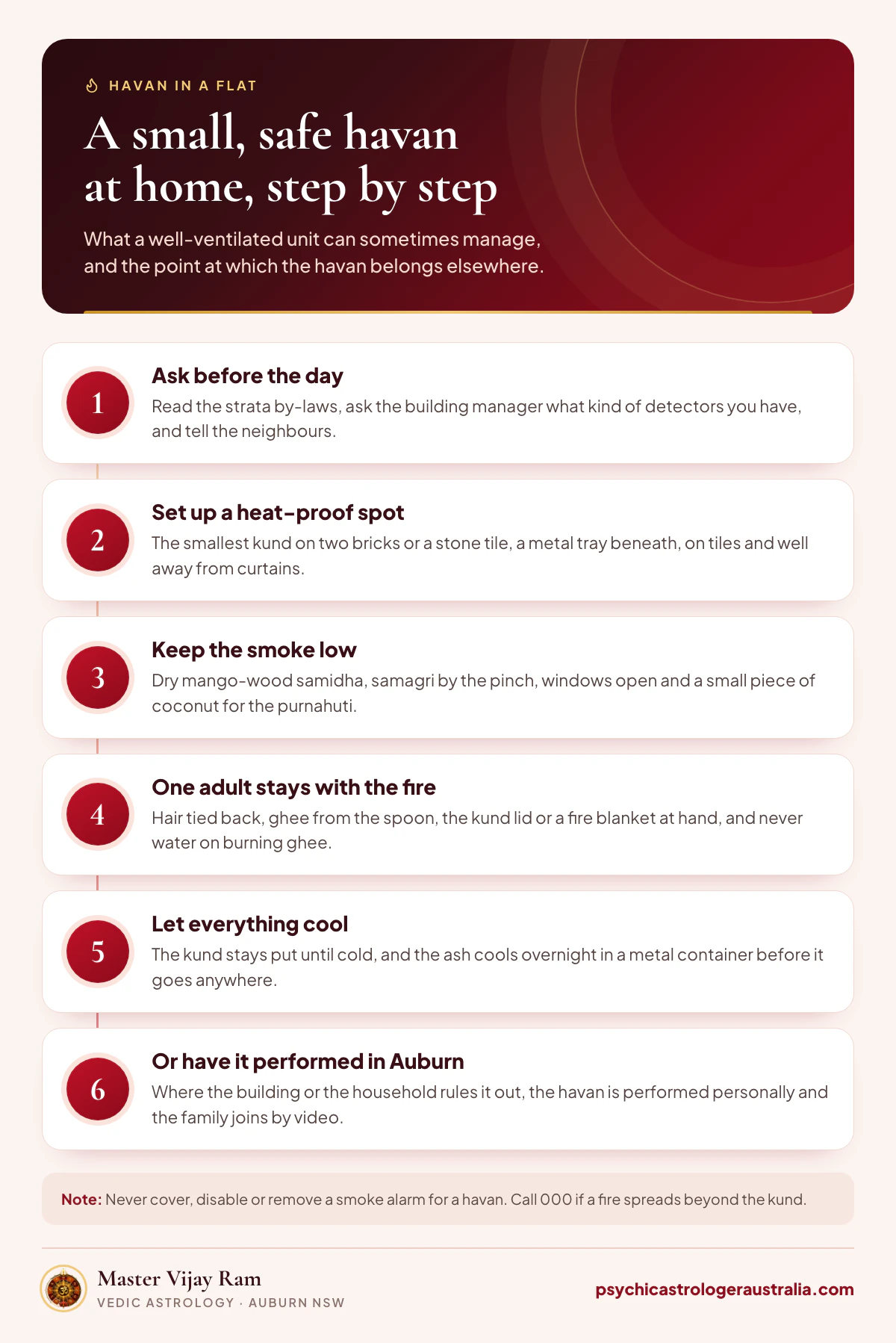
On a hard, heat-proof surface, well away from anything that can catch. Set the kund on two bricks or a thick stone tile, with a metal tray underneath to catch sparks and spilt ghee, on a tiled floor rather than carpet, timber, laminate or a glass table. Keep a clear circle around it: no curtains, cushions, paper, altar cloth or bookshelves within reach of a flare.
Vastu gives fire the south-east of the home, the Agni corner, and the person offering traditionally sits facing east. In a small unit the safe spot matters more than the ideal one, so choose the place with the most ventilation and the least above it, and never directly under a smoke alarm or a ceiling fan. A havan kund at home stays hot long after the flame dies, so the spot has to work for hours, not minutes.
What about the smoke alarm?
Every state requires working smoke alarms in homes, and a puja is never a reason to cover, disable or remove one. A bag over the alarm is easy to forget for a week, and an alarm taken down for the morning has a way of staying in a drawer. If the alarm sounds, open the doors and windows and let the smoke clear; do not pull it off the ceiling.
Find out what kind of alarm you have before the day. In some apartment buildings the detectors are connected to the building’s fire panel, which calls the fire brigade and can empty the whole building onto the street; in others the alarm in each unit sounds only inside it. The strata or building manager can say which, and a building with connected detectors is usually one where the havan belongs elsewhere.
Do strata by-laws allow a havan?
Read them before assuming either way. Strata by-laws can limit open flames and smoke, many forbid any open flame or charcoal on balconies, and smoke that drifts into other units can be treated as a nuisance under the by-laws even when the flame was indoors. A short email to the strata or building manager describing a small, supervised fire for under an hour gets a clear answer and a record of it.
Renters have a second set of rules in the lease. Ask the agent in writing, and remember that a scorch mark on the floor or a smoke-stained ceiling is a bond question long after the havan is forgotten. A havan in an apartment that the building has said yes to is a pleasure; one done quietly against the rules turns a blessing into a dispute.
Should you tell the neighbours?
Yes, a day or two ahead, with the time and how long it will last. Smoke travels up stairwells, under doors and in through the windows of the unit above, and a neighbour who knows what it is will wait it out rather than ring 000. A note under the door beforehand and a plate of prasad afterwards keep the peace.
Listen to the answer, too. A neighbour with a newborn, an oxygen machine or a chest that cannot take smoke is a reason to choose another day or another way, and the tradition has never asked anyone to bless their own home at the cost of someone else’s breath.
Who should stay out of the room?
The smallest members of the household: babies, toddlers and pets, with pet birds at the top of the list because their lungs suffer first; the reasons and the safe alternatives are set out in home cleansing with pets and toddlers. Anyone with asthma or another chest condition waits at the other end of the home behind a closed door, or the household chooses a method without smoke, which is what smoke-free home cleansing for units is about.
That leaves the adults who are offering. One of them is in charge of the fire from the first match to the cold ash, and that person does not leave the room.
How do you keep the fire safe while it burns?
Never leave the flame unattended, even to fetch the prasad from the kitchen. Tie back long hair, pin the dupatta and roll up loose sleeves, because loose cloth near the flame is the risk families forget. Offer ghee from the spoon, never by tipping the jar, and keep the samagri dry and in pinches so the fire never smothers and flares.
Never throw water on burning ghee: like any burning fat it can flare up violently. Smother a flare with the kund’s metal lid or a fire blanket, keep a jug of water for anything else, and call 000 if a fire spreads beyond the kund. Dry, untreated wood is the only fuel; painted timber, treated pine and broken pallets give off fumes no prayer needs.
What happens to the kund and the ash afterwards?
Let the fire burn down to embers and leave the kund where it stands until it is cold, which takes hours; a hot kund carried across a room is how floors get scorched and hands burnt. When it is cold, tip the ash into a metal container and leave it overnight before it goes anywhere else, because ash can hide live coals.
Where the cooled ash then goes, with the flowers and the coconut shell, is set out in eco-friendly visarjan for puja leftovers. Wash the kund with warm water once it is cold, dry it, and store the samidha in an airtight tub; in a Darwin or Cairns wet season, damp sticks smoulder and smoke instead of burning clean.
Is a backyard or balcony easier?
A backyard often is. A family on the Central Coast or in Townsville with a paved courtyard can hold the havan in the open air, where smoke disperses and the alarms are not involved, with a hose run out and dry grass and leaves cleared well back. On a total fire ban day an outdoor fire of any kind is out of the question, and on a windy day it should wait.
A balcony is usually harder than it looks. Wind carries sparks, the units above take the smoke, and balcony flames are exactly what many by-laws forbid; treat it as indoors unless the by-laws say otherwise in writing.
When is it wiser to have the havan performed in Auburn?
When the building has connected detectors or by-laws against open flame, when someone in the home has asthma or a newborn, when the rite is a long one such as a navagraha or Maha Mrityunjaya havan with many ahutis, or when nobody in the family knows the mantras well enough to lead it. In those cases the fire moves to Auburn: Master Vijay Ram performs the havan himself at his place of practice on the chosen muhurat, taking the sankalp in the family’s names, while the family lights a lamp at home and watches on video if they like.
That is how a family in a tower can keep a griha pravesh and home blessing complete, and how a house-warming puja is done shows which parts stay at home. Consultations are $50, and a havan performed on request begins at $250, a sum settled before the fire is lit. Families in Palmerston, Malak and Nightcliff consult by phone or video, as most of his clients do, and readings for Darwin families explains the time difference.
What can a home havan not do?
A home havan for cleansing is an offering, and it does not clean the air, dry out a damp bathroom or settle a dispute with the neighbour it filled with smoke. Where a home feels heavy, damp, gas heaters and sleep are checked first, and negative energy removal is for the narrow case where a pattern remains after them. Everything on this page is offered as faith and custom, not as medical, legal or financial advice.
No havan is worth an injury, an evacuated building or a neighbour in hospital. A small fire done safely, or a full one done elsewhere with the family watching, is the whole of the choice.
Read next
- Smoke-Free Home Cleansing for Units, Renters and Asthma HouseholdsSmoke-free home cleansing for units, renters and asthma households: mantra room by room, water, salt, sound, an LED d…
- Neem in Home and Body Cleansing: The Tradition and Safe UseNeem in Hindu home and body cleansing: Ugadi neem and jaggery, the neem bath, leaves at the door, why neem smoke stay…
- Signs of Negative Energy in Your Home & How to Clear ItSigns of negative energy in a home, the ordinary causes to rule out first, and how nazar, heavier interference and me…
Frequently asked questions
Can I do a havan in my apartment?
Sometimes. It depends on the strata by-laws, whether the building’s detectors are connected to a fire panel, the ventilation in your unit and who lives with you. Where the by-laws allow it, a very small havan on bricks and a metal tray, with windows open, one adult watching and the neighbours told, is possible. Where they do not, the havan can be performed for you elsewhere and joined by video.
Will a havan set off the smoke alarm?
It can, especially at the lighting and the final offering, when most of the smoke comes. Dry samidha, samagri offered in pinches rather than handfuls, a small piece of coconut for the purnahuti and open windows keep the smoke down. If the alarm sounds, open doors and windows and let it clear. Ask the building manager first whether your unit’s detectors call the fire brigade.
Can I cover the smoke alarm during a puja or havan?
No. Every state requires working smoke alarms in homes, and covering, disabling or removing one for a ceremony leaves the household unprotected and is easy to forget afterwards. If a havan cannot be done without the alarm sounding, that is the sign it belongs outdoors, in a different building, or performed elsewhere on the family’s behalf with the family joining by video.
What do I need for a small havan at home?
The smallest metal havan kund, two bricks or a stone tile and a metal tray beneath it, a handful of dry mango-wood samidha, ghee and a long spoon, a little havan samagri, a camphor tablet to light the fire and a small pot of water. Add a fire blanket or the kund’s metal lid, a jug of water and one adult who stays with the fire until the ash is cold.
What wood should be used for a havan?
Mango wood is the common choice for samidha, cut into short, dry sticks, and some traditions add other sacred woods. It must be dry, because damp sticks smoulder and smoke. Never use painted timber, treated pine, pallets or offcuts from a renovation, which release fumes, and in a humid wet season keep the sticks in an airtight tub so they burn cleanly when the day comes.
Can I do a havan on the balcony?
Only if the strata by-laws allow open flame there, which many do not, and only on a still day. Balconies look like the open air but the wind carries sparks, the units above take the smoke and a dropped ember can fall to the balcony below. Ask the strata manager in writing first, and treat the balcony as indoors unless the answer is a clear yes.
How long should the havan kund cool before it is moved?
Until it is completely cold to the touch, which can take a few hours after the last flame. Moving a hot kund is how floors get scorched and hands burnt. Once it is cold, tip the ash into a metal container and leave it overnight before it goes anywhere else, because ash can hide live coals that start a fire in a bin.
Is it safe to do a havan with a baby, toddler or pets at home?
Not in the same room. Babies, toddlers and pets, especially pet birds, are kept well away from the smoke and the fire, ideally behind a closed door at the far end of the home, or out of the house for the hour. A household with a newborn or an asthmatic child often chooses a lamp-only puja at home and has the havan performed elsewhere, with the family joining by video.
Can Master Vijay Ram perform a havan for my home?
Yes, though never at your home. The havan takes place at his place of practice in Auburn on a muhurat chosen for the family, the sankalp taken in their names, and at the same hour the family can light a lamp at home and follow on video. A consultation is $50, and a havan on request starts from $250, the figure agreed before he begins.
People also ask
How do you do a havan without smoke?
A havan always makes some smoke, because ghee and herbs are offered into a flame. It can be kept low with dry wood, pinches of samagri and a small purnahuti, but a household that needs no smoke at all is better served by a lamp-only puja or an electric diya at home, with the havan itself performed elsewhere and joined by video.
Which direction should the havan kund be placed at home?
Vastu gives fire the south-east of the home, the Agni corner, and the person offering traditionally sits facing east. In an apartment, safety comes first: the kund goes where there is the most ventilation, a hard heat-proof surface and nothing that can catch, and never directly under a smoke alarm or a ceiling fan, even if that spot is not the ideal corner.
What is the purpose of a havan at home?
A havan is an offering into the sacred fire with mantras, and families hold one to bless a new home, mark a birthday or festival, begin a venture or ask for peace after a hard season. The tradition reads the fire as carrying the offering to the deities. It is devotion and blessing, not medicine or air cleaning, and its value does not depend on its size.
What size havan kund is best for a flat?
The smallest metal kund you can buy, which is plenty for eleven or twenty-one ahutis. A small kund needs fewer sticks, makes less smoke and cools sooner. Stand it on two bricks or a thick stone tile with a metal tray underneath, on a tiled floor, with a clear circle around it, well away from curtains, cushions and paper.
References & further reading
Serving clients across Australia
Confidential consultations by phone, video & WhatsApp — including: