

Quick answer
Vedic and Western astrology read the same sky from different starting points. The Western tropical zodiac begins at the March equinox; the Vedic sidereal zodiac is anchored to the fixed stars, and the two now sit about 24°14′ apart, a gap called the ayanamsa. That is why most Vedic Sun signs fall one sign earlier than the Western one.
Two zodiacs, one sky
Vedic astrology, or jyotish, is the Indian tradition that measures the planets against the sidereal zodiac, a band of twelve signs anchored to the fixed stars. Western astrology measures the same planets against the tropical zodiac, twelve signs of the same names that begin at the point where the Sun stands at the March equinox. The planets, the minute and the sky are identical; the whole Vedic vs Western astrology question comes down to the ruler laid against them.
That one difference explains most of the confusion people bring to a first Vedic reading, including the shock of learning that a lifelong Leo is a Cancer in a kundli. This article sets out why the two zodiacs parted, how far apart they are, and what else, beyond the zodiac, separates the two traditions.
What is the precession of the equinoxes?
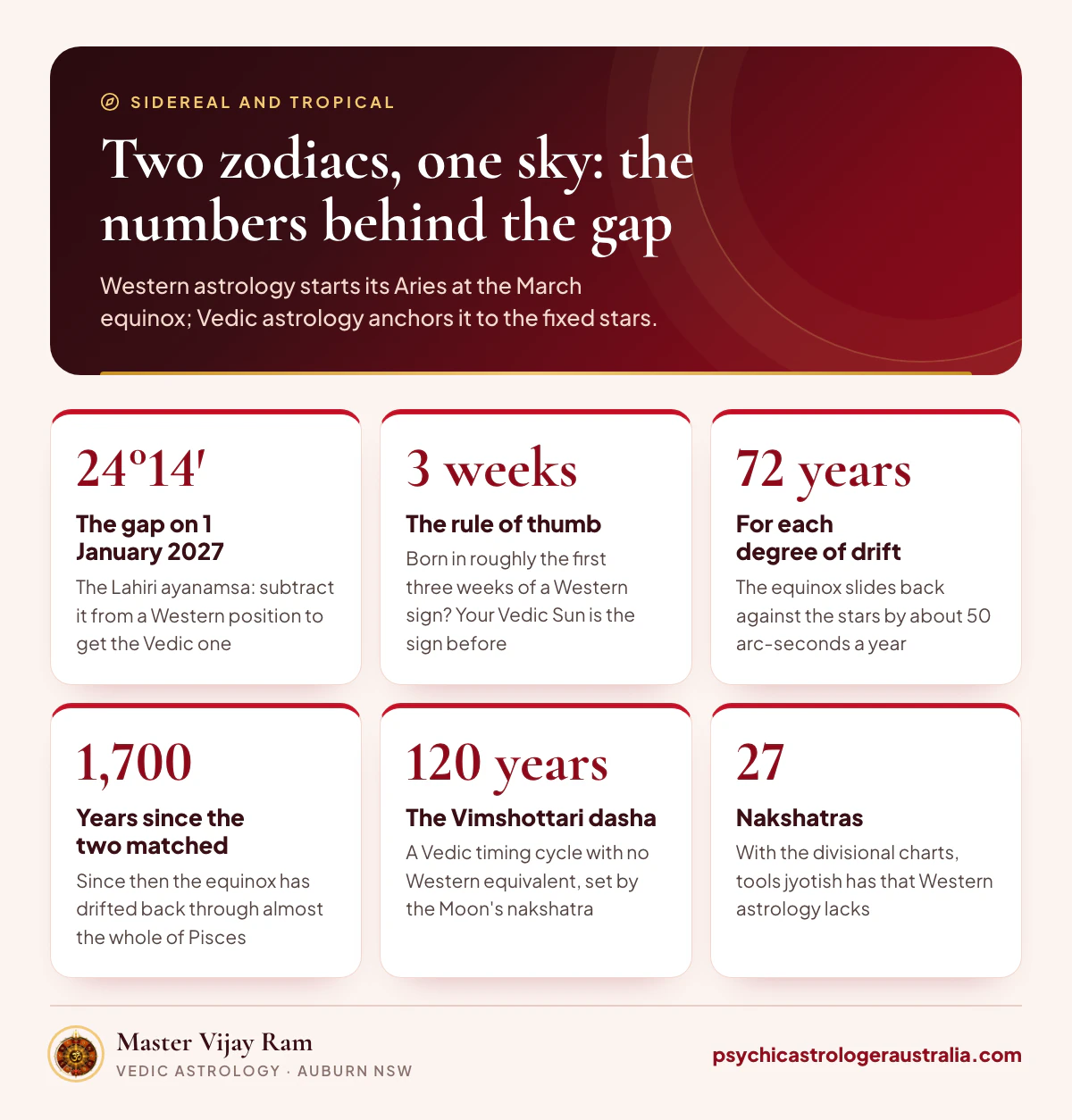
Earth spins like a slightly tilted top, and like a top its axis slowly traces a circle, once every 25,800 years or so. As the axis turns, the point where the Sun crosses the celestial equator each March, the equinox, slides backwards against the stars at about 50 arc-seconds a year, which is roughly one degree every 72 years.
Western astrology ties its zodiac to that equinox point, so its Aries always begins at the March equinox, whatever stars lie behind it. Vedic astrology ties its zodiac to the stars, so its Aries begins where it has always begun, against the same fixed star. About 1,700 years ago the two starting points coincided; since then the equinox has drifted back through almost the whole of the constellation Pisces, and the two zodiacs have slid apart with it.
What is the ayanamsa, and why Lahiri?
The ayanamsa is simply the size of that gap, the number of degrees you subtract from a tropical position to get the sidereal one. It grows a little every year. There are several ways to fix the exact year when the two zodiacs coincided, and each gives a slightly different ayanamsa: Lahiri, Raman, Krishnamurti and the various star-based ‘true’ values differ from one another by up to a degree or so.
Master Vijay Ram uses the Lahiri ayanamsa, also called Chitrapaksha because it places the star Chitra (Spica) at exactly 180° of the sidereal zodiac. It is the value adopted for India's national calendar and used by most Indian panchangs, which means his readings line up with the festival dates and muhurtas your family already follows. On 1 January 2027 the Lahiri ayanamsa is 24°14′; a birth in the early 1990s uses about 23°43′, because the gap was smaller then.
Why is my Vedic sign different from my Western sign?
Because 24° is most of a 30° sign. Subtract it from any Western position and the planet moves back by most of a sign, which carries it across the boundary into the previous sign unless it started in the last six degrees or so of its Western sign.
The rule of thumb: if your birthday falls in roughly the first three weeks of your Western Sun sign, your Vedic Sun is in the sign before. A Western Leo born in late July or the first half of August is a Vedic Cancer; a Leo born in the last few days before the Sun moves into Virgo stays a Leo in both. The same shift applies to the Moon, the ascendant and every planet, which is why a whole chart seems to slide back a sign.
Nothing about you has changed. Your Sun is at exactly the same point in the sky; the two systems simply give that point a different name, and the 2027 sign dates for both zodiacs show how the boundaries fall this year.
The 2027 Sun-sign dates in both systems
The table gives the Sun's entry into each sign in 2027 under both zodiacs, in Sydney time. The Vedic entries are the Sankranti dates used across the Indian calendar; Makar Sankranti, when the Sun enters sidereal Capricorn, is the one most Australians of Indian background already celebrate.
| Sign | Western (tropical) | Vedic (sidereal) |
|---|---|---|
| Aries / Mesha | 21 Mar – 19 Apr | 14 Apr – 14 May |
| Taurus / Vrishabha | 20 Apr – 20 May | 15 May – 14 Jun |
| Gemini / Mithuna | 21 May – 21 Jun | 15 Jun – 16 Jul |
| Cancer / Karka | 22 Jun – 22 Jul | 17 Jul – 16 Aug |
| Leo / Simha | 23 Jul – 22 Aug | 17 Aug – 16 Sep |
| Virgo / Kanya | 23 Aug – 22 Sep | 17 Sep – 17 Oct |
| Libra / Tula | 23 Sep – 23 Oct | 18 Oct – 16 Nov |
| Scorpio / Vrishchika | 24 Oct – 22 Nov | 17 Nov – 15 Dec |
| Sagittarius / Dhanu | 23 Nov – 21 Dec | 16 Dec – 14 Jan |
| Capricorn / Makara | 22 Dec – 19 Jan | 15 Jan – 12 Feb |
| Aquarius / Kumbha | 20 Jan – 18 Feb | 13 Feb – 14 Mar |
| Pisces / Meena | 19 Feb – 20 Mar | 15 Mar – 13 Apr |
Capricorn and Sagittarius run across the new year, so their ranges start in December 2026 or end in January 2028. Computed with the Swiss Ephemeris (Lahiri ayanamsa for Vedic positions) and checked against US Naval Observatory data. Times are rounded to the minute.
Sun sign or Moon sign: where each tradition puts the weight
Popular Western astrology is built on the Sun sign, which is why a newspaper horoscope asks only your birthday. Serious Western astrologers read the whole chart, but the Sun stays central: identity, purpose, the ego.
Vedic astrology starts from the Moon and the ascendant. The Moon sign, the rashi, governs the mind and emotions, it is the sign used for Indian yearly predictions, for Sade Sati and for matching horoscopes, and the Moon's nakshatra starts the dasha clock. If you have ever been told your ‘Vedic sign’ by a family pandit, it was almost certainly your rashi, not your Sun sign, which is a second reason the two traditions seem to disagree about you. How to find your Moon sign explains the difference.
Dashas versus transits: how each system handles timing
Both traditions watch transits, the current positions of the planets against your birth chart; Vedic astrology calls them gochar. Western astrology adds progressions and solar returns to time events. Vedic astrology adds something the Western system has no equivalent for: the Vimshottari dasha, a 120-year sequence of planetary periods fixed by the Moon's nakshatra at birth.
The dasha is the reason a Vedic reading can say ‘the period that began two years ago is why your work changed, and it runs until the year after next’ without looking at a single transit. In Master Vijay Ram's experience it is the part of the system clients recognise most readily, because it maps onto the chapters of a life as they remember them. The Tajika tradition within jyotish also casts a yearly chart, the varshphal, which is the Vedic cousin of the Western solar return.
Houses: whole-sign or Placidus?
Vedic astrology overwhelmingly uses whole-sign houses: the sign rising at birth is the whole first house, the next sign the whole second house, and so on. Most modern Western astrology uses quadrant systems such as Placidus, in which house boundaries fall at calculated degrees and houses are unequal in size.
The practical result is that a planet can occupy one house in your Western chart and another in your Vedic chart even after the zodiac shift is accounted for. Neither is a mistake; they are different conventions, and each tradition's rules were written for its own house system.
Nine grahas, or ten planets?
Vedic astrology uses the seven bodies visible to the naked eye plus Rahu and Ketu, the Moon's nodes, which it treats as shadow planets. Western astrology added Uranus, Neptune and Pluto as they were discovered and uses the nodes less.
In exchange, jyotish has two tools Western astrology lacks: the 27 nakshatras, which divide the zodiac far more finely than the signs, and the divisional charts, the vargas, of which the navamsa used for marriage is the best known. A beginner's guide to reading a Vedic chart walks through these one at a time.
A worked example: one birth, two charts
Take someone born with the Sun at 10° of Taurus in a Western chart, a late-April birthday. Subtract the ayanamsa for the year of birth, say 23°50′ for a birth around the turn of the century, and the Sun lands at about 16°10′ of Aries in the Vedic chart. The person has gone from a steady Taurus to a fiery Aries without moving an inch.
The planets behave the same way. The Mercury retrograde that begins on 10 February 2027 starts at 5°59′ of Pisces in the Western zodiac and at 11°44′ of Aquarius in the Vedic one, the identical moment described twice; the 2027 Mercury retrograde dates give every station in both.
Which system is right?
Astronomy does not settle it. Both zodiacs are human conventions laid over the same sky, and both are internally consistent. The tropical zodiac is tied to the seasons, which gives it a clear meaning in the northern hemisphere where it was devised; the sidereal zodiac is tied to the stars, which is what the ancient observers were actually looking at.
Nor does research settle it in astrology's favour: under controlled testing neither system has shown the ability to predict, and philosophers of science generally class astrology as a tradition rather than a science. This site does not claim otherwise. What Vijay Ram ji offers is faith-based guidance within a tradition that has been practised continuously for well over a thousand years, and he practises the Vedic form because it is his lineage, because its dasha system gives the timing his clients ask for, and because its calendar is the one their families keep. That is an honest reason to choose a system; it is not proof.
Can you use both?
Many people do, reading Western astrology for psychology and Vedic for timing. The one thing not to do is mix them within a single chart: Vedic rules on a tropical chart, or Placidus houses with sidereal signs, produce readings that belong to neither tradition. Pick the frame, apply its own rules, and compare the two readings afterwards if you like. Where they agree, you have something worth weighing.
Does this change my Sade Sati or Mercury retrograde dates?
Sade Sati is a Vedic concept and is always counted from the sidereal Moon sign, so a Western Moon sign tells you nothing about it. Retrogrades, on the other hand, are physical events: Mercury turns at the same minute whatever zodiac you use, and only the sign name attached to that minute changes. Eclipses, Sankranti and the festival calendar are likewise fixed in the sky; it is only the labels that move.
Which zodiac does Master Vijay Ram use for a reading?
Sidereal, with the Lahiri ayanamsa, in a whole-sign chart read from the lagna and the Moon, with the nakshatras, the divisional charts and the Vimshottari dasha. If you come with a Western chart he will recast it rather than reinterpret it, because the rules he applies were written for the Vedic frame. A kundli reading is the place to see the difference in your own chart, by phone, video or WhatsApp, in English, Hindi or Punjabi, whether you are in Melbourne or Cairns.
Why the tropical zodiac's seasons run backwards under Australian skies
The tropical zodiac was built on northern seasons, and in Australia they run the other way. Western Aries opens on the March equinox, which in the north is spring's equinox and in Hobart and Sydney is autumn's; Western Cancer begins on the shortest day of the Australian year and Capricorn on the longest, so the seasonal story the signs were written to tell is upside down here.
The sidereal zodiac has no such problem, because it is anchored to the stars rather than the seasons: the stars behind the Sun are the same seen from Perth as from Punjab, even though the southern sky shows the constellations the other way up. The Tropic of Capricorn, which crosses central Queensland near Rockhampton, makes the point on a map; it was named when the December solstice Sun stood in Capricorn, and today that Sun stands in sidereal Dhanu, Sagittarius.
The festival calendar shows it too. Makar Sankranti, the Sun's entry into sidereal Makara, falls on 15 Jan 2027 in Sydney, more than three weeks after Western Capricorn begins, and Lohri, a midwinter bonfire in Punjab, is lit by Australian Punjabi families in high summer, on the same evening or on their gurdwara's notice, wherever the local fire rules allow.
Whether you read from Hobart, where the seasons swing hardest, or from Townsville, inside the tropics, a Vedic chart is cast the same way, and a Western chart you bring along is recast in the sidereal frame before anything is read from it. Tasmanian clients start from readings for Hobart and the south, North Queenslanders from Townsville astrology readings, and either way an online astrology reading brings the chart to your screen by video, phone or WhatsApp.
Read next
- Zodiac Sign Dates 2027: Western and Vedic Dates ComparedEvery 2027 zodiac sign date in Australian time, Western and Vedic side by side, with Sankranti times for Sydney, Pert…
- 2027 Vedic Horoscope: Forecast for All 12 Moon Signs2027 Vedic horoscope for all 12 Moon signs: Saturn into Aries on 3 June, Sade Sati for Aquarius, Pisces, Aries and Ta…
- Sihr Removal in Australia: Signs of Sihr and How Ruqyah HelpsSihr removal in Australia explained: the signs worth taking seriously, what to rule out first, how ruqyah actually wo…
Frequently asked questions
What is the difference between Vedic and Western astrology?
Western astrology uses the tropical zodiac, which starts at the March equinox; Vedic astrology uses the sidereal zodiac, anchored to the fixed stars, about 24° behind it. Beyond the zodiac, Vedic astrology reads from the Moon sign and ascendant rather than the Sun sign, uses whole-sign houses, adds the 27 nakshatras and divisional charts, and times events with the Vimshottari dasha system.
Why is my Vedic sign one sign earlier than my Western sign?
Because the ayanamsa, the gap between the two zodiacs, is about 24°, most of a 30° sign. Subtracting it moves every planet back by most of a sign, which carries it into the previous sign unless it sat in the last six degrees or so of its Western sign. Your Sun has not moved; the two systems give the same point in the sky a different name.
What is the ayanamsa?
The number of degrees between the tropical and sidereal zodiacs, which you subtract from a Western position to get the Vedic one. It grows by about one degree every 72 years because of the precession of the equinoxes. In the Lahiri reckoning, the standard for Indian panchangs, it is 24°14′ on 1 January 2027 and was roughly 23°43′ in the early 1990s.
Which ayanamsa does Master Vijay Ram use?
Lahiri, also called Chitrapaksha, which places the star Spica at exactly 180° of the sidereal zodiac. It is the value adopted for India's national calendar and used by most panchangs, so his readings line up with the festival dates and muhurtas families already follow. Other ayanamsas such as Raman or Krishnamurti differ by up to about a degree, enough to move a planet near a sign boundary.
Is Vedic astrology more accurate than Western?
Neither has demonstrated predictive accuracy under controlled testing, and this site presents astrology as faith-based guidance rather than as a science. Within the traditions, Vedic astrology has a timing system, the dasha, that Western astrology lacks, and Western astrology has a richer psychological vocabulary. Master Vijay Ram practises the Vedic form because it is his lineage and its calendar is the one his clients keep.
Does Vedic astrology use the Sun sign?
It uses the Sun, but not as the centre of the reading. The Vedic reading begins from the ascendant and the Moon sign, the rashi, which governs the mind and sets the dasha timing. When a family pandit tells you your sign, it is almost always your Moon sign, which is another reason the Vedic and Western answers to the question of your sign so often differ.
What is the Vimshottari dasha, and does Western astrology have it?
A 120-year sequence of planetary periods, fixed by the Moon's nakshatra at birth, that Vedic astrology uses to time when the promises in a chart are delivered. Western astrology has no equivalent; it times events with transits, progressions and solar returns. Vedic astrology also uses transits, called gochar, so the dasha is an addition rather than a replacement.
Do the houses change between a Vedic and a Western chart?
Often. Vedic astrology uses whole-sign houses, in which each sign is one complete house counted from the rising sign; most Western astrology uses quadrant systems such as Placidus with unequal houses. After the zodiac shift a planet can therefore sit in a different house in each chart. Neither is wrong; each tradition's rules were written for its own house system.
Can I use my Western chart for a Vedic reading?
Not directly. The signs will be about 24° out and the houses may differ, so Vedic rules applied to a tropical chart give results that belong to neither tradition. Master Vijay Ram recasts the chart from your birth details in the sidereal zodiac with the Lahiri ayanamsa and whole-sign houses, which takes minutes and avoids the confusion.
Do Mercury retrograde dates change between the two systems?
No. A retrograde is a physical event, and Mercury turns at the same minute whichever zodiac is used. What changes is the sign name attached to that minute: the first 2027 retrograde begins at 5°59′ Pisces in the Western zodiac and 11°44′ Aquarius in the Vedic one. Sade Sati, by contrast, is a purely Vedic idea and always counts from the sidereal Moon sign.
People also ask
Which is more accurate, sidereal or tropical astrology?
Astronomy does not decide between them: both are conventions laid over the same sky, one tied to the seasons and one to the stars, and both are internally consistent. Controlled studies have not shown predictive accuracy for either, so the choice rests on tradition and use. Vedic astrologers use the sidereal zodiac because the whole system of nakshatras, dashas and panchang dates was built on it.
Why do Indian astrologers use a different zodiac?
Indian astronomy fixed its zodiac to the stars, with the star Chitra marking the midpoint, and the calendar of festivals, Sankranti dates and muhurtas grew from that frame. Western astrology, inheriting the Greek system, fixed its zodiac to the equinox instead. The two were aligned about 1,700 years ago and have drifted apart by about 24° since, through the precession of the equinoxes.
What is my Vedic sign if I am a Scorpio?
Most Western Scorpios are Vedic Libras, because the sidereal zodiac sits about 24° behind the tropical one; only those born in roughly the last six days of Western Scorpio stay Scorpio in both. Remember too that a Vedic astrologer usually means the Moon sign when speaking of your sign, which can be any of the twelve regardless of your birthday.
Is Vedic astrology older than Western astrology?
The Indian and Hellenistic traditions both have roots more than two thousand years old and influenced each other; the nakshatra system in India is older than the twelve signs. What is distinctively Indian is the continuous, unbroken use of the system in daily life, from naming ceremonies to wedding dates, which is the tradition a Vedic astrologer practises today.
Does the sidereal zodiac match the constellations?
More closely than the tropical zodiac does, but not exactly. The sidereal signs are twelve equal divisions of 30°, while the real constellations vary in size and the Sun's path also crosses Ophiuchus. The sidereal zodiac is a measuring frame anchored to a star, not a map of the constellations themselves, and Vedic astrology has always treated it that way.
References & further reading
Serving clients across Australia
Confidential consultations by phone, video & WhatsApp — including: