
Quick answer
To read a Vedic birth chart, find the lagna (rising sign) in the first house, then the Moon's sign, which is your rashi. Note which house each of the nine grahas occupies and whether it is comfortable there, check the Moon's nakshatra, and read the Vimshottari dasha to see which planet's period you are in now. The rest is practice.
What a birth chart is
A birth chart is a map of the sky at the exact minute and place you were born, drawn as twelve houses with the nine grahas of Vedic astrology placed in the signs they occupied. In India it is called a kundli or janam patri, and learning how to read a birth chart the Vedic way starts with that map. The Western natal chart is built from the same sky, measured from a different starting point, which is why the two often disagree about your sign.
You do not need to be an astrologer to read the first layer of your own chart, and doing so makes any reading you have later far more useful, because you will recognise what Master Vijay Ram is describing. This guide walks through that first layer in the order he reads it.
North Indian, South Indian or Western wheel: which chart are you looking at?
The same chart is drawn three ways. The North Indian style is a square divided into diamonds, in which the houses stay fixed, the first house at the top centre, and the signs are written in as numbers. The South Indian style is a square of twelve boxes in which the signs stay fixed, Pisces in the top left corner and Aries beside it, and the ascendant is marked with a diagonal line. The Western wheel is a circle with the ascendant on the left.
If your chart came from an Indian family pandit it is almost certainly one of the first two, and the numbers in the diamonds are signs, not houses. Aries is 1 and Pisces is 12. Hold on to that, because it is the single most common beginner's confusion.
Start with the lagna
The lagna, or ascendant, is the sign that was rising on the eastern horizon at the moment of your birth. It occupies the first house, and every other house is counted from it in order through the signs. The lagna changes roughly every two hours, which is why the time of birth matters more than the date for this part of the reading.
The lagna and its ruling planet describe the body, the temperament and the way you meet the world. Find the lagna sign first, note which planet rules it, and find where that planet sits in the chart. That one planet, the lagna lord, tells an experienced reader more about the overall strength of a life than anything else in the chart.
Then find your rashi, the Moon sign
Vedic astrology gives the Moon the weight that popular Western astrology gives the Sun. The sign the Moon occupies is your rashi, and it is the sign used for the daily and yearly predictions published in India, the sign meant when a Vedic astrologer speaks of Sade Sati, and the starting point for the dasha system.
The Moon describes the mind, the emotions and the mother. How to find your Moon sign and why it matters goes into it in more depth; for now, find the Moon, note its sign and count which house it occupies from the lagna.
The twelve houses and what each one governs
Each house is a department of life. The table lists what each one governs and the first thing to look at in it.
| House | Life area | What to look at first |
|---|---|---|
| 1st (lagna) | Self, body, temperament, the life as a whole | The lagna sign, its lord's placement and any planets sitting here |
| 2nd | Family of birth, speech, savings, food | Its lord, and Jupiter or Venus here for wealth |
| 3rd | Younger siblings, courage, skills, short travel | Mars and Mercury, and the lord's strength |
| 4th | Mother, home, property, vehicles, inner peace | The Moon, Venus and the lord; afflictions show up as restlessness at home |
| 5th | Children, intelligence, romance, past-life merit | Jupiter, and whether the lord is well placed |
| 6th | Illness, debt, enemies, service, daily work | Planets here are tested; a strong lord gives the ability to overcome |
| 7th | Marriage, partnerships, the public | Its lord, Venus for men and Jupiter for women, and the navamsa chart |
| 8th | Longevity, sudden change, inheritance, hidden matters | Saturn and the lord; this house is read with care and never alone |
| 9th | Father, guru, fortune, dharma, long journeys | Jupiter and the Sun, and the lord's dignity |
| 10th | Career, status, public action | The lord, Saturn and the Sun, and any planet here |
| 11th | Gains, income, older siblings, friends, wishes | Planets here tend to deliver; the lord's placement shows how |
| 12th | Losses, expenses, sleep, foreign residence, liberation | The lord and Ketu; strong placements here favour life abroad |
A house is read from three things together: the planets in it, the planet that rules it and where that ruler sits. A beginner who learns to find the lord of a house and follow it to its own house has learned half of what the classical texts teach about prediction.
The nine grahas, including Rahu and Ketu
Vedic astrology uses the seven bodies visible to the naked eye and the two lunar nodes. The outer planets of Western astrology, Uranus, Neptune and Pluto, play no part in the classical system.
- Sun (Surya): the self, authority, the father, vitality.
- Moon (Chandra): the mind, emotion, the mother, the public.
- Mars (Mangal): energy, courage, siblings, conflict, property.
- Mercury (Budh): speech, intellect, trade, writing.
- Jupiter (Guru): wisdom, children, wealth, teachers, the husband in a woman's chart.
- Venus (Shukra): love, comfort, art, marriage, the wife in a man's chart.
- Saturn (Shani): discipline, delay, labour, longevity, the lessons that take years.
- Rahu: the north node of the Moon, hunger, obsession, foreign things, sudden rises.
- Ketu: the south node, detachment, past-life skill, spirituality, sudden losses.
Rahu and Ketu are not planets but the two points where the Moon's path crosses the Sun's; they are always exactly opposite each other in the chart, and they are the reason eclipses happen. Note which houses they occupy, because that axis is where life tends to pull hardest.
Is the planet comfortable where it sits? Dignity in brief
Every planet has a sign in which it is exalted, a sign in which it is debilitated, and one or two it rules. A planet in its own or exalted sign acts cleanly; a debilitated one acts late, awkwardly or through someone else. The classical pairs are easy to memorise:
- Sun: exalted in Aries, debilitated in Libra.
- Moon: exalted in Taurus, debilitated in Scorpio.
- Mars: exalted in Capricorn, debilitated in Cancer.
- Mercury: exalted in Virgo, which it also rules, debilitated in Pisces.
- Jupiter: exalted in Cancer, debilitated in Capricorn.
- Venus: exalted in Pisces, debilitated in Virgo.
- Saturn: exalted in Libra, debilitated in Aries.
Debilitation is not a verdict. There are classical conditions that cancel it, and some of the most capable people Vijay Ram ji has read for carry a debilitated planet that taught them their trade.
What is a nakshatra, and why does the Moon's matter most?
The zodiac is also divided into 27 nakshatras of 13°20′ each, the lunar mansions, which are older than the twelve signs in Indian astronomy. Every planet sits in one, but the Moon's nakshatra at birth is the one to find first. It colours the mind more finely than the sign does, it is used for matching horoscopes before marriage, and it decides where your dasha sequence begins.
The Vimshottari dasha: the timing layer
The dasha system is what makes Vedic astrology a system of timing rather than only of character. The Vimshottari scheme runs on a 120-year cycle divided among the nine grahas: Ketu 7 years, Venus 20, Sun 6, Moon 10, Mars 7, Rahu 18, Jupiter 16, Saturn 19 and Mercury 17. The nakshatra of your Moon at birth sets which planet's period you were born into and how much of it was left.
Each major period, the mahadasha, is divided into sub-periods, the antardashas, in the same proportions. A good chart printout lists both with their start and end dates. Find the period you are in now; then look at where that planet sits in your chart, which houses it rules and how dignified it is. That is the single most useful piece of self-reading there is, and the one that makes most people say the reading has described the last few years of their life.
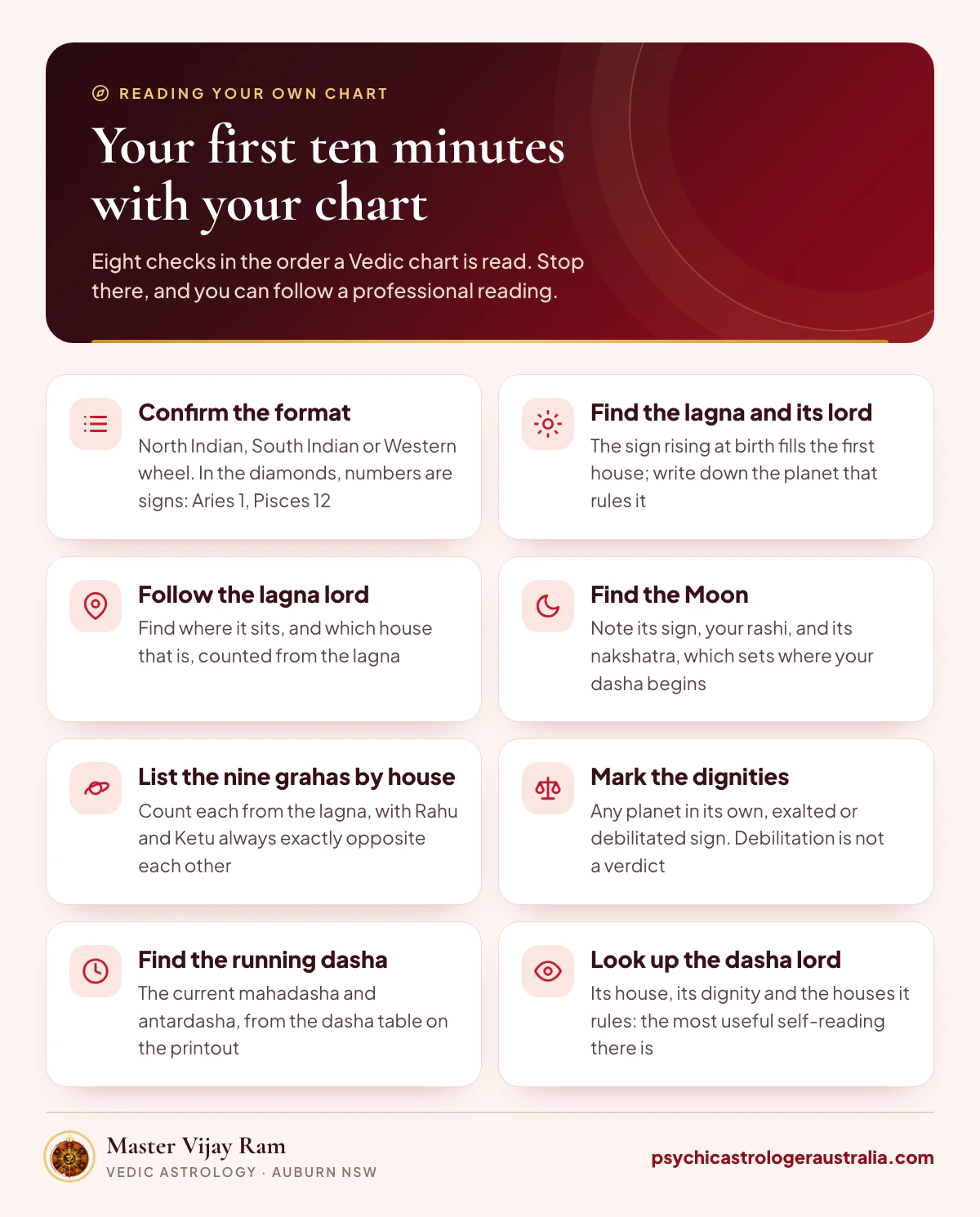
Your first ten minutes with your own chart
- Confirm the format: North Indian, South Indian or Western wheel.
- Find the lagna sign and write down its ruling planet.
- Find where the lagna lord sits, and which house that is from the lagna.
- Find the Moon, note its sign (your rashi) and its nakshatra.
- List the nine grahas by house, counting from the lagna.
- Mark any planet in its own, exalted or debilitated sign.
- Find the current mahadasha and antardasha from the dasha table.
- Look up the planet running the dasha: its house, its dignity and the houses it rules.
Stop there. You now know more about your chart than most people ever learn, and you have the vocabulary to follow a professional reading without losing the thread.
Common beginner mistakes
- Reading a North Indian chart's diamond numbers as houses instead of signs.
- Using a Western chart's signs with Vedic rules, or the other way round. The two zodiacs differ by about 24°, as Vedic versus Western astrology explains.
- Judging a house by the planets in it alone, without following its lord.
- Treating a debilitated planet as a curse and an exalted one as a promise.
- Reading the eighth house in isolation and frightening yourself.
- Forgetting that the dasha governs when a promise in the chart is delivered; a strong placement in a period that has not come yet is a strong placement that is waiting.
What a self-reading can and cannot tell you
It can tell you your lagna, your rashi, the shape of the houses and which period you are in. It can give you the right questions. What it cannot do is weigh the dozen conflicting indications in any real chart against each other, judge the strength of a planet from its degree, its aspects and its divisional charts, or time an event within a period. That weighing is the craft, and it takes years.
It also cannot tell you what to do about any of it. Remedies, where they are called for at all, are chosen from the chart as a whole, and a gemstone recommended from a chart is a different thing from one chosen off a list of birthstones. Nothing on this page is a substitute for professional, medical or legal advice, and astrology here is offered as faith-based guidance.
Why the same birth gives a different sign in Vedic and Western charts
Vedic charts use the sidereal zodiac, measured against the fixed stars; Western charts use the tropical zodiac, measured from the March equinox. The two drift apart by about one degree every 72 years, and the gap, called the ayanamsa, stands at 24°14′ in the Lahiri reckoning in 2027. Subtract that from a Western position and you have the Vedic one, which moves most people's Sun back by one sign.
When to bring the chart to Master Vijay Ram
When you have a question the first layer cannot answer: a decision with a deadline, a marriage that is slow to come, a career that has stalled in a period that should have been good. A full kundli reading covers the strength of each planet, the divisional charts and the timing of the periods ahead, and what a kundli reading reveals describes it in more detail. Readings are by phone, video or WhatsApp, in English, Hindi or Punjabi, wherever you are, from Sydney to Geelong.
Before you read your chart in Australia: check the place and the clock
A first reading goes wrong most often before it starts, in the two boxes marked place and time. A chart is cast for where you were born, not where you live, so someone born in Ludhiana or Chennai and now living in Adelaide needs Indian Standard Time and the Indian town; an app that quietly uses the phone's location casts a chart for South Australia instead, with a different lagna and every house counted from it.
For charts of people born here, the trap is the clock. Adelaide and Darwin share a standard time, half an hour behind Sydney, but South Australia moves its clocks forward in summer and the Northern Territory does not, so a January birth in Adelaide and one in Darwin at the same clock time are an hour apart in real time. Because the rising sign moves on by a whole sign in about two hours, that hour can be the whole difference between two lagnas.
The check is simple. Confirm that the place on the chart is the town on your birth certificate, that the time zone is the one in force there on that date, and that daylight saving was applied only where the state used it that summer; if the family's janam patri from India and your app disagree about the lagna, one of those three is usually the reason.
An uncertain birth time does not stop the exercise; it widens the margins, most of all for the lagna. Whether you live in Salisbury or Palmerston, an Adelaide astrology reading or a reading for Darwin clients can be done by phone, video or WhatsApp, and when the original chart is in a grandparent's handwriting, a consultation in Hindi or Punjabi lets the person who kept it read it out on the call.
Read next
- Retrograde Planets in a Birth Chart: What Vakri Really MeansVakri graha in a kundli: why a planet looks to move backwards, the three schools on its strength, the stationary plan…
- Prashna Kundli: Answering a Question Without a Birth TimePrashna kundli explained: how a question chart is cast and read when there is no birth time, which questions suit it,…
- Kundli Reading Explained: What Your Birth Chart RevealsWhat a Kundli reading reveals about your life, personality, career and destiny. Master Vijay Ram explains Vedic astro…
Frequently asked questions
What is the first thing to look at in a birth chart?
The lagna, or rising sign, in the first house, and the planet that rules it. The lagna sets the numbering of every other house, and the placement and strength of its lord tells an experienced reader more about the overall tone of a life than any other single factor. After that, find the Moon's sign and nakshatra, because the dasha timing starts there.
What is the difference between a North Indian and a South Indian chart?
They are the same chart drawn differently. In the North Indian diamond chart the houses are fixed, with the first house at the top, and the signs are written in as numbers from 1 for Aries to 12 for Pisces. In the South Indian square the signs are fixed, Aries second from the top left, and the ascendant is marked with a line. Beginners most often misread the North Indian numbers as houses.
How do I find my Moon sign in my chart?
Look for the Moon, usually marked Mo, Ch or Chandra, and read the sign it sits in. In a North Indian chart that is the number in the diamond containing the Moon; in a South Indian chart it is the fixed box the Moon is drawn in. That sign is your rashi, used for Sade Sati, horoscope matching and the yearly predictions published in India.
What does each house in a birth chart mean?
Briefly: first the self, second family and savings, third siblings and courage, fourth mother and home, fifth children and intelligence, sixth illness and debt, seventh marriage, eighth longevity and sudden change, ninth fortune and father, tenth career, eleventh gains, twelfth losses and foreign residence. Each is read from the planets in it, the planet ruling it and where that ruler sits.
Are Rahu and Ketu real planets?
No. They are the two points where the Moon's orbit crosses the Sun's apparent path, always exactly opposite each other, and they are why eclipses occur. Vedic astrology treats them as grahas because they act like planets in a chart: Rahu with hunger and sudden rises, Ketu with detachment and sudden losses. The houses they occupy mark the axis where life pulls hardest.
What does it mean if a planet is debilitated?
It sits in the sign where it is least comfortable, such as Saturn in Aries or the Moon in Scorpio, and it tends to deliver its results late, awkwardly or through other people. It is not a curse. The classical texts list conditions that cancel debilitation, and many capable people carry a debilitated planet that taught them their trade the hard way.
What is a nakshatra?
One of 27 divisions of the zodiac, each 13°20′ wide, older in Indian astronomy than the twelve signs. Every planet occupies one, but the Moon's nakshatra at birth matters most: it refines the reading of the mind, it is used to match horoscopes before marriage, and it fixes which planet's dasha period you were born into.
How does the Vimshottari dasha work?
It is a 120-year cycle shared among the nine grahas: Ketu 7 years, Venus 20, Sun 6, Moon 10, Mars 7, Rahu 18, Jupiter 16, Saturn 19, Mercury 17. Your Moon's nakshatra at birth decides which period you were born into and how much of it remained. Each major period is divided into sub-periods in the same proportions, and the planet running now colours the whole period.
Can I read my own birth chart without an astrologer?
You can read the first layer: your lagna, your rashi, where each planet sits, which are dignified and which period you are running. That is enough to follow a professional reading and to ask good questions. Weighing conflicting indications against each other, judging planetary strength from degrees and divisional charts, and timing events within a period are the craft, and those take years.
Why is my Vedic sign different from my Western sign?
Vedic charts use the sidereal zodiac, fixed to the stars; Western charts use the tropical zodiac, fixed to the March equinox. The two have drifted about 24° apart, a gap called the ayanamsa, so a Western position moved back by that amount gives the Vedic one. For most people that shifts the Sun, and often the Moon and ascendant, back one sign.
What birth details do I need to cast a chart?
The date of birth written in full, the time as exactly as it can be found, and the town or city of birth. The time sets the ascendant, which changes about every two hours, and the finer divisional charts, which change every few minutes. If the time is unknown, the chart can still be read from the Moon, with the time-dependent parts given less weight.
People also ask
How do I read my birth chart for beginners?
Find the rising sign and its ruling planet, then the Moon's sign and nakshatra. List the nine grahas by house, counting from the rising sign, and mark which are exalted, in their own sign or debilitated. Then find the dasha period you are in and look at that planet's house and dignity. Those steps take ten minutes and cover the first layer of any Vedic reading.
What is the most important planet in a birth chart?
In the Vedic method, the lord of the lagna, because it carries the whole chart, closely followed by the Moon, which describes the mind and starts the dasha clock. After those, the planet running the current dasha matters most, since it decides which of the chart's promises are being delivered now. There is no single most important planet for everyone.
Which is more important, Sun sign or Moon sign?
Vedic astrology gives the Moon sign, the rashi, the weight popular Western astrology gives the Sun. The rashi governs the mind and emotions, it is the sign used for Indian yearly predictions and for Sade Sati, and the Moon's nakshatra sets the dasha timing. The Sun still matters for vitality, authority and the father, but a Vedic reading starts from the Moon and the ascendant.
What is the 7th house in a birth chart?
The house of marriage, partnership and the public, counted seventh from the rising sign. It is read from the planets in it, its ruling planet and that ruler's placement, together with Venus in a man's chart and Jupiter in a woman's, and the navamsa divisional chart. Marriage timing comes from the periods of these planets rather than from the house alone.
Can a birth chart tell the future?
It can describe the periods a life moves through and which areas each period tends to activate, which is what Vedic astrology means by prediction. It gives windows, not dates, and it reads tendencies, not certainties. This site offers it as faith-based guidance rather than as a science, and no chart replaces a doctor, a lawyer or your own decision.
References & further reading
Serving clients across Australia
Confidential consultations by phone, video & WhatsApp — including: