

Quick answer
Nothing has to be decided quickly. Many Hindu families give clothes away after the thirteenth day, often to people in need in the departed’s name, keep jewellery as a blessing after washing it, place the photograph apart from the deities, and keep letters and phones until accounts are closed. Cleansing means water, sunlight and a prayer, never fear.
What does the tradition say about a loved one’s belongings?
Sorting a loved one’s belongings is a task that every family meets once the rites are over, and the Hindu tradition treats it as an act of care rather than a danger. The clothes, the bed, the jewellery and the reading glasses on the side table belonged to someone the family loved, and the customs around them are about giving well, keeping well and remembering well.
Families sometimes ask whether a parent’s things carry something heavy. Master Vijay Ram’s answer is almost always no: the heaviness is grief, and negative energy removal is for a rare pattern that outlasts every ordinary explanation, not for a mother’s cardigan.
This page is about the objects. The period of mourning and the cleansing of the house are covered in cleansing the home after a death, and the bath taken on returning from a cremation in the Hindu custom of bathing after a funeral.
Is there any hurry to sort their things?
No. Nothing in the custom requires a wardrobe to be emptied in the first fortnight, and many families leave a room exactly as it was for months. The thirteenth day is when clothes are often given away in north Indian families, but that is a custom of giving, not a deadline.
Relatives who fly in for the rites sometimes want everything settled before they fly out, which is understandable and not always wise. A decision made in the second week can be regretted in the second year. Agree what must happen now, such as perishable food, medicines and anything a landlord needs back, and leave the rest until the family is ready.
What happens to the clothes?
In many north Indian families the departed’s clothes are given away on or after the thirteenth day, often as part of the shayya daan, a gift of bedding, clothes and everyday things made in the departed’s name to a priest or to people in need. Families describe the gift as continuing the person’s generosity. In Australia many families keep the same spirit by giving good clothes to an op shop run by a charity, or to a community group collecting for families who have just arrived.
The clothes of the deceased that were worn in hospital, or on the last day, are handled differently in different homes: some families wash and give them, some discard them, a few cremate them. Traditions differ, and none of them is wrong.
Many families keep one or two garments: a father’s turban, a mother’s wedding sari, a shawl. Some households hold that the family should not wear the departed’s worn clothes; others wear a cardigan gladly for years. Choose what lets the family remember well; a reading would never treat a mother’s cardigan as a danger.
What about the bed and their room?
The bed is the object families ask about most. The custom in many homes is to give the bedding away or wash it, air the mattress in the sun, and change the room around so that it becomes a room of the living again: a desk moved, a new cover, the curtains washed.
A mattress is expensive in Australia, and there is no need to throw away a good one. Air it, cover it with a fresh protector, and let whoever sleeps there choose; an old or soiled one goes to the council’s bulky-waste collection. Turning the room into a permanent shrine is not something the tradition asks for, and it can make the grief harder to move through.
Should jewellery be kept, worn or given away?
Kept, very often. Jewellery of the deceased is commonly treated as a blessing that passes down, especially gold given at a wedding, and many families hold that gold and silver need only washing to be ready to wear. Wash a piece in clean water with a few drops of gangajal, dry it, and let it rest at the altar for a night before it is worn.
Some families have a piece remade by a jeweller, so that the gold continues in a new shape. If the departed wore a ring, a mangalsutra or bangles at the funeral home, tell the funeral director in writing which pieces stay and which come back, so nothing is lost or misunderstood.
Older customs asked a widow to give up her own bangles, sindoor and mangalsutra; many families no longer ask it, and what she wears is hers to decide. For a ring or a stone the family wants to wear daily, cleansing a ring or mala before wearing it describes the simple practice.
Where should the photograph of the departed go?
Apart from the deities. The common custom is that a photograph of someone who has died is not placed on the altar among the gods, but on its own shelf or wall nearby, often garlanded, with a lamp lit before it on the anniversary and during Pitru Paksha. Many families follow the vastu advice of a south wall for photographs of ancestors.
A bedroom is usually avoided, and so is a place where the photograph is passed a hundred times a day if that keeps the wound open. A vastu consultation can suggest a place in an awkward unit, but any calm spot where the family can stop for a moment is right. Remembering the ancestors is a duty the tradition takes seriously, and the pitra dosh guide explains what that duty asks of a family.
What about the phone, the letters and the digital life?
Keep the phone charged and the number active until the bank, the telco, the email provider and the government accounts have been told and closed, because security codes are still sent to it. Back up the photographs and voice messages first; many families find a recorded voice is the thing they most wanted to keep.
Letters, diaries and papers are kept or read as the family wishes, and anything with account numbers is shredded once the estate is settled. Social media accounts can usually be closed or memorialised by request. None of this is a ritual question, and no custom asks for a phone to be thrown away.
What should happen to their prayer things?
A personal mala, a well-used Gita, a small murti from the departed’s own altar: these are often kept by the family member who prays most, or given to a temple. They do not need to be disposed of, and they are not affected by the death in the way some relatives fear.
Flowers, garlands and anything from the funeral that cannot be kept go to compost or the council green bin, never into a river or the sea, where it can count as littering or illegal dumping.
How are belongings cleansed, if they need it at all?
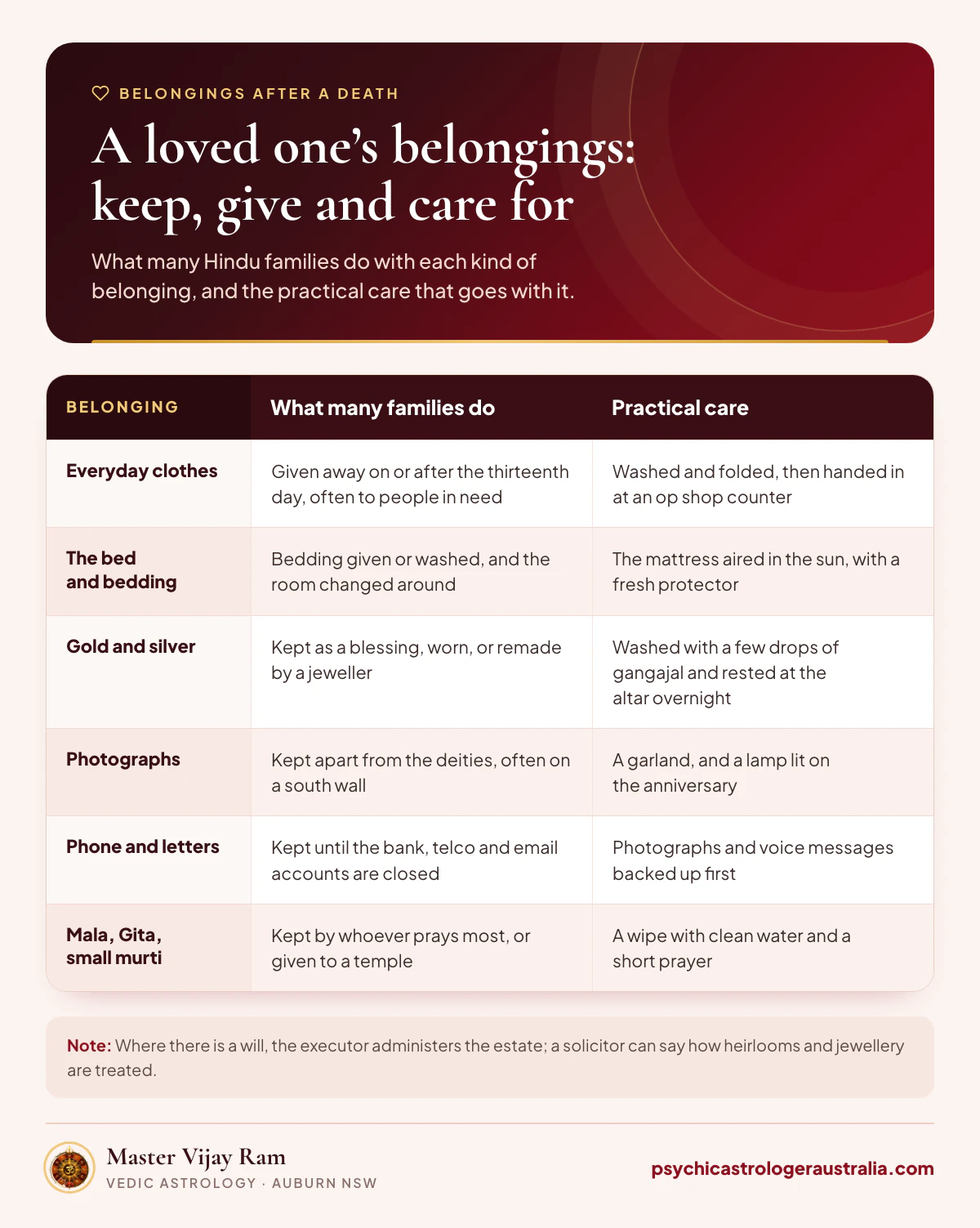
Cleansing items of the deceased is mostly ordinary care with a prayer added. The table gathers the customs many families keep; none of it needs a priest, and families differ.
| Belonging | What many families do | A simple cleansing |
|---|---|---|
| Everyday clothes | Given away on or after the thirteenth day, often to people in need | Washed and folded before they leave the house |
| A garment kept for memory | A turban, a sari or a shawl kept in a cloth bag | Washed or aired in the sun, then put away with care |
| The bed and bedding | Bedding given or washed; the room changed around | Mattress aired in the sun; fresh protector |
| Gold and silver jewellery | Kept as a blessing, worn, or remade | Washed with a few drops of gangajal and rested at the altar overnight |
| Photographs | Kept apart from the deities, often on a south wall | A garland, and a lamp on the anniversary |
| Mala, Gita, small murti | Kept by whoever prays most, or given to a temple | A wipe with clean water and a short prayer |
A short mantra said while the work is done, such as Om Namah Shivaya, is the prayer many families add. It is said for the departed and for the family doing the sorting, not against anything.
What if the family disagrees?
It happens in many families, and it is rarely about the object. A brother in Melbourne wants the watch, a sister in Chandigarh wants it kept for her son, and both are really asking to be remembered as the child who cared. Talk on a video call with everyone present, write down what is agreed, and let the person who did most of the caring speak first.
Where there is a will, the executor administers the estate, and valuable jewellery is part of it; a solicitor can say how the will treats heirlooms. No ring is worth a rift that outlives the people in it, and a family that disagrees calmly is already honouring the person it lost.
Where can things be given in Australia?
Giving away belongings after death is easiest in clean, sorted bags taken inside to an op shop counter rather than left beside a bin. Saris and Indian clothes are often welcomed by community and temple groups, winter coats by charity appeals, and books by libraries and school fetes.
Unused medicines go back to a pharmacy, and hired walking frames or wheelchairs back to the hire service. Anything broken goes to the council’s recycling or bulky-waste collection rather than to a charity, which then has to pay to dispose of it.
Does keeping their things hold the departed back?
No. The tradition speaks of attachment, and of letting the departed go on their journey, but it means the family’s clinging, not a cardigan in a wardrobe. Keeping a few loved things is not holding anyone back, and giving the rest away in their name is a kindness the tradition values.
A family in Hobart sorting a father’s tools, or in Geelong deciding about a grandmother’s saris, is doing ordinary, loving work. Nothing in the house is waiting to frighten them.
When is it worth asking Master Vijay Ram?
Usually a conversation, not a ceremony. In a $50 consultation, by WhatsApp, phone or video and in Hindi, Punjabi or English, he can help settle which customs your family keeps, where a photograph should go, or how to divide things when relatives disagree. A family in Hobart can see how these calls run on the Hobart astrology page, and families in Wollongong or on the Sunshine Coast are helped the same way.
Where a family wants a puja said for the departed, Vijay Ram ji performs it himself in Auburn; it starts from $250, the amount is agreed with you first, and the family may join by video. Online puja and havan explains what is included. He sells no objects and asks for none of the departed’s belongings.
Will the right choices make the loss smaller?
No: sorting cannot finish grief, and keeping or giving away the right things will not make the loss smaller. A reading is faith-based guidance, not legal advice about the estate or counselling for the family. If the sorting brings grief back hard, Griefline supports people who are grieving, and Lifeline is on 13 11 14.
Read next
- A Home Cleansing Kit in Australia: What to Keep and What to SkipA home cleansing kit for Australian homes: the short list of puja items worth keeping, how to store them, where they …
- Cleansing the Home After a Death: Sutak, the Thirteen Days and ShuddhiSutak after a death, gently explained: what a Hindu home pauses for ten to thirteen days, the lamp, the terahvi, the …
- Aura Cleansing in Australia: How It Works & When You Need ItHow aura cleansing actually works in Australia: the five-doorway read, each stage of a remote remedy, what you provid…
Frequently asked questions
What do Hindus do with the clothes of someone who has died?
Many north Indian families give the clothes away on or after the thirteenth day, often to people in need or a priest in the departed’s name. In Australia that usually means washing and giving good clothes to a charity op shop or community group. Clothes worn in hospital or on the last day are washed, discarded or cremated, depending on the family. Many keep one garment for memory.
Can I wear my mother’s or father’s clothes after they die?
Families differ. Some hold that the departed’s worn clothes should not be worn by the family, and give them all away; others keep a cardigan, a shawl or a turban and wear it gladly for years. Neither is wrong. If you want to wear something, wash it, say a short prayer for them, and wear it as a way of remembering, not as something to fear.
Is it bad luck to keep a dead person’s belongings?
No. Keeping a few loved things is ordinary remembrance, and the tradition does not treat them as unlucky. What it asks is that the family does not cling, which is about the heart rather than the wardrobe, and that what is not needed is given away in the departed’s name. A room kept unchanged for years can make grief harder, which is a reason to change it slowly.
Can we wear the jewellery of someone who has died?
Yes, and many families treat it as a blessing that passes down. Wash gold or silver in clean water with a few drops of gangajal, dry it, and rest it at the altar overnight before it is worn. Some families have a piece remade by a jeweller. If the estate is being divided, check with the executor first, because valuable jewellery forms part of it.
Where should a photograph of a deceased parent be placed at home?
Apart from the deities, on its own shelf or wall near the altar rather than among the gods. Many families follow the vastu advice of a south wall, garland the frame, and light a lamp before it on the anniversary and during Pitru Paksha. A bedroom is usually avoided. Any calm place where the family can stop for a moment is right.
What should we do with the bed of someone who died?
Wash or give away the bedding, air the mattress in the sun, and rearrange the room so it becomes a room of the living again. A good mattress does not need to be thrown out; a fresh protector and some sunlight are the custom in many homes. An old or soiled one goes to the council’s bulky-waste collection.
What should happen to a loved one’s mobile phone?
Keep it charged and the number active until the bank, the telco, the email provider and government accounts are told and closed, because security codes still arrive on it. Back up photographs and voice messages first. No custom asks for a phone to be destroyed; once the accounts are settled, the family can keep it, reset it or recycle it.
How do you cleanse the belongings of someone who has died?
Mostly with ordinary care: clothes washed, bedding laundered, a mattress aired in the sun, jewellery washed with a few drops of gangajal and rested at the altar overnight, prayer things wiped with clean water. Many families say a short mantra, such as Om Namah Shivaya, while they work. Nothing needs a priest, and nothing is being driven out.
Does Master Vijay Ram cleanse a deceased person’s belongings?
No belongings are sent to him, and he sells nothing to put with them. What he offers is a $50 conversation, on the phone or by video, about which customs your family keeps, where a photograph belongs or how to share things out fairly. A puja for the departed, if the family wants one, is performed by him in Auburn from $250, with the amount agreed first.
People also ask
How long should you wait before giving away a loved one’s things?
As long as the family needs. North Indian families often give clothes away on or after the thirteenth day, but that is a custom of giving, not a deadline. Deal first with perishable food, medicines and anything a landlord needs back, and leave the rest until the family is ready. Decisions made in the second week can be regretted in the second year.
What is shayya daan?
Shayya daan is a gift of bedding, clothes and everyday things made in the departed’s name, kept in many north Indian families around the twelfth or thirteenth day after a death. It is given to a priest or to people in need, and the tradition sees it as continuing the person’s generosity. In Australia many families give to a charity in the same spirit.
Should a photo of a dead person be kept in the puja room?
Many families keep it apart from the deities, on its own shelf or wall near the altar, rather than among the gods. Many follow the vastu advice of a south wall, garland the frame and light a lamp before it on the anniversary. The point is a calm place of remembrance that does not replace the altar.
Where can you donate a deceased person’s clothes in Australia?
Charity op shops take clean, wearable clothes, best handed in at the counter rather than left beside a bin. Saris and Indian clothes are often welcomed by community and temple groups, and winter coats by charity appeals. Broken or stained items go to council recycling instead, so the charity does not pay to dispose of them.
References & further reading
Serving clients across Australia
Confidential consultations by phone, video & WhatsApp — including: