
Quick answer
Ruqyah is the Islamic remedy of recited Quranic verses; Vedic healing is mantra, havan and planetary remedy from the Hindu tradition. The right one is usually the one your own faith recognises, matched to what is actually being described. Master Vijay Ram offers both, says plainly which fits a family’s faith and situation, and rules out ordinary causes before either.
Two remedies, one kind of trouble
A family in Perth describes a son who stopped sleeping, a shop that emptied and a marriage that soured in a month, and asks whether they need ruqyah or a Vedic remedy. Ruqyah is the Islamic practice of reciting verses of the Quran and prescribed supplications over a person for healing and protection; Vedic healing is the remedy side of Jyotish, the mantra, havan and planetary remedies that follow a reading of the birth chart. The trouble people bring to each is almost identical. The frame, the practitioner and the work are not.
Deciding between ruqyah or Vedic healing is simpler than the internet makes it look, because the choice turns on three plain questions: which tradition your household holds, what is actually being described, and who is trained to do the work. Master Vijay Ram answers all three in a consultation and, where the honest answer is ruqyah, says so and sends the family to ruqyah healing rather than to his own altar.
Where does each remedy come from?
Ruqyah belongs to Islam. It is recitation, in Arabic, of particular surahs and verses, often with water that has been recited over, and it is practised by people who know what may and may not be used; anything that calls on other than God is outside it. Its purpose is protection and relief from sihr, the evil eye and jinn, within the limits the tradition sets.
Vedic healing belongs to Jyotish and the temple. The chart is read first, then the remedy is chosen to match it: a mantra for the planet concerned, a havan on a muhurat, a yantra installed, a fast kept on a particular weekday, charity of a particular kind. Its purpose is the same as that of ruqyah, protection and relief, but it reaches the trouble through the chart rather than through a single text.
Neither is a brand of the other, and nobody should sell you a ruqyah-plus-havan package. A practitioner who offers both in one breath is usually trained in neither.
Which one does your own faith recognise?
This question settles most cases on its own. A Muslim household should go to ruqyah, because it is the remedy their own tradition prescribes, it carries no theological cost, and the practices around it, the recitations kept at home, the water, the morning and evening adhkar, are ones the family already knows. A Hindu or Sikh household, or one with no particular practice that nonetheless keeps a lamp and knows a mantra, is at home with the Vedic frame.
Vijay Ram ji is clear about this because people are sometimes embarrassed to say it. There is no benefit in a Muslim family sitting through a havan they cannot in conscience take part in, and no benefit in a Hindu family being told their lamp is wrong. Islamic spiritual healing in Australia is well served by ruqyah practitioners in every capital, and he offers ruqyah himself for Muslim clients who ask for it, within that framework and without claiming to be an imam.
What is actually being described?
The second question matters when the first does not settle it. Sihr, jinn and the evil eye are the three categories the Islamic frame names, and ruqyah addresses all three. The Vedic frame names more: nazar, a pret-atma or spirit, kala jadu or tona-totka done by a person, and a planetary period that produces the same signs with nobody behind them at all.
That last category is the one ruqyah has no language for and the chart does. A Saturn period, a Rahu transit over the Moon or a weak fourth house will empty a shop, sour a marriage and break sleep as surely as any spell, and the remedy is planetary, not protective. The guide to kala jadu, sihr and voodoo sets out what each tradition's words mean; the point here is that the Vedic reading can also return the answer that nobody did this, which is the most common answer of all.
Where a family describes a jinn, a being in its own right, the frame is Islamic whatever their faith, and Vijay Ram ji approaches jinn removal through ruqyah, or points the family to their own imam or raqi if they prefer. Where they describe a shadow on a house after an envious visitor, or a run of bad months that began on a date the chart explains, the Vedic work fits.
Who is trained to do the work?
The third question is about the practitioner, not the tradition. Ruqyah must be recited by someone who knows the Quran well enough to recite it correctly and knows the limits of what may be used; a man with a video channel and a price list is not that person by default. Vedic healing must be done by someone who can read a chart, name the period and the planet, and explain why this remedy and not another; a baba who prescribes the same havan to everyone is not reading anything.
Master Vijay Ram has practised Jyotish for more than forty years in a Himalayan lineage, and his place of practice is Auburn in Sydney; everywhere else he works by phone, video and WhatsApp. He offers ruqyah within the Islamic framework without claiming to be an imam, and he says plainly when a family’s own imam or raqi is the better first call. That honesty about where each practice comes from is what you should look for in any practitioner, whichever tradition they work in.
What questions does a careful consultation ask?
- When did it begin, to the month, and what else changed in the same months: a move, a death, a new job, a visitor?
- Does it follow a person or a place, and does it lift when you leave the house?
- Has anyone seen a doctor, and have the heater, the damp and the sleep been checked?
- Which practice does your household actually keep, and who in the family keeps it?
- What has already been tried, by whom, and for how much?
A reciter and an astrologer should both ask these before naming anything. The answers decide the frame more reliably than the fear does, and they are the same answers Vijay Ram ji writes down at the start of every call.
Ruqyah and Vedic healing side by side
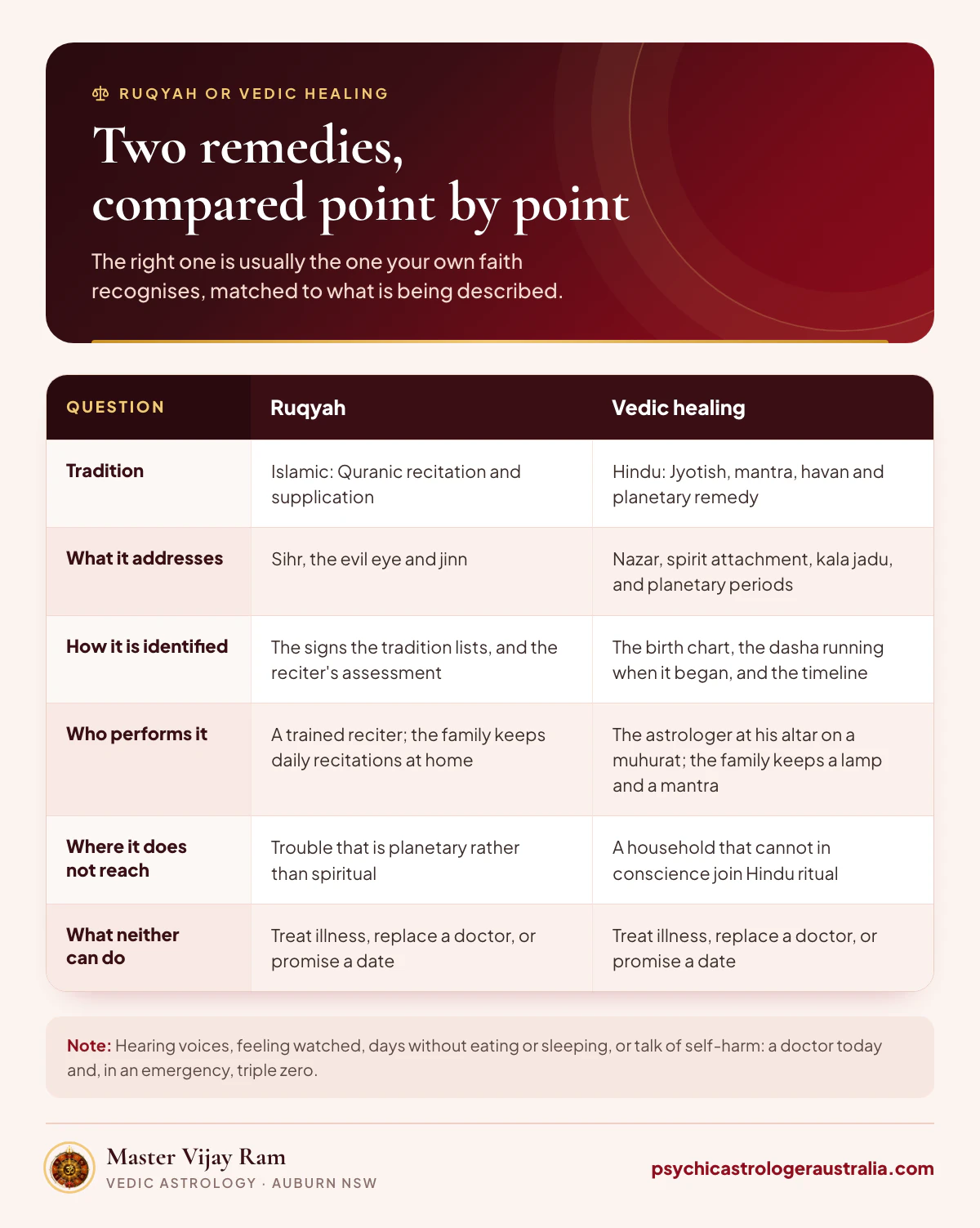
The table puts the two remedies next to each other on the points that decide a choice.
| Question | Ruqyah | Vedic healing |
|---|---|---|
| Tradition | Islamic; Quranic recitation and supplication | Hindu; Jyotish, mantra, havan and planetary remedy |
| What it addresses | Sihr, the evil eye and jinn | Nazar, spirit attachment, kala jadu, and planetary periods with nobody behind them |
| How the trouble is identified | The signs the tradition lists, and the reciter's assessment | The birth chart, the dasha running when it began, and the timeline |
| Who performs it | A trained reciter; the family keeps daily recitations at home | The astrologer, at his own altar on a muhurat; the family keeps a lamp and a mantra |
| Where it does not reach | Trouble that is planetary rather than spiritual | A household that cannot in conscience take part in Hindu ritual |
| What it cannot do | Treat illness, replace a doctor, or promise a date | Treat illness, replace a doctor, or promise a date |
What about a mixed-faith household?
Mixed households are common in Sydney and Melbourne, and the choice is often made by whichever partner is more frightened. The better rule is that each person keeps their own practice for themselves, and the house is cleansed in the frame of whoever keeps the house's altar or prayer space. A Hindu wife may keep her lamp while her Muslim husband keeps his adhkar; neither cancels the other, and nobody is converted by a remedy.
Where the trouble sits on one person, that person's tradition decides. Where it sits on the house, the family chooses one frame for the cleansing and does not run both on the same evening, which produces confusion rather than peace. Vijay Ram ji has sat with many such families and the conversation is usually calmer than they feared.
What do the two remedies have in common?
Everything that matters. Both begin by ruling out the ordinary causes that account for most calls: sleep debt and shift work, mould and a faulty heater, grief, medication, a marriage that has simply worn thin, a business in a bad street. Both refuse theatre: no shouting, no restraint, no person told they are possessed in front of their children. Neither promises a date, and both are cheap beside the fakes.
And both are faith-based guidance, not medical, legal or financial advice. A reciter or an astrologer who says otherwise is selling something the tradition does not contain.
When is neither the right answer?
When someone hears voices, believes they are watched, has stopped eating or sleeping for days, or speaks of harming themselves, the answer is a doctor today, and in an emergency triple zero or Lifeline. Headache and confusion that lift outside the house point to a gas appliance. A child who has changed needs a GP and the school before anyone spiritual. Vijay Ram ji says these things in the first minutes and will not take a consultation forward until they are addressed; the guide on astrology and mental health explains where the line sits.
What does Vedic healing involve with Master Vijay Ram?
A consultation by phone, video or WhatsApp, in English, Hindi or Punjabi, where the chart and the timeline are read and the ordinary causes tested. If the reading finds nazar, a spirit or kala jadu, the remedy is chosen to match it: black magic removal where a person's work is found, nazar removal where it is envy, a release where it is a spirit. It is performed personally at his altar in Auburn on a muhurat, with the hour given to you, and the family keeps simple practices at home for a few weeks.
Vedic spiritual healing of this kind does not need the practitioner in your house, which is why a caller on the Perth page is served exactly as a family in Auburn is. What it does need is an honest reading first, and the willingness to hear that nobody did this.
What does it cost?
A consultation is $50. A remedy, where one is warranted, is puja or havan performed personally from $250, agreed with you before anything is done and not raised afterwards. Ruqyah practitioners set their own fees and a fair one will tell you the figure before the session, as the ruqyah sessions and cost guide describes; the warning signs are the same in both traditions, a price that rises with your fear and a remedy that is never quite finished.
How to decide this week
Write down three things: the tradition your household actually keeps, what is being described in plain words, and when it began. If the first answer is Islam, book ruqyah with a reciter who will tell you their training and their fee. If it is Hindu or Sikh, or the trouble looks planetary, ring or message with your birth details ready.
Among all the spiritual healing options advertised in Australia, the right one is the one your own tradition recognises, matched honestly to what is in front of you, and the consultation exists to make that match plainly.
Read next
- Ruqyah for Anxiety, Fear and Waswas: A Gentle ApproachRuqyah for anxiety, fear and waswas: a gentle approach that puts your GP, a psychologist and Lifeline first and offer…
- Jinn Removal in Melbourne and Sydney: How Remote Ruqyah Sessions WorkJinn removal for Melbourne and Sydney families: how a remote ruqyah session is set up and run by video, what medical …
- Sihr Removal in Australia: Signs of Sihr and How Ruqyah HelpsSihr removal in Australia explained: the signs worth taking seriously, what to rule out first, how ruqyah actually wo…
Frequently asked questions
Can a Hindu family use ruqyah?
Ruqyah is the Islamic tradition's remedy, recited in Arabic from the Quran, and a reciter would normally expect the person to share that faith and keep its practices at home afterwards. A Hindu or Sikh family is better served by the Vedic frame, where the chart is read and the remedy matches it. The question to ask is which practice your household will actually keep once the practitioner has gone, because that is where most of the protection lies.
Does Master Vijay Ram perform ruqyah?
Yes, for Muslim clients who ask for it, within the Islamic framework and without claiming to be an imam: selected verses and supplications recited by video or in person in Auburn. He also says plainly when a family’s own imam or raqi is the better first call, and for Hindu households the Vedic remedies of mantra, havan and planetary work usually fit better. Ordinary and medical causes are ruled out first either way.
What is the difference between sihr and kala jadu?
They are two traditions' words for harm done by a person through ritual. Sihr is the Islamic term, and its remedy is ruqyah; kala jadu is the Hindi and Punjabi term, and its remedy is Vedic removal after a chart reading. The signs families describe overlap almost entirely, so the useful difference is the frame your household holds and the practitioner that frame calls for, not the vocabulary.
Which is stronger, ruqyah or a havan?
Neither is a stronger version of the other, and anyone selling one as stronger is selling fear. Each is complete within its own tradition. The right one is the one your faith recognises, matched to what is being described: a planetary period, which ruqyah has no language for, calls for a Vedic remedy; sihr or jinn in a Muslim home calls for ruqyah. Doing both on the same evening produces confusion rather than peace.
Can we do both at the same time?
In a mixed household each person keeps their own practice for themselves without conflict, a lamp in one room and adhkar in another. For a cleansing of the house itself, choose one frame, the one of whoever keeps the house's prayer space, and do not run two rituals on one night. Vijay Ram ji has sat with many mixed families and the conversation is usually calmer than they expect.
How do I find a genuine ruqyah practitioner in Australia?
Ask about training and the limits they keep: a genuine reciter uses only the Quran and prescribed supplications, names a fee before the session, does not sell amulets, and will tell you when a doctor is needed. Mosques in every capital can point you to someone. The warning signs are the same as for any healer: a price that rises with your fear, a remedy that is never finished, and a culprit named.
What does Vedic healing cost compared with ruqyah?
With Master Vijay Ram a consultation is $50 and a remedy, where one is warranted, starts from $250, agreed before it is performed. Ruqyah practitioners set their own fees, and a fair one states the figure before the session. In both traditions most enquiries end at the first conversation with an ordinary cause found, and in both the fee that should worry you is the one that keeps growing.
Can either remedy be done over the phone?
Yes. Ruqyah is recited over the person and can be done by video or phone, with the family keeping the recitations at home afterwards. A Vedic remedy is performed at the astrologer's own altar on a muhurat, with the hour given to you, so distance makes no difference to it. What cannot be done over the phone is a proper medical check, which is why both begin by asking whether a doctor has been seen.
What if the trouble is a planetary period and not a spell at all?
Then no removal of any kind is the answer, and a chart reading will say so. Saturn's Sade Sati, a Rahu period or a transit over the Moon produce broken sleep, a quiet shop and a sour marriage with nobody behind them, and the remedy is planetary: a mantra, a fast, charity, a shanti. This is the most common finding in a consultation, and it is the one ruqyah has no language for.
People also ask
Is ruqyah the same as spiritual healing?
Ruqyah is one tradition's spiritual healing: Quranic recitation over a person for protection and relief from sihr, the evil eye and jinn. Spiritual healing more broadly includes the Vedic remedies of mantra, havan and planetary pacification chosen from a birth chart. They share an aim and a first step, ruling out ordinary causes, but belong to different faiths and are performed by differently trained people.
Can astrology detect sihr or black magic?
A Vedic reading looks for a pattern: the dasha running when the trouble began, afflictions to the Moon and the ascendant, the positions of Rahu, Ketu and Saturn, and a timeline that matches. It can say that the chart is consistent with a person's work, or that it is not and the period alone explains everything. It never names who did it, and a practitioner who does is to be avoided.
Who should not rely on ruqyah or a Vedic remedy?
Anyone who hears voices, believes they are watched, has stopped eating or sleeping for days, or speaks of harming themselves needs a doctor today, and in an emergency triple zero or Lifeline. A child who has changed needs a GP and the school first. Both traditions put medical care before any remedy, and a genuine practitioner will not proceed while such a sign stands.
Is Vedic healing allowed for Muslims?
That is a question for a family's own scholars, not for an astrologer, and Master Vijay Ram does not answer it on their behalf. His practice is to offer Muslim families ruqyah, their own tradition's remedy, or to point them to their own imam or raqi, rather than draw them into a havan they may not in conscience join. Where a mixed family asks, each member keeps their own practice and the house is cleansed in one frame.
How do I know which tradition my problem belongs to?
Start with the tradition your household keeps, which settles most cases. Then describe the trouble in plain words: a being in its own right is the Islamic frame of jinn; envy after a visitor is nazar; a run of bad months from a datable start is often a planetary period, which only the chart can name. A consultation asks exactly these questions before any word is chosen.
References & further reading
Serving clients across Australia
Confidential consultations by phone, video & WhatsApp — including: