

Quick answer
Choosing a black magic removal specialist is mostly a test of what a practitioner refuses to do: name your enemy, guarantee an outcome, raise a fee once it has been agreed, or put spiritual help above your doctor. Judge the first conversation rather than the advertising.
What best is actually measuring
Nobody advertises themselves as the second best. Every listing you read will use the same handful of words, so the label itself carries almost no information. Treating it as a ranking sends you in circles.
It helps to decide what you want the word to mean. You cannot audit somebody's spiritual ability from a web page. You can audit how a person behaves in the first ten minutes of a conversation. Do they listen before they diagnose. Do they say when something looks ordinary rather than spiritual. Do they state a fixed fee before any work begins, or let the figure grow once you are frightened.
Those things are testable. Long biographies, decoration and confident language are not. Everything below is a way of testing them without needing to believe anything in advance.
Why the search results page is a poor starting point
The order of names on a results page reflects advertising budget, page structure and how long a site has existed. None of those measure care. Paid placements sit above everything else, directory positions can be bought, and star counts can be farmed by anyone willing to pay for them.
A practitioner offering Vedic help across Adelaide is not automatically better placed to help you than one three states away, and the same query typed in two different homes returns two different pages of names. That is geography and bidding, not quality.
Use the results page for one thing only: a list of candidates. Then do the assessing yourself. A name you found through a friend deserves the same scrutiny as a name you found through an advertisement, because a recommendation tells you how someone made your friend feel, not what they actually did.
The Four Refusals
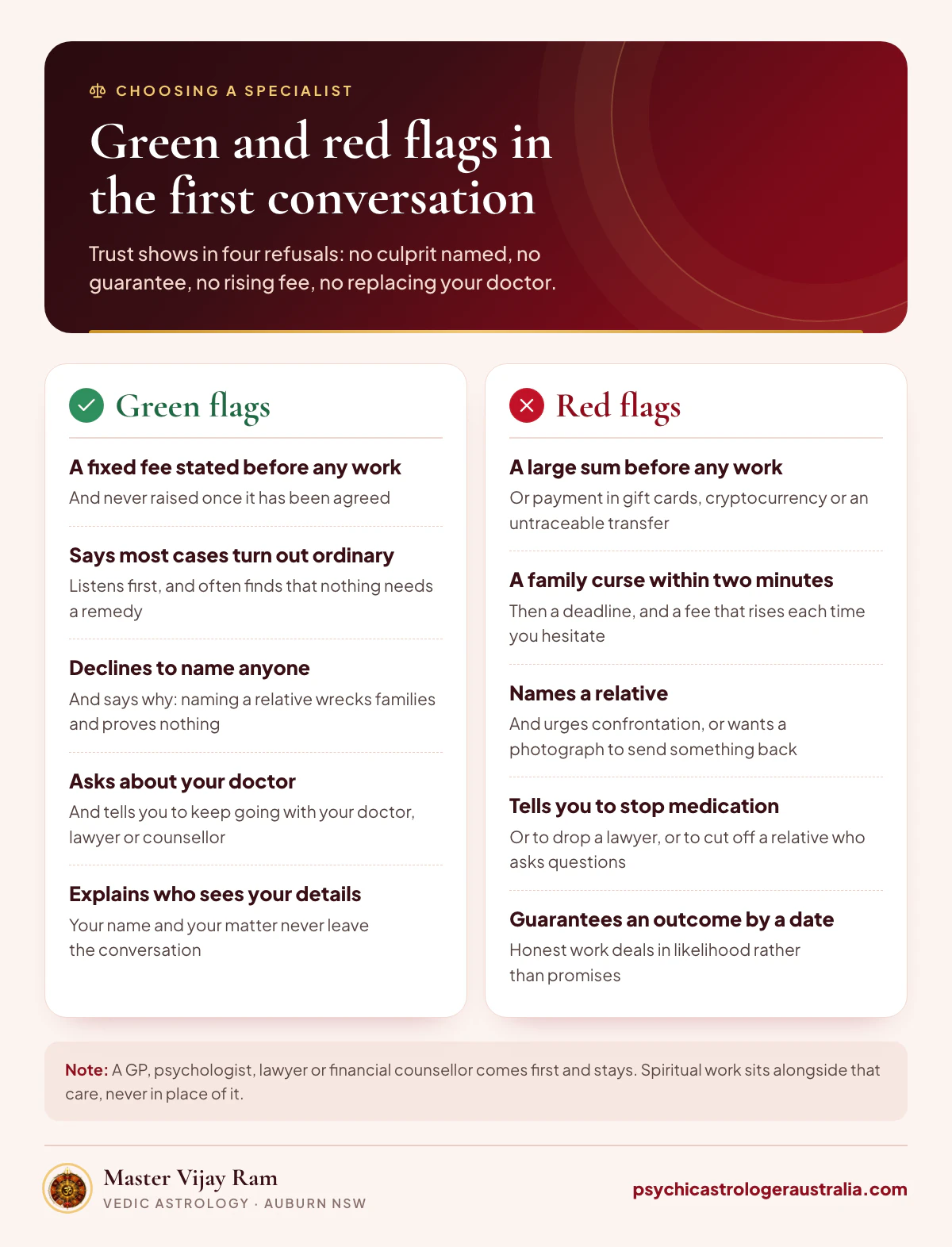
Here is a rule of thumb worth carrying into any first conversation. Call it the Four Refusals. A practitioner worth trusting will refuse at least four things, and usually offers those refusals before you think to ask for them.
- Refuses to name the person who did it, because naming a relative on thin evidence wrecks families and proves nothing.
- Refuses to guarantee an outcome or a date, because honest work deals in likelihood rather than promises.
- Refuses to raise a fee once it has been agreed, because a figure that grows each time you hesitate is how frightened people are drained.
- Refuses to place spiritual work ahead of your doctor, your lawyer or your counsellor.
Those four apply to the clearing work itself exactly as they apply to any other kind of spiritual help. If none of them appear anywhere in a conversation, you are being sold to rather than assessed.
Green flags, amber flags and red flags
Most warning signs are not dramatic. They are small tonal things you notice and then talk yourself out of. Set out in columns, they are harder to explain away, and they apply equally to a page about black magic removal across the Peel region south of Perth.
| What you are watching | Green flag | Amber flag | Red flag |
|---|---|---|---|
| Payment | A fixed fee, stated before any work begins | A fee that stays vague until after the first call | A large sum demanded before any work |
| Diagnosis | Says most cases turn out to be ordinary | Sounds certain before hearing details | Declares a family curse within two minutes |
| Naming a culprit | Declines to name anyone, and says why | Offers a vague description to match | Names a relative and urges confrontation |
| Medical and legal | Asks about your doctor and says keep going | Says nothing either way | Tells you to stop medication or drop a lawyer |
| Talk about results | Describes what usually shifts and what may not | Leans on absolutes like always and permanently | Guarantees a fixed outcome by a fixed date |
| Privacy | Explains who sees your details | Vague about what is stored | Posts client screenshots publicly |
What an honest first conversation sounds like
It is mostly listening. Sleep, health, money, work, the state of the household, what changed and when. Someone who is genuinely assessing will ask about doctors and diagnoses, and will ask what has already been tried. There is often a long pause while they think.
It is also unhurried and slightly dull. No performance, no sudden gasp, no theatrical reaction to a photograph. Many of these conversations end with a version of the same sentence: nothing here needs a remedy, and here is what I think is actually going on. Hearing that is a good sign rather than a wasted call.
A companion article on Does Black Magic Removal Really Work? Honest Answers & Reviews goes further into what people notice afterwards and what they do not.
Five questions worth asking before you agree to anything
You are allowed to interview the person you are considering. Nobody serious will mind, and the way the questions are received matters as much as the answers themselves.
- What do you think is going on here, and what would change your mind?
- What happens if you look and find nothing spiritual at all?
- When do I pay, and what exactly am I paying for?
- Who else will ever see what I have told you?
- What should I keep doing with my doctor, my lawyer or my counsellor?
The list does not change with the postcode. Someone reading about what this looks like for people near Parramatta in Greater Western Sydney should ask the same five as someone enquiring from a farm two hours from a town. Vague answers to plain questions are themselves an answer.
What you should never be asked for
Some requests should end a conversation on the spot. Payment in gift cards, cryptocurrency or an untraceable transfer. Access to your bank accounts. A running series of payments that grows each time you report no change. A demand that you cut contact with a relative who is asking questions.
Be careful too with requests aimed at another person. If you are asked for a photograph of somebody so that something can be sent back at them, you have moved from healing into harm. Genuine work on a curse or hex that will not lift is concerned with lifting a weight off you, not placing one on someone else.
There is a practical reason as well as an ethical one. Anyone who will agree to harm a person on your behalf has shown you exactly what they would agree to do to you, for somebody else, on another day.
Reading reviews and testimonials without fooling yourself
Screenshots of messages are trivially easy to fabricate. Five-star counts can be purchased. Anonymous testimonials cannot be checked by anybody, and a page carrying nothing but praise is less believable than one that admits what did not work.
Reviews tell you how somebody felt in a moment. They rarely tell you what was promised, what was charged, or whether the change lasted a year. Look instead for consistency: whether the site describes the same process the practitioner describes on the phone, and whether fees are explained the same way in both places.
Black Magic Removal in Australia: Cost, Process & Results sets out stages and money in plain terms, and a written account like that is far easier to check against a live conversation than a review count is.
Fear is the main tool of a fraud
The pattern is consistent. An alarming diagnosis inside the first two minutes. A deadline attached to it, often tied to a moon phase or a festival. A fee that rises each time you hesitate. Then a warning that stopping now will make everything worse.
Fear shortens thinking, which is the point of it. Somebody who wants your money needs your judgement switched off, and frightening you is the fastest way to manage that. A practitioner working honestly does the opposite and slows you down.
Serious traditions around witchcraft and sihr treat fear as something to settle, not something to raise. If you come off a call more frightened than you were before it, that reaction is information about the caller rather than about your situation.
What it costs
A consultation with Master Vijay Ram is $50, by phone, video or WhatsApp. It is where the chart and the timeline are read, and it is where most enquiries end, because an ordinary cause fits better than anything spiritual.
Where a remedy is warranted, spell or prayer work starts from $250. The figure is agreed with you before anything is performed, it does not escalate once the work has begun, and nothing is ever sold on the strength of fear, urgency or a named culprit. That arrangement is the whole of it; there is no package to upgrade to and no second fee waiting behind the first. The same terms hold for every kind of work, including reunion work for families in Joondalup, where urgency runs highest and people are most tempted to agree to anything just to feel that something has begun.
Why nearest is rarely the right filter
Proximity feels reassuring. It rarely measures anything. A practitioner on the Gold Coast is no closer to the truth of your situation than one in another state, and a suburb name in a heading is one of the cheapest things to add to a website.
Consultations with Vijay Ram ji happen by phone, video and WhatsApp. Remedies are performed personally at his own place of practice, which is precisely why your address does not alter the work, and in-person appointments are available there for people who want them.
Treat any claim of an office in every suburb with care. Very few practitioners hold premises across a dozen postcodes, and a page implying otherwise has already told you something about how carefully it was written.
Confidentiality, and what to check before you share
Before you hand over names, dates and family history, ask three things. What is written down and kept. Who else, if anyone, ever sees it. Whether your situation might be used as an example, even anonymously, in marketing or on social media.
Anyone who posts client screenshots publicly has already shown you what would happen to yours. Strictly confidential should mean that your name and your matter never leave the conversation, including with the relative who referred you in the first place.
Reading about Master Vijay Ram before a first call is a reasonable step, and asking directly is better still. You are also never obliged to name the person you suspect. Declining to accuse anybody is a normal thing to say, and Vijay Ram ji will not press you for a name.
When this is not the answer
Most enquiries turn out not to need a remedy at all, and you deserve to be told that plainly. A great many patterns that look spiritual have an ordinary cause that responds well to ordinary treatment.
Exhaustion, brain fog and low mood are often thyroid disorders, iron or B12 deficiency, sleep apnoea, undiagnosed diabetes, perimenopause or chronic pain. Sudden changes in behaviour, hearing voices, or a sense of being watched can be depression, anxiety, post-traumatic stress, bipolar disorder, postnatal depression or a psychotic episode, and every one of those is treatable. A run of financial collapse or a hostile workplace usually traces back to debt, visa problems, bullying, family violence or an unresolved legal dispute.
See a GP, a psychologist, a lawyer or a financial counsellor first, and keep seeing them. Spiritual work sits alongside that care and never in place of it. If anybody is at immediate risk, call emergency services. Black Magic vs Bad Luck: How to Tell the Difference works through the ordinary explanations in more detail.
Deciding without rushing
Write down what you were told, then read it back the next morning. Anything genuine survives a night of sleep. Deadlines that expire before dawn exist to stop you thinking, and there is no spiritual reason a decision must be made inside an hour.
Then check the four refusals against your notes. Did they decline to name a culprit. Did they avoid guaranteeing a result or a date. Did they state a fixed fee before any work and refuse to raise it. Did they tell you to stay with your doctor and your lawyer. Four out of four is not proof of skill, but three or fewer is reason to keep looking.
The same unhurried approach applies whether an enquiry concerns a family estrangement or voodoo work and how it is undone. Take the time. Anyone worth consulting will still be there tomorrow.
Read next
- Black Magic Removal Near Me: What “Near” Actually Buys YouBlack magic removal near me: what a visit genuinely adds, what it does not, how the work reaches every suburb from Au…
- Black Magic Removal in Australia: Cost, Process & ResultsBlack magic removal in Australia explained honestly: how fees are built, what should never be charged, how the work i…
- Black Magic Removal for NRIs & the Indian DiasporaBlack magic removal for NRIs and Indian diaspora families: how remote assessment works, what usually explains the tro…
Frequently asked questions
What is the most useful question to ask on a first call with a black magic specialist?
Ask what would change their mind. A practitioner who can describe what they would expect to see if nothing spiritual were involved is thinking rather than selling. Someone who cannot name a single alternative explanation has already decided the answer before hearing your situation, which tells you the assessment is not really an assessment.
Should a genuine practitioner be able to name the person who cast it?
They may sense a direction, a relationship or a motive. Turning that into a name is a different act, and it is one that breaks families on evidence nobody can check. A careful practitioner will decline, explain why, and work on lifting the effect instead. Pressure to accuse a specific relative is a warning sign, not a sign of power.
Is it a bad sign if a practitioner declines to take my case?
It is usually a good one. Turning work away costs money, so someone who does it is not simply optimising for income. Cases are declined when the cause looks medical, when legal help is needed first, when the request would harm somebody, or when a person is not ready to begin. A considered refusal is worth more than a quick yes.
How can I judge whether testimonials on a healer's website are genuine?
You largely cannot, and that is the honest answer. Screenshots are simple to fabricate and anonymous quotes cannot be traced back to anyone. Treat them as decoration rather than evidence. What you can check is consistency: whether the process described online matches what you are told on the phone, and whether anyone ever admits to a case that needed no remedy.
What should I do if someone tells me my entire family is cursed?
Slow down. A sweeping diagnosis delivered before anyone has heard your details is a sales technique, designed to produce fear across several people at once so that several people pay. Ask what specifically led to that conclusion and what would disprove it. If the answer is vague, or turns straight into urgency, end the conversation there.
Is it safe to send photographs of my family to a practitioner?
Send as little as you can until you trust the person. Ask what happens to images afterwards, whether they are deleted, and whether anything is ever reused publicly. Be firmer still about photographs of a person you suspect. Any request framed as targeting somebody has left healing behind and moved into causing harm.
Should I seek a second opinion before agreeing to any remedy?
Yes, and nobody honest will be offended. Describe the situation to a second practitioner without repeating the first diagnosis, then compare what each says unprompted. Two careful assessments will overlap on the ordinary explanations even if they differ on detail. If one dismisses medical causes entirely while the other raises them, you have learned something useful.
What if two practitioners give me completely different readings?
Take the disagreement seriously rather than picking the version you prefer. Look at how each one reached the conclusion. The person who names their reasoning, admits uncertainty and asks about your health is far easier to check. If neither can explain how they arrived at an answer, the sensible next step is a doctor rather than a third opinion.
Does a large social media following indicate real ability?
No. A following measures how well somebody produces content and buys reach, which is a separate skill from spiritual work and often a full-time job in itself. Some careful practitioners have almost no online presence at all. Judge the private conversation, the terms of payment, and the willingness to tell you that nothing is wrong.
How much should a practitioner know about my situation before offering an opinion?
Enough to have asked you questions. A useful opinion follows a conversation about sleep, health, money, family, and what changed and when. If a conclusion arrives before you have finished describing the problem, it did not come from your situation. Be equally wary of an opinion produced from a single name typed into a message.
Should I be concerned if I am asked for hair, nail clippings or worn clothing?
Ask why, and ask what happens to it afterwards. Some traditions do use a personal item, so the request alone proves nothing either way. What matters is whether the purpose is explained in plain language, whether the item is returned or destroyed, and whether you are ever told it could be used against you if you stop paying.
What does a consultation cost, and what should the fee cover?
A consultation is $50, and spell or prayer work, where it is warranted, starts from $250. The figure for any remedy is agreed with you before anything is performed, and it does not rise once the work has started. A fixed fee does not make anyone honest on its own, so also ask what the work involves, how long it runs and what it cannot promise.
I have already paid someone and nothing changed. What now?
Stop paying, and stop before any further instalment. Write down what was promised, in what words, and on what dates. If money was taken by deception, that is a matter for consumer protection or the police rather than for another remedy. Then treat the underlying problem from the beginning again, starting with medical and practical causes.
Can I have a family member on the call while I decide?
You can, and anyone who objects has told you something. A second listener remembers what was said, notices pressure you may miss, and helps you resist a deadline. Choose someone calm rather than someone already certain a curse is involved, since a frightened relative can push harder than any practitioner ever would.
Is it disrespectful to ask about a practitioner's background and training?
Not at all. Asking how long someone has practised, what tradition they were taught in and who taught them is entirely normal, and a straightforward answer is easy for anyone genuine. What matters more than the length of a biography is whether the answer stays specific and consistent, and is offered without irritation when you ask again.
People also ask
How do you spot a fake black magic removal specialist?
Watch for a diagnosis delivered before you have finished speaking, a deadline attached to it, money demanded up front, and a named culprit you are urged to confront. Add pressure to stop medication or avoid a lawyer and the picture is complete. Honest practitioners slow you down, admit uncertainty, and turn work away when nothing spiritual is present.
Are online black magic removal services trustworthy?
Being online says nothing either way. Consultations by phone, video or messaging are ordinary now, and remedies are performed by the practitioner at their own place of practice regardless of where you sit. Judge the same things you would judge in person: the terms of payment, the refusals, the answers about privacy, and the willingness to say nothing is wrong.
Why do some spiritual healers ask for money before the work?
Some ask for a modest consultation fee and explain it clearly, which is a normal way to run any practice. The real concern is a large sum demanded first, especially in cash, gift cards or cryptocurrency, and especially when the amount grows each time you report that nothing has changed. A fixed fee, agreed before any work begins and never raised afterwards, removes that pressure entirely.
Should I tell my family that I am consulting a spiritual healer?
That is entirely your decision, and no practitioner has any business insisting either way. Telling one calm person helps you think, and gives you a witness to what was promised. What should worry you is an instruction to keep it secret from a relative who is asking sensible questions, because isolation is how pressure gets applied.
What is the difference between a black magic specialist and an astrologer?
An astrologer reads a birth chart to describe timing, tendencies and pressure points across a life. Removal work addresses an effect somebody believes has been placed on them. The two overlap in practice, because a chart is often used to check whether the pattern has a natural explanation before any remedy is even considered.
References & further reading
Serving clients across Australia
Confidential consultations by phone, video & WhatsApp — including: