

Quick answer
The Satyanarayan katha is a vow-story read aloud in honour of Vishnu as Satyanarayana: five short chapters, an aarti, and sheera with banana passed to everyone. Families hold it on a Purnima after moving house, after a recovery or when a difficult year finally closes, as thanks and as a promise kept.
What is the Satyanarayan katha, and why hold it after a move or a hard year?
The Satyanarayan katha is a vow-story read aloud in honour of Vishnu in his form as Satyanarayana, the lord of truth, in which five short chapters are told and a sweet prasad goes round the whole room. Families reach for it at the turning points: the first full moon in a new house, the month a parent comes home from hospital, the week a visa is granted, or the close of a year that nobody wants to repeat. A Satyanarayan katha at home says two things at once, thank you for what came through, and we mean to keep our word from here.
Master Vijay Ram is asked about it most often by families who have just moved, or who promised the katha during a bad stretch and now want to keep that promise properly. What follows covers where the katha comes from, its chapters, the full moons of 2027 and the prasad, and a puja performed on your behalf describes what he does when a family cannot hold it themselves.
Where does the katha come from?
The puja is described in the Bhavishya Purana and in the Reva Khanda of the Skanda Purana as it appears in printed editions, and the version most north Indian families read follows the Skanda telling. It opens in the Naimisha forest, where the sage Suta tells the assembled rishis what Vishnu once told Narada: that in the Kali Yuga, an age of short lives and heavy troubles, this simple vow is open to anyone, of any caste, on any day.
Scholars debate how old the katha is, since it appears in some printed editions of the Skanda Purana and not in others. In Bengal, Satyanarayana has long been linked with Satya Pir, honoured by Hindu and Muslim households with the same sweet offering of flour, milk, sugar and banana. None of that history changes what the puja means to a family on the night, and it explains why the katha is told so simply.
What happens in the five chapters?
The Satyanarayan vrat katha is short enough to read in well under an hour, and each chapter is a small story with a turn in it. The details differ between the printed versions and between regions, and the table follows the telling most families in Australia will hear.
| Chapter | Who it is about | What the story turns on |
|---|---|---|
| First | Narada and Vishnu | Narada, troubled by human suffering, asks for a remedy, and Vishnu describes the vow and the prasad |
| Second | A poor Brahmin of Kashi and a woodcutter | The Brahmin is taught the puja by Vishnu in disguise; the woodcutter sees it, keeps it, and prospers |
| Third | A king on a riverbank and a merchant named Sadhu | The childless merchant vows the puja if a child is born, keeps putting it off, and lands in prison with his son-in-law |
| Fourth | The merchant, his wife Lilavati and daughter Kalavati | Freed, he lies about his cargo and it turns to leaves; at home Kalavati rushes off without prasad and a boat sinks |
| Fifth | King Tungadhwaja and the cowherds | A proud king refuses the prasad cowherds offer him, loses everything, and recovers when he humbles himself |
What do the stories ask of a family?
Read together, the chapters keep returning to two things: a promise made to God is a promise to be kept, and what is offered with love should be received with humility. The merchant’s trouble comes from delay, and the king’s from pride. That is the whole moral, and it is a gentle one.
Some people are frightened by the shipwrecks and the prison, and worry that a missed step will bring the same on them. The tradition does not read the katha that way: the stories punish broken promises and arrogance, not a family that lit the lamp late or forgot a flower. If anything, the katha is a reassurance that a household which turns back towards its word is taken back.
Why on Purnima, and which full moons fall in 2027?
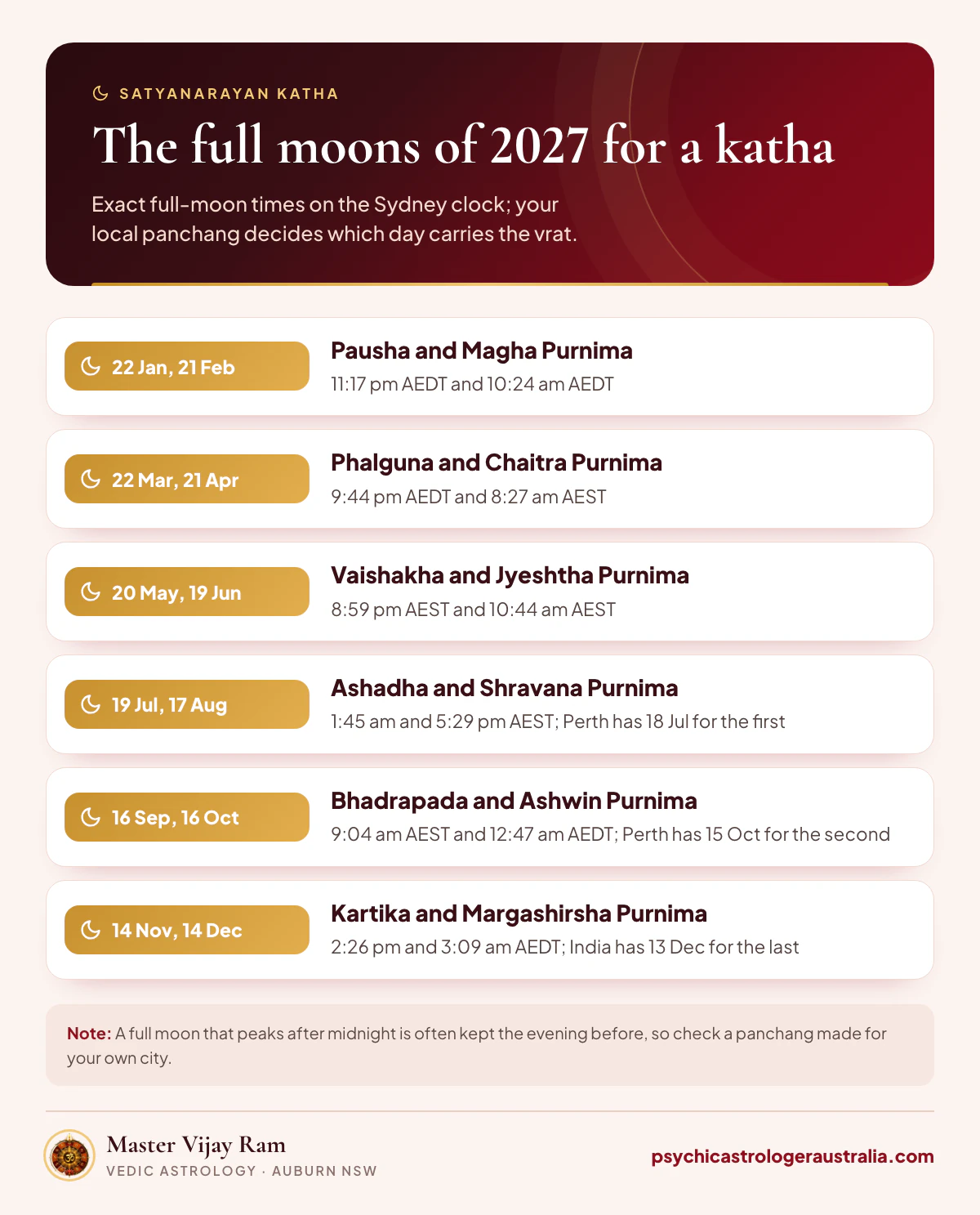
The katha itself allows any day, and families still prefer the full moon. A Satyanarayan puja on Purnima is the most common pattern, often in the evening, with the hosts fasting lightly until the prasad is shared; some households keep it every month, and others only at the turns of the year. The full moons of 2027 are below in Sydney and Perth time.
| Date (Sydney) | Exact time (Sydney) | Perth | Date in India | Hindu month name | Moon’s Vedic sign · nakshatra |
|---|---|---|---|---|---|
| Fri 22 Jan | 11:17 pm AEDT | Fri 22 Jan, 8:17 pm | 22 Jan | Pausha Purnima | Karka · Pushya |
| Sun 21 Feb | 10:24 am AEDT | Sun 21 Feb, 7:24 am | 21 Feb | Magha Purnima | Simha · Magha |
| Mon 22 Mar | 9:44 pm AEDT | Mon 22 Mar, 6:44 pm | 22 Mar | Phalguna Purnima | Kanya · Uttara Phalguni |
| Wed 21 Apr | 8:27 am AEST | Wed 21 Apr, 6:27 am | 21 Apr | Chaitra Purnima | Tula · Chitra |
| Thu 20 May | 8:59 pm AEST | Thu 20 May, 6:59 pm | 20 May | Vaishakha Purnima | Vrishchika · Anuradha |
| Sat 19 Jun | 10:44 am AEST | Sat 19 Jun, 8:44 am | 19 Jun | Jyeshtha Purnima | Dhanu · Mula |
| Mon 19 Jul | 1:45 am AEST | Sun 18 Jul, 11:45 pm | 18 Jul | Ashadha Purnima | Makara · Uttara Ashadha |
| Tue 17 Aug | 5:29 pm AEST | Tue 17 Aug, 3:29 pm | 17 Aug | Shravana Purnima | Makara · Dhanishta |
| Thu 16 Sep | 9:04 am AEST | Thu 16 Sep, 7:04 am | 16 Sep | Bhadrapada Purnima | Kumbha · Purva Bhadrapada |
| Sat 16 Oct | 12:47 am AEDT | Fri 15 Oct, 9:47 pm | 15 Oct | Ashwin Purnima | Meena · Revati |
| Sun 14 Nov | 2:26 pm AEDT | Sun 14 Nov, 11:26 am | 14 Nov | Kartika Purnima | Mesha · Krittika |
| Tue 14 Dec | 3:09 am AEDT | Tue 14 Dec, 12:09 am | 13 Dec | Margashirsha Purnima | Vrishabha · Mrigashira |
Brisbane and Queensland: subtract one hour from Sydney time between January and 4 April and from 3 October; otherwise the same. Adelaide is always 30 minutes behind Sydney. Computed with the Swiss Ephemeris (Lahiri ayanamsa for Vedic positions) and checked against US Naval Observatory data. Times are rounded to the minute.
The exact instant is not always the day a family keeps, since a full moon that peaks after midnight belongs, in panchang terms, mostly to the evening before. Purnima 2027 dates by city explains how each city reads the table, and where a family wants a precise day and hour, choosing an auspicious date is the consultation that sets it.
Is a Satyanarayan puja right for a new house?
It is one of the commonest ways families settle into one. Some hold the Satyanarayan puja for a new house on the griha pravesh day itself, after the entry and the boiling of the milk, and others wait for the first full moon after the boxes are unpacked. A family that gets its keys in early May, for instance, might choose the Vaishakha Purnima on Thursday 20 May.
The katha is not the griha pravesh, and it does not replace it. How a griha pravesh is done covers the rite of entry, and griha pravesh and home blessing is the version Vijay Ram ji performs; the katha is the thanksgiving that so often follows it.
The same thinking works at the other end of a tenancy. Families leaving a home they were happy in sometimes hold a last katha there, and a thank-you puja before moving out describes that quieter farewell.
What about after an illness, a job loss or a year that went wrong?
This is the katha’s other great use. A mother in Wollongong might have promised it while her husband was in surgery; a young couple in Canberra might have said they would hold one when the visa came through. Keeping that promise is the point, and the puja is held once the danger has passed, not as a bargain while it is still happening.
Practical help comes first, always: the specialist, the rehabilitation plan, the employment adviser, the migration agent. The katha closes a chapter that those people helped the family through, and it gathers relatives who were scattered by the hard year into one room for an evening of thanks.
How is the katha set up at home?
A low wooden stool or chowki is covered with a red or yellow cloth, and in many Marathi and Telugu homes four banana stems are tied at its corners to make a small canopy; Indian grocers sell the leaves, and plenty of Sunshine Coast backyards grow them. On it go a kalash, a picture of Satyanarayana or Vishnu, a shaligram where the family has one, tulsi leaves, fruit, betel leaves and a lamp.
Ganesha is worshipped first, then Satyanarayana, then the five chapters are read with the household seated around. The evening closes with an aarti, in many north Indian homes Om Jai Jagdish Hare, and the prasad is given out before anyone eats.
A brass or steel tray under the lamp, a clear gap to the curtains, the smoke alarm left alone, and the aarti camphor kept out of small children’s reach: that is all the safety the evening needs.
What is the prasad, and why must everyone take some?
The classic prasad is sheera, semolina roasted in ghee and cooked with milk, sugar and banana, with a tulsi leaf on top, and many families make it in sava measures, one and a quarter of each ingredient, as the katha asks. Panchamrit, milk, curd, ghee, honey and sugar, is offered too, and Bengali households often make sinni, a mixture of flour, milk, banana and sugar.
Everyone present takes a little, because two of the five stories turn on prasad refused or forgotten. A guest with diabetes, a wheat intolerance or a dairy allergy needs only a crumb or a touch to the forehead, and a thoughtful host keeps a fruit portion aside so nobody has to choose between courtesy and their health.
Can a family read it without a priest, and in English?
Yes. Katha booklets with an English translation facing the original are not hard to come by, and plenty of Australian households read the chapters in English for the sake of the children. One person can read all five, or each chapter can go to a different reader, a grandparent for the first and a teenager for the last.
Where the family has a pandit it trusts, he will bring the fuller order of worship. Where it does not, the reading, the prasad and the aarti done with care are a complete katha in the tradition’s own terms.
What if something goes wrong on the day?
The prasad burns, the pandit is late, a toddler knocks over the kalash, the smoke alarm goes off. Keep going: relight the lamp, make a little more sheera, and finish the reading. The stories are about promises broken on purpose, and nothing in them punishes a family for an ordinary mishap.
If a family is genuinely frightened that a mistake has brought bad luck, that fear is worth talking through rather than acting on. A calm conversation usually shows that the worry came from the shipwreck in chapter four, not from anything that happened in the lounge room.
Where do families in Canberra, Hobart and Newcastle hold it?
Mostly at home, which is exactly where the katha belongs. Canberra has temples at Mawson, Florey and Torrens and a BAPS mandir at Taylor, but the katha is still usually held in the lounge room; in Hobart, Newcastle and Geelong, where no large temple has been confirmed, home is the only option and loses nothing by it. Illawarra families who want a temple setting drive up the coast to the Sri Venkateswara Temple at Helensburgh.
The Satyanarayan katha in Australia has also become a way of including grandparents overseas, who join by video and hear the chapters read in their own language. Readings for Canberra families explains how consultations work across the country, and in-person appointments happen only at Auburn.
When does it make sense to have it performed for you?
When the family is too scattered to gather, when nobody feels able to read it, or when a reading has suggested that a fuller puja would help after a heavy stretch. Vijay Ram ji can then hold the puja for them in Auburn, where he practises, reading the katha himself on a Purnima or another chosen day with the family’s names in the sankalp, while relatives watch by video if they like.
The fee starts at $250 and is agreed with the family before the day. Where the timing itself is the question, a $50 consultation by phone, video or WhatsApp comes before any of that.
What can a katha not do?
No katha brings money, dries out a damp house, heals an illness or rewrites a bad year, and anyone who says otherwise is overselling it. What this page describes is devotion and faith-based guidance rather than medical, legal or financial advice, so a family still recovering keeps its doctors, its advisers and each other close.
What it does is mark a turning. The lamp is lit, the five stories are read, the prasad goes round, and a family that has come through something says so out loud, together.
Read next
- Purnima 2027 in Australia: Vrat Days and Full Moon Times by CityPurnima 2027 in Australia: all 12 full moon dates and times, how Cairns, Townsville, Darwin and Perth convert them, a…
- Moving Into a Rental: A Simple Muhurat and BlessingMoving into a rental: how to pick the best day inside the dates your lease allows, and a short blessing with no nails…
- Diwali 2026 House & Aura Cleansing: Clear the Year's Heavy EnergyDiwali 2026 house and aura cleansing done honestly: clean first, use the Five-Lamp Check, and learn when heaviness is…
Frequently asked questions
Does a Satyanarayan katha need a priest?
No. A family can hold it alone: katha booklets with an English translation are not hard to come by, and one person can read all five chapters or share them around the family. Ganesha is worshipped first, the chapters are read, the aarti is sung and the prasad is shared. A pandit brings a fuller order of worship, but a careful family reading is a complete katha.
On which day should a Satyanarayan puja be held?
The katha allows any day, but Purnima, the full moon, is the most common choice, usually in the evening. Families also hold it on the griha pravesh day, on the first full moon in a new house, or on a date chosen by muhurat. The local panchang decides which calendar day keeps the Purnima, since the vrat day can differ from the exact instant.
Should the Satyanarayan puja be done after griha pravesh?
Many families do, either on the house-warming day itself after the entry and the boiling of the milk, or on the first full moon after moving in. It is a thanksgiving rather than a rite of entry, so it sits alongside the griha pravesh, never instead of it. In a rental or an apartment it needs only a lamp, a small altar and the prasad.
What are the five chapters of the Satyanarayan katha?
The first tells how Narada asked Vishnu for a remedy for human suffering. The second follows a poor Brahmin of Kashi and a woodcutter who keep the vow. The third and fourth follow a merchant who promised the puja, kept delaying it, and suffered until his family kept their word. The fifth tells of a proud king who refused prasad.
What prasad is made for the Satyanarayan puja?
Sheera is the classic offering: semolina roasted in ghee and cooked with milk, sugar and banana, topped with a tulsi leaf, and often made in sava measures of one and a quarter of each ingredient. Panchamrit of milk, curd, ghee, honey and sugar is offered too, and Bengali families often make sinni. Everyone present takes a little before eating.
Do I have to fast for the Satyanarayan katha?
Many hosts fast lightly until the prasad is shared, but fasting is a custom, not a condition of the puja. Anyone who is pregnant, diabetic, on regular medication or working shifts should eat as their GP advises, and can still host or attend. The tradition values the promise and the reading far more than an empty stomach.
What if I promised a Satyanarayan katha and could not hold it?
Hold it when you can. The stories are about promises delayed on purpose, and a family that turns back to its word is welcomed in the katha itself. If circumstances make a home puja impossible, it can be performed on your behalf at Auburn with relatives watching online, starting from $250 and agreed before it is performed.
Can the katha be read in English or another language?
Yes. The katha has always been told in the languages of the people who keep it, Hindi, Marathi, Telugu, Gujarati, Bengali and Nepali among them, and English versions let Australian-raised children follow the stories. What matters is that the chapters are heard and understood. Grandparents overseas can join by video and follow in their own language.
How much does it cost to have the Satyanarayan puja performed?
Master Vijay Ram reads the katha and performs the puja himself in Auburn on a Purnima or another chosen day, naming the family in the sankalp, and relatives can watch over video. The fee starts at $250 and is agreed with the family beforehand, and a $50 consultation is the place to begin if the timing needs reading.
People also ask
What is the benefit of the Satyanarayan katha?
In the tradition, the katha brings Vishnu’s grace to a household that keeps its word, and families hold it to give thanks after a move, a recovery, a wedding or a hard year. In practical terms it gathers a family for an evening of stories and prasad. It cannot bring money, cure illness or fix a house, and no one can honestly promise that it will.
Why is the Satyanarayan puja done on Purnima?
The katha itself allows any day, but the full moon has long been the preferred evening, a bright and complete night for a puja about completeness and keeping one’s word. Families who keep it monthly simply follow each Purnima. Because the full-moon instant can fall after midnight, the local panchang decides which calendar day carries the vrat.
Who wrote the Satyanarayan katha?
No single author is named. The puja is described in the Bhavishya Purana and in the Reva Khanda of the Skanda Purana in printed editions, framed as the sage Suta repeating what Vishnu told Narada. Scholars debate its age, and in Bengal Satyanarayana has long been linked with Satya Pir, honoured by Hindu and Muslim households alike.
Can the Satyanarayan puja be done in the evening?
Yes, and the evening is the most common time, especially on a Purnima, with the hosts fasting lightly until the prasad is shared. Morning pujas are also kept, particularly on a griha pravesh day. Choose the time the family can actually gather, keep the lamp safely away from smoke alarms, and make sure everyone receives the prasad.
References & further reading
Serving clients across Australia
Confidential consultations by phone, video & WhatsApp — including: