
Quick answer
Kaal Sarp Dosh is a chart pattern in which every planet sits on one side of the Rahu–Ketu axis. It is said to bring delays, fear and repeated setbacks, but most charts that carry it also carry cancellations. Master Vijay Ram checks the exact degrees first; a Kaal Sarp puja is recommended only when the pattern is complete and active.
What is Kaal Sarp Dosh?
Kaal Sarp Dosh is a birth-chart pattern in which all seven classical planets sit within the half of the zodiac bounded by Rahu and Ketu, the two lunar nodes. The name means the serpent of time, and the tradition reads it as a chart whose energy is hemmed in on one side, so that effort meets delay and plans stall at the last step. It is one of the most searched doshas among Indian-Australians, usually after a phone app has flagged it, and one of the most over-diagnosed.
Master Vijay Ram treats it the way the chart deserves: as one pattern among many, weighed against the strength of the planets inside it. A Kaal Sarp and Pitra Dosh reading begins with the exact degrees of Rahu and Ketu, not with the label.
Do I have Kaal Sarp Dosh? How to check your chart
Take your Vedic chart and find Rahu and Ketu; they are always exactly opposite each other, 180 degrees apart. Now move through the zodiac from Rahu towards Ketu in the order of the signs. If the Sun, Moon, Mars, Mercury, Jupiter, Venus and Saturn all fall inside that arc, the chart has the pattern; if even one planet sits outside it, the strict rule says there is no dosha.
Two details decide many borderline cases. The first is which node you use: the mean node and the true node can differ by more than a degree, enough to move a planet across the line, and Vijay Ram ji checks both. The second is a planet sitting at the same degree as Rahu or Ketu, which some schools count as inside and others as outside, and which he reads by the minute of arc.
If you are asking do I have Kaal Sarp Dosh because a wedding or a job has stalled, the honest first answer is that a quick online chart says less than it seems. The ascendant, the Moon's nakshatra and the dasha running at the time matter more than the label.
The twelve types of Kaal Sarp Dosh
The tradition names the pattern after the house Rahu occupies, borrowing the names of twelve serpents. The Kaal Sarp Dosh types are read as twelve flavours of the same tension, each pressing on the pair of houses the nodes occupy.
| Type | Rahu in house | Ketu in house | Where the pressure is traditionally felt |
|---|---|---|---|
| Anant | 1st | 7th | Self, health, marriage and partnerships |
| Kulik | 2nd | 8th | Family, savings, speech, sudden losses |
| Vasuki | 3rd | 9th | Siblings, courage, luck and the father |
| Shankhpal | 4th | 10th | Home, mother, property and career |
| Padma | 5th | 11th | Children, studies, gains and friends |
| Mahapadma | 6th | 12th | Debts, illness, enemies, expenses and foreign lands |
| Takshak | 7th | 1st | Marriage, business partners and the self |
| Karkotak | 8th | 2nd | Inheritance, longevity, in-laws and family wealth |
| Shankhachud | 9th | 3rd | Fortune, faith, teachers and siblings |
| Ghatak | 10th | 4th | Profession, reputation, home and vehicles |
| Vishdhar | 11th | 5th | Income, elder siblings, children and romance |
| Sheshnag | 12th | 6th | Expenses, sleep, hidden enemies and health |
Anant, Kulik, Vasuki and Shankhpal types have Rahu in the first four houses and tend to be felt in the body, the family and the home. Takshak to Sheshnag have Rahu in the seventh to twelfth and press on marriage, inheritance, luck, career, gains and expenses. The names are a reading aid rather than a diagnosis; the same type behaves very differently in a chart with a strong Jupiter and in one without.
Full, partial and cancelled: why most charts escape
A full Kaal Sarp pattern needs every planet inside the arc and none on the axis itself. A partial pattern, where one planet sits outside or on the line, is read by many astrologers as no dosha at all and by others as a mild one; Vijay Ram ji treats it as a note in the margin, not a headline. Even a full pattern is softened when Rahu or Ketu sit in their own or exalted signs, when Jupiter aspects the Moon or the ascendant, or when the ascendant lord is strong.
The result is that most charts said to carry Kaal Sarp Dosh carry a cancelled or mild version of it. A dosha in Jyotish is a weight on one side of the scale, never a sentence, which is why the rules of dosha cancellation matter more than the list of doshas.
What are the symptoms people describe?
The Kaal Sarp Dosh symptoms and remedies lists that circulate online are long because they are vague: dreams of snakes, fear without cause, work that is praised but not paid, promotions that go to someone else, a marriage that is always nearly arranged. Some of those experiences are real and painful. None of them is unique to this pattern, and all of them have ordinary causes that must be looked at first.
What the pattern more reliably describes is a rhythm rather than a list of events: long stretches where effort brings little, followed by sudden movement when the dasha changes. People who carry it often say their life has run in chapters with hard edges. That is a description worth taking to a reading; a list of thirty symptoms is not.
When is the pattern actually felt? The dasha decides
A natal pattern is a standing condition; the Vimshottari dasha is the clock that switches it on and off. The years when Kaal Sarp Dosh is most noticeable are the mahadasha and antardasha of Rahu and Ketu, and the periods of any planet sitting within a few degrees of either node. Outside those periods many people with a full pattern report nothing unusual at all.
This is why two cousins with the same type can describe opposite lives. One is in a Jupiter period with Jupiter far from the axis; the other is in Rahu-Saturn with Saturn conjunct Ketu. Vijay Ram ji always places the pattern on the dasha timeline before he says a word about remedies.
Kaal Sarp Dosh is not in the classical texts: what that means
Honesty requires saying that the Brihat Parashara Hora Shastra and the other standard classics do not list Kaal Sarp Yoga at all. The pattern entered common use in the last century, and some respected astrologers decline to read it for that reason. Master Vijay Ram's position is that the nodes have always been read, that a chart with every planet on one side of them does behave in a recognisable way, and that the modern name should not be allowed to carry more fear than the chart itself justifies.
In practice that means he will tell you plainly when the pattern is present and plainly when it is cancelled. He will not perform a puja for a pattern that is not there, which is the single most common thing Indian-Australians report having been offered elsewhere.
Does Kaal Sarp Dosh affect marriage, career and money?
The Kaal Sarp yog effects on marriage come through the houses the nodes occupy: a Takshak or Anant type puts Rahu or Ketu in the seventh, and that is where delays, unconventional partners and family objections tend to appear. The partner's chart matters as much, which is why Vijay Ram ji reads both charts together when a wedding is the question. Career and money follow the same logic through the tenth, eleventh and second houses, and a strong Saturn or Jupiter usually matters more than the nodal pattern.
Relationships formed under a strong nodal axis are a subject of their own; the post on Rahu, Ketu and karmic partners explains why such bonds feel fated and where they ask for care.
Rahu and Ketu in 2027: does the transit matter?
Rahu moved into Vedic Capricorn and Ketu into Cancer on 6 December 2026, and they stay there until 24 June 2028, so the nodal axis runs through Capricorn and Cancer for all of 2027. For someone whose natal Rahu is in Capricorn or Cancer this is a nodal return, the eighteen-and-a-half-year point where the pattern's themes come round again. For everyone else the transit mostly colours the houses those two signs occupy in the chart.
A transit does not create or remove Kaal Sarp Dosh, which is fixed at birth. What changes is the dasha: the pattern is felt most during the periods of Rahu, Ketu or the planets closest to the axis, which the Rahu mahadasha guide describes year by year.
Which puja is done for Kaal Sarp Dosh, and where?
The traditional Kaal Sarp Dosh puja is a shanti rite addressed to Rahu, Ketu and Lord Shiva, performed on an auspicious day with sankalp in the person's name and gotra, a Rudrabhishek, the nodal mantras and the offering of a silver serpent pair. Pilgrims travel to Trimbakeshwar near Nashik, to Mahakaleshwar at Ujjain or to Srikalahasti in Andhra Pradesh for it, and a family trip to one of those temples is a fine thing to do if you can.
From Australia, Master Vijay Ram performs the same rite personally at his own place of practice in Auburn on a muhurat chosen for the chart, with the family joining by video and the sankalp spoken in their name. The online puja and havan page explains what is included and how the day runs. He recommends it only when the pattern is complete, uncancelled and active in the current dasha; otherwise he says so and suggests the simpler practices below.
What does the remedy cost with Master Vijay Ram?
A consultation is $50, and it is where the chart is checked degree by degree and the question of whether a remedy is warranted is settled. Spell or prayer work, including a Kaal Sarp shanti puja, starts from $250, and the figure is agreed with you before anything is performed. There is no other price list, and a practitioner who quotes thousands for a one-day cure of a lifelong pattern is telling you something about themselves rather than about the chart.
Where the nodes are not the real pressure, he will usually recommend a graha shanti puja for the planet that is, or no puja at all.
Simple practices you can keep at home
None of these needs a priest. Offer water to a Shiva lingam on Mondays and recite the Maha Mrityunjaya mantra; keep a Rahu mantra, Om Raam Rahave Namah, on Saturdays; feed birds in the morning and avoid harming any snake, which in Australia is also sound advice. Nag Panchami falls on Friday 6 August 2027 in every Australian city, and a simple offering of milk at a temple's serpent image that day is the traditional observance for this dosha.
The practices work on the person more than on the planets: they build the patience the pattern demands. They sit alongside, never instead of, the practical steps a stalled life needs.
What a reading checks, in order
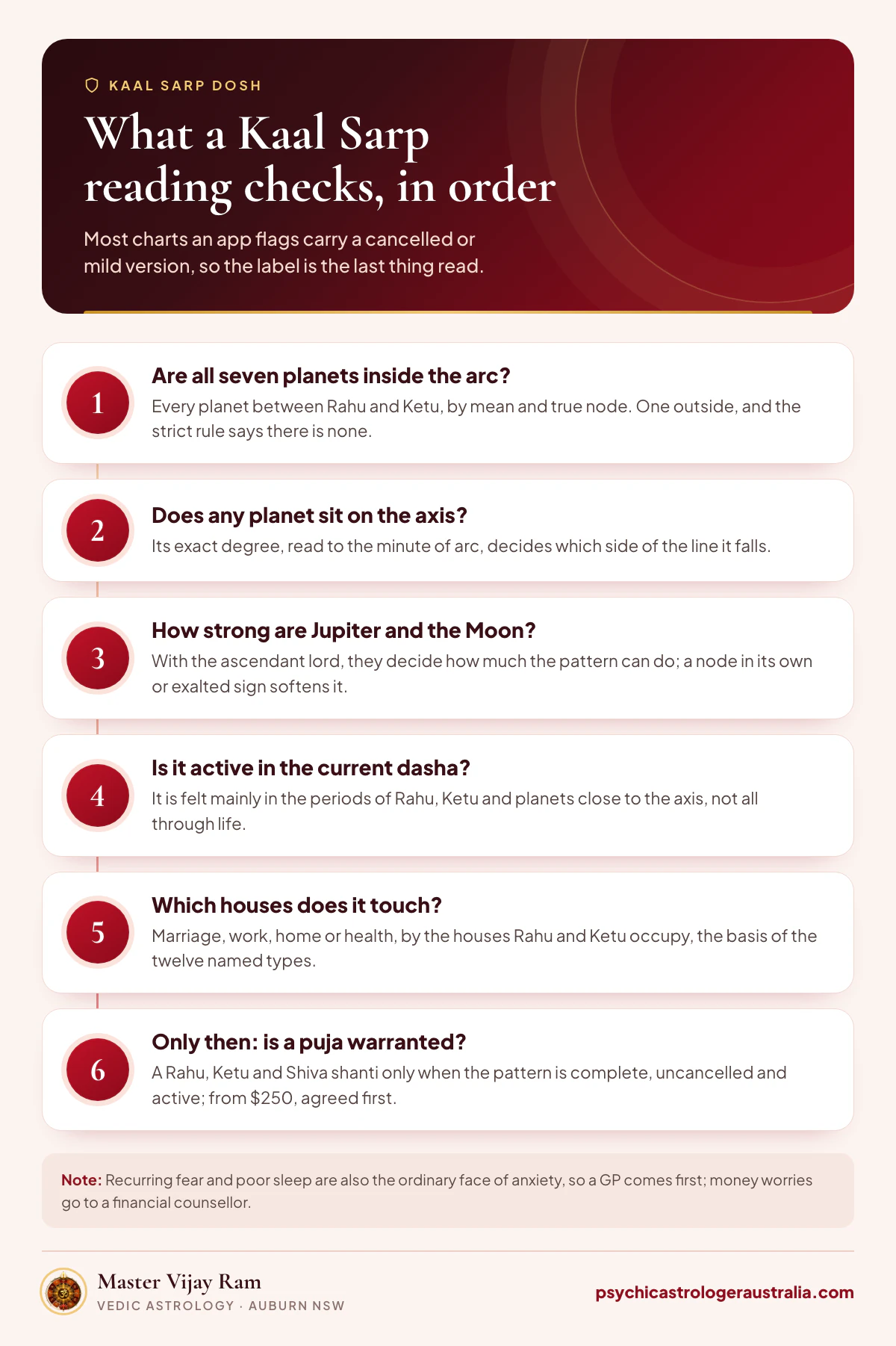
- Whether all seven planets really fall between Rahu and Ketu, by mean node and by true node.
- Whether any planet sits on the axis, and on which side its exact degree places it.
- The strength of Jupiter, the ascendant lord and the Moon, which decide how much the pattern can do.
- The current mahadasha and antardasha, which decide whether it is active now.
- The houses involved, which decide what it touches: marriage, work, home or health.
- Only then, whether a puja is warranted, which practice fits, and what it will cost.
When it is not Kaal Sarp Dosh at all
Recurring fear, poor sleep and a sense of being hemmed in are also the ordinary face of anxiety, and a GP is the first call, not an astrologer. Money that never seems to arrive is a question for a financial counsellor before it is a question for Rahu. Master Vijay Ram says this at the start of every reading because the pattern is blamed for things it did not do far more often than it is missed.
Vedic astrology is faith-based guidance and not medical, legal or financial advice, and the post on astrology and mental health sets out where the line sits.
How Master Vijay Ram reads a Kaal Sarp chart from Australia
Most readings happen by phone, video or WhatsApp, in English, Hindi or Punjabi, with clients from Melbourne, the Central Coast, Adelaide, Hobart, Geelong and Townsville; in person is possible in Auburn by appointment. You send your date, time and place of birth, he casts the chart with the Lahiri ayanamsa, and the first thing he tells you is whether the pattern is there at all.
From there the reading follows the dasha and the houses, and a full kundli reading places the nodes in the context of everything else. Ancestral patterns that run alongside the nodes are a separate question, covered in the guide to Pitra Dosh.
Read next
- Pitra Dosh: Signs Ancestral Karma Is Affecting YouPitra Dosh explained: the chart placements that show it, the signs families report, Pitru Paksha 2027 dates for Austr…
- Grahan Dosha: Sun or Moon with Rahu or Ketu in the Birth ChartGrahan dosha, the Sun or Moon with Rahu or Ketu, explained calmly: the four forms, what each colours, what changes it…
- Sihr Removal in Australia: Signs of Sihr and How Ruqyah HelpsSihr removal in Australia explained: the signs worth taking seriously, what to rule out first, how ruqyah actually wo…
Frequently asked questions
How do I know if I have Kaal Sarp Dosh?
Find Rahu and Ketu in your Vedic chart and move through the signs from Rahu towards Ketu. If the Sun, Moon, Mars, Mercury, Jupiter, Venus and Saturn all fall inside that half of the zodiac, the pattern is present. A planet outside the arc, or sitting on the axis, breaks it. Because the mean and true nodes can differ by more than a degree, borderline charts need an astrologer to check the exact minutes rather than an app.
Is Kaal Sarp Dosh real or a modern invention?
The name does not appear in the Brihat Parashara Hora Shastra or the other classical texts; it came into common use in the last century. The nodes themselves have always been read, and a chart with every planet on one side of them does show a recognisable rhythm of delay followed by sudden movement. Master Vijay Ram reads the pattern but refuses to let the modern name carry more fear than the chart justifies.
What are the twelve types of Kaal Sarp Dosh?
They are named by the house Rahu occupies: Anant in the first, Kulik second, Vasuki third, Shankhpal fourth, Padma fifth, Mahapadma sixth, Takshak seventh, Karkotak eighth, Shankhachud ninth, Ghatak tenth, Vishdhar eleventh and Sheshnag twelfth, with Ketu always in the opposite house. Each type presses on the pair of houses the nodes occupy, so Takshak touches marriage and Ghatak touches career.
Does Kaal Sarp Dosh delay marriage?
It can when Rahu or Ketu sits in the seventh house, as in the Anant and Takshak types, and when the dasha of a node is running during the marrying years. Delay is not refusal, and the partner's chart carries as much weight as yours. Master Vijay Ram reads both charts together, checks the seventh lord and Venus, and only then says whether the nodes are the reason a match keeps stalling.
Where is the Kaal Sarp Dosh puja performed?
Traditionally at Trimbakeshwar near Nashik, Mahakaleshwar in Ujjain or Srikalahasti in Andhra Pradesh, where priests perform the Rahu–Ketu shanti with a Rudrabhishek and the offering of silver serpents. From Australia, Master Vijay Ram performs the same rite personally at his place of practice in Auburn on a chosen muhurat, with the family joining by video and the sankalp spoken in their name and gotra.
How much does a Kaal Sarp Dosh puja cost in Australia?
With Master Vijay Ram a consultation is $50, and that is where the chart is checked and the need for a puja settled. Spell or prayer work, including a Kaal Sarp shanti puja, starts from $250, agreed with you before anything is performed. Be wary of anyone who quotes a large sum before seeing the chart or who promises the pattern will be gone in a day.
Can Kaal Sarp Dosh be removed permanently?
The natal pattern is fixed at birth and no rite changes the positions of the planets. What a shanti puja and daily practice do is soften the way the pattern is lived: the fear it feeds, the impatience that makes delays worse, and the sense that effort is wasted. Most people feel the difference as steadiness rather than as a sudden change of fortune, and the dasha still sets the timing.
What is the difference between Kaal Sarp Dosh and Kaal Sarp Yog?
Nothing in the chart; the words differ. Yog simply means a combination of planets, and some astrologers prefer it because a combination can be good, bad or neutral. Dosh means a fault and carries the fear. Master Vijay Ram uses dosh when the pattern is full and active and yog when he wants to remind a client that it is a combination to be weighed, not a verdict.
Does Kaal Sarp Dosh affect the whole life or only certain years?
Mostly certain years. The pattern is felt during the mahadasha and antardasha of Rahu and Ketu and during the periods of planets sitting close to either node. In other dashas many people with a full pattern notice nothing unusual. That is why a reading places the pattern on your dasha timeline before discussing remedies, and why the same type can look like two different lives in two cousins.
People also ask
What are the symptoms of Kaal Sarp Dosh?
The lists online are vague on purpose: snake dreams, unexplained fear, effort that is praised but not rewarded, matches that nearly happen. The more useful description is a rhythm of long stalls followed by sudden movement when a dasha changes. None of the symptoms is unique to the pattern, and anxiety, poor sleep or money stress should be taken to a GP or a financial counsellor before they are blamed on Rahu.
Which planet causes Kaal Sarp Dosh?
No single planet. The pattern is made by Rahu and Ketu, the two lunar nodes, which always sit opposite each other, when every other planet falls on one side of the line between them. Rahu is read as craving and Ketu as withdrawal, so the chart is said to swing between the two. The planet nearest either node, and the dasha running, decide how strongly the pattern is felt.
Is Kaal Sarp Dosh bad for career?
It is felt in career when Rahu or Ketu occupies the tenth house, the Ghatak and Shankhpal types, or when a node sits close to Saturn or the tenth lord. The usual shape is work that stalls rather than fails: promotions that go elsewhere, projects that finish late. A strong Saturn or Jupiter overrides much of it, and the pattern is active only in certain dasha periods.
What should I avoid if I have Kaal Sarp Dosh?
Avoid the two extremes the pattern invites: paralysis, where you wait for the right year before acting, and frantic over-commitment, where you take every chance because you fear the next stall. Keep Monday Shiva worship and a Saturday Rahu mantra, do not harm snakes, and do not pay anyone who promises to remove the dosha in a day. Practical help for health or money comes first.
At what age does Kaal Sarp Dosh end?
The pattern itself never ends because it is fixed in the birth chart, but its active years are limited. Many astrologers say it eases after the early forties; the honest reason is that by then most people have passed through a Rahu or Ketu period and the dasha has moved on. The precise years come from your own Vimshottari timeline, not from a general age.
References & further reading
Serving clients across Australia
Confidential consultations by phone, video & WhatsApp — including: