
Quick answer
Kaal Bhairav is Shiva in his most fearsome form, the guardian of Kashi, worshipped to remove fear and to protect homes, journeys and work. Devotees keep Kalashtami on every waning Ashtami, recite Adi Shankara’s Kalabhairava Ashtakam and feed dogs, his vahana. At home he is honoured simply and with restraint; deeper sadhana belongs with a guru.
Who is Kaal Bhairav, and why do people pray to him when they are afraid?
Kaal Bhairav is the form of Shiva that frightens fear itself: a dark, fierce guardian with a staff and a dog, who keeps the holy city of Kashi and anyone who takes refuge in him. His name joins kala, time and death, with bhairava, the terrible one, and devotees read it both ways at once, the one who is fearsome and the one beyond whom there is nothing left to fear. That is why a frightened person reaches for him, and why Kaal Bhairav protection is sought for a home, a journey or a business as often as for the self.
Master Vijay Ram is most often asked about him by people who were told, somewhere along the way, that he is the cure for black magic, and by Shaiva households who have honoured him for generations. Both deserve a calm, accurate account, and black magic removal, assessed honestly sets out the work he does when prayer alone is not enough.
How did Bhairava come to guard Kashi?
The Shiva Purana tells it. Brahma, boasting falsely that he had found the top of Shiva’s endless pillar of light, spoke with his fifth head, and Shiva sent forth Bhairava, who struck that head off. The skull clung to Bhairava’s hand, and the sin of what he had done followed him through the three worlds until he reached Kashi, where the skull at last fell away.
So Kashi became his, and in the tradition he is its kotwal, the keeper of the city, whom pilgrims to Varanasi visit so that their stay is under his watch. The story is about arrogance cut down and a burden finally set down, and both halves matter to the people who pray to him.
What do his staff, his skull and his dog mean?
He is shown dark-skinned, wreathed in serpents, holding a staff, the danda that gives him the name Dandapani, and the skull from the Kashi story, with a dog at his side. The staff is the discipline of the guardian, the skull is pride ended, and the dog is the most loyal watchman any household has ever had. Iconography differs from temple to temple, and many shrines show him calmer than the stories.
The tradition counts eight Bhairavas, Asitanga, Ruru, Chanda, Krodha, Unmatta, Kapala, Bhishana and Samhara, each guarding a direction, and it adds a gentle child form, Batuk Bhairav, whom many householders prefer for worship at home. A family does not need to know all eight to pray to one.
Why does a dog travel with him, and what does feeding dogs mean today?
Because a dog keeps watch at the threshold and never takes a bribe, which is exactly what a guardian deity is asked to do. Devotees honour the dog as his vahana, and in India many feed street dogs on the days kept for him, some choosing a black dog on Saturdays because of Bhairava’s link with Saturn.
In Australia that kindness needs care. Strays are rare and council rules apply, so the practical forms are a donation to a shelter or rescue group, a lonely neighbour’s dog walked, or your own dog treated a little better that day; never feed a dog anything salty or spiced, and ask a vet or the RSPCA what is safe. Dogs barking at nothing looks at the other side of dogs and the unseen, and at the ordinary reasons first.
What is the Kalabhairava Ashtakam?
The Kalabhairava Ashtakam is a hymn of eight verses that Adi Shankara wrote in Kashi, each ending with the same refrain: kashika puradhinatha kalabhairavam bhaje, I worship Kalabhairava, lord of the city of Kashi. It describes him with the king of the gods serving at his feet and the trident, the noose and the staff in his hands, and it calls him the death of death itself.
Its closing verse is the part most worth knowing. It says that those who recite it are freed from grief, delusion, poverty, greed, anger and burning distress, which places the protection exactly where frightened people need it, inside their own minds. Many families recite it on Kalashtami or on a fixed weekday, slowly, once.
When are Kalashtami and Bhairava Ashtami kept?
Kalashtami is the Ashtami, the eighth lunar day, of every waning fortnight, so it comes around once a month, roughly a week after each full moon. Bhairava Ashtami, his birthday, falls on the Ashtami of the waning fortnight of Margashirsha, which arrives in the weeks after the Kartika full moon, in an Australian late spring.
Neither date is set out here, because a tithi depends on where you are and when the Moon reaches it. A temple panchang or a calendar worked out for your own city gives the day, and a family that misses one Kalashtami simply keeps the next.
What do devotees ask Kaal Bhairav for?
Mostly for protection of what they cannot watch themselves. Below, the common requests sit beside the practical step that comes first, because in this tradition the guardian is asked to stand behind a locked door, not instead of one.
| What people ask for | What the tradition offers | What comes first |
|---|---|---|
| Safety on journeys | A short prayer before leaving, the name mantra on the road | A rested driver, a serviced car, travel insurance |
| A safe home | A lamp at the threshold on Kalashtami | Working locks and smoke alarms, and the police on 000 for any threat |
| Freedom from fear at night | The Ashtakam recited slowly before sleep | A GP for panic, insomnia or dread that will not lift |
| Steadiness in a hard Saturn period | Saturday or Kalashtami worship, in the tradition’s view of Bhairava as Shani’s teacher | Honest work, patience, and a reading of the dasha before any remedy |
| Protection of a shop or work site | His picture near the entrance, honoured weekly | Insurance, cameras, safe cash handling, a security assessment |
Is Kaal Bhairav worshipped against black magic?
He is, in folk tradition, and a household afraid of black magic is often sent to a Bhairava shrine. The honest version of Kaal Bhairav for black magic is defensive: he is asked to guard the household, never to strike whoever is suspected, and no prayer to him should ever begin with a name.
What frightens a household is usually illness, debt, conflict or exhaustion wearing a darker name, and those come first. Daily protection from black magic covers the ordinary household habits, and Bhairava worship sits on top of them, not in their place.
How do families keep Bhairava at home, with restraint?
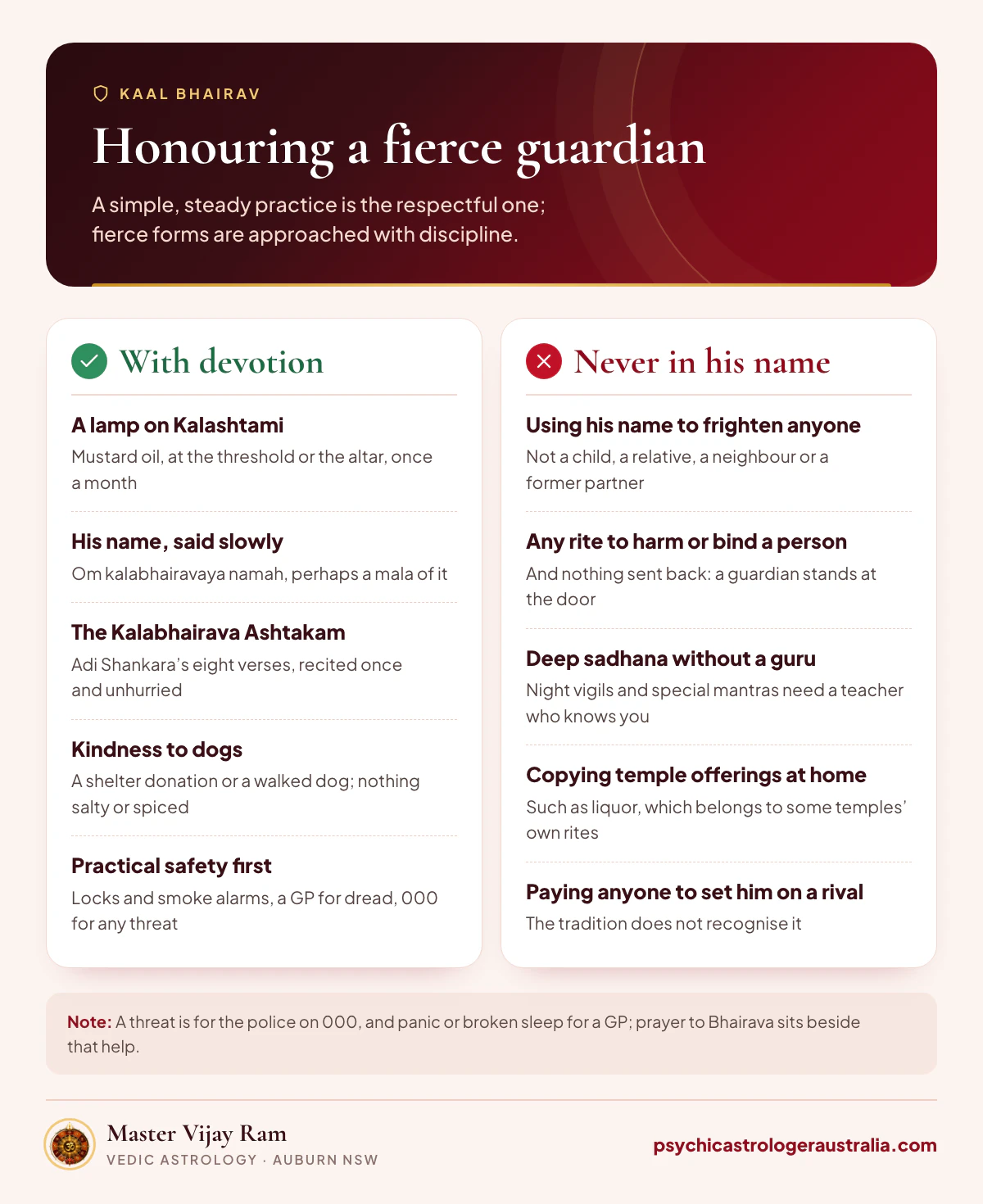
Simply. A picture of Batuk Bhairav or Kaal Bhairav, a mustard-oil lamp on Kalashtami or a weekly day the family chooses, a plain offering of sweets or fruit, and the Kaal Bhairav mantra most households use, the name itself: om kalabhairavaya namah, said slowly, perhaps a mala of it. The Ashtakam can be added, and that is the whole of it.
Fierce forms are approached with discipline, which here means steadiness rather than intensity. Long night vigils, special mantras and the deeper Bhairava sadhana belong with a guru who knows the student; offerings that some temples make by their own rites, such as liquor at Ujjain’s Kal Bhairav temple, are not copied in a family shrine.
What should never be done in his name?
Nobody should use Bhairava to frighten anyone: not a child who misbehaves, not a relative in a property dispute, not a former partner. No rite to harm, bind or punish another person belongs in his worship, and anyone who offers to set Bhairava on a rival for a fee is selling something the tradition does not recognise.
Nothing should be sent back either. He is a guardian, and a guardian stands at the door; he does not go looking for the people outside it. If a practitioner starts with who did this to you, the conversation should end there.
How does Bhairava connect with Shiva, Saturn and the Rudrabhishek?
He is Shiva, in one of his forms, so devotion to him sits naturally beside the gentler Shiva worship of the house. A Rudrabhishek for a troubled house is the quiet, domestic face of that same worship, and many families keep both: the abhishek on Mondays, the lamp for Bhairava on Kalashtami.
Tradition also treats Kaal Bhairav as the teacher of Shani, which is why his worship appears among Saturn remedies. Sade Sati and Shani remedies explains how a reading decides whether a Saturn period calls for anything at all.
Where does Australia meet Bhairava?
More often than people expect. Tamil families know him as Vairavar, a village guardian with his own shrine, often near the north-east corner of a Shiva or Murugan temple, and in many Tamil temples, tradition says, the keys are laid before him when the doors close for the night. Nepali families from the Kathmandu valley know the great Bhairava festivals of the Newar towns, and north Indian Shaiva families keep Kalashtami at home.
In Newcastle, Geelong, Cairns, Townsville and on the Sunshine Coast, where there is no large temple close by, a household lamp on Kalashtami is how most families keep him, and Illawarra families have the Sri Venkateswara Temple at Helensburgh within a drive. Anyone can consult by phone or video, as readings for Newcastle families explains, and in-person consultations take place only at Auburn.
When is a Bhairav puja performed on your behalf?
Rarely, and only where a reading points to it, usually in a heavy Saturn or Rahu period or after a long run of fear that ordinary help has already addressed. In that case the Bhairav puja is done by Vijay Ram ji in person, in Auburn, where he practises, usually on a Kalashtami night; the sankalp carries the names of the people it is for, and relatives who want to see it can join on a video call.
The fee for a puja performed on your behalf starts at $250 and is agreed with the family in advance. The $50 consultation that precedes it more often ends with a lamp, the Ashtakam and a quieter mind.
What can Bhairava worship not do?
It cannot lock a door, stop a burglar, cure insomnia or end a dispute, and nobody can honestly promise that it will. None of this is medical, legal or psychological advice; it is guidance within a faith, so a threat is for the police on 000, panic and broken sleep are for a GP, and conflict is for a mediator or a lawyer.
What it offers instead is a guardian a frightened household can picture, a lamp it can light once a month, and an old hymn that names the real enemies, grief, greed, anger and fear, and asks for them to go. That is a good deal of protection, honestly described.
Read next
- Maa Kali and Protection: What the Fierce Goddess Is Invoked ForMaa Kali and protection: the first Mahavidya, her sword and tongue, Dakshina Kali at home, Kali Puja on the 2027 Amav…
- Spiritual Protection for Children at School and OnlineSpiritual protection for children at school and online: what a parent does first, the gentle practices a family keeps…
- Protecting Children From Black Magic & Negative EnergyA grounded guide for parents worried about black magic or negative energy around a child: what it usually turns out t…
Frequently asked questions
Who is Kaal Bhairav?
Kaal Bhairav is a fierce form of Shiva, shown dark, holding a staff and a skull, with a dog as his vahana. In the Shiva Purana he cut off Brahma’s boasting fifth head and was freed of the skull in Kashi, whose guardian he became. Devotees pray to him for courage and protection of homes, journeys and work.
What is the Kaal Bhairav mantra for protection?
The mantra most households use is his name: om kalabhairavaya namah, said slowly, perhaps a mala of it, beside a mustard-oil lamp on Kalashtami or a weekly day. Many add Adi Shankara’s Kalabhairava Ashtakam. Longer or special Bhairava mantras and night sadhana belong with a guru who knows the student, not with instructions found online.
When is Kalashtami?
Kalashtami is the Ashtami, the eighth lunar day, of every waning fortnight, so it falls once a month, roughly a week after each full moon. Because a tithi depends on location, the exact day differs between cities and from India; a temple panchang or a calendar computed for your own city gives it. Bhairava Ashtami is the waning Ashtami of Margashirsha.
Why is a dog associated with Kaal Bhairav?
The dog is his vahana, the animal he rides, and a fitting one for a guardian: loyal, watchful and impossible to bribe. Devotees in India often feed dogs on his days. In Australia the kinder forms are a shelter donation, walking a neighbour’s dog or caring for your own, and never feeding anything salty or spiced.
Can Kaal Bhairav be worshipped at home?
Yes, simply and steadily: a picture, often of the gentle child form Batuk Bhairav, a mustard-oil lamp on Kalashtami, a plain offering of sweets or fruit, his name mantra and perhaps the Ashtakam. Deeper sadhana, long night vigils and special mantras belong with a guru, and temple offerings such as liquor are not copied at home.
Is Kaal Bhairav prayed to for protection from black magic?
In folk tradition he is the guardian families turn to when they fear black magic, and his worship is purely defensive: he is asked to guard the household, never to strike anyone. A frightening run of events usually has plain causes, illness, debt or conflict among them, and those come first, with prayer beside them.
What does the Kalabhairava Ashtakam say?
It is eight verses by Adi Shankara, each ending kashika puradhinatha kalabhairavam bhaje, I worship Kalabhairava, lord of the city of Kashi. It praises his form, calls him the death of death itself, and its closing verse says reciting it removes grief, delusion, poverty, greed, anger and burning distress.
Is it safe to worship a fierce deity like Bhairava?
Yes, when it is done as devotion. Shaiva households have honoured him for centuries with a lamp, his name and a hymn. What is not safe is using his name to frighten anyone, attempting rites to harm or bind another person, or taking up intense sadhana without a guru. A steady, simple practice is the respectful one.
What does a Bhairav puja performed for us cost?
Only where a reading points to it. The puja is done by Master Vijay Ram in person in Auburn, usually on a Kalashtami, with the names of those it is for in the sankalp, and relatives can join a video call. The fee starts at $250 and is fixed with the family in advance, after a $50 consultation that often finds a home lamp is enough.
People also ask
What is Kaal Bhairav the god of?
He is Shiva as the guardian: the keeper of Kashi, the protector of temples and the remover of fear, linked with time and death through the word kala. Devotees ask him to guard homes, journeys and work, and tradition treats him as the teacher of Shani. He is honoured with a lamp, his name and the Kalabhairava Ashtakam.
On which days is Kaal Bhairav worshipped?
Kalashtami, the waning Ashtami of each month, is his day, and Bhairava Ashtami in Margashirsha is his birthday. Many families also keep a weekly day, Sunday, Tuesday or Saturday depending on their tradition, with Saturday chosen by those thinking of Saturn. A temple panchang or a calendar for your own city gives the tithi dates.
Why is Kaal Bhairav called the kotwal of Kashi?
Because in the Shiva Purana story the skull of Brahma, which had clung to Bhairava’s hand, finally fell away when he reached Kashi, and the city became his to guard. Kotwal means the keeper or police chief of a town, and pilgrims to Varanasi traditionally visit him so that their stay is under his watch.
Can Kaal Bhairav remove fear?
Fear is the thing his name addresses, and many people find his worship steadying, especially the Ashtakam recited slowly at night. Fear that is constant, physical or overwhelming needs a GP, and any real threat needs the police on 000. Prayer to Bhairava sits beside that help as courage, never in place of it.
References & further reading
Serving clients across Australia
Confidential consultations by phone, video & WhatsApp — including: