

Quick answer
Abhijit muhurat is the eighth of the fifteen equal parts of daylight, centred on local solar noon, and is treated as a window that suits almost any beginning. It runs about half a muhurta either side of solar noon, which is rarely clock midday. Many families avoid it on Wednesday, and it never replaces a full muhurat.
What is the Abhijit muhurat?
Abhijit muhurat is the eighth of the fifteen muhurtas into which the tradition divides the daylight, the one that sits across local solar noon, and it is widely treated as a window that suits almost any beginning. The name means victorious, or unconquered, and its reputation is that it can carry an act through even when the rest of the day's panchang is ordinary.
It is the window astrologers reach for when a date is fixed and the usual options are closed. It is not a replacement for a full auspicious date and hour for your event, and the tradition itself names days when it should not be used.
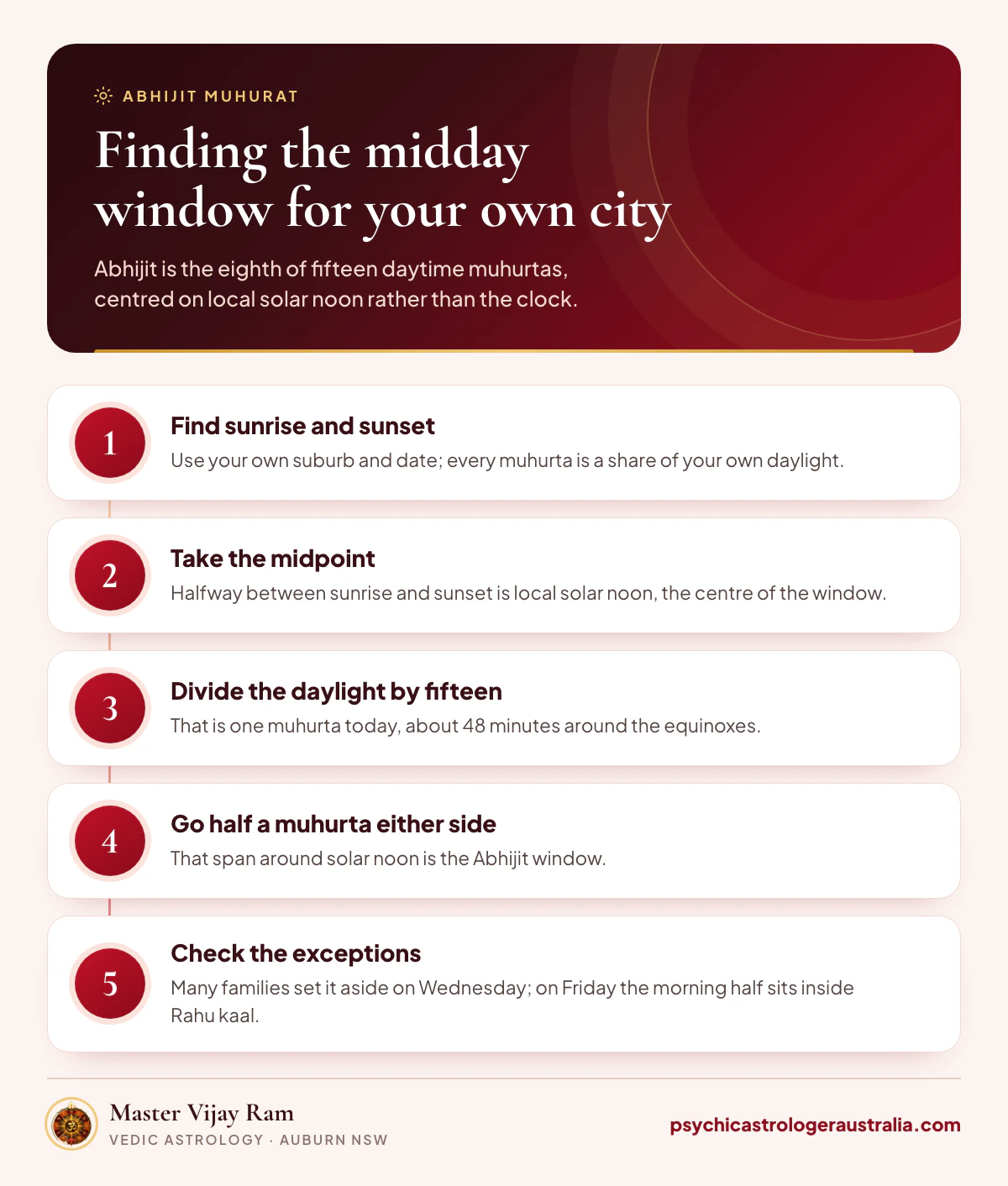
How are the fifteen day muhurtas measured?
The daylight between local sunrise and local sunset is divided into fifteen equal parts, and the night into fifteen more, making thirty muhurtas in a full day. Around the equinoxes each part comes to about 48 minutes, which is the figure most people remember; in a long summer day each part stretches, and in winter it shrinks.
Because there are fifteen parts, the eighth is the one in the middle, with seven before it and seven after. Its centre is therefore the midpoint between sunrise and sunset, which is solar noon, and the window runs roughly half a muhurta either side of it, about 24 minutes each way at the equinox.
| Step | What you do | Why |
|---|---|---|
| 1 | Find local sunrise and sunset for your suburb and date | Every muhurta is a share of your own daylight |
| 2 | Take the midpoint between them | That is local solar noon, the centre of the window |
| 3 | Divide the daylight by fifteen | That is the length of one muhurta today |
| 4 | Go half a muhurta before and after solar noon | That span is the Abhijit window |
| 5 | Check the weekday and the rest of the panchang | Wednesday and some acts are exceptions |
Why is solar noon not the same as midday on the clock?
Clock time is shared across a whole time zone, but the Sun reaches its highest point at a slightly different moment in every town. A place west of its zone's reference line sees the Sun peak later than one on the line, and the gap can be large: Darwin sits well west of the line for Central Australian time, so its solar noon comes noticeably later than the clock's midday.
Two smaller effects add to this. The Earth's tilted, elliptical orbit pushes solar noon a little earlier or later through the year, and daylight saving in the south-eastern states moves every clock reading an hour later from October to April. A Melbourne summer Abhijit, for that reason, falls well after the lunch break.
So Abhijit muhurat today in Cairns, Townsville and the Central Coast are three different windows, even where two of those places share a clock. An app set to your own suburb, or Geoscience Australia's sunrise and sunset figures, gives the honest answer.
Why is Abhijit treated as so powerful?
Several stories attach to it. In one widely told tradition, Rama was born in the Abhijit muhurat at midday, which is why his birth is celebrated in the midday window on Ram Navami; the Ram Navami midday timing explains how that is placed in Australian cities. Other traditions connect the window with Vishnu's discus, the Sudarshana, cutting away the faults of the hour.
Behind the stories sits a simpler observation. At solar noon the Sun is at its strongest and highest, with the day's work fully under way, and a culture that reads the Sun as the soul of the chart naturally sees that moment as favourable.
On which days and for which acts is it not used?
Traditions differ, but three exceptions come up repeatedly. Many families avoid Abhijit on Wednesday, so Abhijit muhurat Wednesday is the one combination the tradition most often sets aside, and a Wednesday beginning is placed in another window. Some astrologers also decline it for setting out on a journey towards the south.
The third exception is about scale. For a wedding or a griha pravesh, many lineages want a properly chosen lagna and a good tithi and nakshatra rather than a midday window used as a shortcut; Abhijit may support that choice but rarely replaces it. And no midday window turns a closed season, such as Kharmas for weddings, into an open one.
When is Abhijit genuinely useful?
When the day is fixed and the clock is the only thing still free. A settlement booked for a Thursday, a shop launch set by the landlord's handover, a naming held on the only Sunday the grandparents are in the country: in each case Abhijit offers a window in the middle of the day, which is also when most offices and venues are open.
- Signing a document at home in the midday window, even if the agent's office processes it later.
- Lighting the first lamp in a new shop, or making its first sale, around solar noon.
- Beginning a short puja or a mantra sankalpa, where the hour is flexible and the day is not.
- Sending an application, booking a ticket or paying a deposit when no other window suits.
It also helps on days whose other quick tools disagree. The choghadiya periods of the day and the Rahu kaal and the periods families avoid may leave very little room, and Abhijit sometimes fills the gap.
What if Rahu kaal overlaps the Abhijit window?
On two weekdays it always does, and the arithmetic shows why. Rahu kaal takes the fourth eighth of the daylight on Friday, which ends exactly at solar noon, and the fifth on Wednesday, which begins there; the Abhijit window straddles that same midpoint. So on Fridays the morning half of Abhijit lies inside Rahu kaal, and on Wednesdays the afternoon half does, which may be part of why Wednesday is the day so many families set aside.
On a Friday, most astrologers use the afternoon half of the Abhijit window, outside the Rahu kaal, or choose another time altogether. Nothing is gained by forcing a beginning into a window that one rule welcomes and another warns against.
What is the Abhijit nakshatra?
The same name belongs to a star. Older lists of the lunar mansions add a twenty-eighth, Abhijit, identified with the bright star Vega, squeezed between Uttara Ashadha and Shravana; it covers the last part of Uttara Ashadha and the opening part of Shravana. Most modern charts use twenty-seven nakshatras and fold Abhijit back into its neighbours, but some muhurta tools and chakras still count it.
The nakshatra and the midday window share a name and a sense of victory, but they are different things: one is a stretch of the zodiac, the other a stretch of the day. Readers curious about how a nakshatra itself becomes a muhurat can see Pushya nakshatra and Pushya muhurat, the best-known example.
How can you check an app's Abhijit time?
Apps are convenient and usually right, but a quick check takes two minutes and catches the common mistakes. Note the app's sunrise and sunset for today, add them together and halve the result: the Abhijit window should be centred on that moment. Then subtract sunrise from sunset, divide by fifteen, and the window should be about that long.
If the centre is out by an hour, the app is ignoring daylight saving or is set to a city in another state. If it is out by many hours, it is still on an Indian location. If it sits exactly on the clock's midday every day of the year, it is not computing solar noon at all, and a better app is worth finding.
How do families in the north use it?
In Darwin, Cairns and Townsville the daylight changes less through the year than in the south, so the Abhijit window sits at a steadier place on the clock and families get used to it. A Darwin household that keeps the midday window for a small puja soon learns that it falls later than the clock suggests, and plans lunch around it.
Further south, the Central Coast and Sydney swing with daylight saving, and Melbourne's window moves further still. Readers in the Territory can see how readings work for Darwin, where the half-hour time zone adds its own small twist.
Does Abhijit work for everyone?
It is a general window, not a personal one. A person's own chart can make a particular weekday or rising sign unhelpful for them, and a muhurat for a major act checks that through tara bala and chandra bala, which a midday window ignores. For that layer, a reading of your own kundli comes first.
Master Vijay Ram chooses muhurats in a $50 consultation, in English, Hindi or Punjabi, and will say plainly when Abhijit is the best a fixed day allows. Where a puja is wanted at the chosen moment, he performs it personally at his place of practice in Auburn; a puja timed to the muhurat starts from $250, agreed before it is performed.
What can a midday window not do?
It cannot rescue a poor decision. A rushed car purchase, an unread contract or an operation postponed for a better hour are not improved by solar noon, and the tradition never claimed they would be. Abhijit is a courtesy of timing added to choices made carefully in the ordinary way, and like all of this it is faith-based guidance, not legal, medical or financial advice.
Read next
- Muhurat Explained: How an Auspicious Date and Hour Are ChosenHow a muhurat is chosen: tithi, nakshatra, yoga, karana, weekday, lagna and Rahu kaal, the periods avoided in 2027, a…
- Choghadiya: The Daily Auspicious Windows, ExplainedChoghadiya explained: the seven names, which are good, the daytime order for each weekday, how apps compute it from l…
- How Long Does Black Magic Removal Take to Show Results?Black magic removal rarely runs to a fixed date. Here is the honest arc, what tends to shift first, what stretches it…
Frequently asked questions
What time is Abhijit muhurat today?
It depends on where you are. Find your local sunrise and sunset, take the midpoint, which is solar noon, and go half a muhurta, one thirtieth of the daylight, either side of it. An app set to your suburb does this for you; a time copied from an Indian or interstate website will be wrong for your location.
Why is Abhijit muhurat avoided on Wednesday?
Many traditions simply list Wednesday as the exception, and astrologers following them place a Wednesday beginning in another window instead. Explanations vary from text to text, and not every lineage observes the rule. If your family or priest follows it, choose a different period on Wednesday, or a different day.
Is Abhijit muhurat good for a wedding?
It can support a wedding muhurat but rarely replaces one. Many lineages want a carefully chosen lagna, tithi and nakshatra for the central rite, and use Abhijit only when a fixed day leaves no better option. No midday window opens a closed season such as Kharmas, when weddings traditionally pause.
How long is Abhijit muhurat?
One muhurta, which is one fifteenth of the daylight. Around the equinoxes that is about 48 minutes, roughly 24 minutes either side of solar noon. In a southern summer, with longer days, it is longer; in winter it is shorter. In tropical Darwin it changes little through the year.
Can I buy a car or sign a contract in Abhijit?
Many families do, especially when the day is fixed by a dealer or an agent. Make the practical checks first, the inspection, the insurance and the lawyer’s reading of the contract, then place the act you control, such as your signature, in the window if you wish. The tradition adds timing; it does not replace due care.
What is the Abhijit nakshatra?
Older lists of the lunar mansions include a twenty-eighth nakshatra called Abhijit, identified with the star Vega, between Uttara Ashadha and Shravana. Most modern charts use twenty-seven nakshatras and fold it into its neighbours, though some muhurta tools still count it. It shares a name with the midday window but is a stretch of the zodiac, not of the day.
What if Rahu kaal and Abhijit overlap?
On Fridays and Wednesdays they always do: Rahu kaal ends at solar noon on Friday and begins there on Wednesday, so it covers half the Abhijit window. Most astrologers then use the half outside the Rahu kaal, or choose another time. Forcing a beginning into a period that one rule favours and another avoids gains nothing.
Do I need an astrologer for Abhijit muhurat?
Not to find it; an app or a short calculation from your own sunrise and sunset is enough. A consultation helps when a major act needs a full muhurat that checks the tithi, nakshatra, lagna and your chart. Master Vijay Ram does that for $50, in English, Hindi or Punjabi.
People also ask
Is Abhijit muhurat always auspicious?
It is widely treated as favourable for most beginnings, but traditions name exceptions: many avoid it on Wednesday, some decline it for journeys towards the south, and it does not open a closed season such as Kharmas. For major events it supports a full muhurat rather than replacing one.
How is Abhijit muhurat calculated?
Divide the daylight between local sunrise and sunset into fifteen equal parts. The eighth part, centred on solar noon, is Abhijit. In practice, find solar noon as the midpoint of sunrise and sunset, then go half of one part either side of it.
Why was Rama born in Abhijit muhurat?
A widely told tradition places Rama’s birth at midday in the Abhijit muhurat, and Ram Navami worship is centred on the midday window for that reason. The story is part of why the window is regarded as victorious and favourable for beginnings.
What is the midday muhurat called?
The midday muhurat is called Abhijit, the eighth of the fifteen daytime muhurtas. Its centre is local solar noon, which is rarely the same as clock midday, so its exact time changes with your city, the season and daylight saving.
References & further reading
Serving clients across Australia
Confidential consultations by phone, video & WhatsApp — including: