
Quick answer
Choghadiya divides daylight and night into eight periods each, named Amrit, Shubh, Labh, Chal, Udveg, Kaal or Rog. Amrit, Shubh and Labh are good for beginnings, Chal suits travel, and Udveg, Kaal and Rog are avoided. Each day starts with its weekday planet’s name, and all timings come from your own local sunrise and sunset.
What is a choghadiya?
Choghadiya is a Gujarati and Rajasthani system that splits the day and the night into eight periods each and gives every period a name that says whether it suits a new undertaking. The word means four ghadis, and a ghadi is a traditional unit of twenty-four minutes, so a choghadiya is roughly an hour and a half; in practice it is one eighth of the actual daylight or night, longer in summer and shorter in winter.
It is the quick tool families reach for when there is no time for a full muhurat: which part of this afternoon is good to pay the deposit, collect the keys or leave for the airport? For anything larger, a muhurat worked out for your event weighs far more than the choghadiya.
What are the seven names, and which are good?
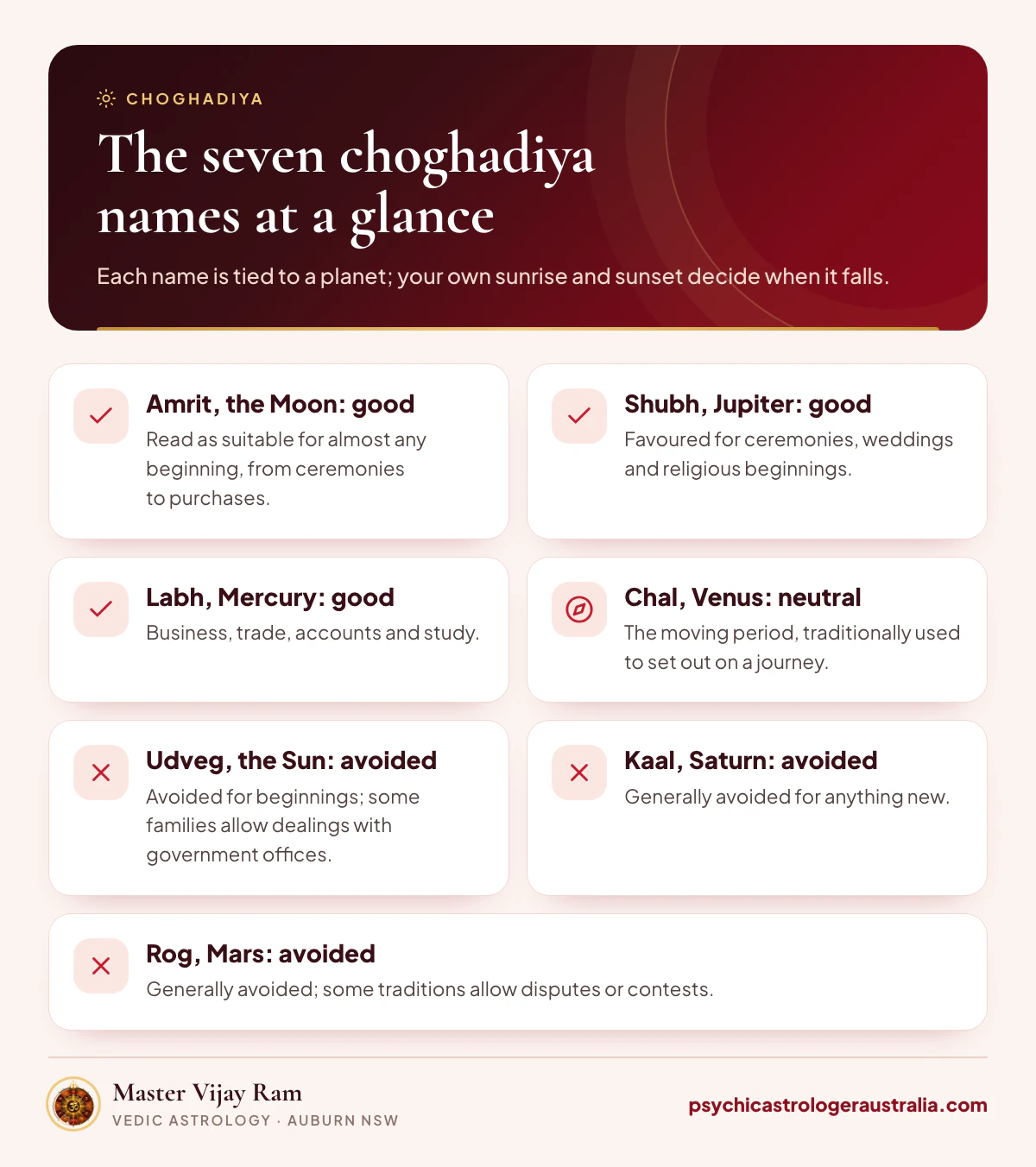
Seven names rotate through the sixteen periods, each traditionally tied to a planet. Three are welcomed, one is neutral and three are avoided for beginnings, though families do not all read the neutral and avoided ones the same way.
| Name | Planet linked with it | Reading | Commonly used for |
|---|---|---|---|
| Amrit | Moon | Good | Almost anything: ceremonies, purchases, the start of study |
| Shubh | Jupiter | Good | Ceremonies, weddings, religious beginnings |
| Labh | Mercury | Good | Business, trade, accounts, education |
| Chal | Venus | Neutral | Travel and anything that involves moving |
| Udveg | Sun | Avoided | Some families allow dealings with government offices |
| Kaal | Saturn | Avoided | Generally avoided for beginnings |
| Rog | Mars | Avoided | Generally avoided; some traditions allow disputes or contests |
So an Amrit choghadiya is the period people hope for, and Shubh or Labh is nearly as welcome. Chal, the moving one, is the classic window for setting out on a trip.
In what order do they come each day?
Each daytime sequence starts with the name belonging to the weekday's own planet, then follows a fixed order: Udveg, Chal, Labh, Amrit, Kaal, Shubh, Rog, and round again, so the eighth period repeats the first. That order is the old hora order of the planets, Sun, Venus, Mercury, Moon, Saturn, Jupiter, Mars, which is why the system holds together so neatly.
| Weekday | The day's eight periods in order |
|---|---|
| Sunday | Udveg, Chal, Labh, Amrit, Kaal, Shubh, Rog, Udveg |
| Monday | Amrit, Kaal, Shubh, Rog, Udveg, Chal, Labh, Amrit |
| Tuesday | Rog, Udveg, Chal, Labh, Amrit, Kaal, Shubh, Rog |
| Wednesday | Labh, Amrit, Kaal, Shubh, Rog, Udveg, Chal, Labh |
| Thursday | Shubh, Rog, Udveg, Chal, Labh, Amrit, Kaal, Shubh |
| Friday | Chal, Labh, Amrit, Kaal, Shubh, Rog, Udveg, Chal |
| Saturday | Kaal, Shubh, Rog, Udveg, Chal, Labh, Amrit, Kaal |
The night has eight periods of its own, from sunset to the next sunrise, starting from a different name and running in a different order. Most apps list both, and the night list matters mainly for late ceremonies such as a Diwali chopda pujan.
How do the apps compute it?
Every choghadiya app does the same three things. It finds your location, either from the phone or from the city you choose; it computes sunrise and sunset for that place and date; and it divides each half of the day into eight. The names come from the weekday tables, so the only real variable is the sunrise and sunset.
That is also where apps disagree by a minute or two. Some take sunrise when the top edge of the Sun clears the horizon, some when its centre does, and some allow for the bending of light by the atmosphere while others do not. None of that matters for choosing an afternoon to sign a lease; it only looks alarming when two relatives compare screenshots.
The error that does matter is the wrong place. An app left on a default of Ahmedabad, or set to Sydney when you live in Hobart or on the Sunshine Coast, will give you someone else's day, and an app that ignores daylight saving will be an hour out for half the year in Canberra and Wollongong.
Why does local sunrise change everything?
The day in this system begins at sunrise, not at midnight, and both its length and its position on the clock come from the Sun at your own address. A Newcastle morning and a Geelong morning are minutes apart even on the same clock, and the Sunshine Coast never moves its clock at all.
The consequence is plain. A list of today's choghadiya on a Mumbai website is not today's list for you, and neither is a relative's list from another Australian city. The table above tells you the names; only your own sunrise and sunset tell you when they fall.
What happens when choghadiya and Rahu kaal disagree?
They sometimes do, because they were built by different regional traditions. On a Tuesday the seventh daytime period is a Shubh choghadiya and also the Rahu kaal; on a Thursday the sixth is an Amrit choghadiya and also the Rahu kaal. A family that uses both will see a good name sitting on top of an avoided window.
For a small task most astrologers let either system settle it and move on. For a beginning that matters, they usually let the Rahu kaal win and pick another good period the same day; Rahu kaal, Yamaganda and Gulika explains how those periods are found.
What is choghadiya good for, and where does it fall short?
It is excellent for small, repeatable decisions. Which part of the day to send the signed contract, collect a new car, open the shop shutters for the first time or leave for a pilgrimage: a good choghadiya is a reasonable, quick answer, and Gujarati and Marwari business families have used it for exactly that for generations.
It falls short for anything large. A choghadiya knows nothing about the tithi, the nakshatra, the rising sign or your own chart, so a Labh period on a poor day is still a poor day. Weddings, house entries and business launches need the full method set out in timing a shop or company launch, of which the choghadiya is only the last, smallest step.
How do families use it in practice?
- A shop owner in Wollongong opens the till for the first time each financial year in a Labh choghadiya.
- A Canberra family leaving for India sets the suitcases outside the door in a Chal period, even if the taxi comes later.
- A Hobart student submits a scholarship application in an Amrit period because it calms her, which is reason enough.
- A Geelong couple sign their lease in a Shubh period on a day their astrologer already approved.
None of these people are anxious about it. Used well, the choghadiya is a small habit of attention, not a source of fear, and nobody's opportunity has ever been lost by missing one.
How does a choghadiya fit around a fixed appointment?
Most real days come with fixed points: the dealer can hand over the car only on Saturday morning, the agent wants the lease back by Friday, the flight leaves when the airline says. The choghadiya does not move those. What it can do is mark the small act inside your own control, such as the moment you sign at home, the first time you turn the key or the moment you lock your front door behind you.
That split, the outside appointment kept and the private act placed in a good period, is how most families actually use the system. It loses no convenience, offends no employer or agent, and lets someone who cares about the tradition keep it without inconveniencing anyone else. If the good period falls after the appointment, many people simply say a short prayer before they leave instead.
Is choghadiya used for Diwali and other festivals?
Yes, especially in Gujarati homes, where the Diwali chopda pujan, the worship of the new account books, is placed in a good choghadiya on Lakshmi Puja night. Dhanteras purchases and the opening of new ledgers follow the same idea. The festival date itself comes from the tithi; the choghadiya only places the act within the evening or night.
Business families may also ask how their own year is shaping up; career and business readings cover that, and they rely on the chart rather than any daily period.
Do you need an astrologer for choghadiya?
No. A good app set to your suburb, checked against the weekday table above, is enough for daily use. An astrologer earns his fee when the decision is bigger than the day: when the tithi, the nakshatra, the lagna and the people involved all have to be weighed, and when the honest answer might be a different week altogether.
Master Vijay Ram chooses those muhurats in a $50 consultation, in English, Hindi or Punjabi, and returns windows in your own city's clock. If a puja is wanted at the chosen time, he performs it personally at his place of practice in Auburn; a puja performed at the muhurat starts from $250, agreed before it is performed. Families in the Hunter can read how readings work for Newcastle, and the Abhijit muhurat around midday is the other quick window worth knowing.
What can a good choghadiya not do?
It cannot make a weak contract sound, a risky car safe or an unready business profitable. It is a timing courtesy layered on top of good decisions made the ordinary way, with the lawyer, the mechanic or the accountant, and it is faith-based guidance rather than advice of any professional kind.
Read next
- Abhijit Muhurat: The Midday WindowAbhijit muhurat explained: the eighth of fifteen day muhurtas around local solar noon, how to work it out, why Wednes…
- Vivah Muhurat 2027: Wedding Season for Australian FamiliesVivah muhurat 2027 for Australian families: the two wedding seasons, the closed periods, nakshatras and tithis, the p…
- How to Protect Yourself from Black Magic: Daily RemediesPractical daily protection from black magic: the three-doorway habit, what is safe to do at home, what needs guidance…
Frequently asked questions
Which choghadiya is best?
Amrit is read as the best, suitable for almost any beginning. Shubh is favoured for ceremonies and religious acts, and Labh for business, trade and study. Chal is neutral and traditionally good for travel. Udveg, Kaal and Rog are avoided for new undertakings, though some families allow Udveg for dealings with government offices.
How long is one choghadiya?
One eighth of the daylight for a daytime period, or one eighth of the night for a night period. Around the equinoxes that is close to an hour and a half; in a southern summer the daytime periods are longer and the night ones shorter, and in winter the reverse. Your local sunrise and sunset decide the exact length.
Why does my choghadiya app differ from my relative’s?
Usually because the apps are set to different places, or one ignores daylight saving. Small differences of a minute or two come from how sunrise is defined, whether by the top edge or the centre of the Sun and whether atmospheric refraction is allowed for. Set the app to your own suburb and the larger differences disappear.
Can I use an Indian choghadiya list in Australia?
No. The list is built from sunrise and sunset in the city it was made for, and Indian lists use Indian Standard Time as well. Even another Australian city’s list will be off. The names follow the weekday everywhere, but when they fall depends on your own location and clock.
Is Chal choghadiya good or bad?
It is treated as neutral. Chal means moving, so it is traditionally the period for starting a journey, and many families are comfortable using it for ordinary tasks. It is not usually chosen for a ceremony or a major purchase when an Amrit, Shubh or Labh period is available on the same day.
What if the only free time is in Rog or Kaal?
Then do what has to be done, with a short prayer first if that helps you. A choghadiya is a convenience for flexible tasks, not a rule that overrides work, medical care or appointments set by others. For a major event, a consultation looks for a better window on another day rather than forcing the act into a poor one.
Do South Indian families use choghadiya?
Less often. Choghadiya is strongest in Gujarati, Rajasthani and Marwari families and in north and west India generally. South Indian families more often use the Rahu kaal, Yamaganda and Gulika periods with the gowri panchangam. Both sets of tools serve the same purpose of placing a beginning inside the day.
Does Master Vijay Ram use choghadiya when choosing a muhurat?
As a final check, after the tithi, nakshatra, weekday, rising sign and the people’s charts have been weighed. A muhurat consultation costs $50 and returns windows in your own city’s clock. For everyday decisions he suggests an app set to your suburb rather than paying for advice you can find yourself.
People also ask
What is choghadiya today?
Today’s choghadiya depends on your weekday and your own sunrise and sunset. Each day starts with the weekday planet’s name and runs through Udveg, Chal, Labh, Amrit, Kaal, Shubh and Rog in turn. An app set to your suburb gives the clock times, and the weekday table on this page lets you check its names.
Is Labh choghadiya good for buying?
Yes. Labh, linked with Mercury, is traditionally favoured for trade, purchases, accounts and study, so many families choose it for paying a deposit or opening a new account. For a large purchase such as a car or a house, the day’s tithi, nakshatra and Rahu kaal are checked as well.
Which choghadiya is good for travel?
Chal, the moving period, is the classic choice for starting a journey, and Amrit, Shubh and Labh are also acceptable. Families often mark the start by stepping out of the house or setting the bags outside in a good period, even if the flight leaves later.
What is the difference between Amrit and Shubh choghadiya?
Both are good. Amrit, linked with the Moon, is read as suitable for almost anything. Shubh, linked with Jupiter, is especially favoured for ceremonies, weddings and religious beginnings. Where both fall on the same day, families often choose by the nature of the task.
References & further reading
Serving clients across Australia
Confidential consultations by phone, video & WhatsApp — including: