
Quick answer
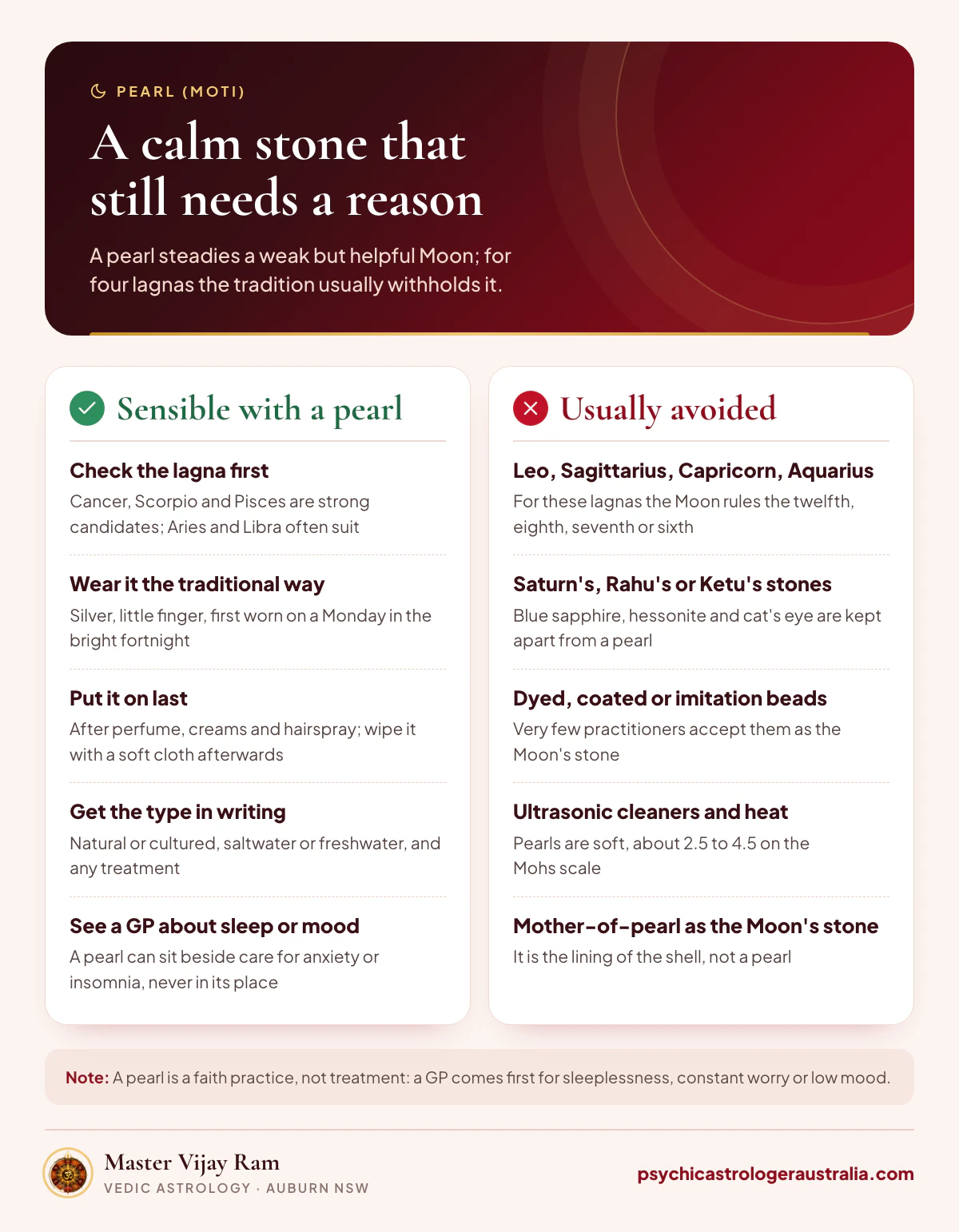
Pearl (moti) is the Moon's stone in Vedic astrology, worn in the tradition to steady a weak but helpful Moon. It is usually suggested for Cancer, Scorpio and Pisces lagnas, often weighed for Aries and Libra, and avoided for Leo, Sagittarius, Capricorn and Aquarius. It is a faith practice, not a treatment for anxiety or poor sleep.
What is a pearl in Vedic astrology?
A pearl, moti in Hindi and mukta in Sanskrit, is the gem that Jyotisha, Vedic astrology, assigns to the Moon, the planet of the mind, the mother, sleep, moods and the feeling of being at home. In pearl astrology it is the gentlest of the nine gems, worn to steady a Moon that is weak but helpful, and that gentleness is exactly why it gets handed out so freely. A calm stone can still be the wrong stone, and this page is about telling the two apart.
It covers why the Moon is matched with a pearl, how pearls actually form, which lagnas usually receive a pearl and which are steered away from it, how a weak Moon is judged, wearing and care, substitutes and the questions to ask a seller. Gemstone advice read from your own chart is where the general picture becomes a decision.
Why does the tradition pair the Moon with a pearl?
The Moon is white, cool and watery in the texts, and the pearl is the one gem that comes out of the water already finished, needing no cutting to show its glow. Indian poetry adds a legend: a raindrop that falls into an open shell while the Moon passes through Swati nakshatra becomes a pearl. The Moon's day is Monday, sacred to Shiva, who wears the crescent in his hair, and its metal is silver.
The moti stone benefits people ask about all come from the Moon's portfolio: a settled mind, deeper sleep, a softer temper, warmth with the mother and family, and ease with the public. Those are hopes the tradition attaches to a strong Moon, not effects anyone can promise, and a pearl worn for the wrong Moon is said to bring the opposite: moods, dependence and restlessness.
How does a pearl form, and does natural matter?
A pearl is an organic gem: a mollusc coats an irritant with layer upon layer of nacre, made of the mineral aragonite and an organic binder called conchiolin. A natural pearl forms with no human help and is now rare and costly; a cultured pearl forms the same way after a farmer inserts a bead or a sliver of tissue. Almost every pearl sold today is cultured, from saltwater oysters such as the Akoya, Tahitian and South Sea types, or from freshwater mussels.
Western Australia has pearls of its own, since the large South Sea pearl oyster is farmed off the north-west coast around Broome. Traditions differ on what counts for the Moon: the older texts assume a natural sea pearl and many families still look for one, while many practitioners today accept a cultured saltwater pearl with good lustre. Very few accept a dyed, coated or imitation bead.
Which rising signs suit a pearl?
The Moon rules a single sign, Cancer, so the house Cancer occupies from your lagna is the part of life a pearl would strengthen. Deciding who should wear moti starts from that count, not from your Moon sign, and the table runs it for every rising sign.
| Rising sign | The Moon rules | A pearl, usually |
|---|---|---|
| Aries | The fourth: mother, home, peace of mind | Often suitable when the Moon is weak |
| Taurus | The third: effort, short journeys, younger siblings | Rarely needed |
| Gemini | The second: family wealth, food and speech; a maraka house | Weighed case by case |
| Cancer | The lagna itself | A strong candidate |
| Leo | The twelfth: loss, expense, sleep, life abroad | Usually withheld |
| Virgo | The eleventh: gains, friends, networks | Weighed case by case |
| Libra | The tenth: career and standing | Often suitable when the Moon is weak |
| Scorpio | The ninth: fortune, father, faith | A strong candidate |
| Sagittarius | The eighth: sudden change, hidden matters | Usually withheld |
| Capricorn | The seventh: spouse and partnerships; a maraka house | Usually withheld |
| Aquarius | The sixth: debts, disputes, illness | Usually withheld |
| Pisces | The fifth: children, study, past merit | A strong candidate |
A strong candidate still needs a reason. A bright, well-placed Moon for a Cancer lagna wants nothing added, and a Libra-lagna Moon ruling the tenth may suit a pearl in one chart and not in another, depending on where it sits and what aspects it; the birth-chart method for gemstones shows how lordship, strength and the dasha are weighed together.
When is a pearl the wrong choice?
With a Leo lagna the Moon governs the twelfth, the house of spending, sleep and losses; with Sagittarius, the eighth of upheaval; with Aquarius, the sixth of quarrels, loans and illness; and with Capricorn, the seventh, one of the two maraka houses. In those four charts a pearl strengthens the house the Moon is responsible for, which is why the tradition usually withholds it however soothing it sounds. Taurus lagnas, for whom the Moon rules only the third, rarely need it.
The planet's company matters as much as its lordship. A Moon sharing a sign with Rahu or Ketu, or under Saturn's pressure, needs a complete reading before any ring is made, and the usual lists keep a pearl away from blue sapphire, hessonite and cat's eye, with many adding diamond and emerald; the stones the tradition will not combine explains the reasoning.
How does the tradition judge a weak Moon?
The Moon is the one planet whose strength changes visibly through the month. A Moon close to full is bright and counted as a benefic, while the classical texts treat a thin, waning Moon near the new moon as weak or even malefic. The Moon is also debilitated in Scorpio and exalted in Taurus, so the sign matters as well as the phase.
A reading also looks at the Moon's neighbours. Kemadruma yoga, where no planet other than the Sun, Rahu and Ketu sits in the second or twelfth from the Moon, is the classical picture of a lonely Moon, and it is cancelled far more often than its reputation suggests; a Moon placed in a dusthana, the sixth, eighth or twelfth, or caught on the eclipse axis with Rahu or Ketu, is read as strained. The Moon in each of the twelve houses describes how placement colours the emotional nature.
Can a pearl calm an anxious mind?
This is the question behind most pearl enquiries, and it deserves a plain answer. The tradition holds that a pearl supports a weak Moon and that a supported Moon goes with a steadier mind, but that is a faith practice, not a treatment for anxiety, depression or insomnia. If you are not sleeping, if worry has become constant, or if low mood is colouring every day, a GP is the first call, and Beyond Blue and Lifeline are there when it cannot wait.
A pearl, a Monday practice or a mantra can sit beside that care for people who find meaning in them. None of them sits in its place, and a practitioner who says otherwise is not looking after you; health and wellbeing readings are offered on exactly that footing.
What does a pearl that does not suit you feel like?
The pearl side effects people report are the Moon's qualities turned up too far: moods that swing, tearfulness, a clinging attachment to people or the past, heavy sleepiness, indecision, and a sense of being emotionally porous. The tradition reads those as a sign that the Moon was not the planet to strengthen, or that a Moon ruling a difficult house was fed. Remove the pearl, keep a note of when it went on and came off, and ask for the chart to be checked; if the low mood stays once the pearl is gone, it was not the pearl, and a doctor should hear about it.
Which finger, which day, and how do you look after a pearl?
The common practice sets the pearl in silver, on the little finger, and the first day of wearing is a Monday, usually in the bright half of the lunar month, after the Moon's beej mantra, Om Shraam Shreem Shraum Sah Chandraya Namah. Lineages disagree about which hand, whether morning or evening is better and how the stone is prepared, and a family's own version is fine. A ring with an open back lets the pearl touch the skin, as most lineages ask.
Pearls are soft, about 2.5 to 4.5 on the Mohs scale, and their nacre is damaged by perfume, hairspray, cleaning products, acids and sweat left to dry. Put the ring on after creams and scent, wipe it with a soft cloth after wearing, store it away from harder gems that would scratch it, and keep it out of ultrasonic cleaners. A pearl that has lost its lustre through neglect is no longer quite the stone that was chosen.
Is moonstone a fair substitute?
The tradition's uparatna for the Moon is moonstone, a feldspar with a soft blue-white sheen that seems to float under the surface, called adularescence. It is cheaper than a fine pearl, harder-wearing and easy to trial, so it is often where a reading starts when the Moon wants only modest help. Mother-of-pearl, the lining of the shell, is not a pearl, and most practitioners do not accept it as the Moon's stone.
A substitute softens the dose; it does not change the direction. For a Leo, Sagittarius, Capricorn or Aquarius lagna, moonstone carries the same caution as pearl, and the better remedy for an unsettled Moon in those charts is a Monday practice rather than any stone.
Is your pearl natural, cultured, dyed or fake?
Pearls are often bleached to even the colour, dyed, or irradiated to darken them, and some are coated to improve lustre, while imitations are glass, shell or plastic beads with a pearly coating. Rubbing a pearl gently along the edge of a tooth is a rough old test, gritty for a real pearl and smooth for most imitations, but only a laboratory can separate natural from cultured, usually by X-ray. Ask whether the pearl is natural or cultured, saltwater or freshwater, and whether it has been treated, and have the answers written on the invoice.
Whether to buy, and from whom, is a gemmologist's question, and under the Australian Consumer Law a moti ratna has to be what the seller said it was. Master Vijay Ram has no pearls to sell, or stones of any kind, so his part ends with whether the Moon in your chart should be strengthened at all.
Does the Moon's ten-year dasha change the answer?
The Moon's mahadasha runs ten years and opens with the Moon–Moon sub-period of ten months. Inside it, the Moon–Rahu sub-period of a year and six months and the Moon–Saturn sub-period of a year and seven months are the stretches most often read as heavy, and they are when people are tempted to add Rahu's or Saturn's stone beside the pearl, a pairing the tradition refuses; the answer in those months is usually a practice, not a purchase. People born with the Moon in Rohini, Hasta or Shravana begin life in this period, since the first dasha belongs to the lord of the birth nakshatra.
How those ten years are traditionally read, sub-period by sub-period, is the subject of the ten years of the Moon mahadasha.
What happens when you ask him about a pearl?
Master Vijay Ram starts with three things: when and where you were born, to the minute if you can, who suggested a pearl and why, and whatever rings or pendants you already wear. He reads which house the Moon rules for your lagna, how bright and how well placed it is, and which period is running, then says whether a pearl, a moonstone or no stone fits, and which Monday practices would serve either way. A consultation costs $50 and can happen over the phone, on video or on WhatsApp, in Hindi, Punjabi or English, or face to face at Auburn if you book ahead.
As an illustration, a young mother in Perth whose husband works fly-in, fly-out might ask whether a pearl would help her sleep through the weeks he is away. If her lagna is Sagittarius the Moon rules her eighth and the answer is no, while a Pisces lagna would make the question worth weighing; either way her GP hears about the sleep first, and astrology readings for Perth are arranged in Western Australian time. Where a Chandra shanti suits the chart better than a stone, the puja and havan he performs takes place personally in Auburn, starting from $250, with the figure agreed before anything is done.
Read next
- Hessonite (Gomed): Rahu’s Stone and When It Is SuggestedHessonite (gomed) in Vedic astrology: Rahu’s stone, how it is judged without a sign, when it is suggested or avoided,…
- Ruby (Manik) in Vedic Astrology: The Sun’s Stone and Who Should Avoid ItRuby (manik) in Vedic astrology: why it is the Sun’s stone, the lagnas it suits, who should avoid it, how it is worn,…
- Love Spell Backfire: What Goes Wrong and How to Repair ItA love spell backfire rarely looks dramatic. Learn the three ways it goes wrong, when it tends to surface, and how ho…
Frequently asked questions
Who should wear a pearl (moti)?
In the tradition, people whose lagna makes the Moon a helpful planet and whose Moon is weak: Cancer, Scorpio and Pisces lagnas first, where the Moon rules the lagna, the ninth or the fifth, then Aries and Libra, where it rules the fourth or the tenth. A bright, well-placed Moon needs nothing added. The decision comes from the birth time and the whole chart, not from the Moon sign.
Which lagnas should not wear a pearl?
Leo, Sagittarius, Capricorn and Aquarius lagnas usually go without one, because the Moon rules their twelfth, eighth, seventh and sixth houses, and strengthening it strengthens those houses. Taurus lagnas, where the Moon rules only the third, rarely need it. A Moon joined by Rahu or Ketu or pressed by Saturn is read in full before any stone is considered, whatever the lagna.
Can I wear a pearl for anxiety or poor sleep?
You can wear one as a faith practice if your chart supports it, but it is not a treatment. Constant worry, low mood or nights without sleep belong with a GP first, and Beyond Blue and Lifeline take calls when it cannot wait. Many people find a Monday practice or the Moon's mantra steadying beside proper care; nobody should rely on a stone in place of it.
Is a cultured pearl acceptable as moti?
Traditions differ. The older texts assume a natural sea pearl, and some families still insist on one, while many practitioners today accept a cultured saltwater pearl with good lustre and no dye or coating. Freshwater cultured pearls are accepted by fewer, and imitation beads by almost no one. Ask the seller to put the pearl's type and any treatment on the receipt, so you know exactly what is on your finger.
What is the traditional way to wear a pearl?
Set in silver with an open back and worn on the little finger, a pearl is traditionally put on for the first time on a Monday, usually during the waxing half of the lunar month, once the Moon's beej mantra has been said. Some families prefer a pendant resting over the heart instead of a ring. Hands, hours and preparations vary between lineages, and the version your family priest teaches is perfectly acceptable.
Can I wear a pearl alongside a ruby or red coral?
Usually, if the chart wants both planets strengthened, since the tradition counts the Sun, Mars and Jupiter as friendly to the Moon, so a pearl can share a hand with ruby, red coral or yellow sapphire. Blue sapphire, hessonite and cat's eye are kept apart from it, and most lists add diamond and emerald. A second stone should answer a second weak, helpful planet, not a second table.
How can I tell whether a pearl is real?
Gently rubbing it along the edge of a tooth is a rough old test, gritty for a real pearl and smooth for most imitations, but it cannot separate natural from cultured or detect dye. Only a laboratory can, usually by X-ray. Buy where the type and any treatment are written down, and if the pearl turns out not to be what the receipt says, the Australian Consumer Law gives you a remedy.
How do I care for a pearl ring?
Pearls are soft and their nacre dislikes perfume, hairspray, creams, cleaning products and dried sweat. Put the ring on last, after scent and lotion, wipe it with a soft damp cloth after wearing, and store it on its own so harder stones cannot scratch it. Keep it out of ultrasonic cleaners and away from heat, and have a setting checked if the pearl ever feels loose.
People also ask
What are the benefits of moti stone?
A pearl is believed to lend strength to a Moon that is helpful to the chart but struggling, and such a Moon is linked with a settled mind, deeper sleep, a softer temper, warmth with the mother and ease with the public. Those are hopes, not promises, and they apply only where the Moon rules good houses for your lagna. For the wrong chart the same stone is associated with moodiness and restlessness instead.
What happens if a pearl does not suit you?
People describe swinging moods, tearfulness, clinginess, heavy sleepiness and indecision, the Moon's qualities pushed too far. The tradition's answer is simple: remove it, jot down when you started and stopped, and ask for a proper chart reading. If the low mood continues after the pearl is removed, it was not the pearl, and a GP should hear about it.
Can moonstone replace a pearl?
Yes, as the tradition's accepted substitute for the Moon. Moonstone is a feldspar with a floating blue-white sheen, cheaper than a fine pearl, harder-wearing and simple to test for a week or two, so it suits a Moon that wants a nudge rather than a push. It carries the same caution as pearl for Leo, Sagittarius, Capricorn and Aquarius lagnas.
Is a pearl good for a Cancer Moon sign?
Not automatically. With the Moon in Cancer, the Moon is your rashi lord, yet its value to you is set by the house it governs counted from the lagna. With a Cancer lagna it rules the lagna itself; with a Leo lagna it rules the twelfth and is usually left alone. The birth time settles the lagna, and the lagna settles the stone.
Are freshwater pearls good enough for astrology?
Opinions vary more here than anywhere else in the subject. Freshwater cultured pearls are real pearls grown in mussels, often with little or no bead, and they are the most widely sold today; some practitioners accept a good one, while others ask for a saltwater pearl because the texts describe sea pearls. Either way, dyed and coated beads are best avoided.
References & further reading
Serving clients across Australia
Confidential consultations by phone, video & WhatsApp — including: