
Quick answer
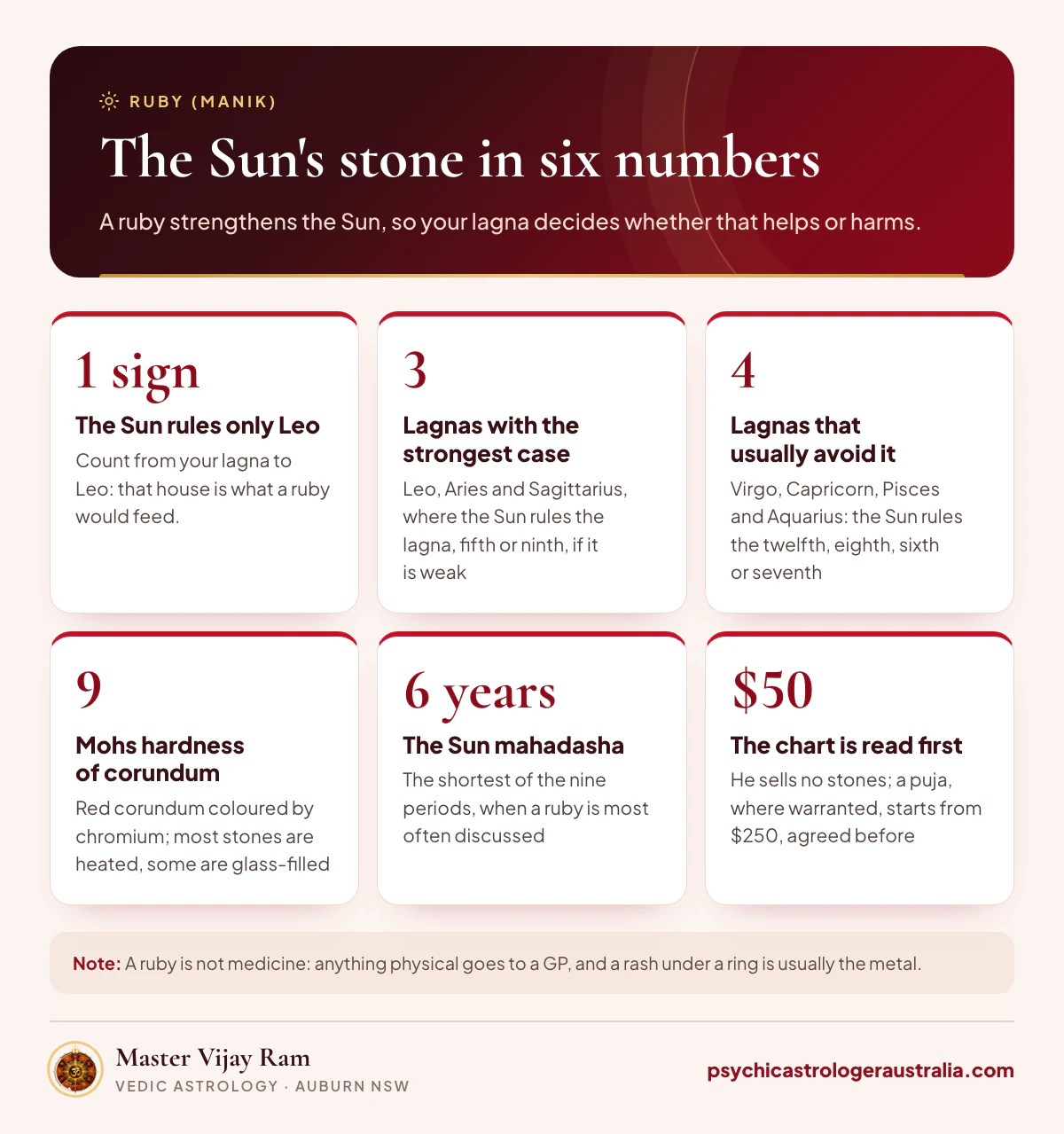
Ruby (manik) is the Sun's stone in Vedic astrology. It is considered mainly for Leo, Aries and Sagittarius lagnas, where the Sun rules the lagna, fifth or ninth house, and only when that Sun is weak. Virgo, Capricorn, Pisces and Aquarius lagnas usually avoid it, because there the Sun rules the twelfth, eighth, sixth or seventh house.
What is a ruby in Vedic astrology?
Ruby, called manik in Hindi and manikya in Sanskrit, is the gemstone the Jyotisha tradition gives to the Sun, the planet of authority, the father, confidence and the sense of self. In ruby astrology the stone is treated as an amplifier: it is said to make the Sun's influence louder in the life of the person who wears it, for better or for worse. That is why the useful question is never whether ruby is a lucky stone, but whether your particular Sun deserves to be louder.
This page works through that question the way a chart reading does: the planet, the mineral, the rising signs for which a ruby is traditionally considered and those for which it is usually refused, the way it is worn, its substitutes and the buying traps. A gemstone consultation with your chart is where these general rules meet your own birth details.
Why does the tradition give the Sun a red stone?
The nine stones of the navaratna follow the colours the texts give the nine planets, and the Sun's colour is the red-gold of copper and of the sky at sunrise. The Sun is also the king among the grahas, and ruby has long been called ratnaraj, the king of gems, so the pairing carries rank as well as colour. Older Sanskrit works on gems call the stone padmaraga, the colour of the red lotus.
What the Sun governs in a chart explains the manik stone benefits people hope for: standing with employers and government, the relationship with the father, decisiveness, a steady sense of who you are, and the vitality the tradition reads from the first house. Sunday is the Sun's day, copper its metal, wheat and jaggery its traditional offerings. None of this is a medical statement, and the heart and eyes that some lists attach to the Sun remain a doctor's business.
What is a ruby, in plain gemmology?
A ruby is the red variety of corundum, which is crystalline aluminium oxide; the same mineral in every other colour is sold as sapphire. Traces of chromium give the red, and they also make many rubies glow under ultraviolet light. At 9 on the Mohs scale, ruby is among the hardest gems in ordinary jewellery, second only to diamond, which is one reason it survives daily wear on a ring.
The classic source is the Mogok valley in Myanmar, with Thailand, Sri Lanka, Mozambique and Madagascar among the others. Where deep pink ends and light red begins is argued over by laboratories and traders, and pigeon's blood is a trade name for a prized saturated red that laboratories apply in different ways. For an astrological ruby none of those labels matters as much as two plain facts: the stone should be corundum, and you should know what has been done to it.
For which lagnas is a ruby traditionally considered?
A gemstone is judged from the lagna, the sign rising at birth, because the lagna decides which houses each planet rules in your chart. The Sun rules only one sign, Leo, so its role is easy to trace: count from your rising sign to Leo, and the house you land on is the Sun's portfolio. The short answer to who should wear manik comes from that count, set out for all twelve lagnas below.
| Usual reading of a ruby | Lagnas | What the Sun rules there |
|---|---|---|
| Strongest case, if the Sun is weak | Leo, Aries, Sagittarius | The lagna itself; the fifth (children, study, merit); the ninth (father, fortune, faith) |
| Workable, weighed with care | Scorpio, Taurus | The tenth (career and status); the fourth (home, mother, inner peace) |
| Mixed, read case by case | Cancer | The second (family, savings, speech), which is also a maraka house |
| Usually declined | Gemini, Libra | The third (effort, younger siblings); the eleventh (gains and networks) |
| Usually avoided | Virgo, Capricorn, Pisces, Aquarius | The twelfth (loss, expense); the eighth (sudden change); the sixth (disputes, debts, illness); the seventh, a maraka house |
Lordship is the first filter, not the verdict. A Leo-lagna Sun that is already strong needs no help, and a Scorpio-lagna Sun sitting in the eighth house may be a poor candidate even though it rules the tenth; choosing a stone from the whole chart sets out that weighing in full.
Who should avoid a ruby?
Four lagnas usually leave the ruby alone. For Virgo the Sun rules the twelfth house of loss and expense, for Capricorn the eighth of sudden upheaval, for Pisces the sixth of debts, disputes and illness, and for Aquarius the seventh, a maraka house the tradition prefers not to feed. Strengthening the Sun in those charts is read as strengthening the house it rules, which is the opposite of what anyone buying a ruby intends.
Three more situations call for restraint whatever the lagna. A Sun that is already strong, exalted in Aries or at home in Leo in a good house, needs no amplifier, and a ruby there tends to bring out the Sun's faults: pride, impatience, friction with bosses and with the father. A Sun tied up with Saturn, Rahu or Ketu needs reading before anything is worn, and a ruby is never combined with the stones of the Sun's enemies, which the guide to stones that backfire lists.
What does a weak Sun look like in a chart?
A stone is meant for a helpful planet that struggles, so after lordship the reading asks how the Sun is placed. The tradition reads it as weak when it is debilitated in Libra, placed in the sixth, eighth or twelfth house, hemmed in by malefics, or eclipsed by Rahu or Ketu in the same sign. A weak Sun in a chart where it rules good houses is the textbook case for a ruby, and even then the dasha decides whether the support is needed now.
In ordinary life the tradition links a struggling Sun with hesitancy in front of authority, a strained or distant relationship with the father, credit taken by others and a sense of being overlooked. Those experiences have many causes, most of them nothing to do with planets, and a reading names a tendency, never a fate.
What side effects do people associate with a ruby?
The ruby side effects people describe follow the Sun's nature: a hotter temper, impatience, sharper words with a manager or a parent, broken sleep in the first nights, and a restless need to be in charge. The tradition's response is the same whether the cause is the stone or a coincidence noticed because a new ring went on: take it off, note the dates, and have the chart checked. A rash under the ring is usually the metal, and anything physical, from headaches to eye trouble, goes to a GP rather than an astrologer.
How is a ruby traditionally worn?
The common northern Indian practice sets a ruby in gold or copper, on the ring finger of the working hand, and first wears it on a Sunday morning around sunrise, after the Sun's beej mantra, Om Hraam Hreem Hraum Sah Suryaya Namah, has been said. Traditions differ on the hand, the hour, the number of repetitions and the purification beforehand, and a family priest or guru may give a different version that is just as valid. Most lineages ask for an open-backed setting so the stone touches the skin.
Some lineages keep any primary stone close for a few days before it is set, tied in red cloth or carried in a pocket, while the wearer watches sleep and temper. That trial is best known for blue sapphire, but it is a sensible habit with a ruby too.
Which stones can stand in for a ruby?
The tradition's uparatnas, or substitute stones, for the Sun are red garnet and red spinel. Both are milder in the tradition's reading, easier to find clean and easier to trial, which is why a substitute is often the better first step for a Sun that needs only a little support. A substitute does not make a wrong Sun right: if the Sun rules your sixth, eighth or twelfth house, a garnet is a gentler version of the same mistake.
Spinel has a long history of being taken for ruby. Several celebrated red stones in old royal collections, including the Black Prince's Ruby set in the British Imperial State Crown, were later identified as spinel, a separate mineral that is slightly softer than corundum and often sold untreated.
Heated, glass-filled or lab-grown: what should a buyer know?
Most rubies sold today have been heated to improve colour and clarity, a long-standing practice the trade accepts when it is disclosed. Cheaper stones are sometimes fracture-filled with lead glass; gemmologists call these composite or lead glass-filled rubies, and they need gentler care because the glass can be damaged by heat and some household chemicals. Laboratory-grown ruby, made since the early twentieth century, is real corundum with the same chemistry and hardness as a mined stone, and it has to be sold as laboratory-grown.
Whether a heated or laboratory-grown stone carries the Sun's influence is a question of belief, and traditions differ: many practitioners ask for a natural, unheated manik ratna, while others accept a disclosed treatment. The buying itself belongs to a qualified gemmologist and an independent laboratory report, and under the Australian Consumer Law a stone must match the seller's description, so get the origin and any treatment in writing and keep the receipt. Master Vijay Ram sells no stones and recommends no jeweller.
Does a ruby matter more in the Sun's mahadasha?
The Sun's mahadasha is the shortest of the nine, six years, and it opens with the Sun–Sun sub-period of three months and eighteen days before the Moon, Mars, Rahu, Jupiter, Saturn, Mercury, Ketu and Venus sub-periods follow. A ruby is most often discussed when that period, or a Sun sub-period inside another dasha, is running, because the stone of the planet in charge does more visible work than the stone of a planet whose turn is decades away. The six years of the Sun mahadasha explains what that period is traditionally read to bring.
For a Leo lagna the Sun is the chart's own ruler, so its periods carry extra weight; the Leo ascendant chart shows how the Sun and Mars share the work there.
What can a ruby not do?
It cannot pass a selection panel, settle an argument with a parent or decide a visa. The application, the interview, the conversation and the paperwork are still yours, and a migration question belongs to Home Affairs and a registered migration agent long before it belongs to a chart. A ruby is a faith-based support for one planet; it is not medical, legal or financial advice, and it never replaces a doctor.
How does Master Vijay Ram answer a ruby question?
He asks for your date, time and place of birth, the reason you are thinking of a ruby, and any stones you already wear. He then reads the Sun's lordship for your lagna, its strength and the period you are running, and says plainly whether a ruby, a substitute or no stone at all fits the chart. The consultation is $50 by phone, video or WhatsApp, in English, Hindi or Punjabi, or in person in Auburn by appointment.
Take an illustration: a nurse unit manager in Darwin, passed over twice, might ask whether a ruby would help at the next round. If her lagna is Virgo the answer is no, because the Sun rules her twelfth, so the reading would turn to the Sun's Sunday practices, a career reading of the tenth house and a plain look at the selection criteria; Darwin keeps Central Standard Time without daylight saving, and readings for Darwin clients are booked in local time. Where the chart calls for pacifying the Sun rather than feeding it, a puja or havan performed on request is done personally by him in Auburn, from $250 and agreed before it is performed.
Read next
- Hessonite (Gomed): Rahu’s Stone and When It Is SuggestedHessonite (gomed) in Vedic astrology: Rahu’s stone, how it is judged without a sign, when it is suggested or avoided,…
- Diamond (Heera) in Astrology: Venus, Love and ComfortDiamond (heera) in Vedic astrology: Venus’s stone, which lagnas suit it, who should avoid it, engagement rings, lab-g…
- Love Spell Backfire: What Goes Wrong and How to Repair ItA love spell backfire rarely looks dramatic. Learn the three ways it goes wrong, when it tends to surface, and how ho…
Frequently asked questions
Who should wear a ruby (manik)?
In the tradition, mainly people with a Leo, Aries or Sagittarius lagna, for whom the Sun rules the lagna, the fifth or the ninth house, and only when that Sun is weak by sign, house or affliction. Scorpio and Taurus lagnas are weighed case by case. The Moon sign and the sun sign cannot decide it on their own; the birth time fixes the lagna, and the running dasha decides whether the support is needed now.
Who should not wear a ruby?
Virgo, Capricorn, Pisces and Aquarius lagnas usually avoid it, because the Sun rules their twelfth, eighth, sixth and seventh houses, and Gemini and Libra lagnas usually decline it too. Anyone whose Sun is already strong, exalted in Aries or at home in Leo in a good house, gains nothing from more Sun, and the tradition warns that a ruby there brings out pride and friction with authority.
What are the side effects of wearing a ruby?
The reports follow the Sun's temperament: irritability, impatience, clashes with a boss or a father, restless nights early on, and a pushiness that others notice before you do. Whether it is the stone or a coincidence, the response is the same: remove it, write down the dates, and have the chart read. A rash is usually the metal, and headaches or anything else physical belong to a GP.
Which finger, metal and day are used for a ruby?
The common practice is the ring finger, a gold or copper setting with an open back so the stone touches the skin, and first wearing on a Sunday morning around sunrise after the Sun's beej mantra. Traditions differ on the hand, the hour and the preparation, and a family priest's version is as valid as any. The stone is worn alone or beside friendly stones, never beside blue sapphire or diamond.
Can a ruby help me get a government job or a promotion?
The Sun is the tradition's planet of government and authority, so the question is common, but a ruby supports a planet; it does not sit the selection panel. If the Sun is a weak benefic for your lagna and its period is running, a ruby may be suggested as support beside the work. If the Sun rules a difficult house in your chart, it is the wrong stone however much the job matters.
Is a heated or lab-grown ruby acceptable for astrology?
Traditions differ. Many practitioners ask for a natural, unheated stone because the classical texts assume one, while others accept disclosed heat treatment, and opinion on laboratory-grown ruby, which is real corundum, is divided. Lead glass-filled composite stones are generally not regarded as an astrological ruby. Whatever you choose, have the origin and treatment written on the invoice and checked by an independent gemmologist.
Can a ruby be worn with other gemstones?
The tradition pairs it only with the stones of the Sun's friends, the Moon, Mars and Jupiter, so pearl, red coral or yellow sapphire can sit beside it when the chart genuinely needs both. It is not worn with blue sapphire or diamond, the stones of Saturn and Venus, and most practitioners keep it away from hessonite and cat's eye. One well-chosen stone usually does more than several.
My Moon sign is Leo. Should I wear a ruby?
Not on that basis. A Leo Moon makes the Sun the ruler of your Moon sign, but whether the Sun helps your chart depends on the houses it rules for your lagna, which can be completely different; a Leo Moon with a Pisces lagna, for example, has a Sun ruling the sixth house. The rising sign needs an accurate birth time, and the decision needs the whole chart.
Does a ruby have to be energised before it is worn?
Most families purify a new stone before the first wearing, commonly by washing it in raw milk and Ganga water and saying the Sun's mantra, and the details vary by lineage. A certificate of energising sold with a stone adds nothing to that simple rite. Where someone wants the purification done as part of a puja, Master Vijay Ram performs it personally in Auburn, from $250, agreed beforehand.
People also ask
What are the benefits of manik stone?
In the tradition, manik supports a weak but helpful Sun: confidence, standing with authority and government, the bond with the father, and the vitality read from the first house. It offers nothing useful to a chart where the Sun rules a difficult house. Treat any benefit as support beside your own effort, never as a promise, and never in place of medical care.
Is ruby the same as manik?
Yes. Manik is the Hindi name and manikya the Sanskrit one, and older works on gems also call it padmaraga, the lotus-red stone. All of them mean the red variety of corundum, the same mineral as sapphire. Red garnet and red spinel are different minerals, which the tradition accepts as the Sun's substitute stones rather than as ruby itself.
How soon does a ruby show its effect?
The tradition sets no fixed time and promises nothing. It watches the first days closely for discomfort, which is the reason for a trial, and it judges any benefit slowly, over months, against the dasha that is running. A stone that seems to change everything within a week is more likely coinciding with something else in your life than working on its own.
Can women wear a ruby?
Yes; the tradition decides by the chart, not by gender. A woman with a Leo, Aries or Sagittarius lagna and a weak Sun is as much a candidate as a man with the same chart, and a woman with a Virgo or Pisces lagna avoids it for the same reasons he would. Some families add their own customs about the finger and the hand, and those are matters of family practice.
Which is better for the Sun, ruby or red garnet?
Ruby is the primary stone and garnet the substitute. The substitute is milder in the tradition's reading, easier to buy clean and easier to trial, which makes it the sensible first choice for a Sun that needs only a little support. For a Sun that rules your sixth, eighth or twelfth house, neither is right, and the remedy becomes pacification rather than strengthening.
References & further reading
Serving clients across Australia
Confidential consultations by phone, video & WhatsApp — including: