

Quick answer
The dusthana houses are the 6th, 8th and 12th, which the tradition links with illness and debt, sudden change and loss. They also govern service, research, inheritance, rest, foreign settlement and spiritual release. Planets there and the lords of these houses need careful reading, and when dusthana lords sit in each other's houses, vipreet raja yoga can turn difficulty into strength.
What is a dusthana house?
A dusthana house is one of three houses in a Vedic chart, the 6th, 8th and 12th, that the classical texts call difficult places. The word joins dush, hard or troubled, with sthana, place. They are also known as the trik houses, the group of three. Their reputation is the reason many people open their chart and freeze when they see a planet sitting in one of them.
This guide takes the opposite approach. It explains what the tradition genuinely finds hard in these houses and why, and then shows what the same houses give, because every one of them governs things people need. A kundli reading by Master Vijay Ram reads them as part of a whole chart, never as a sentence.
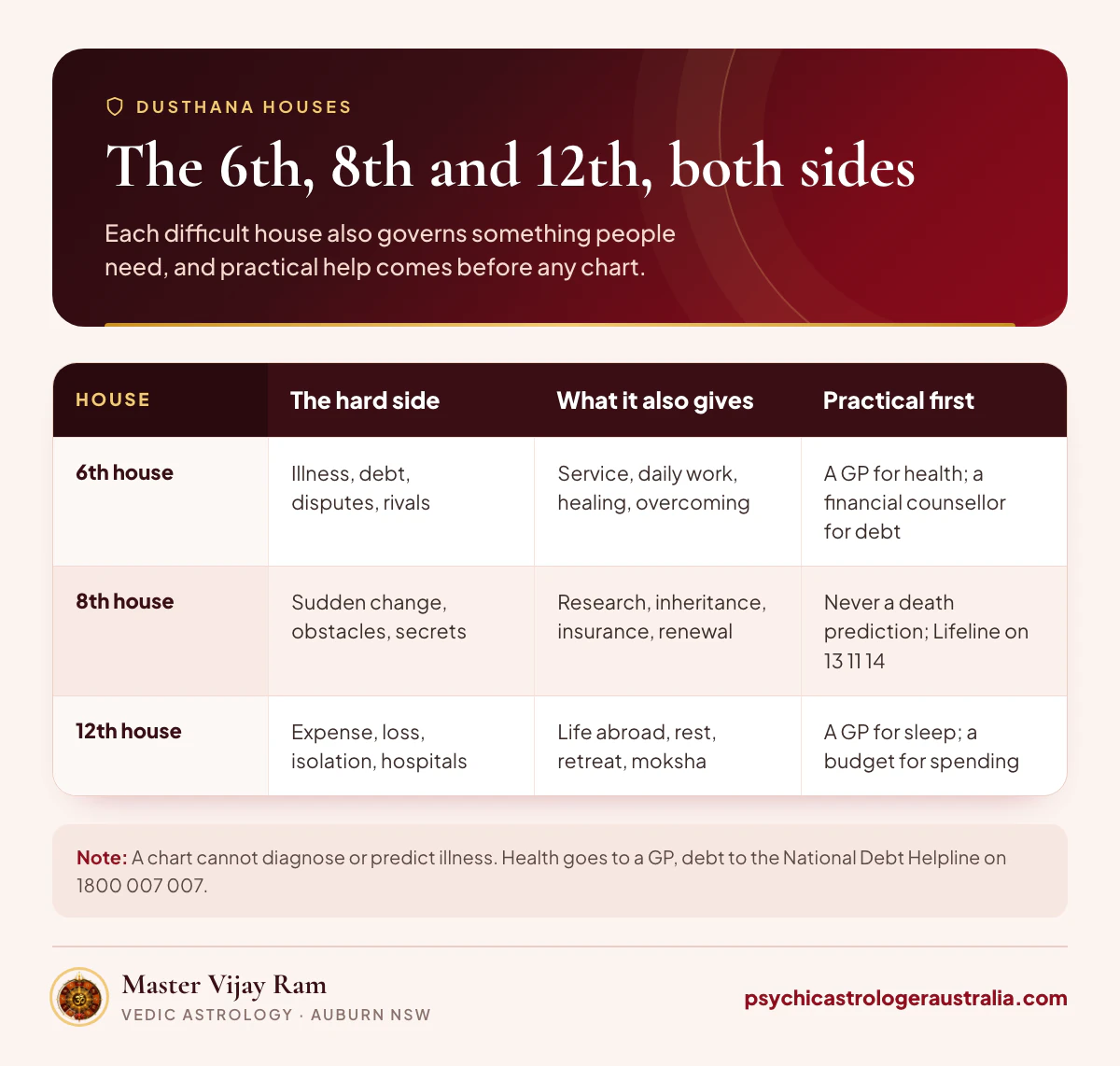
Why does the tradition call them difficult?
Each of the three covers a part of life most people would rather avoid. The 6th governs illness, debt, disputes and enemies. The 8th governs sudden change, obstacles, hidden matters and questions of longevity. The 12th governs expense, loss, isolation, hospitals and sleep. Put together, they describe the friction of life: what wears us down, what surprises us and what we let go of.
There is also a structural reason. The 6th and 8th are the houses hidden from the lagna in a particular way, and the 12th is the house just before it, the end of one cycle before the next begins. The texts treat planets placed there as working with less freedom, and the lords of these houses as carrying their themes into whatever they touch.
What do the dusthana houses also give?
This is the part that frightened readers rarely hear. Each difficult house holds something valuable, and many careers and callings live there.
| House | What the tradition finds hard | What the same house also governs | How it often shows |
|---|---|---|---|
| 6th | Illness, debt, disputes, rivals | Service, daily work, healing, the ability to overcome | Nurses, carers, lawyers, tradespeople and anyone working shifts |
| 8th | Sudden change, obstacles, longevity questions, secrets | Research, inheritance, insurance, in-laws' wealth, transformation | Researchers, investigators, psychologists, people who rebuild after upheaval |
| 12th | Expense, loss, isolation, hospitals | Foreign lands, settlement abroad, rest, retreat, moksha | Migrants who settled in Australia, hospital staff, people drawn to meditation |
For a family that has moved from India, Fiji or Sri Lanka to Australia, the 12th is often one of the most active houses in the chart, because it governs living far from the land of birth. Reading it only as loss would miss the life the person actually chose.
Is a planet in the 6th, 8th or 12th always weakened?
It is read as working under some pressure, but how that shows depends on the planet. Hard planets, Saturn, Mars, Rahu and the Sun, often cope well in the 6th, which is also an upachaya or growth house; the guide to upachaya houses of growth explains that side. Gentle planets, such as Venus or the Moon, usually feel the strain of these houses more.
Dignity matters too. A planet in its own or exaltation sign in a dusthana keeps much of its strength. And the houses it rules decide what is affected: the 10th lord in the 8th is read as a career with sudden turns, the 4th lord in the 12th as a home far from the birthplace, which for many readers is simply a description of their migration.
What do the lords of the dusthanas do?
A dusthana lord carries the themes of its house wherever it goes. The 6th lord in the 7th can bring disputes or service themes into partnerships; the 12th lord in the 2nd can bring expenses into family finances. This is why astrologers check not just what sits in the 6th, 8th and 12th, but where their lords have gone.
There is an important exception. When the lord of the 8th is also the lagna lord, as Mars is for an Aries lagna and Venus for a Libra lagna, the classical texts say the 8th-lordship blemish does not apply in the usual way, because the planet's first loyalty is to the self. A reading that ignores this exception misjudges two lagnas out of twelve.
What is vipreet raja yoga?
Vipreet raja yoga forms when the lords of the 6th, 8th and 12th are placed in the 6th, 8th or 12th. The idea is that difficulty placed inside difficulty cancels itself out, the way a minus multiplied by a minus becomes a plus. There are three named forms: Harsha, when the 6th lord is involved; Sarala, for the 8th lord; and Vimala, for the 12th lord.
The classic description is success that comes through, or after, adversity: rising when a rival falls, benefiting from a crisis others cannot handle, or finding freedom after a loss. The full explanation is in vipreet raja yoga explained plainly. Like every yoga, it depends on the strength of the planets involved and on the dasha bringing it forward.
Does the 8th house mean death?
No reading should frighten anyone this way. The 8th is traditionally linked with longevity, which is a different thing from a prediction, and the texts that discuss it are hedged with warnings about how hard and how unwise such judgements are. In practice, the 8th is read for change, research, shared or inherited resources, insurance, in-laws and the deep inner shifts that follow a crisis.
The guide to the eighth house of change and inheritance goes through the house in full. If anyone has told you that your 8th house predicts a death or an accident, that is a misuse of the chart, and you are right to set it aside. Anxiety after such a reading is real: Lifeline is on 13 11 14 and a GP can help.
Is a planet in the 12th house a sign of loss?
It can describe expense, but expense is not always loss. The 12th governs what we spend on purpose: rent and travel, a child's education overseas, charity, a pilgrimage, and the sleep and rest that restore us. It is also the house of foreign settlement, which is why it lights up in so many charts of people who built their lives in Sydney, Melbourne or Brisbane after growing up elsewhere.
The 12th is also the house of moksha, release, and in the spiritual reading of a chart it is one of the most important houses. Ketu or Jupiter in the 12th is often read as a person who finds peace in prayer, retreat or quiet service. The twelfth house of foreign lands and release explores this further.
What happens in the dasha of a dusthana lord?
Periods of the 6th, 8th or 12th lord are often read as times of effort, clearing and change. A 6th-lord period may bring work pressure, a health matter that needs attention or a dispute that has to be settled; it may equally bring a new job in a service field. An 8th-lord period may bring a move, a restructuring or an inheritance matter. A 12th-lord period may bring travel, relocation, extra expense or a turn inward.
None of these is fixed. The planet's dignity, the house it occupies and the antardashas inside its period decide whether the period mostly tests or mostly releases. Many people look back on a dusthana-lord period as the time they cleared out what had stopped working.
What practical help comes first?
The dusthana houses touch health, money and conflict, so the chart is never the first stop. A health worry goes to a GP; healthdirect on 1800 022 222 can advise after hours. Debt goes to a financial counsellor, and the National Debt Helpline is on 1800 007 007. A legal dispute goes to a lawyer or Legal Aid. A reading can describe the season you are in, but it cannot treat, settle or fix any of these.
Is a remedy needed for the dusthana houses?
Most people with planets in the 6th, 8th or 12th need no remedy at all. Where a reading finds real strain, such as an afflicted dusthana lord running its period with nothing to soften it, the first suggestions are steady: the planet's weekday prayer and mantra, regular service to others for the 6th, and charity for the 12th. These ask for discipline, not money.
If health is the theme, the health and wellbeing readings keep astrology alongside medical care rather than in place of it. A graha shanti is chosen only where the whole chart points to it; Master Vijay Ram performs it personally at his place of practice in Auburn, from $250, with the figure agreed before the rite, as described under puja and havan on request. A consultation is $50.
What a dusthana reading cannot tell you
It cannot tell you when or whether you will fall ill, lose money or face a crisis, and it cannot diagnose anything. It describes areas of life that ask for care and the periods when they are more likely to come forward. This is faith-based guidance, not medical, financial, legal or psychological advice.
Consultations run by phone, video or WhatsApp in English, Hindi or Punjabi, or in person at Auburn by appointment. Western Australian clients often book in the evening, their time; see astrology readings for Perth.
Read next
- Vipreet Raja Yoga: Success Through Difficulty, Explained PlainlyVipreet Raja Yoga explained plainly: Harsha, Sarala and Vimala, the dusthana lords for every lagna, what spoils the y…
- Lakshmi Yoga: What the Wealth Yoga RequiresLakshmi yoga in a kundli: a dignified ninth lord in a kendra or trikona with a strong lagna lord, why versions differ…
- Exorcism vs Spiritual Healing: A Safer AlternativeExorcism is not the only option. Learn how quiet spiritual healing compares, what is never safe, and when a doctor or…
Frequently asked questions
Which houses are dusthana in Vedic astrology?
The 6th, 8th and 12th houses are the dusthanas, also called the trik houses. The tradition links the 6th with illness, debt and disputes, the 8th with sudden change and hidden matters, and the 12th with expense, loss and isolation. Each of them also governs valuable areas of life, such as service, research and foreign settlement.
Is having planets in the 6th, 8th or 12th house bad?
Not in itself. Planets there are read as working under some pressure, but hard planets often cope well in the 6th, dignified planets keep much of their strength, and the 12th is central for people settled abroad. The houses those planets rule, the aspects they receive and the running dasha decide what the placement means for one life.
What is vipreet raja yoga?
It is a combination formed when the lords of the 6th, 8th and 12th houses sit in the 6th, 8th or 12th. The idea is that difficulty placed inside difficulty cancels out, often giving success through or after adversity. Its three named forms are Harsha for the 6th lord, Sarala for the 8th lord and Vimala for the 12th lord.
Does the 8th house show when a person will die?
No responsible reading should claim that. The 8th is traditionally linked with longevity, but the texts themselves warn how uncertain such judgements are, and predicting death causes real harm. In practice the 8th is read for change, research, inheritance, insurance and inner transformation. Anyone distressed by a prediction like this can call Lifeline on 13 11 14.
Why is the 12th house important for migrants?
The 12th governs foreign lands and settlement away from the birthplace, along with expense, rest and release. For families who moved to Australia from India or elsewhere, the 12th and its lord are often among the most active parts of the chart. Reading the house only as loss would miss the life the person chose to build.
What happens in the dasha of the 6th lord?
It is often read as a period of effort and problem-solving: work pressure, a health matter that needs attention, a dispute to settle, or a new role in a service field. The planet's dignity, its house and the antardashas inside the period decide whether it mostly tests or mostly strengthens. It is a tendency, not a forecast of illness.
Is the 8th lord bad for an Aries or Libra lagna?
For these two lagnas the lagna lord also rules the 8th house: Mars for Aries and Venus for Libra. The classical texts say the usual 8th-lordship blemish does not apply in the ordinary way, because the planet's first duty is to the self. Its placement, dignity and aspects are still read, but it is not treated as an enemy of the chart.
Do dusthana houses need a puja?
Usually not. Most charts have planets in some of these houses and need no ritual. Where a reading finds a strained dusthana lord running its period, the first suggestions are the planet's weekday prayer, service and charity. A graha shanti is considered only when the whole chart points to it, from $250, agreed before it is performed.
People also ask
What are trik houses in astrology?
Trik means group of three, and the trik houses are the 6th, 8th and 12th, the same houses called dusthanas. The tradition reads them as the difficult houses of a chart, linked with illness, debt, sudden change and loss, while they also govern service, research, inheritance and foreign settlement.
Is the 6th house good for a career?
It can be. The 6th governs daily work, service and competition, and it is also an upachaya house that improves with effort. Strong planets there are common in the charts of nurses, carers, lawyers, tradespeople and people who work long shifts. The 10th house and its lord still describe the career as a whole.
What does the 12th lord in the 1st house mean?
It is traditionally read as a person shaped by the 12th house's themes: foreign places, spending, solitude or spiritual interest. Many people with this placement live away from their birthplace or are drawn to quiet, reflective work. Its dignity and aspects decide whether it shows mostly as expense or as freedom.
Can a dusthana house give success?
Yes. Vipreet raja yoga, formed by the dusthana lords in dusthana houses, is read as success through adversity. Hard planets in the 6th help overcome competition, the 8th can bring inheritance or research success, and the 12th can bring a good life abroad. These houses describe challenge, and challenge often leads somewhere useful.
References & further reading
Serving clients across Australia
Confidential consultations by phone, video & WhatsApp — including: