
Quick answer
The Chandra mahadasha is the Moon’s ten-year period in the Vimshottari dasha. It turns life toward the mind, feelings, the mother, home, the public and care for others. A bright, dignified Moon tends to give a settled, popular decade; a weak or afflicted one asks for more care with mood and sleep, and a GP comes first for low mood.
What is the Chandra mahadasha?
The Chandra mahadasha is the Moon’s period in the Vimshottari dasha, ten years long in the classical tables, in which the planet of the mind sets the tone of a life. The Moon governs manas, the feeling, remembering, reacting mind, along with the mother, home, nourishment, the public and everything that waxes and wanes. Its decade is less about what you achieve than about how life feels while you achieve it.
Read on for the decade’s usual themes, the way the Moon’s phase at birth tilts them, its nine sub-periods in sequence, what happens at the joins with the Sun and with Mars, and the quiet remedies the tradition keeps for it. The arithmetic of the dates sits in how Vimshottari dasha timing works, while a kundli reading places your own Moon and its decade.
Who enters the Moon’s ten years, and when?
The Moon’s period always follows the Sun’s six years and comes before Mars’s seven. Anyone whose birth Moon sits in the Moon’s own nakshatras, Rohini, Hasta and Shravana, begins life inside this period with a partial balance; everyone else reaches it later, at an age fixed by the birth nakshatra.
Childhood Moon periods are read for the mother’s presence and the child’s temperament, adult ones for home, family and the emotional cost of work, and later ones for health, rest and the comfort of being cared for. The same ten years can therefore be about a new baby, a new mortgage or an ageing mother, depending on when they fall.
Why is the Moon’s period the period of the mind?
In Jyotisha the Moon is the mind itself, so its dasha brings the inner weather to the surface: moods are felt more, memories return, attachments deepen, and the need for home and belonging grows. Ask people what the decade did and the Moon mahadasha effects they name cluster together: a stronger pull toward family, a move of house, closer ties with the mother, more sensitivity to criticism and a greater need for rest.
A settled Moon turns all of that into warmth: a home that others gather in, a talent for care, a popularity that comes easily. An unsettled Moon turns the same sensitivity into worry, broken sleep and mood that follows events too closely, which is when the period needs gentle, practical attention rather than fear.
Does the Moon’s brightness change the period?
It does, and this is what sets the Moon apart from the other planets: the tradition measures paksha bala, strength by phase. Born bright, far from the Sun and close to full, the Moon is counted rich in light; born hugging the Sun around Amavasya, it is counted thin and asks for support. Your phase at birth is fixed, and it colours the whole decade.
Two other checks follow. A Moon flanked by empty houses, with nothing but the Sun or a node in the second and twelfth from it, forms Kemadruma, the lonely Moon, which is far rarer in practice than its reputation once its cancellations are counted; Jupiter standing in a kendra from the Moon forms Gajakesari, one of the most common supportive yogas. Both are read before anything is said about the Moon’s years.
How do sign, house and lordship shape the ten years?
Taurus exalts the Moon, Cancer is its home and Scorpio its fall, and among the planets it counts no natural enemies, which is one reason its period is often gentle. Its house shows where the mind is drawn: a Moon in the fourth turns the decade toward home, in the tenth toward the public, in the twelfth toward rest, distance and the inner life.
Lordship completes the picture, because the Moon rules only Cancer. For a Cancer lagna it is the lagna lord and the period is the person’s own; for Libra rising it rules the tenth and the decade turns to career; for Scorpio rising, the ninth and fortune; for Pisces rising, the fifth and children; for Leo rising, the twelfth and expenses or life abroad. For Sagittarius rising it owns the eighth, though the Moon is traditionally spared the blemish of that lordship.
How do the nine sub-periods of the Moon’s decade run?
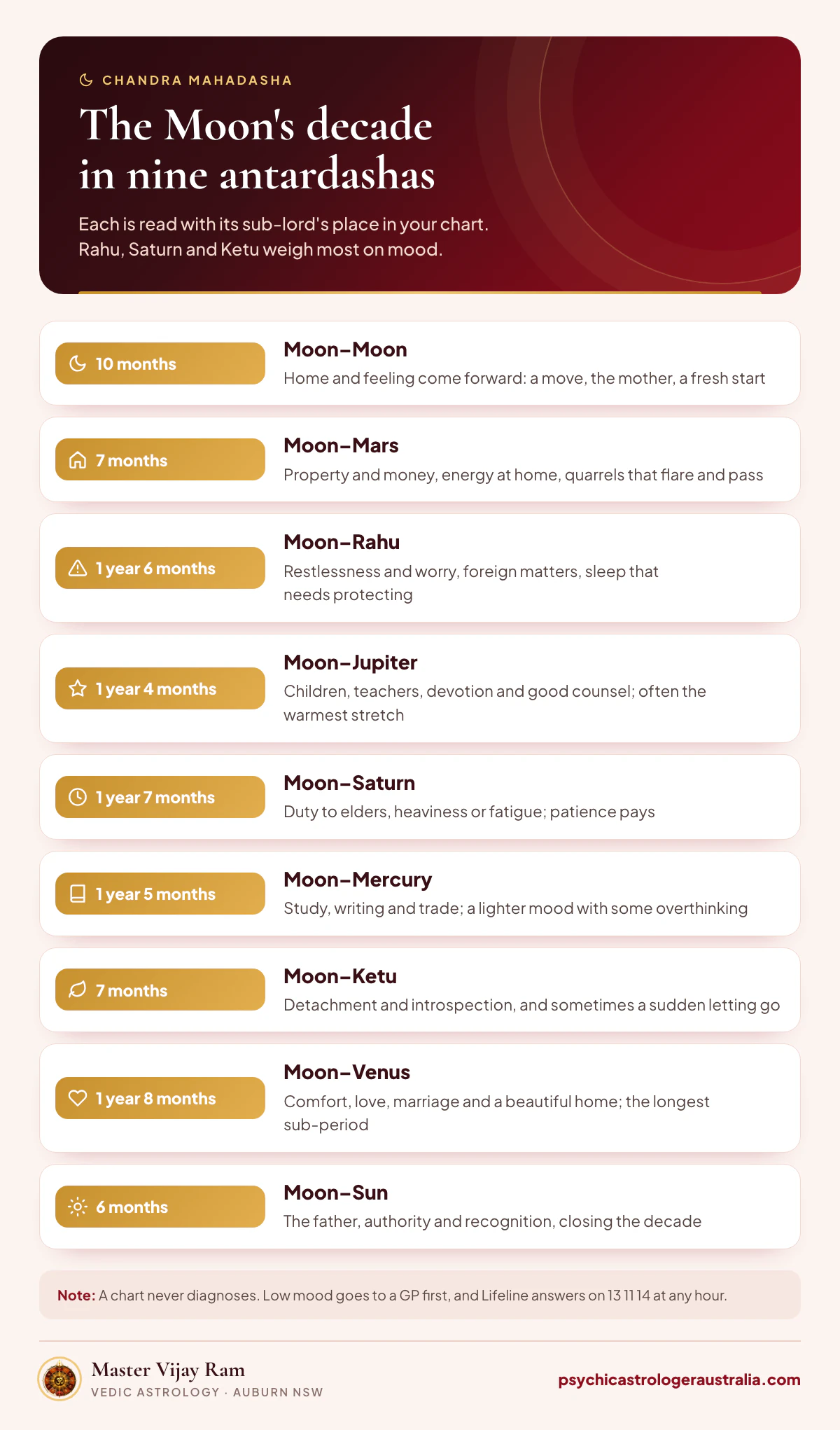
The Chandra mahadasha antardasha sequence begins with the Moon itself and then follows the fixed order, each sub-period lasting in proportion to its lord’s own years. These sub-periods are where a reading actually times things, because ten years is too long a stretch to describe in one breath.
| Sub-period | Duration | Its usual colour |
|---|---|---|
| Moon–Moon | 10 months | Home and feeling come forward: a move, the mother, a fresh emotional start |
| Moon–Mars | 7 months | Property and money, energy at home, quarrels that flare and pass |
| Moon–Rahu | 1 year 6 months | Restlessness and worry, foreign matters, sleep that needs protecting |
| Moon–Jupiter | 1 year 4 months | Children, teachers, devotion and good counsel; often the warmest stretch |
| Moon–Saturn | 1 year 7 months | Duty to elders, heaviness, loneliness or fatigue; patience pays |
| Moon–Mercury | 1 year 5 months | Study, writing and trade; a lighter mood with some overthinking |
| Moon–Ketu | 7 months | Detachment and introspection; a sudden letting go; the mother’s health watched |
| Moon–Venus | 1 year 8 months | Comfort, love, marriage and a beautiful home; the longest sub-period |
| Moon–Sun | 6 months | The father, authority and recognition, closing the decade |
Moon–Rahu, Moon–Saturn and Moon–Ketu are the three that most often weigh on mood, because Rahu clouds the mind, Saturn slows it and Ketu loosens its attachments. The sub-lord’s position in your own chart still decides, and a well-placed Saturn can turn Moon–Saturn into a year of quiet, useful discipline.
What does the Moon’s decade do for mother and home?
The Moon is the karaka of the mother, so its decade often changes that relationship: a mother arriving from India to help with a new grandchild, a mother whose health needs watching from far away, or a reconciliation after years of distance. The fourth house and its lord are read beside the Moon for these questions, and the reading describes the season rather than predicting a parent’s health.
Home itself is a Moon matter. A family buying in Armstrong Creek near Geelong, renovating a Queenslander in Townsville or moving to be closer to grandchildren on the Sunshine Coast is acting out the Moon’s period in a very literal way; Moon–Mars and Moon–Venus are the sub-periods most often tied to property and the home.
What if low mood is more than the Moon?
Because the Moon is the mind, people in its period sometimes ask whether the planet explains how they feel. A chart can describe a season of sensitivity; it cannot diagnose anxiety or depression, and it must never stand between a person and care. When low mood has hung on for more than two weeks, sleep has collapsed or hopelessness has set in, the right first step is a GP, and astrology and mental health explains where the line sits.
Beyond Blue is there for anxiety and depression, and anyone in crisis can reach Lifeline on 13 11 14, day and night; new and expecting parents can also call PANDA. Master Vijay Ram says plainly when a caller needs those services before any reading, and a remedy is only ever a support beside proper care.
Which kinds of work suit the Moon’s years?
Nourishment, water, nurture and crowds are all lunar, so the decade often suits nursing, midwifery, aged care, childcare, hospitality and other work that looks after people. A nurse in Cairns or a café owner in Darwin may find the Moon’s years bring both busier rosters and more public goodwill, with the risk of giving too much of themselves.
The Moon also rules travel and the tides of popularity. Its period can bring frequent movement, work near the sea or a reputation that rises and falls with public mood, and the advice is to build routines that do not depend on how people feel about you that month.
Does the Moon period bring marriage or children?
The Moon–Venus sub-period, the longest of the nine at a year and eight months, is the one most often linked with marriage, engagement and a settled home, particularly where Venus or the Moon is tied to the seventh house. For a Capricorn lagna the Moon itself rules the seventh, so the whole decade carries partnership questions, read with care because the seventh lord is also a maraka.
Children belong here through the Moon’s nurturing nature and through Moon–Jupiter, the sub-period of blessings and teachers. A couple hoping for a child is read from the fifth house and Jupiter as well as the dasha, and medical questions about fertility go to a GP and a specialist first.
What happens at the seams with the Sun and with Mars?
Before the decade come twelve months of Sun–Venus, the last stretch of the Sun’s six years, so the first seam runs from public duty into private feeling; many people notice it as a move home or a turn toward family. The decade closes with the six-month Moon–Sun sub-period, after which Mars’s seven years begin with Mars–Mars, a turn from feeling to action.
The tradition counts both junctions among the brisk, gentler ones rather than the sharp ones. The changeover between planetary periods explains how the months around each seam are read.
Which remedies suit the Moon’s period?
The Moon dasha remedies the tradition keeps are calm ones: Monday observed for the Moon and Shiva, water or milk offered to a Shiva lingam, the Moon’s seed mantra, Om Shraam Shreem Shraum Sah Chandraya Namah, rice or milk given in charity, time near water, and a protected bedtime. Looking after your mother, whether at her side or through a weekly call, is counted as the first of them.
A pearl, the Moon’s stone, is worth considering only when a full reading finds that this Moon should be made stronger, and it does nothing for anxiety, as the pearl and its cautions explains; Master Vijay Ram sells no stones. Where the Moon is badly afflicted and a hard sub-period is running, a Chandra graha shanti is something he performs himself in Auburn; the cost starts at $250 and is settled first, and online puja and havan shows how families join by video.
What a Moon-period reading cannot do
It cannot diagnose or treat any mental or physical illness, predict a mother’s health, or tell you whether to move house or start a family. Those questions belong with doctors, counsellors and your own family, whose advice comes before the chart’s. What a reading of the Chandra dasha offers is a description of the season and its sub-periods, so that hard months are expected rather than feared.
A reading of your Moon period
Vijay Ram ji begins with your birth details. He reads the Moon’s phase, sign, house, lordship and company, checks Kemadruma and Gajakesari, places the current sub-period and the next two, and lays the year’s transits over them, then tells you plainly what the decade is asking of you.
The fee for a consultation is $50. Clients from Geelong to Darwin speak with him over the phone, by video or on WhatsApp, in English, Hindi or Punjabi, and anyone wanting to meet in person comes to Auburn.
Read next
- Guru Mahadasha: The Jupiter Years ExplainedGuru mahadasha explained: what the sixteen-year Jupiter period brings for study, children, marriage and money, its an…
- Moon Mahadasha, Rahu Antardasha: A Restless MindMoon mahadasha Rahu antardasha: 1 yr 6 mo the tradition links with a restless mind, who to call first, the Grahan dos…
- Love Spell Backfire: What Goes Wrong and How to Repair ItA love spell backfire rarely looks dramatic. Learn the three ways it goes wrong, when it tends to surface, and how ho…
Frequently asked questions
How long is the Chandra mahadasha?
Ten years in the classical tables, which count years of 360 days. It always follows the Sun’s six-year period and comes before the seven years of Mars. Inside it the nine antardashas range from six months for Moon–Sun up to a year and eight months for Moon–Venus, the longest. When yours begins and ends follows from where the Moon stood at your birth, worked out from the birth time.
Why is the Moon mahadasha called the period of the mind?
Because in Jyotisha the Moon is manas, the feeling and reacting mind. Its dasha brings inner life to the surface: moods are felt more, memories return, attachments deepen and the need for home grows. A settled Moon turns that into warmth and popularity; an unsettled one into worry and broken sleep, which deserves practical care rather than fear.
Does a waning Moon make the Moon mahadasha harder?
It can. The tradition measures paksha bala, strength by phase: a Moon born bright and well away from the Sun is read as strong, while one born close to Amavasya is read as needing support. The phase is one factor among several, alongside sign, house, lordship and company, and a weak-phase Moon with Jupiter’s support often gives a perfectly good decade.
Which Moon sub-periods are hardest on mood?
Moon–Rahu, a year and a half, is the one most often linked with restlessness, worry and poor sleep; Moon–Saturn, a year and seven months, with heaviness and duty to elders; and Moon–Ketu, seven months, with detachment and a sense of loss. How each one lands depends on where its sub-lord sits, and a dignified Saturn or Rahu changes the picture considerably.
Can the Moon mahadasha cause anxiety or depression?
A chart can describe a season of emotional sensitivity, but it cannot diagnose anxiety or depression or explain them away. Low mood that stays beyond a fortnight, sleep that has fallen apart or a sense of hopelessness all mean a GP visit first. Beyond Blue supports anxiety and depression, and Lifeline takes calls on 13 11 14 around the clock. Any remedy is a support beside proper care, never instead of it.
Does the Moon mahadasha bring a new house?
It often brings home matters forward, because the Moon is the planet of home and the mother. Moon–Mars and Moon–Venus are the sub-periods most often tied to buying, renovating or moving, especially where the fourth house is involved. Whether a purchase is wise is a question for your finances, a broker and a conveyancer; the chart describes the season, not the deal.
Is the Moon mahadasha good for marriage?
It can be. Moon–Venus, the longest sub-period, is the one most often linked with marriage and a settled home, especially where the Moon or Venus touches the seventh house. For a Capricorn lagna the Moon rules the seventh, so the whole decade carries partnership questions, read with care because the seventh lord is also a maraka. Timing still depends on the whole chart and the transits.
Is a pearl the answer to a difficult Moon period?
Not on its own. Consider one only when a complete reading finds your Moon in need of strength, and never as a cure for worry or low mood. Where the Moon owns an awkward house for your lagna, a pearl simply feeds that house. Master Vijay Ram sells no stones and takes nothing from their sale, and a purchase is a matter for a gemmologist and Australian Consumer Law.
How does the Moon’s decade hand over to Mars?
Through a short, brisk seam into the seven-year Mars mahadasha, which opens with the Mars–Mars sub-period. The Moon’s decade closes with the six-month Moon–Sun antardasha, so the seam runs from the father and authority into Mars’s energy, property and drive. The tradition counts Moon to Mars among the brisk, gentler junctions, often felt as a turn from reflection to action.
People also ask
What happens in the Moon mahadasha?
Life turns toward the mind, feelings, the mother, home, nourishment and the public for ten years. Many people move house, grow closer to family, take up caring work or feel their moods more sharply. How it goes depends on the Moon’s phase, sign, house and lordship and on the sub-period running, which is where a reading does its timing.
Is the Chandra mahadasha good?
For many people it is one of the gentler decades, because the Moon has no natural enemies and a bright, dignified Moon gives warmth, popularity and a settled home. Born near Amavasya, debilitated in Scorpio or pressed by Saturn, Rahu or Ketu, the Moon gives the same themes with more emotional strain, which calls for routine, support and, where needed, a doctor.
Which part of the Moon’s decade is usually the warmest?
Moon–Jupiter is traditionally the warmest, bringing children, teachers, devotion and good counsel, and Moon–Venus, the longest, often brings love, marriage and a beautiful home. Moon–Mercury is usually light and studious. Your own ranking follows the sub-lords’ positions and the houses they own in your chart.
At what age does the Moon mahadasha start?
The birth nakshatra decides. A Moon in one of its own nakshatras, Rohini, Hasta or Shravana, means starting life inside this period with a partial balance; for everyone else it comes after the Sun’s six years, earlier or later according to where the sequence began. The exact date needs an accurate birth time.
How does the Moon period affect the mother?
The Moon is the karaka of the mother, so its decade often changes that relationship: a mother arriving to help with a grandchild, health that needs watching from afar, or a reconciliation. The reading describes the season and the sub-periods in which mother-related matters tend to come forward; it never predicts a parent’s illness or death.
References & further reading
Serving clients across Australia
Confidential consultations by phone, video & WhatsApp — including: