
Quick answer
Hessonite (gomed) is Rahu's stone in Vedic astrology. Because Rahu rules no sign, it is suggested from Rahu's placement rather than lordship: most often when Rahu sits in the third, sixth, tenth or eleventh house with a strong, friendly sign lord, or during a favourable Rahu period. It is refused when Rahu sits in the eighth or twelfth or beside the Moon.
What is hessonite in Vedic astrology?
Hessonite, gomed in Hindi and gomeda in Sanskrit, is the honey-brown garnet that the navaratna assigns to Rahu, the shadow planet of ambition, foreign places, technology, sudden change and restless desire. Hessonite astrology works differently from the stones of the seven visible planets, because Rahu owns no sign and so cannot be judged by house lordship alone. That is why the question in the title, when gomed is suggested, has a longer answer than most.
This page explains how Rahu is read for a stone, the situations in which gomed is considered and those in which it is refused, the Kaal Sarp and visa questions it is often sold for, wearing and the trial, the substitute and how to check what you are buying. A gemstone consultation on your own chart is the sensible first step before any of it.
Why does a shadow planet have a stone at all?
Rahu is not a body in the sky but the Moon's north node, one of the two points where the Moon's path crosses the Sun's, and the story of the demon Svarbhanu, whose severed head became Rahu and whose body became Ketu, explains the eclipses he is said to cause. The texts give Rahu a smoky colour, and the honey-to-cinnamon tones of hessonite carry that smoke. A well-known saying in the tradition holds that Rahu acts like Saturn, which is why its stone shares Saturn's day, Saturday, and Saturn's metals.
When people ask about gomed stone benefits, they are describing Rahu at its best: drive and boldness in new fields, success with foreign employers and technology, quick thinking under pressure, and a way through rivals and red tape. The tradition reads Rahu at its worst as confusion, obsession, deception and restlessness, and a gomed strengthens whichever face your chart shows.
What exactly is hessonite?
Hessonite is a variety of grossular garnet, a calcium aluminium silicate, in shades from honey and orange to cinnamon brown, and an old name for it is cinnamon stone. It rates about 7 on the Mohs scale, and under magnification it often shows a swirled, syrupy look that gemmologists call a treacle or roiled effect, caused by tiny included crystals. Sri Lanka is the classic source, with India and parts of Africa among the others.
Hessonite is usually sold untreated, which makes it simpler than sapphire or emerald in one respect. Its look-alikes are the trouble: orange glass, citrine, orange zircon and other garnets can all pass for gomed to an untrained eye.
If Rahu owns no sign, how is gomed judged?
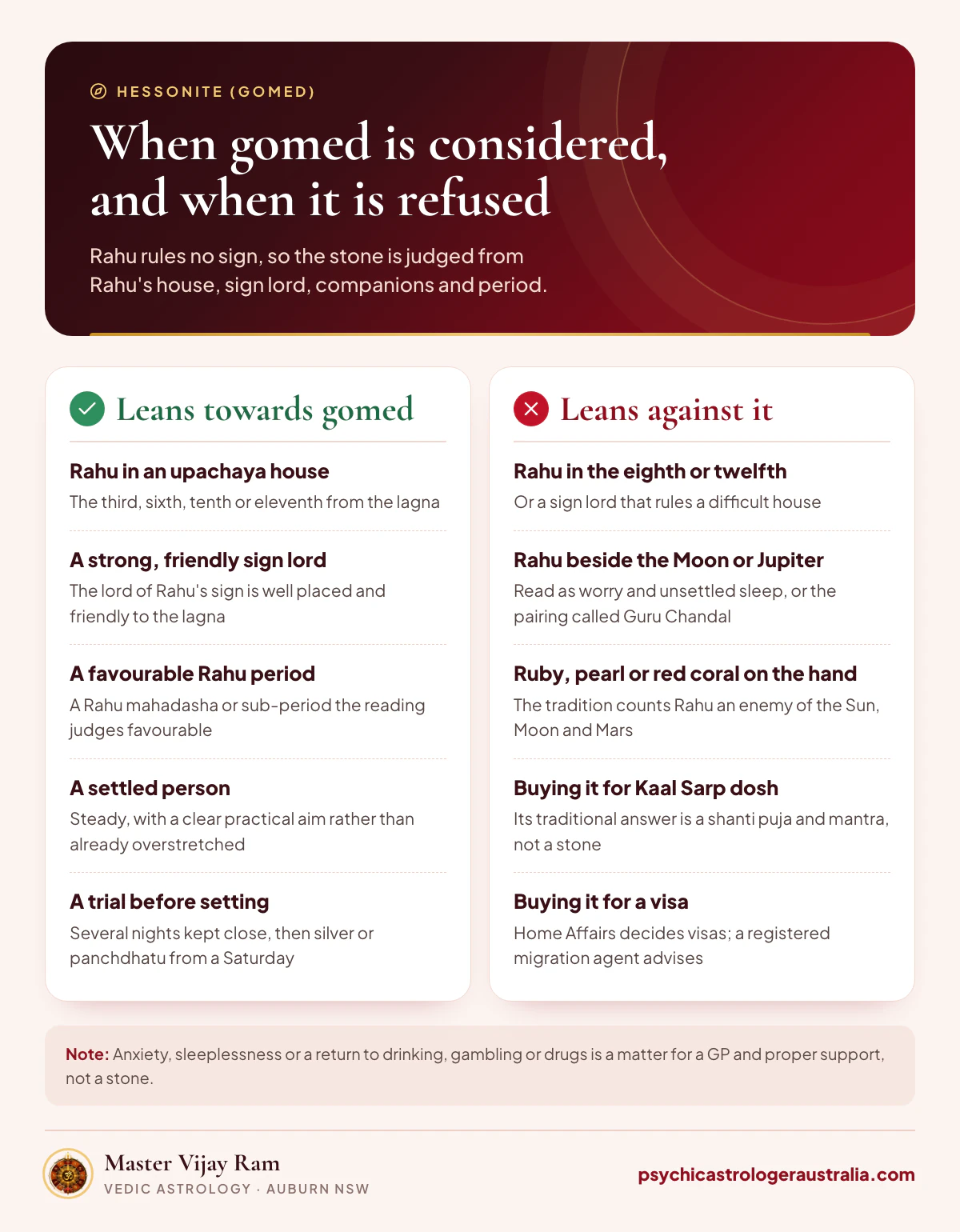
For the seven visible planets a stone is judged by the houses they rule from the lagna, but Rahu rules none in the classical scheme, though some lineages give it Aquarius or another sign as a co-rulership, and traditions differ. Instead the reading looks at the house Rahu occupies, the lord of the sign it sits in, the planets beside it and its nakshatra, and Rahu is said to give the results of that sign lord and those companions. The table shows how each factor tends to lean, which is the real answer to who should wear gomed.
| Factor | Leans towards gomed | Leans against it |
|---|---|---|
| House Rahu occupies from the lagna | The third, sixth, tenth or eleventh, the upachaya houses where Rahu is traditionally read as doing well | The eighth or twelfth, or the lagna itself in an anxious chart |
| The lord of Rahu's sign | Friendly to the lagna and well placed | A lord of the sixth, eighth or twelfth, or itself weak |
| Planets beside Rahu | None, or a strong benefic that rules good houses | The Moon or the Sun, the combinations called Grahan dosha, or Jupiter, the one called Guru Chandal |
| The running period | A Rahu mahadasha or sub-period the reading judges favourable | A Rahu period already bringing confusion or excess |
| The person | Settled, with a clear practical aim | Anxious, sleepless or struggling with addiction, and in need of a GP first |
Some lineages add that gomed sits more easily with the lagnas ruled by Venus, Mercury and Saturn, which they count as Rahu's friends, than with those ruled by the Sun, Moon and Mars, which they count as its enemies; traditions differ, and the factors in the table come first. The method behind a chart-based stone covers the visible planets' side of the same reasoning.
When is gomed suggested?
The clearest case is a Rahu in the third, sixth, tenth or eleventh house whose sign lord is strong and friendly to the lagna, with a Rahu period running or about to begin. A Rahu in a good house joined by the lord of a trikona is also read by many as able to give that lord's good results, and gomed is sometimes considered then. In each case the person's state of mind matters as much as the chart: gomed is for someone steady who needs boldness, not for someone already overstretched.
When is hessonite better left alone?
A Rahu in the eighth or twelfth, a Rahu whose sign lord rules a difficult house, and a Rahu sitting with the Moon are the usual reasons to refuse gomed, because the tradition links Rahu with the Moon to worry and unsettled sleep. A Rahu beside Jupiter, the pairing popularly called Guru Chandal, is read carefully as well; Guru Chandal dosha without the panic explains what that combination is and is not. Gomed is never paired with ruby, pearl or red coral either, because the tradition counts Rahu an enemy of the Sun, Moon and Mars, and the stones the tradition handles with care explains why hessonite is among them.
Is hessonite a remedy for Kaal Sarp dosh?
It is often sold as one, and the tradition does not support the sale. Kaal Sarp dosh describes all seven visible planets falling on one side of the Rahu–Ketu axis, a later popular label rather than a classical yoga, and its traditional answer is a shanti puja and the nodal mantras, not a stone that makes Rahu stronger. A person told to buy gomed because of Kaal Sarp should have both claims checked: whether the dosha is really there, and whether Rahu in their chart should be fed at all.
The Kaal Sarp and Pitra dosh service explains how the dosha is checked and what the shanti involves.
Can gomed help with a move overseas or a visa?
Rahu is the tradition's planet of foreign lands and outsiders, so families who have migrated, or hope to, ask about gomed more than almost any other stone. A stone cannot lodge an application, change a points score or influence a decision: the Department of Home Affairs makes every visa decision, and the professional to advise you is a registered migration agent. What a chart can do is describe the period you are in and the houses Rahu touches, the twelfth and ninth among them, which is a different and more modest kind of help.
What do people feel when gomed is wrong for them?
The hessonite side effects people describe are Rahu unleashed: racing, scattered thoughts, broken sleep and vivid dreams, impulsive risks with money, suspicion of those close to them, and a pull back towards habits they had left behind. Such a pattern is read as Rahu strengthened against the chart's wishes, and the stone comes off at once. Anxiety, sleeplessness or a return to drinking, gambling or drugs is a matter for a GP and proper support services, and no stone or mantra replaces them.
How is hessonite worn, and is it trialled?
The common practice sets gomed in silver or panchdhatu for the middle finger and begins on a Saturday, after Rahu's beej mantra, Om Bhraam Bhreem Bhraum Sah Rahave Namah, and many families also pray to Durga for Rahu. Practice varies on the finger and the hour, and the way your family does it is a fair guide. Because Rahu is unpredictable, most lineages trial gomed as they trial neelam, keeping it close for several nights and watching sleep, mood and judgement before it is set.
What about orange garnet as a substitute?
The tradition's uparatna for Rahu is a lighter or less costly orange garnet, which carries the same planet more gently. It suits a person whose Rahu is judged helpful but who wants a softer start, and it is no way around a Rahu the reading has refused. For many people in a Rahu period the better support is not a stone at all but Saturday discipline, the Rahu mantra, honest dealing and steady routines.
Glass, zircon or the real thing: how is gomed checked?
Because hessonite is rarely treated, the buyer's risk is substitution rather than enhancement: orange glass, citrine, orange zircon and other garnets can all be offered as gomed. Its swirled internal look and its other properties let a gemmologist identify it quickly, so ask for an independent report on anything costly and for the stone's identity and origin on the invoice. A gomed ratna sold as hessonite has to be hessonite garnet, which is what the Australian Consumer Law expects, and buying advice is a gemmologist's field; Master Vijay Ram has no gomed or any other stone to sell.
What does Rahu's eighteen-year period change?
Rahu's mahadasha lasts eighteen years, and a child whose birth star is Ardra, Swati or Shatabhisha starts life in it. A gomed is discussed most during that period or a Rahu sub-period, and the same Rahu can feel very different across eighteen years, so a stone that suited its opening years is worth reviewing later. What the eighteen years of Rahu bring describes the period and how to live through it.
The transit is a separate matter. Rahu moved into Capricorn on 6 December 2026, Sydney date, and stays there through all of 2027, which colours everyone's year and gives nobody a reason, by itself, to buy a stone.
What does Vijay Ram ji look at before suggesting gomed?
Master Vijay Ram reads Rahu's house, its sign lord's role for your lagna, the planets beside it, the nakshatra it occupies and the period running, and he asks plainly how you are sleeping and how settled life feels before saying whether gomed, a gentler garnet or no stone suits. He needs an exact birth time, date and place, and the reason the stone was suggested. Consultations are $50, whether by phone, video or WhatsApp, he speaks English, Hindi and Punjabi, and Auburn appointments can be arranged for anyone who would rather come in.
As an illustration, an IT contractor in Canberra whose Rahu mahadasha began last year might be offered a gomed with a promise of permanent residency attached. If his Rahu sits in the eighth with the Moon, the stone is refused, the visa question goes to a registered migration agent, and the reading turns to sleep, routine and the Rahu practices; Canberra astrology readings share Sydney's clock. Where a Rahu shanti suits the chart, puja and havan performed for you is done by him personally in Auburn, from $250, with the amount agreed before the puja.
Read next
- Ruby (Manik) in Vedic Astrology: The Sun’s Stone and Who Should Avoid ItRuby (manik) in Vedic astrology: why it is the Sun’s stone, the lagnas it suits, who should avoid it, how it is worn,…
- Diamond (Heera) in Astrology: Venus, Love and ComfortDiamond (heera) in Vedic astrology: Venus’s stone, which lagnas suit it, who should avoid it, engagement rings, lab-g…
- Love Spell Backfire: What Goes Wrong and How to Repair ItA love spell backfire rarely looks dramatic. Learn the three ways it goes wrong, when it tends to surface, and how ho…
Frequently asked questions
Who should wear hessonite (gomed)?
In the tradition, someone whose Rahu sits in the third, sixth, tenth or eleventh house, whose Rahu's sign lord is strong and friendly to the lagna, and who is in or near a Rahu period the reading judges favourable. Some lineages add that it suits lagnas ruled by Venus, Mercury and Saturn better than others. A settled temperament matters too, and the birth time has to be accurate.
Who should avoid gomed?
People whose Rahu is in the eighth or twelfth house, whose Rahu's sign lord rules a difficult house, or whose Rahu sits with the Moon, the Sun or Jupiter, and anyone already anxious, sleepless or struggling with addiction. Nor is it worn alongside ruby, pearl or red coral. Wearing it because of a frightening prediction, rather than a chart reading, is the commonest mistake.
Does gomed remove Kaal Sarp dosh?
No. Kaal Sarp dosh, a later popular label for all seven planets falling on one side of the Rahu–Ketu axis, is traditionally answered with a shanti puja and mantra, not with a stone that strengthens Rahu. Check first whether the dosha is really present and whether Rahu should be fed in your chart at all. A gomed sold as a Kaal Sarp fix is a sale, not a remedy.
Is hessonite good during Rahu mahadasha?
Sometimes. The eighteen-year Rahu period is when gomed is most often discussed, but whether it helps depends on Rahu's house, its sign lord and its companions, and on how the period is actually going. A Rahu period that is bringing confusion, sleeplessness or excess is usually a reason to pacify Rahu rather than strengthen it, with the mantra, Saturday discipline and, where warranted, a shanti.
Can gomed help me get a visa or settle abroad?
It cannot. Rahu is linked with foreign lands in the tradition, so the hope is understandable, but every visa decision rests with the Department of Home Affairs, and a registered migration agent is the adviser to see. A reading can describe the period you are in and the houses involved in settling abroad; the application, the evidence and the decision are outside any stone's reach.
How is gomed set, and on which day is it first worn?
Silver or panchdhatu, the middle finger, and a Saturday start after Rahu's beej mantra, with the setting open at the back. Most lineages trial gomed first, keeping it close for several nights and watching sleep, mood and judgement, because Rahu is unpredictable. The finger, hour and preparation differ between families, and your own family's custom is an acceptable guide.
Can hessonite be worn with pearl or ruby?
No. The tradition counts Rahu an enemy of the Sun, Moon and Mars, so gomed is not combined with ruby, pearl or red coral. Some lineages allow it beside emerald or diamond, the stones of Mercury and Venus, and most are very cautious about pairing it with blue sapphire, since Saturn and Rahu together are read as a heavy combination. One stone is usually enough.
Why does gomed need a trial?
Because Rahu is the least predictable of the nine in the tradition, and a stone that strengthens it can unsettle sleep and judgement quickly in the wrong chart. A trial of several nights, with the stone kept close and a short note each evening, catches an obvious problem before the stone is set. It guards against the obvious mistake but proves nothing, and a bad night or two can be coincidence.
Is hessonite usually treated?
Rarely, which makes it simpler to buy than sapphire or emerald in one respect. The risk is substitution: orange glass, citrine, orange zircon and other garnets are sometimes sold as gomed. A gemmologist can identify hessonite readily by its swirled internal look and other properties, so have its identity written on the invoice and, for anything costly, a laboratory report.
People also ask
What are the benefits of gomed stone?
Where Rahu is well placed and its sign lord is friendly to the lagna, gomed is traditionally worn to support boldness in new ventures, success with foreign employers or technology, quick decisions and a way through competition. The tradition treats these as tendencies of a strengthened Rahu, never as promises. Where Rahu is badly placed, gomed tends instead to be associated with confusion and restlessness.
Can hessonite cause anxiety?
In the tradition a wrongly chosen gomed is linked with restlessness, racing thoughts and broken sleep, and that is the reason for both the trial and the refusal when Rahu sits with the Moon. No stone causes or treats an anxiety disorder, though. If anxiety is building, take the stone off and see a GP, whatever the cause turns out to be.
Is gomed good for business or politics?
Rahu is the tradition's planet of ambition, the unconventional and public stages, so people in business, media and politics often ask. The answer still depends on Rahu's house, its sign lord and its companions in your chart, not on the field you work in. A favourable Rahu may suit a gomed; an unfavourable one makes the stone a risk however ambitious the plan.
Should I wear gomed because Rahu is transiting Capricorn?
No. Rahu entered Capricorn on 6 December 2026, Sydney date, and stays there through 2027, a transit shared by everyone. It may touch an important house in your chart, which a reading can show, but whether gomed belongs on your hand depends on natal Rahu's placement, its sign lord and the dasha in progress, not on the sky this year.
References & further reading
Serving clients across Australia
Confidential consultations by phone, video & WhatsApp — including: