
Quick answer
Swati is the fifteenth nakshatra, 6°40′ to 20° of sidereal Libra. Its deity is Vayu, the wind, its symbol a young shoot swaying in the breeze and its lord Rahu, so a Swati Moon begins life in Rahu's dasha of up to eighteen years. Tradition reads independence, adaptability, fairness and a gift for trade and travel.
What is Swati nakshatra?
Swati nakshatra is the fifteenth lunar mansion, lying wholly within sidereal Libra from 6°40′ to 20°. Its picture is a young shoot bending in the wind, its deity is Vayu, the god of wind and breath, and its ruling planet is Rahu. It is identified with Arcturus, the brightest star of the northern celestial hemisphere, which from Australia shines low in the northern sky.
Tamil calendars spell it Swathi and Malayalam calendars call it Chothi. Its themes are movement, independence and exchange, the qualities of air, which is fitting for a star in Libra, the sign of the scales and of trade. A personal kundli reading sets the star against Rahu's placement, Venus as lord of Libra and the lagna, because a star alone never makes the forecast.
Who is Vayu, and why does the wind matter here?
Vayu is the wind, and in Vedic thought the wind is also prana, the breath that keeps every creature alive. He moves everywhere, belongs to no one place and cannot be held in a fist. In the epics he is the father of Hanuman and of Bhima, both famous for strength used in someone else's service.
The tradition reads this deity into the star as a need for room to move: freedom of thought, freedom to travel, freedom to arrange one's own work. It also reads the wind's gift for carrying things, seeds, scent, news and goods, which is why Swati is so often linked with trade and communication.
What does the swaying shoot teach?
A young plant in a strong wind bends almost to the ground and springs back when the gust has passed, while a stiff branch snaps. That is Swati's lesson as the tradition tells it: adaptability is a strength, and a person who can bend with circumstances without giving up their roots usually outlasts the rigid.
The same image carries a warning. A shoot is young and its roots are shallow, and a Swati Moon under pressure can be blown about by every opinion, every new offer and every change of plan. Some lists give the symbol as coral or a sword instead, so traditions differ, but the shoot is the reading most families know.
Why do poets love the Swati raindrop?
A much-loved poetic tradition holds that rain falling while the Sun is in Swati becomes a pearl if a drop lands inside an oyster, and that the chataka bird refuses all water except that rain. Poets use it for patience, devotion and the right thing arriving at the right moment. It is a poem, not a promise, but it gives the star a gentle reputation for waiting well.
What does Rahu's eighteen-year opening mean?
Rahu rules Swati, and because the first mahadasha of a life belongs to the birth star's ruler, a Swati child begins inside Rahu's period, one of the longest at eighteen years. The balance depends on how far the Moon had travelled through the star. The table follows a Moon at the star's midpoint, who would receive nine years of Rahu.
| Mahadasha | Length | Ages, midpoint birth | What the tradition watches for |
|---|---|---|---|
| Rahu (balance) | 9 of 18 years | birth to 9 | moves of home or school, a child who feels different |
| Jupiter | 16 years | 9 to 25 | study, teachers, faith, first independence |
| Saturn | 19 years | 25 to 44 | work, responsibility, the slow build of a career |
| Mercury | 17 years | 44 to 61 | trade, writing, a second career |
| Ketu | 7 years | 61 to 68 | letting go, the inner life |
A Moon at Swati's first degree would carry Rahu to eighteen and Jupiter to thirty-four; one near 20° of Libra would enter Jupiter almost at birth. What eighteen years of Rahu bring describes the period itself; Rahu's own house and sign in your chart say which parts of it apply.
Which Swati nakshatra traits does the tradition read?
The older lists describe the Swati-born as modest and self-controlled, merchants by inclination, kind, sweet in speech and fair in their dealings. Modern readings of the Swati nakshatra traits keep that picture: independence, adaptability, diplomacy, a strong sense of fairness, curiosity about other places and ideas, and an easy way with strangers. Many have a knack for seeing both sides of an argument, which makes them good negotiators and reluctant judges.
The shadow is restlessness. Swati can find it hard to choose, harder to stay, and hardest of all to be told what to do; projects begun with enthusiasm are left when the wind changes. A strong Saturn or a fixed-sign lagna often anchors the same Moon, so these are tendencies to know rather than verdicts.
Which work suits an independent star?
The Swati nakshatra career pattern points to trade and movement: import and export, sales, retail, travel and tourism, aviation, logistics, diplomacy, mediation and law, journalism, and any work that can be done independently or remotely. Many Swati people are happiest self-employed, and many do best when they have a partner who handles the routine they would rather avoid.
A freelance designer in Hobart with clients in three time zones might ask whether to take a secure salaried role or keep her independence. The chart answers it through the tenth house of work, the eleventh of gains and the period now running, which is the ground a career and business reading covers, and astrology readings for Hobart take it by phone or video on Tasmanian time.
What are Swati's padas and name sounds?
Swati's four quarters belong to the navamsas of Sagittarius, Capricorn, Aquarius and Pisces, and its traditional starting sounds are Ru, Re, Ro and Ta.
- First pada, 6°40′ to 10° Libra, Sagittarius navamsa, Ru: Rupa, Rudra or Ruchi. Idealistic, frank and fond of travel.
- Second pada, 10° to 13°20′, Capricorn navamsa, Re: Rekha, Reva or Reyansh. Practical, ambitious, good with money.
- Third pada, 13°20′ to 16°40′, Aquarius navamsa, Ro: Rohan, Rohit or Roshni. The most independent and unconventional quarter.
- Fourth pada, 16°40′ to 20°, Pisces navamsa, Ta: Tara, Tanmay or Tanvi. Gentle, imaginative and devout.
The pada must be confirmed from the recorded birth time, and baby naming from the birth star gives the family a short list once it is.
What is a Swati child like to raise?
Parents of a Swati child often describe a curious, sociable, independent little person who resists being hurried and asks why before agreeing to anything. Because many Swati children spend their early years in Rahu's period, the tradition reads changes of house, school or country as common in this childhood, and the child as adaptable but in need of a steady anchor.
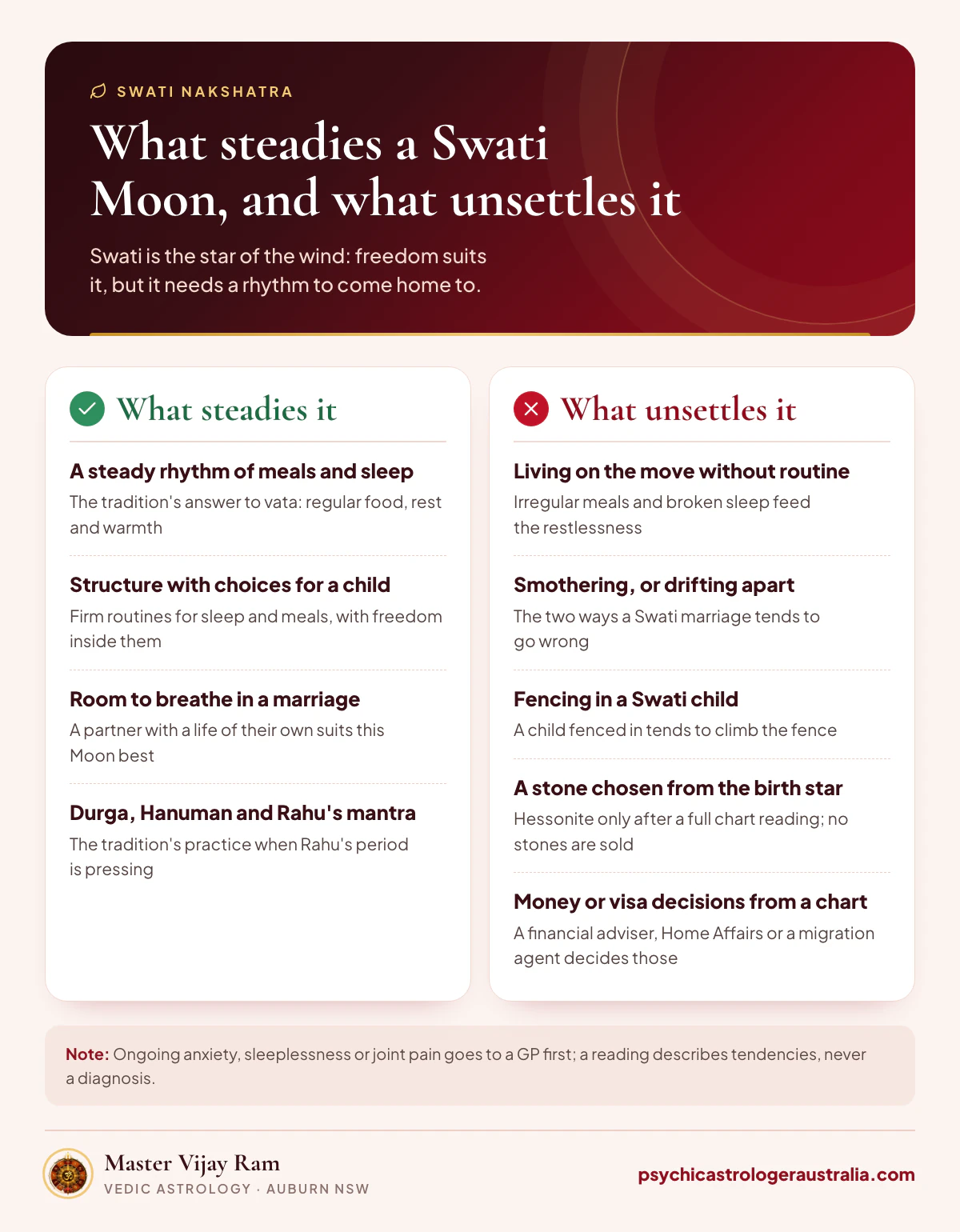
The tradition's advice to parents is structure with choices: firm routines for sleep and meals, and freedom inside them. A child given room tends to come back; a child fenced in tends to climb the fence.
How does Swati approach love and marriage?
The tradition reads Swati nakshatra marriage as companionable, fair-minded and in need of air. A Swati partner commits most happily when commitment does not feel like a cage, and does best with someone who has a life of their own. Trouble tends to come from smothering on one side or drifting on the other.
For matching, Swati is Deva gana, Antya nadi and male buffalo yoni. Hasta, the female buffalo, scores well with it on all three: the same Deva gana, a different nadi and the matching yoni, while Ashwini and Shatabhisha, the two horse stars, sit opposite it on yoni, and a partner in another Antya star such as Magha, Vishakha or Revati meets Nadi dosha unless one of its exceptions applies. Nakshatra compatibility in matching explains how these weigh against everything else.
Is Swati used for travel, vehicles and weddings?
Muhurat texts place Swati in the chara, or movable, group with Punarvasu, Shravana, Dhanishta and Shatabhisha, stars traditionally chosen for journeys, buying a vehicle, moving and anything that should travel well. Swati also belongs to the classical wedding list of eleven and is accepted in most lists for opening a business, while only some lineages accept it for a house-warming. As always, the tithi, weekday, lagna and the people's charts finish the choice.
What health habits go with a star of the wind?
In the tradition, wind means vata: irregular meals, broken sleep, cold hands, stiff joints, a nervous stomach and a mind that will not settle at night. Libra, the sign of the scales, is associated in tradition with the lower back and the kidneys. The Swati habit to watch is living on the move without routine, and the tradition's advice is a steady rhythm of meals, sleep and warmth.
These are tendencies, never diagnoses. Ongoing anxiety, sleeplessness, joint pain or anything involving the kidneys goes to a GP first.
What steadies a restless Rahu?
When Rahu is badly placed and its years are under way, the tradition turns to Durga, to Hanuman, the wind god's son, and to Rahu's beej mantra, Om Bhraam Bhreem Bhraum Sah Rahave Namah, alongside an ordered daily routine. Hessonite comes up only after the whole chart has been studied, not because the Moon sits in Swati, and Master Vijay Ram keeps no stones for sale.
A Rahu shanti is suggested only when the period is pressing hard. Vijay Ram ji conducts it personally in Auburn, with the fee starting at $250 and fixed with you in advance, after a $50 consultation, and online puja and havan explains how families interstate join by video.
What can a Swati reading not tell you?
It can describe a temperament and the shape of its periods, but it cannot choose a business for you, approve an investment or decide whether to move countries. Money questions belong with a licensed financial adviser; Home Affairs decides visas, and a registered migration agent can advise on them. This is faith-based guidance in the Vedic tradition, nothing more.
The star before Swati is Chitra, the craftsman's bright jewel, and the star after it is Vishakha, the star of purpose, where Swati's wandering turns into a single aim.
Read next
- Shatabhisha Nakshatra: The Star of a Hundred HealersShatabhisha nakshatra explained: Varuna and the empty circle, Rahu as lord, padas and name sounds, traits, career and…
- Ardra Nakshatra: Rudra’s Star of Storms and ClearingArdra nakshatra: Rudra, the teardrop and the storm that clears, Rahu as lord and its 18-year dasha, padas and name so…
- Online Istikhara Service in Australia for Marriage & DecisionsHow online istikhara for marriage and other decisions works in Australia, what a genuine practitioner asks for, and t…
Frequently asked questions
Why is Swati called the independent star?
Because its deity is Vayu, the wind, which goes where it pleases and belongs to no one, and its symbol is a young shoot that bends with every gust and springs back. The tradition reads a person who needs room to think, travel and arrange their own work, and who does best when trusted rather than supervised. Independence is the gift; restlessness is its shadow.
Is Swati nakshatra good for business?
The tradition links Swati closely with trade, and the star appears in the usual muhurat lists for opening a business. People with a Swati Moon are often natural traders, negotiators and self-employed workers. Whether a particular business will do well is a different question, read from the tenth and eleventh houses and the dasha, and the money side belongs with a financial adviser.
How long is the Rahu dasha at birth for a Swati Moon?
Up to eighteen years, set by the Moon's distance from the star's far edge at birth. A Moon at Swati's first degree carries nearly the full eighteen, one at its midpoint about nine, and one near 20° of Libra very little. Jupiter's sixteen-year period follows, so most Swati people move from Rahu to Jupiter somewhere between infancy and their late teens.
What names suit a baby born in Swati?
Names that open with the quarter's sound: Ru in the first, as in Rupa or Rudra; Re in the second, as in Rekha or Reyansh; Ro in the third, as in Rohan or Roshni; and Ta in the fourth, as in Tara or Tanmay. Regional lists vary a little, and the quarter should be confirmed from the hospital's recorded time before a name is announced.
Is Swati nakshatra good for a wedding?
Yes, traditionally. Swati is among the eleven stars the classical texts allow for a wedding, and as a movable star it is also favoured for journeys, vehicles and moves. A ceremony still needs a suitable tithi, a good weekday, the right lagna and the couple's own charts, so the star opens the door rather than settling the date; the household's priest decides the rest.
Who makes a good match for a Swati Moon?
On the nakshatra layer, Hasta suits Swati on all three counts: it shares the Deva gana, sits in a different nadi, Adi, and carries the female buffalo yoni. A partner in another Antya-nadi star such as Magha, Vishakha or Revati creates Nadi dosha that a recognised exception may cancel, and Ashwini and Shatabhisha, with their horse yoni, are the weakest yoni pairing. The full kundli decides.
Does a Swati Moon mean I will live abroad?
Not by itself. The tradition reads a love of travel and new places in Swati, but settlement abroad is read from the ninth and twelfth houses, their lords and the dasha, and many Swati people travel widely and live at home. Whether a visa is granted is decided by Home Affairs, and a registered migration agent is the right adviser for that question.
What is the story of the Swati raindrop?
A poetic tradition says that rain falling while the Sun is in Swati turns into a pearl if a drop lands in an oyster, and that the chataka bird drinks no water except that rain. Indian poets use the image for patience, devotion and waiting for the right moment. It is a poem rather than a prediction, and it gives the star its gentle reputation.
People also ask
What is the symbol of Swati nakshatra?
A young shoot or sapling swaying in the wind, which bends almost to the ground and springs back when the gust has passed. It stands for adaptability and independence, and also for the shallow roots of something young. Some lists give coral or a sword instead, so traditions differ, but the swaying shoot is the image most families know.
Who is the deity of Swati nakshatra?
Vayu, the god of wind and of prana, the breath of life. He moves everywhere and is held by nothing, and in the epics he is the father of Hanuman and of Bhima. Because the wind carries things from place to place, the tradition ties the star to freedom, movement, communication and trade.
Which rashi is Swati nakshatra?
Libra, Tula rashi, for every pada, since Swati begins at 6°40′ and ends at 20° of sidereal Libra. A Swati Moon is therefore a Libra Moon, with Venus ruling the sign and Rahu the star, so Sade Sati and Jupiter's yearly movement are measured from Libra. The four quarters differ only in their navamsa, from Sagittarius to Pisces.
What is the animal of Swati nakshatra?
The male buffalo, in the yoni scheme that compares two Moons for marriage. Hasta, two stars earlier, carries the female buffalo and pairs fully with it, while the horse yoni of Ashwini and Shatabhisha stands opposite. Yoni is a single strand of the eight-koota match and concerns physical temperament between partners, not character.
Which star is Swati in the night sky?
Arcturus, the brightest star of the northern celestial hemisphere and one of the brightest in the whole sky, with a warm orange colour. From Australia it shines low in the northern sky. In the sidereal zodiac its nakshatra, Swati, covers 6°40′ to 20° of Libra.
References & further reading
Serving clients across Australia
Confidential consultations by phone, video & WhatsApp — including: