

Quick answer
Sharad Navratri 2027 begins with Ghatasthapana on Friday 1 October in every Australian city, the Pratipada being present at sunrise and ending at 10:06 am AEST, and in India on Thursday 30 September. Durga Ashtami is Friday 8 October in Australia, Maha Navami is Saturday 9 October, and Vijayadashami falls the same Saturday afternoon, in India and Australia alike.
Navratri 2027 in Australia at a glance
Sharad Navratri is the nine-night festival of the Goddess that begins on the Pratipada of Ashwin's bright fortnight and closes with Vijayadashami on the tenth day. In 2027 the kalash is installed on Friday 1 October in every Australian city, Durga Ashtami falls on Friday 8 October, and the ninth night and Dussehra share Saturday 9 October.
India begins a day earlier, on Thursday 30 September, and ends on the same Saturday. The nine nights also carry two events of their own this year: daylight saving returns on the third night, Sunday 3 October, and Mercury turns retrograde on the Ashtami.
| City | Date | Ashwin Shukla Pratipada (local time) | Rule applied |
|---|---|---|---|
| Sydney | Fri 1 Oct 2027 | Thu 30 Sep 2027, 12:36 PM AEST – Fri 01 Oct 2027, 10:06 AM AEST | tithi present at sunrise (udaya tithi) |
| Melbourne | Fri 1 Oct 2027 | Thu 30 Sep 2027, 12:36 PM AEST – Fri 01 Oct 2027, 10:06 AM AEST | tithi present at sunrise (udaya tithi) |
| Brisbane | Fri 1 Oct 2027 | Thu 30 Sep 2027, 12:36 PM AEST – Fri 01 Oct 2027, 10:06 AM AEST | tithi present at sunrise (udaya tithi) |
| Perth | Fri 1 Oct 2027 | Thu 30 Sep 2027, 10:36 AM AWST – Fri 01 Oct 2027, 8:06 AM AWST | tithi present at sunrise (udaya tithi) |
| Adelaide | Fri 1 Oct 2027 | Thu 30 Sep 2027, 12:06 PM ACST – Fri 01 Oct 2027, 9:36 AM ACST | tithi present at sunrise (udaya tithi) |
| Canberra | Fri 1 Oct 2027 | Thu 30 Sep 2027, 12:36 PM AEST – Fri 01 Oct 2027, 10:06 AM AEST | tithi present at sunrise (udaya tithi) |
| Hobart | Fri 1 Oct 2027 | Thu 30 Sep 2027, 12:36 PM AEST – Fri 01 Oct 2027, 10:06 AM AEST | tithi present at sunrise (udaya tithi) |
| Darwin | Fri 1 Oct 2027 | Thu 30 Sep 2027, 12:06 PM ACST – Fri 01 Oct 2027, 9:36 AM ACST | tithi present at sunrise (udaya tithi) |
| New Delhi (reference) | Thu 30 Sep 2027 | Thu 30 Sep 2027, 8:06 AM IST – Fri 01 Oct 2027, 5:36 AM IST | the day the tithi covers most of the daylight — it meets no sunrise here (kshaya) |
The tithi is one moment everywhere; only the clock and the sunrise differ, which is why a city can fall a day apart from India. Computed with the Swiss Ephemeris (Lahiri ayanamsa for Vedic positions) and checked against US Naval Observatory data. Times are rounded to the minute.
Every time on this page was computed for the city centre with the Swiss Ephemeris and the Lahiri ayanamsa, in the city's own clock. Temples follow their own panchang, and Navratri 2027 in Australia will be kept on more than one timetable; what follows is the one the sky gives.
Why Ghatasthapana is Friday here and Thursday in India
Ghatasthapana belongs to the Pratipada, and the rule is the usual one: the civil day on which the tithi is present at sunrise. In 2027 the Pratipada runs from 12:36 pm on Thursday 30 September to 10:06 am on Friday 1 October, Sydney time, so it is present at every Australian sunrise on the Friday and at none on the Thursday.
In India the same tithi runs from 8:06 am on the Thursday to 5:36 am on the Friday, which misses both sunrises, Thursday's at 6:14 am and Friday's a minute later. A tithi that meets no sunrise is kshaya for that place, and the panchangs then use the day it fills, which is Thursday 30 September; Drik Panchang lists the same date, with the kalash installed after 8:06 am.
That is why a Sydney family and their parents in Jalandhar will install the kalash a day apart in 2027 and both be right. The nine nights then run in step, because the later tithis are present at sunrise in both countries on the same dates, until the Ashtami, where India is again a day ahead.
Ghatasthapana times by city
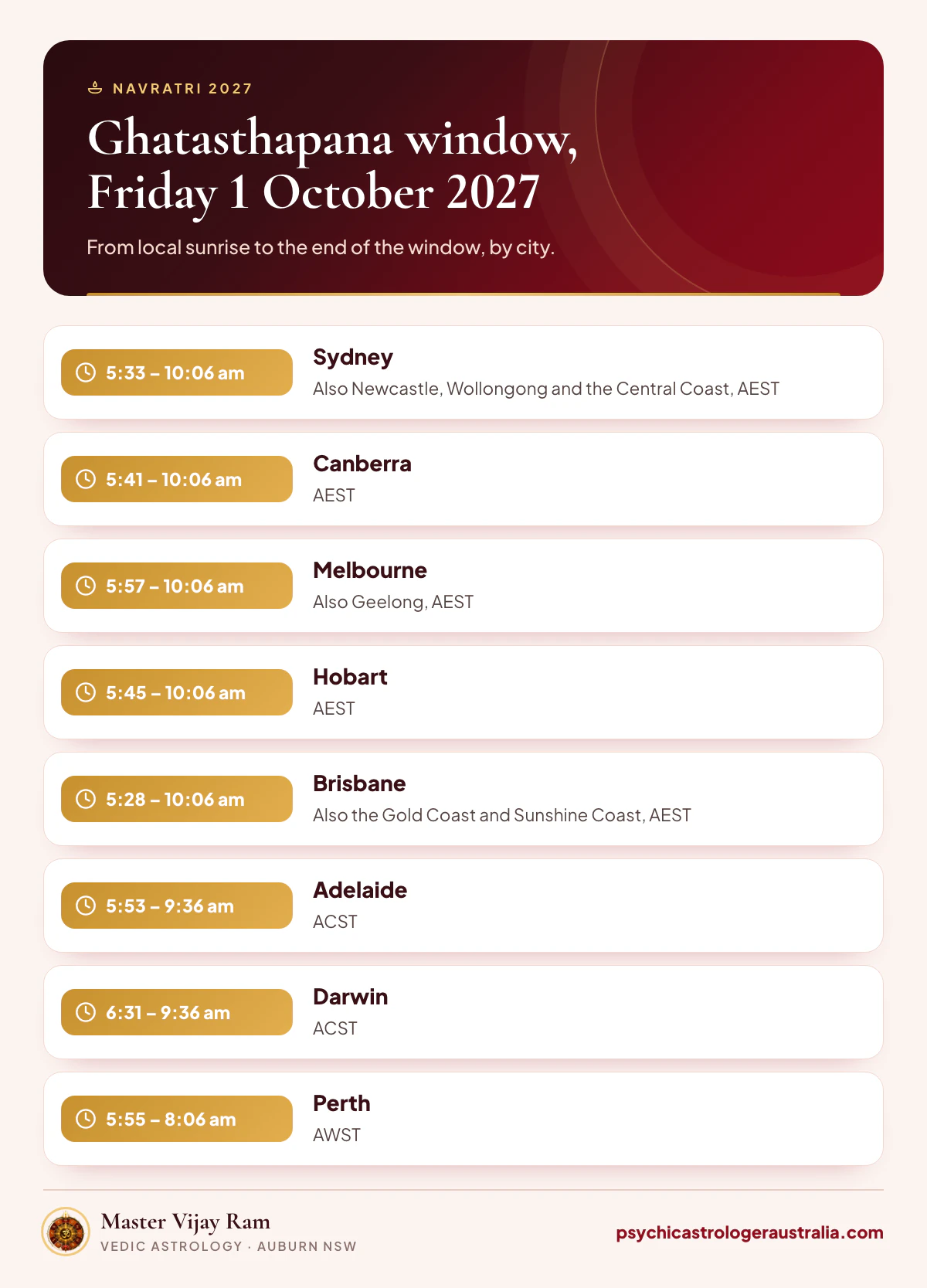
The kalash is installed in the morning while the Pratipada runs, so the window is from local sunrise to the moment the tithi ends: 10:06 am in the eastern cities, 9:36 am in Adelaide and Darwin and 8:06 am in Perth. Abhijit muhurat, the midday alternative, is of no use in Australia this year because the Pratipada has ended by then.
| City | Sunrise, Friday 1 October 2027 | Ghatasthapana window |
|---|---|---|
| Sydney, Newcastle, Wollongong, Central Coast | 5:33 am AEST | 5:33 am – 10:06 am |
| Canberra | 5:41 am AEST | 5:41 am – 10:06 am |
| Melbourne, Geelong | 5:57 am AEST | 5:57 am – 10:06 am |
| Hobart | 5:45 am AEST | 5:45 am – 10:06 am |
| Brisbane, Gold Coast, Sunshine Coast | 5:28 am AEST | 5:28 am – 10:06 am |
| Adelaide | 5:53 am ACST | 5:53 am – 9:36 am |
| Darwin | 6:31 am ACST | 6:31 am – 9:36 am |
| Perth | 5:55 am AWST | 5:55 am – 8:06 am |
| New Delhi (reference) | 6:14 am IST, Thursday 30 September | after 8:06 am, when the Pratipada begins |
A working family that cannot install the kalash before leaving should do it at sunrise rather than in the evening; Ghatasthapana 2027 is a morning rite everywhere in Australia this year. Perth's two-hour window is the shortest, and a Perth household that installs the kalash at 7:30 am has kept it in full.
The nine nights, day by day, on the Australian clock
Each night is given to one form of the Goddess, and the tithi present at sunrise names the day. In the eastern cities, Adelaide and Darwin the sequence is clean in 2027, one tithi to a day, which is not always the case.
| Day | Date (Sydney) | Tithi at sunrise | Form of Durga | Note |
|---|---|---|---|---|
| 1 | Fri 1 Oct | Pratipada (until 10:06 am AEST) | Shailaputri | Ghatasthapana at sunrise |
| 2 | Sat 2 Oct | Dwitiya | Brahmacharini | |
| 3 | Sun 3 Oct | Tritiya | Chandraghanta | Daylight saving begins at 2:00 am in NSW, Vic, ACT, Tas, SA |
| 4 | Mon 4 Oct | Chaturthi | Kushmanda | |
| 5 | Tue 5 Oct | Panchami | Skandamata | |
| 6 | Wed 6 Oct | Shashthi | Katyayani | |
| 7 | Thu 7 Oct | Saptami | Kalaratri | India keeps Durga Ashtami today |
| 8 | Fri 8 Oct | Ashtami (until 11:58 am AEDT) | Mahagauri | Durga Ashtami; Mercury retrograde from 1:37 am AEDT |
| 9 | Sat 9 Oct | Navami (until 2:32 pm AEDT) | Siddhidatri | Maha Navami; Vijayadashami from the afternoon |
Perth's sunrises come two and a half hours later in real time, which changes two days there: the Tritiya has ended before Perth's Sunday sunrise, so Perth keeps Chaturthi on Sunday 3 October, and the Saptami is present at both the Wednesday and the Thursday sunrise. Perth's Ashtami and Navami fall on the Friday and Saturday like the rest of the country.
Durga Ashtami, Sandhi puja and Maha Navami
The Ashtami runs from 9:43 am on Thursday 7 October to 11:58 am on Friday 8 October, Sydney time. It is present at Friday's sunrise and not Thursday's, so Durga Ashtami is Friday 8 October in Australia; in India the same tithi is present at Thursday's sunrise, which puts their Ashtami on Thursday 7 October.
| City | Date | Ashwin Shukla Ashtami (local time) | Rule applied |
|---|---|---|---|
| Sydney | Fri 8 Oct 2027 | Thu 07 Oct 2027, 9:44 AM AEDT – Fri 08 Oct 2027, 11:58 AM AEDT | tithi present at sunrise (udaya tithi) |
| Melbourne | Fri 8 Oct 2027 | Thu 07 Oct 2027, 9:44 AM AEDT – Fri 08 Oct 2027, 11:58 AM AEDT | tithi present at sunrise (udaya tithi) |
| Brisbane | Fri 8 Oct 2027 | Thu 07 Oct 2027, 8:44 AM AEST – Fri 08 Oct 2027, 10:58 AM AEST | tithi present at sunrise (udaya tithi) |
| Perth | Fri 8 Oct 2027 | Thu 07 Oct 2027, 6:44 AM AWST – Fri 08 Oct 2027, 8:58 AM AWST | tithi present at sunrise (udaya tithi) |
| Adelaide | Fri 8 Oct 2027 | Thu 07 Oct 2027, 9:14 AM ACDT – Fri 08 Oct 2027, 11:28 AM ACDT | tithi present at sunrise (udaya tithi) |
| Canberra | Fri 8 Oct 2027 | Thu 07 Oct 2027, 9:44 AM AEDT – Fri 08 Oct 2027, 11:58 AM AEDT | tithi present at sunrise (udaya tithi) |
| Hobart | Fri 8 Oct 2027 | Thu 07 Oct 2027, 9:44 AM AEDT – Fri 08 Oct 2027, 11:58 AM AEDT | tithi present at sunrise (udaya tithi) |
| Darwin | Fri 8 Oct 2027 | Thu 07 Oct 2027, 8:14 AM ACST – Fri 08 Oct 2027, 10:28 AM ACST | tithi present at sunrise (udaya tithi) |
| New Delhi (reference) | Thu 7 Oct 2027 | Thu 07 Oct 2027, 4:14 AM IST – Fri 08 Oct 2027, 6:28 AM IST | tithi present at sunrise (udaya tithi) |
The tithi is one moment everywhere; only the clock and the sunrise differ, which is why a city can fall a day apart from India. Computed with the Swiss Ephemeris (Lahiri ayanamsa for Vedic positions) and checked against US Naval Observatory data. Times are rounded to the minute.
Sandhi puja, the forty-eight minutes that straddle the junction of Ashtami and Navami, falls on Friday 8 October at 11:34 am to 12:22 pm AEDT in Sydney, Melbourne, Canberra and Hobart, 10:34 to 11:22 am AEST in Brisbane, 11:04 to 11:52 am ACDT in Adelaide, 10:04 to 10:52 am ACST in Darwin and 8:34 to 9:22 am AWST in Perth. The Navami then runs until 2:32 pm on Saturday 9 October, so Maha Navami's havan and kanya puja belong to Saturday morning, and the Dashami begins that afternoon.
Vijayadashami on Saturday 9 October
The Dashami begins at 2:32 pm AEDT on Saturday 9 October and is present through that afternoon in every Australian city, with the Moon passing into Shravana nakshatra as it does, the combination the panchangs prize most for Vijayadashami. It is the same date in India, where the Dashami began that morning.
Nine nights and the tenth day therefore fit inside nine civil days in 2027, from Friday 1 October to Saturday 9 October, and families should not look for a tenth day on the Sunday for Dussehra itself, although the Dashami is still present then. The Dussehra 2027 page gives the Vijay muhurat for each city.
Daylight saving arrives on the third night
At 2:00 am on Sunday 3 October 2027 the clocks go forward in New South Wales, Victoria, the ACT, Tasmania and South Australia, and the rest of Sharad Navratri 2027 runs on summer time in those states. Queensland, the Northern Territory and Western Australia do not change, so the gap between Sydney and Perth widens from two hours to three in the middle of the festival.
For a family with a daily aarti at a fixed hour this is only a matter of the alarm clock. For anyone timing the Sandhi puja or the Navami havan, it is the reason the times above are given in AEDT, ACDT and AEST separately rather than as one list.
Mercury turns retrograde on the Ashtami
Mercury stations retrograde at 1:37 am AEDT on Friday 8 October 2027, the morning of Durga Ashtami, and stays retrograde until 1:11 am on Friday 29 October, Diwali morning. The pujas of Navratri are not affected in the slightest; devotion is not a contract, and no tradition postpones the Goddess for Mercury.
What the retrograde touches is the Navratri shopping and the Dussehra purchases, the car, the phone, the account opened for a new venture. The Mercury retrograde 2027 calendar sets out the dates, and the honest advice is to buy if you must, read everything twice and keep the receipts.
A Navratri sadhana for protection
Navratri is the traditional season for a Navratri sadhana of protection, because the Goddess of these nine nights is the one who removes what oppresses. The simplest form needs no priest: the kalash installed on the first morning, a lamp kept lit, and a fixed daily count of the Navarna mantra, Om Aim Hreem Kleem Chamundayai Vichche, or a daily reading from the Durga Saptashati for those who can.
- Install the kalash in the morning window for your city on Friday 1 October, with barley sown in a tray of earth beside it and a lamp that is relit each evening.
- Choose one practice and keep it every day: a mala of the Navarna mantra, the Devi Kavacham, or one chapter of the Saptashati, at the same hour.
- Fast as your health and roster allow; a nurse on nights or a student in exams keeps a lighter fast with a clear conscience.
- On the Ashtami or the Navami, feed and honour young girls as the Goddess, and on the Saturday afternoon complete the sadhana at the Vijay muhurat.
A sadhana like this is a devotion, and it will not do what medicine, a lawyer or a locksmith does. Anyone frightened in their own home should ring the police or a doctor first, and for a house that has felt heavy, the Navratri house-cleansing guide looks at the ordinary causes before the spiritual ones.
Fasting and garba on Australian rosters
The nine nights land across two working weeks, and the garba and dandiya nights in Melbourne's west and south-east, in Sydney's Harris Park and Blacktown and in Brisbane's southern suburbs are mostly held on the weekends inside the festival, Saturday 2 and Saturday 9 October in 2027. That is a community timetable, not a tithi, and it sits comfortably beside the home observance.
Smaller communities improvise. On the Sunshine Coast the Hindu community meets in hired halls, Townsville's Durga Mahalakshmi temple is under construction, and families in Newcastle and on the Central Coast often drive to Sydney for a single big night and keep the other eight at home, which is how most of the country does it.
What Navratri means in a reading
The nine nights follow the waxing Moon from the new moon of 30 September to the Sharad Purnima of 16 October, and Vedic astrologers have always treated them as a season for beginning remedies, above all those for Mars, Rahu and Ketu, the planets whose troubles the Goddess is invoked against. Whether a particular chart calls for a Chandi havan, a Durga mantra or nothing at all is what a reading decides; the calendar cannot.
Where a remedy is warranted and the family cannot perform it, a Chandi or Navratri havan is performed personally on request at his own place of practice in Auburn on the right night, with the family joining by video. A consultation is $50; a havan performed on request starts from $250, and the figure is agreed before anything is performed. This is faith-based guidance, not medical, legal or financial advice, and a yearly forecast will tell you whether the season matters for your chart at all.
What this calendar cannot do
It cannot overrule your temple. Many Australian temples will begin on the Thursday with India's panchang and some will begin on the Friday with the local sunrise, and a family that joins either congregation is inside the tradition. The full 2027 festival calendar shows where the two countries agree and where they part.
It also cannot choose a muhurat for a wedding, a griha pravesh or a business opening in the Navratri season, which is a question about a particular chart on a particular day. A muhurat consultation is where that is settled, and the Vijay muhurat of Saturday 9 October is the one date in the season that needs no such checking.
Read next
- Hindu Festival Dates 2027 in Australia: The Full CalendarEvery major Hindu festival date for 2027 in Australian time, city by city, with the India date beside it and the rule…
- Diwali 2026 and 2027 in Australia: Dates and Lakshmi Puja Times by CityDiwali falls on Sun 8 Nov 2026 and Fri 29 Oct 2027 across Australia. Lakshmi Puja sunset, Pradosh Kaal and Vrishabha …
- Evil Eye Protection for Your Business & ShopTrade dropped and nothing on the books explains it. A plain guide to nazar on a shop, what to rule out first, and hon…
Frequently asked questions
When does Navratri 2027 start in Australia?
Sharad Navratri 2027 begins with Ghatasthapana on Friday 1 October in every Australian city. The Ashwin Shukla Pratipada runs from 12:36 pm on Thursday 30 September to 10:06 am on Friday 1 October, Sydney time, so it is present at the Friday sunrise everywhere from Brisbane to Perth and at no Australian sunrise on the Thursday. The kalash is installed in the morning, before the tithi ends.
When does Navratri 2027 start in India?
Thursday 30 September 2027. In India the Pratipada runs from 8:06 am on the Thursday to 5:36 am on the Friday, which misses both sunrises, and a tithi that meets no sunrise is kshaya for that place. The panchangs then use the day the tithi fills, which is the Thursday, and Drik Panchang lists Ghatasthapana on 30 September with the kalash installed after 8:06 am. India is therefore a day ahead of Australia for the first night.
What time is Ghatasthapana in Sydney, Melbourne and Brisbane?
From local sunrise on Friday 1 October 2027 until the Pratipada ends at 10:06 am AEST: sunrise is 5:33 am in Sydney, 5:57 am in Melbourne and 5:28 am in Brisbane, with Canberra at 5:41 am and Hobart at 5:45 am. Newcastle, Wollongong and the Central Coast follow Sydney, Geelong follows Melbourne, and the Gold Coast and the Sunshine Coast follow Brisbane. There is no useful Abhijit window in Australia this year because the tithi has ended by midday.
What time is Ghatasthapana in Perth, Adelaide and Darwin?
Perth's window is from sunrise at 5:55 am AWST to 8:06 am, when the Pratipada ends on the Perth clock, the shortest in the country. Adelaide's runs from 5:53 am ACST to 9:36 am, and Darwin's from 6:31 am ACST to 9:36 am. All three cities are still on standard time on Friday 1 October; Adelaide moves to daylight saving on Sunday 3 October, while Perth and Darwin do not change at all.
When is Durga Ashtami 2027 in Australia?
Friday 8 October 2027. The Ashtami runs from 9:43 am on Thursday 7 October to 11:58 am on Friday 8 October, Sydney time, so it is present at Friday's sunrise and not Thursday's. India keeps Durga Ashtami on Thursday 7 October, because the same tithi is present at the Indian sunrise that day. Sandhi puja, at the junction of Ashtami and Navami, falls at 11:34 am to 12:22 pm AEDT in the eastern cities.
When is Maha Navami and Dussehra 2027?
Both fall on Saturday 9 October 2027 in Australia. The Navami is present at Saturday's sunrise and runs until 2:32 pm AEDT, so the Navami havan and kanya puja belong to Saturday morning, and the Dashami begins that afternoon with the Moon entering Shravana nakshatra, which makes the Saturday afternoon Vijayadashami. India also keeps Dussehra on Saturday 9 October, with Maha Navami on Friday 8 October in Drik Panchang's reckoning.
Does daylight saving change the Navratri times?
Yes, in the middle of the festival. Clocks go forward at 2:00 am on Sunday 3 October 2027 in New South Wales, Victoria, the ACT, Tasmania and South Australia, so the Ghatasthapana times are in standard time and the Ashtami, Navami and Dussehra times are in daylight time. Queensland, the Northern Territory and Western Australia do not change, which is why Brisbane, Darwin and Perth are listed separately on this page.
Is Mercury retrograde during Navratri 2027?
From the Ashtami onwards. Mercury stations retrograde at 1:37 am AEDT on Friday 8 October 2027 and turns direct at 1:11 am on Friday 29 October, Diwali morning, so the last two days of Navratri, Dussehra, Karva Chauth and Dhanteras all fall inside it. The pujas are unaffected; purchases and agreements made for Dussehra deserve a second reading, and nothing in the tradition postpones the Goddess for a planet.
What is a safe Navratri sadhana for protection at home?
The kalash installed on the first morning, a lamp relit each evening, and one practice kept daily at the same hour: a mala of the Navarna mantra, the Devi Kavacham, or a chapter of the Durga Saptashati. Fast as your health and roster allow, honour young girls on the Ashtami or Navami, and finish at the Vijay muhurat on Saturday 9 October. It is a devotion, not a substitute for a doctor, the police or a locksmith when a home is unsafe.
People also ask
How many days is Navratri 2027?
Nine nights from Friday 1 October to Saturday 9 October 2027 in Australia, with Vijayadashami on the Saturday afternoon, so the nine nights and the tenth day fit inside nine civil days this year. In India the count runs from Thursday 30 September to Friday 8 October with Dussehra on Saturday 9 October. The difference is a kshaya Pratipada in India, not a different calendar.
What are the nine forms of Durga and their days in 2027?
In the eastern Australian cities, Adelaide and Darwin: Shailaputri on Friday 1 October, Brahmacharini on Saturday 2, Chandraghanta on Sunday 3, Kushmanda on Monday 4, Skandamata on Tuesday 5, Katyayani on Wednesday 6, Kalaratri on Thursday 7, Mahagauri on Friday 8 and Siddhidatri on Saturday 9 October. Perth keeps Chaturthi on the Sunday and Saptami on both Wednesday and Thursday because of its later sunrises.
What is Ghatasthapana?
The installation of the kalash, the water pot that represents the Goddess for the nine nights, with barley sown beside it and a lamp lit. It is done on the Pratipada of Ashwin's bright fortnight, in the morning while the tithi is present at sunrise, which in Australia in 2027 means from sunrise to 10:06 am AEST on Friday 1 October, 9:36 am in Adelaide and Darwin and 8:06 am in Perth.
Can I fast during Navratri if I work night shifts?
Yes, and the tradition has always allowed the fast to bend to health and duty. A nurse on nights, a student in exams or a parent with young children keeps a lighter fast, one meal of fruit or sattvic food, and the sadhana of a daily mantra or reading at a fixed hour. Anyone with diabetes, a pregnancy or a medical condition should ask their doctor first; the Goddess is not honoured by a hospital visit.
Is Navratri a good time to start a business or move house?
The tradition treats the season as auspicious and Vijayadashami, Saturday 9 October 2027, as a day that needs no separate muhurat for a beginning. For a particular business or house, though, the date still has to be checked against the owner's chart, and in 2027 Mercury is retrograde from the Ashtami, which matters for contracts. A muhurat consultation settles both questions for a specific family.
References & further reading
Serving clients across Australia
Confidential consultations by phone, video & WhatsApp — including: