

Quick answer
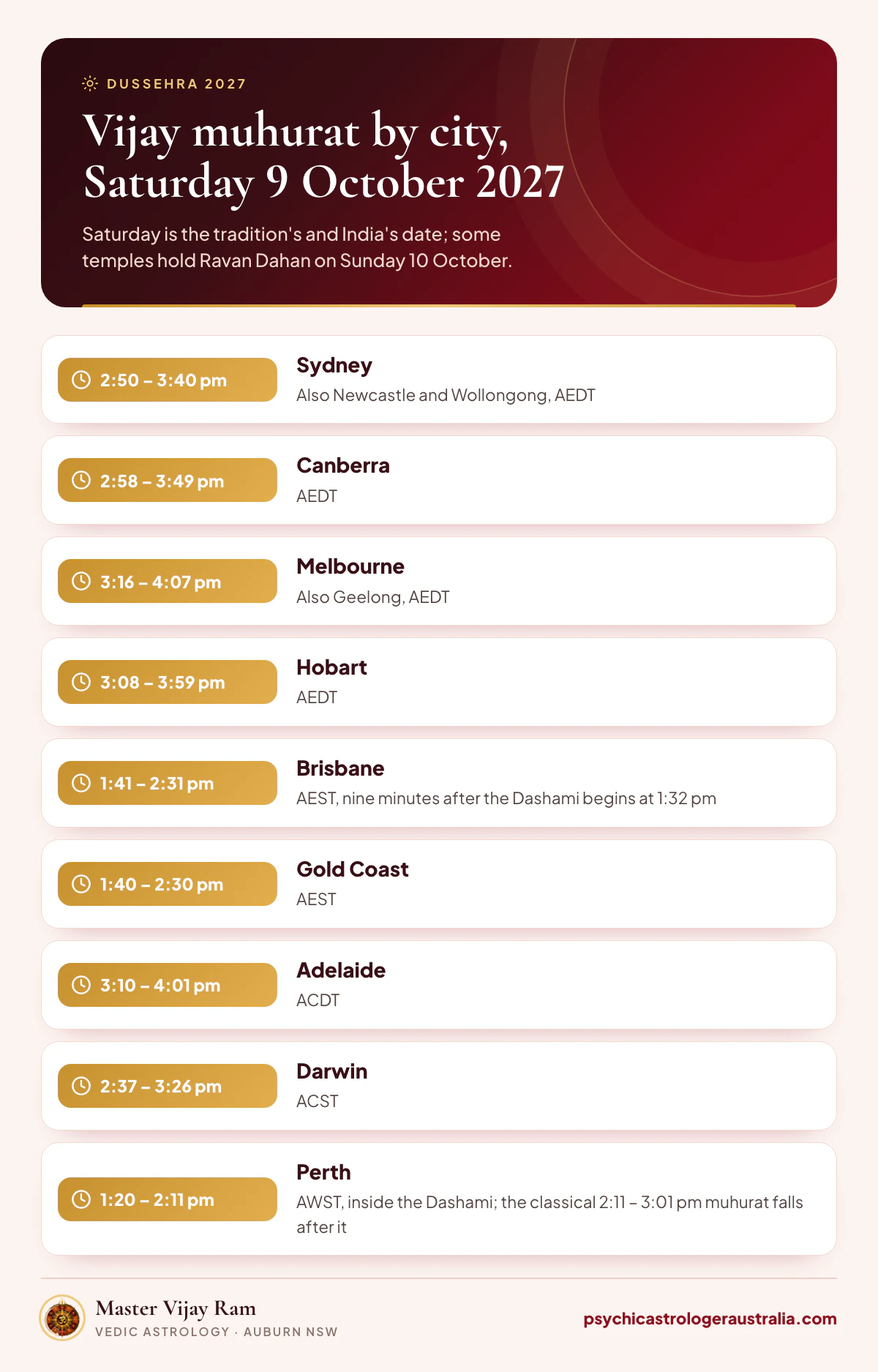
Dussehra 2027, Vijayadashami, falls on Saturday 9 October in every Australian city and in India. The Dashami begins at 2:32 pm AEDT and is present through the Saturday afternoon everywhere, so the Vijay muhurat is 2:50 to 3:40 pm in Sydney, 3:16 to 4:07 pm in Melbourne and 1:41 to 2:31 pm in Brisbane; in Perth the Dashami ends at 2:11 pm, so the puja is done between 1:20 and 2:11 pm.
Dussehra 2027 in Australia at a glance
Dussehra, or Vijayadashami, is the tenth-day festival that closes Navratri, kept on the Dashami of Ashwin's bright fortnight when that tithi is present in the afternoon. In 2027 it falls on Saturday 9 October in every Australian city, and on the same Saturday in India, which makes it one of the few festivals of the year on which the two countries agree without a day's difference.
The Dashami begins at 2:32 pm AEDT on the Saturday, Sydney time, and lasts until 5:11 pm on the Sunday. The afternoon of Saturday is therefore inside it from Cairns to Hobart, and the only city with a complication is Perth, where the tithi ends at 2:11 pm on the local clock.
| City | Date | Ashwin Shukla Dashami (local time) | Rule applied |
|---|---|---|---|
| Sydney | Sat 9 Oct 2027 | Sat 09 Oct 2027, 2:32 PM AEDT – Sun 10 Oct 2027, 5:11 PM AEDT | tithi present in the afternoon (aparahna) |
| Melbourne | Sat 9 Oct 2027 | Sat 09 Oct 2027, 2:32 PM AEDT – Sun 10 Oct 2027, 5:11 PM AEDT | tithi present in the afternoon (aparahna) |
| Brisbane | Sat 9 Oct 2027 | Sat 09 Oct 2027, 1:32 PM AEST – Sun 10 Oct 2027, 4:11 PM AEST | tithi present in the afternoon (aparahna) |
| Perth | Sat 9 Oct 2027 | Sat 09 Oct 2027, 11:32 AM AWST – Sun 10 Oct 2027, 2:11 PM AWST | tithi present in the afternoon (aparahna) |
| Adelaide | Sat 9 Oct 2027 | Sat 09 Oct 2027, 2:02 PM ACDT – Sun 10 Oct 2027, 4:41 PM ACDT | tithi present in the afternoon (aparahna) |
| Canberra | Sat 9 Oct 2027 | Sat 09 Oct 2027, 2:32 PM AEDT – Sun 10 Oct 2027, 5:11 PM AEDT | tithi present in the afternoon (aparahna) |
| Hobart | Sat 9 Oct 2027 | Sat 09 Oct 2027, 2:32 PM AEDT – Sun 10 Oct 2027, 5:11 PM AEDT | tithi present in the afternoon (aparahna) |
| Darwin | Sat 9 Oct 2027 | Sat 09 Oct 2027, 1:02 PM ACST – Sun 10 Oct 2027, 3:41 PM ACST | tithi present in the afternoon (aparahna) |
| New Delhi (reference) | Sat 9 Oct 2027 | Sat 09 Oct 2027, 9:02 AM IST – Sun 10 Oct 2027, 11:41 AM IST | tithi present in the afternoon (aparahna) |
The tithi is one moment everywhere; only the clock and the sunrise differ, which is why a city can fall a day apart from India. Computed with the Swiss Ephemeris (Lahiri ayanamsa for Vedic positions) and checked against US Naval Observatory data. Times are rounded to the minute.
Every time on this page was computed for the city centre with the Swiss Ephemeris and the Lahiri ayanamsa. Dussehra 2027 comes two days into a Mercury retrograde and one week into daylight saving in the south-eastern states, both of which are explained below, and neither of which touches the rite itself.
Why Saturday 9 October everywhere
The rule for Vijayadashami is aparahna, the fourth of the five parts into which the daylight is divided, roughly the middle of the afternoon. The civil day on which the Dashami is present during aparahna is Dussehra; where it is present on two consecutive afternoons, the first is preferred, and the panchangs weigh the Moon's nakshatra as well, favouring the day on which Shravana joins the Dashami.
In 2027 both tests point the same way. The Dashami is present in the Saturday aparahna of every Australian city, and the Moon crosses into Shravana nakshatra during that same afternoon, so Saturday 9 October is the Vijayadashami 2027 of the sky and of India alike, where the Dashami began at 9:02 am and runs until Sunday mid-morning.
Sunday 10 October also has the Dashami through its afternoon in Australia, because the tithi lasts until 5:11 pm AEDT that day, and that is the reason some temples will hold their Ravan Dahan on the Sunday. The tradition prefers the first afternoon, and India keeps the Saturday; both days are inside the tithi, and the choice is a community one.
What is the Vijay muhurat?
The daylight is divided into fifteen muhurtas of equal length, and the eleventh of them, in the early afternoon, is Vijaya, the muhurta of victory. On Dussehra it is the preferred window for the Shami puja, the Aparajita puja and any beginning a family wants to mark, and its length depends on the day's length, which in early October is about fifty minutes in the southern cities and a little under in Darwin.
Because it is counted from sunrise, the Vijay muhurat falls at a different clock time in every city, and it is the reason a Brisbane family and a Melbourne family doing the same puja are an hour and a half apart. What matters is that the Dashami be present while the muhurta runs, and in 2027 it is, everywhere except Perth.
Vijay muhurat by city
| City | Dashami present (local clock) | Aparahna, Saturday 9 October 2027 | Vijay muhurat |
|---|---|---|---|
| Sydney, Newcastle, Wollongong | 2:32 pm Sat – 5:11 pm Sun AEDT | 1:59 pm – 4:31 pm | 2:50 pm – 3:40 pm |
| Canberra | 2:32 pm Sat – 5:11 pm Sun AEDT | 2:07 pm – 4:40 pm | 2:58 pm – 3:49 pm |
| Melbourne, Geelong | 2:32 pm Sat – 5:11 pm Sun AEDT | 2:25 pm – 4:58 pm | 3:16 pm – 4:07 pm |
| Hobart | 2:32 pm Sat – 5:11 pm Sun AEDT | 2:16 pm – 4:51 pm | 3:08 pm – 3:59 pm |
| Brisbane | 1:32 pm Sat – 4:11 pm Sun AEST | 12:51 pm – 3:21 pm | 1:41 pm – 2:31 pm |
| Gold Coast | 1:32 pm Sat – 4:11 pm Sun AEST | 12:49 pm – 3:20 pm | 1:40 pm – 2:30 pm |
| Adelaide | 2:02 pm Sat – 4:41 pm Sun ACDT | 2:20 pm – 4:52 pm | 3:10 pm – 4:01 pm |
| Darwin | 1:02 pm Sat – 3:41 pm Sun ACST | 1:48 pm – 4:15 pm | 2:37 pm – 3:26 pm |
| Perth | 11:32 am Sat – 2:11 pm Sun AWST | 1:20 pm – 3:52 pm | 2:11 pm – 3:01 pm, after the Dashami; use 1:20 pm – 2:11 pm |
| New Delhi (reference) | 9:02 am Sat – 11:41 am Sun IST | 1:18 pm – 3:38 pm | 2:05 pm – 2:52 pm |
In Brisbane the Dashami begins at 1:32 pm and the Vijay muhurat opens nine minutes later, which is tight but whole. In Sydney, Canberra, Melbourne and Hobart the muhurta sits comfortably inside the tithi, and in Adelaide and Darwin the whole of aparahna is available.
Perth: the Dashami ends as the muhurat begins
Perth is two and a half hours behind the Indian clock and three behind Sydney's summer time, and in 2027 that puts the Dashami on its clock from 11:32 am on Saturday to 2:11 pm on Sunday. Saturday's aparahna begins at 1:20 pm, so the tithi is present for the first fifty-one minutes of it, and Saturday is Dussehra in Perth as everywhere else.
The classical Vijay muhurat, though, opens at 2:11 pm, the very minute the Dashami ends, and runs outside the tithi. The tradition values the tithi over the muhurta, so a Perth family should do its Shami and Aparajita puja between 1:20 and 2:11 pm, and families who want the muhurta as well can begin at the start of aparahna and finish inside it. Vijay Ram ji's advice to Perth callers is the same every year the clocks fall this way: the Dashami is the festival, and the muhurta is a refinement.
Shami, Aparajita and the crossing of the boundary
Three small rites belong to the afternoon. The Shami puja honours the tree under which the Pandavas hid their weapons; where there is no shami, a leaf of the tree or a picture stands in, and many Australian families keep a sprig from the temple. The Aparajita puja, to the Goddess who cannot be defeated, is a short offering of flowers and a lamp in the north-east, with a prayer for victory over what has oppressed the house.
Seemollanghan, the crossing of the boundary, is the oldest of the three: the household walks beyond its own limit in the afternoon, once the boundary of the village, now the end of the street or the park. It is a rite about leaving fear behind, and children like it best. None of the three needs a priest, and all three fit inside the Vijay muhurat of any city.
New beginnings on Vijayadashami
Vijayadashami is one of the handful of days the tradition treats as an abujh muhurat, a day on which beginnings need no separate timing: a child's first letters at Vidyarambham, a new course of study, a new tool or instrument, a vehicle, a venture. Ayudha puja, the honouring of tools, books and vehicles, is kept on the Navami morning or the Dashami afternoon according to family custom, and in 2027 the Navami runs until 2:32 pm on the same Saturday, so both fall on one day.
A beginning on Dussehra is a blessing, not an exemption. The day blesses the start; whether the venture suits the person is a question about their chart, which is what a business and career reading looks at, and the guide to timing a launch explains how the two fit together. For a wedding or a griha pravesh the day still has to be matched to the particular family, and that is the work of a muhurat consultation.
Mercury retrograde and the Dussehra purchases
Mercury stationed retrograde at 1:37 am AEDT on Friday 8 October 2027, the Durga Ashtami, and stays retrograde until Diwali morning. Dussehra is a traditional day for buying a car, a phone or gold, and 2027 puts that custom two days into a retrograde of the planet of contracts.
The honest answer is not to cancel the purchase but to slow it: read the contract twice, keep the paperwork, and prefer the purchase that was decided before the retrograde began to the one found on the day. The Mercury retrograde 2027 calendar gives the three periods of the year in every Australian time zone, and the Dussehra puja itself is untouched by any of it.
From Dussehra to Diwali: the twenty days
Dussehra opens the brightest stretch of the Hindu year. Sharad Purnima, the full moon of Ashwin, comes a week later on the night of Friday 15 October into Saturday 16 October, with the full moon at 12:47 am AEDT; Karva Chauth follows on Monday 18 or Tuesday 19 October, the one date of 2027 on which panchangs disagree; Dhanteras is Wednesday 27 October and Diwali is Friday 29 October, twenty days after Vijayadashami.
The Karva Chauth 2027 moonrise page sets out both evenings city by city, and the Diwali page gives the Lakshmi Puja windows. Families who begin a sadhana at Navratri traditionally carry it through to Diwali, and the twenty days are the span.
Dussehra in Sydney, Perth and the regions
The Ravan Dahan fairs of Sydney's west and Melbourne's are community events and in 2027 they have a Saturday to work with, so most will burn the effigy on the right afternoon or that evening; Canberra and Wollongong keep Sydney's clock to the minute. Perth families have the tithi until 2:11 pm and the muhurta question above.
In the north, Townsville's community has broken ground on its Durga Mahalakshmi temple and keeps Brisbane's clock, with the Dashami from 1:32 pm, and Cairns Hindu Samaj gathers in halls and parks. Geelong follows Melbourne's times exactly, and a Geelong family that wants the big night drives to Carrum Downs or the western suburbs on the Saturday evening.
What Dussehra means in a reading
Vijayadashami is the day the tradition assigns to the end of a long fight, which is why astrologers have always used it to close a remedy begun at Navratri or to open one for a chart under pressure from Mars, Rahu or Ketu. The Dussehra 2027 date does not change a dasha, but it is a clean threshold for a resolution, and that is worth more than most people expect.
Where a reading finds that an Aparajita or Chandi havan is warranted and the family cannot perform it, the havan is performed personally on request at his own place of practice in Auburn, on the Saturday afternoon, with the family joining by video. A consultation is $50; a havan performed on request starts from $250, and the figure is agreed before anything is performed. This is faith-based guidance, not medical, legal or financial advice.
What this page cannot do
It cannot tell your temple which afternoon to choose, and it does not try. The Navratri 2027 page shows how the nine nights lead to this Saturday and where India's count differs, and the honest summary is that the Dashami is present on both Saturday and Sunday afternoons in Australia, with Saturday the tradition's preference and India's date.
It also cannot make the Vijay muhurat fall inside the tithi in Perth, which the sky has declined to do this year. Where the muhurta and the tithi part, keep the tithi, light the lamp, and cross the boundary with the children before the sun goes down.
Read next
- Holi 2027 in Australia: Date and Holika Dahan TimingHolika Dahan is Monday 22 March 2027 in every Australian city and Rangwali Holi is Tuesday 23 March; India is a day e…
- Ganesh Chaturthi 2027 in Australia: Date and Sthapana TimingGanesh Chaturthi 2027 is Saturday 4 September in Australia and India. Midday sthapana windows for Sydney, Melbourne, …
- Navratri & Dussehra 2026: Cleanse Your Home of Negative EnergyNavratri and Dussehra 2026 land in an Australian spring. Here is what a home cleansing can honestly do at festival ti…
Frequently asked questions
What is the date of Dussehra 2027 in Australia?
Saturday 9 October 2027 in every Australian city, from Cairns to Perth, and the same Saturday in India. The Ashwin Shukla Dashami begins at 2:32 pm AEDT on the Saturday and is present through the afternoon everywhere, which is the test for Vijayadashami, and the Moon passes into Shravana nakshatra during that afternoon, the combination the panchangs prefer. Sunday 10 October also carries the Dashami, but the first afternoon is the festival.
What is the Vijay muhurat in Sydney and Melbourne on Dussehra 2027?
In Sydney the Vijay muhurat is 2:50 to 3:40 pm AEDT on Saturday 9 October 2027, inside an aparahna of 1:59 to 4:31 pm, with the Dashami present from 2:32 pm. In Melbourne it is 3:16 to 4:07 pm, inside an aparahna of 2:25 to 4:58 pm. Canberra's muhurta is 2:58 to 3:49 pm and Hobart's 3:08 to 3:59 pm; Newcastle, Wollongong and Geelong follow their capitals within a few minutes.
What is the Vijay muhurat in Brisbane, Adelaide and Darwin?
Brisbane, on standard time, has the Dashami from 1:32 pm AEST and a Vijay muhurat of 1:41 to 2:31 pm, nine minutes after the tithi begins; the Gold Coast is 1:40 to 2:30 pm. Adelaide, on daylight time, has the Dashami from 2:02 pm ACDT and a muhurta of 3:10 to 4:01 pm. Darwin has the Dashami from 1:02 pm ACST and a muhurta of 2:37 to 3:26 pm, with the whole aparahna of 1:48 to 4:15 pm available.
What time is Dussehra puja in Perth in 2027?
Between 1:20 and 2:11 pm AWST on Saturday 9 October 2027. The Dashami runs from 11:32 am on the Saturday to 2:11 pm on the Sunday on Perth's clock, and Saturday's aparahna begins at 1:20 pm, so the tithi is present for its first fifty-one minutes. The classical Vijay muhurat of 2:11 to 3:01 pm opens as the Dashami ends and falls outside the tithi, and the tradition keeps the tithi rather than the muhurta.
Why do some temples celebrate Dussehra on Sunday 10 October 2027?
Because the Dashami lasts until 5:11 pm AEDT on the Sunday, so it is present through the Sunday afternoon as well as the Saturday one. Where a tithi covers two afternoons the tradition prefers the first, and the Moon's entry into Shravana on the Saturday afternoon strengthens that choice, which is why India keeps the Saturday. A temple that chooses the Sunday for a community fair is still inside the tithi, and a family may attend both.
Is Dussehra on the same day in India and Australia in 2027?
Yes. In India the Dashami runs from 9:02 am on Saturday 9 October to 11:41 am on Sunday 10 October, so Saturday's aparahna is inside it and Sunday's is not; Delhi's Vijay muhurat is 2:05 to 2:52 pm IST. In Australia the same tithi covers the Saturday afternoon everywhere. It is one of the few 2027 festivals on which the two countries agree, unlike Navratri's first night, Holi and Janmashtami.
Can I buy a car or gold on Dussehra 2027 with Mercury retrograde?
You can, with care. Mercury stationed retrograde at 1:37 am AEDT on Friday 8 October 2027 and turns direct on Diwali morning, 29 October, so Dussehra falls two days into the period. The purchase decided before the retrograde and completed on the day is the safer one; read the contract twice and keep every receipt. The puja and the Vijay muhurat are unaffected, because devotion is not a contract.
What is done on Dussehra at home?
Three short rites in the afternoon: the Shami puja to the tree or a leaf of it, the Aparajita puja with flowers and a lamp in the north-east, and Seemollanghan, a walk with the family beyond the boundary of the home, now the end of the street or the park. Many families also keep Ayudha puja for tools, books and vehicles, and children begin their letters at Vidyarambham. None of it needs a priest, and all of it fits inside the Vijay muhurat.
What happens between Dussehra and Diwali in 2027?
Sharad Purnima falls on the night of Friday 15 into Saturday 16 October, with the full moon at 12:47 am AEDT; Karva Chauth is Monday 18 or Tuesday 19 October, depending on the rule a family follows; Dhanteras is Wednesday 27 October; and Diwali is Friday 29 October, twenty days after Vijayadashami. Mercury turns direct at 1:11 am AEDT on Diwali morning, so the Lakshmi Puja comes after the retrograde ends.
People also ask
When is Dussehra 2027?
Saturday 9 October 2027, in Australia and in India. The festival is kept on the Dashami of Ashwin's bright fortnight when the tithi is present in the afternoon, and in 2027 the Dashami begins at 2:32 pm AEDT in Sydney, 1:32 pm AEST in Brisbane, 11:32 am AWST in Perth and 9:02 am IST in Delhi, all on the Saturday. The Vijay muhurat differs by city because it is counted from local sunrise.
What is the Vijay muhurat?
The eleventh of the fifteen muhurtas into which the daylight is divided, falling in the early afternoon and lasting about fifty minutes in early October. On Vijayadashami it is the preferred window for the Shami and Aparajita puja and for any new beginning, provided the Dashami is present while it runs. In 2027 that holds in every Australian city except Perth, where the tithi ends at 2:11 pm as the muhurta begins.
Is Dussehra an auspicious day to start something new?
The tradition counts Vijayadashami among the abujh muhurats, days on which a beginning needs no separate timing: learning, a new tool, a vehicle, a venture. In 2027 the day is complicated only by Mercury, retrograde since 8 October, which argues for slowing a purchase rather than cancelling it. Whether a particular venture suits a particular person remains a question for their chart, not for the calendar.
What is Seemollanghan on Dussehra?
The crossing of the boundary: the household walks beyond the limit of its own ground in the afternoon, in memory of kings who set out on campaign after the rains. In an Australian suburb the boundary is the end of the street or the gate of the park, and the walk is usually taken with the children after the Shami puja. It is a rite about leaving fear behind, and it needs nothing but the afternoon.
Why is Dussehra ten days after Navratri begins in India but nine in Australia in 2027?
India began Navratri on Thursday 30 September 2027 because the Pratipada met no Indian sunrise and the day it filled was used, while Australia began on Friday 1 October with the Pratipada present at sunrise. Both countries keep Vijayadashami on Saturday 9 October, so India counts ten days and Australia nine. The nine nights are the same nights; only the first civil day differs.
References & further reading
Serving clients across Australia
Confidential consultations by phone, video & WhatsApp — including: