
Quick answer
Maa Kali is the fierce Mother, first of the ten Mahavidyas, invoked to cut through ego, fear and evil and to protect her children. Families keep her gentle Dakshina form at home with a lamp, red flowers and her name, and hold Kali Puja on the Diwali Amavasya. Deeper sadhana belongs only with a guru, and she is never invoked to frighten anyone.
Who is Maa Kali, and why do families turn to her for protection?
Maa Kali is the fierce form of the Goddess who embodies time, death and the destruction of evil, and who is loved, above all in Bengal, as a mother who protects her children from everything that threatens them. Her name is read two ways at once, she who governs time and she who is dark, and her image, black or deep blue, with a sword, a lolling tongue and a garland of heads, is deliberately terrible. The tradition’s point is that the terror is turned outward, at what harms her devotees, never at the devotees themselves.
Bengali families who have kept her for generations call Master Vijay Ram, and so do others who have been told that only Kali can lift what is troubling them. Both deserve a careful answer, and black magic removal, assessed with care describes his own work for the cases where prayer is not the whole answer.
Where does Kali appear in the scriptures?
Her great entrance is in the Devi Mahatmya. When the demons Chanda and Munda attack, the Goddess’s face darkens with anger and Kali springs from her forehead, gaunt and terrible, and destroys them, earning the name Chamunda. When the demon Raktabija proves that every drop of his blood that touches the ground becomes another demon, it is Kali who catches the blood before it falls and ends the multiplying.
That second story is the one devotees return to. Some troubles breed more of themselves every time they are struck, anger answered with anger, fear answered with panic, and Kali is the power that stops the multiplying at its source. The Durga Kavach and the Devi Mahatmya sets out the whole text she steps out of.
Why is Kali the first of the ten Mahavidyas?
The Mahavidyas are ten goddesses of liberating knowledge: Kali, Tara, Tripura Sundari, Bhuvaneshvari, Bhairavi, Chhinnamasta, Dhumavati, Bagalamukhi, Matangi and Kamala. Kali stands first because she is time itself, the power before which everything else is temporary, and the knowledge she gives is the hardest kind: that nothing we cling to is permanent, including our fear.
The other Mahavidyas carry their own traditions and their own cautions. Baglamukhi puja and its ethical limits looks at the eighth, the goddess who stills an opponent’s speech, and at where prayer about another person has to stop.
What do her sword, her tongue and her garland mean?
In the most common image she has four arms. One left hand holds a sword, the knowledge that cuts through ignorance, and the other a severed head, the ego that knowledge removes; her right hands are raised in the gestures that mean do not fear and receive a blessing. The garland is usually counted at fifty or fifty-one heads, read as the letters of the Sanskrit alphabet, which makes her the mother of language and of every mantra.
Her tongue is the detail outsiders misread. In Bengal and Odisha it is widely understood as the gesture of a woman biting her tongue in embarrassment, because in her battle frenzy she has stepped onto Shiva, who lay down in her path to calm her. The fiercest image in Hinduism, in other words, is a picture of fury catching itself and stopping.
Who is Dakshina Kali, and which form belongs at home?
Dakshina Kali is the form most Bengali households keep: the benevolent mother, right foot forward on Shiva’s chest, her right hands blessing. One explanation of her name says that when Yama, lord of death, who lives in the south, heard her name he fled, which is why her devotees are said to have nothing to fear from death itself. The form with the left foot forward, Vamakali, is traditionally kept by renunciates and tantric practitioners, not by householders.
| Form | What she is known for | Where she is usually worshipped |
|---|---|---|
| Dakshina Kali | The protective mother, right foot forward, hands in blessing | Bengali homes and most Kali temples |
| Shyama Kali | The dark, beloved Mother of Bengali devotional song | Homes and community pujas on the Diwali Amavasya |
| Raksha Kali | Protection of a whole village from epidemics and drought | Community pujas in Bengal |
| Bhadrakali | The auspicious, gentler Kali | Temples across India, Kerala above all |
| Mahakali | Kali as the great power of time and the night | Temples, and the first part of the Devi Mahatmya |
| Vamakali or Samhara Kali | Kali as destruction itself, left foot forward | Tantric practice under a guru, never a family shrine |
What is Kali invoked for?
For protection, in the widest sense: of children, of the household, of a community in a time of disease, of a person facing something that frightens them more than they can say. Devotees also invoke her against the inner enemies, pride, anger, greed and the fear of death, which in the tradition are the demons that multiply most readily.
Kali puja for protection is therefore more about courage than about a shield. Bengali poets such as Ramprasad Sen sang to her as a child sings to a difficult, adored mother, and the protection they asked for was the strength to face whatever came, not the promise that nothing would.
When is Kali Puja, and how does the 2027 Amavasya fall?
Kali Puja is held on the Amavasya of Diwali, when Bengal, Odisha and Assam worship Kali through the deep of the night while most of India worships Lakshmi. In 2027 that Amavasya runs from 2:19 am on Friday 29 October to 12:37 am on Saturday 30 October, Sydney time, and from 8:49 pm on Thursday 28 October to 7:07 pm on Friday 29 October in India; Lakshmi Puja falls on Friday 29 October everywhere.
Because the puja seeks the deep night inside the Amavasya, and the 2027 Amavasya ends a little after midnight on the Friday in eastern Australia, Bengali associations will settle the night and the hour by their own panchang, and families should follow that announcement. Diwali 2027 dates and Lakshmi Puja times gives the Diwali evening for each city, and many devotees also keep the monthly new moons below.
| Date (Sydney) | Exact time (Sydney) | Perth | Date in India | Hindu month name | Moon’s Vedic sign · nakshatra |
|---|---|---|---|---|---|
| Fri 8 Jan | 7:24 am AEDT | Fri 8 Jan, 4:24 am | 8 Jan | Margashirsha Amavasya (Pausha in the north Indian calendar) | Dhanu · Purva Ashadha |
| Sun 7 Feb | 2:56 am AEDT | Sat 6 Feb, 11:56 pm | 6 Feb | Pausha Amavasya (Magha in the north Indian calendar) | Makara · Dhanishta |
| Mon 8 Mar | 8:29 pm AEDT | Mon 8 Mar, 5:29 pm | 8 Mar | Magha Amavasya (Phalguna in the north Indian calendar) | Kumbha · Purva Bhadrapada |
| Wed 7 Apr | 9:51 am AEST | Wed 7 Apr, 7:51 am | 7 Apr | Phalguna Amavasya (Chaitra in the north Indian calendar) | Meena · Revati |
| Thu 6 May | 8:59 pm AEST | Thu 6 May, 6:59 pm | 6 May | Chaitra Amavasya (Vaishakha in the north Indian calendar) | Mesha · Bharani |
| Sat 5 Jun | 5:40 am AEST | Sat 5 Jun, 3:40 am | 5 Jun | Vaishakha Amavasya (Jyeshtha in the north Indian calendar) | Vrishabha · Rohini |
| Sun 4 Jul | 1:02 pm AEST | Sun 4 Jul, 11:02 am | 4 Jul | Jyeshtha Amavasya (Ashadha in the north Indian calendar) | Mithuna · Ardra |
| Mon 2 Aug | 8:05 pm AEST | Mon 2 Aug, 6:05 pm | 2 Aug | Ashadha Amavasya (Shravana in the north Indian calendar) | Karka · Pushya |
| Wed 1 Sep | 3:41 am AEST | Wed 1 Sep, 1:41 am | 31 Aug | Shravana Amavasya (Bhadrapada in the north Indian calendar) | Simha · Purva Phalguni |
| Thu 30 Sep | 12:36 pm AEST | Thu 30 Sep, 10:36 am | 30 Sep | Bhadrapada Amavasya (Ashwin in the north Indian calendar) | Kanya · Hasta |
| Sat 30 Oct | 12:37 am AEDT | Fri 29 Oct, 9:37 pm | 29 Oct | Ashwin Amavasya (Kartika in the north Indian calendar) | Tula · Swati |
| Sun 28 Nov | 2:24 pm AEDT | Sun 28 Nov, 11:24 am | 28 Nov | Kartika Amavasya (Margashirsha in the north Indian calendar) | Vrishchika · Anuradha |
| Tue 28 Dec | 7:12 am AEDT | Tue 28 Dec, 4:12 am | 28 Dec | Margashirsha Amavasya (Pausha in the north Indian calendar) | Dhanu · Mula |
Brisbane and Queensland: subtract one hour from Sydney time between January and 4 April and from 3 October; otherwise the same. Adelaide is always 30 minutes behind Sydney. Computed with the Swiss Ephemeris (Lahiri ayanamsa for Vedic positions) and checked against US Naval Observatory data. Times are rounded to the minute.
Is Kali prayed to against black magic and spirits?
In folk tradition, yes, and Kali for black magic is one of the commonest requests a frightened family brings. The honest form of it is defensive: the Mother is asked to guard her child, never to strike a person, and no prayer to her should start with a suspect’s name.
Before anything spiritual, the ordinary causes come first: illness, exhaustion, grief, money, conflict at home, and for anyone who hears or sees things others do not, a GP without delay. Spirit and ghost disturbance, assessed calmly explains how he separates a frightening experience from a medical or household problem, and most calls end with practical advice rather than a rite.
How do families keep Kali at home, simply?
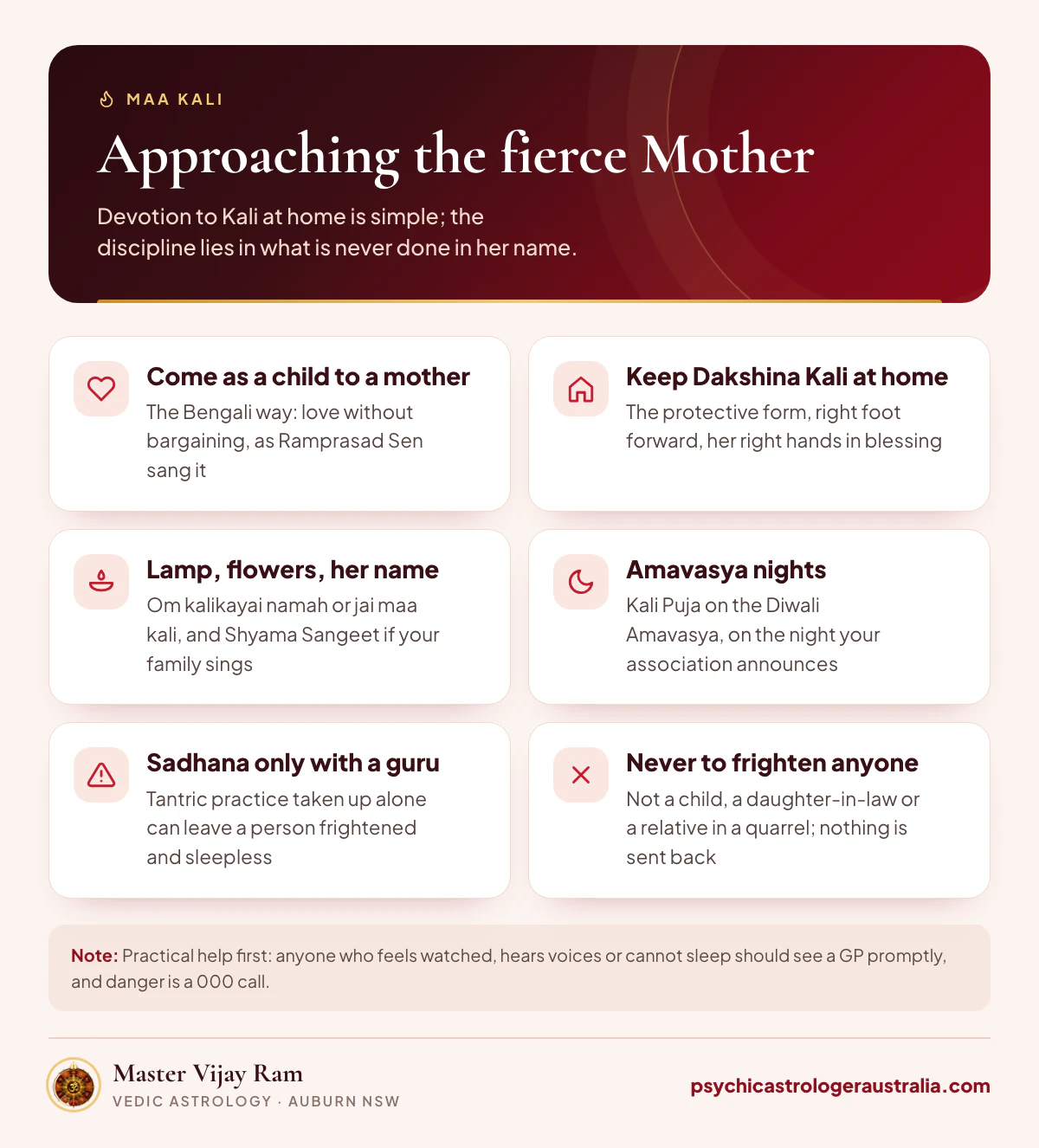
A picture of Dakshina Kali, a lamp, red hibiscus where it grows, a sweet, and a few minutes in her presence are the whole of it. For a Maa Kali mantra, families mostly keep to her name, om kalikayai namah, or simply jai maa kali, and many Bengali families sing Shyama Sangeet, the devotional songs written for her.
Those songs are a Kali protection prayer in the oldest sense, and Amavasya nights suit them, though the attitude matters more than the hour: come as a child to a mother, without bargaining. Nothing harmful to any creature belongs in household worship, and the lamp stays on a metal plate, away from curtains and the smoke alarm.
Why is Kali sadhana kept for those with a guru?
Because the deeper practices of Kali are tantric, designed to confront fear and death directly, and they were never meant to be learned from a video. Practised alone, intense night-time mantra work, fasting and isolation can leave a person frightened, sleepless and unwell, which is the opposite of what the goddess is for; that is the real meaning of Kali sadhana caution.
A genuine teacher knows the student, sets the practice to the person, and never charges for fear. Anyone offering online Kali sadhana for power over others, or demanding money to keep the goddess from turning on you, is trading on fear, and the tradition gives them no standing. Anyone who feels watched, hears voices or cannot sleep after such practices should see a GP promptly.
What must never be done in Kali’s name?
Her name is never a threat. A child should not be told Kali will punish disobedience, a daughter-in-law should never hear the goddess invoked against her, and a family quarrel is no reason to call on her; rites meant to injure, bind or punish someone have no place in her worship, and nothing is ever sent back.
Old films turned Kali into a goddess of murderous cults, and some families still feel the sting of that image. The Kali of Bengali homes is the opposite: a mother whose ferocity is entirely on her children’s side, and whose own story ends with her biting her tongue.
Where do Australian families keep Kali Puja?
Bengali associations in several Australian cities hold Kali Puja on the Amavasya night, usually in a hired hall or alongside an existing temple, and families in smaller centres often travel to the nearest one. In Hobart and Newcastle, where the community is small and no large temple has been confirmed, the puja is more often a family affair at home.
Consultations from any of these cities run by phone or video; readings for Adelaide families explains how that works, and in-person visits are by appointment at Auburn alone.
When is a Kali puja performed on your behalf?
A reading has to point to it first, with the practical help already in place. Then Vijay Ram ji holds a Kali puja himself in Auburn, generally on an Amavasya; the sankalp names the people it is meant for, and family members may follow on video.
A puja performed on your behalf is priced from $250, agreed with the family ahead of the puja. The $50 consultation before it often ends with a picture of Dakshina Kali, a lamp on Amavasya, and that is all.
What are the limits of Kali worship?
No puja cures an illness, restrains an abusive partner, wins a legal fight or fireproofs a home, and any promise about what a puja will achieve should be refused. This is guidance within a faith and does not replace a doctor, a lawyer or a psychologist: danger is a 000 call, and fear that will not lift is a conversation with a GP.
What Kali offers is older and harder than a shield. She asks her devotees to stop multiplying their fears, to face what frightens them as a child faces the dark with a mother’s hand to hold, and to let her deal with the rest.
Read next
- Kaal Bhairav: The Guardian Deity and Protection From FearKaal Bhairav, Shiva’s guardian form: the Kashi story, his dog, Kalashtami and Bhairava Ashtami, the Kalabhairava Asht…
- Spiritual Protection for Children at School and OnlineSpiritual protection for children at school and online: what a parent does first, the gentle practices a family keeps…
- Protecting Children From Black Magic & Negative EnergyA grounded guide for parents worried about black magic or negative energy around a child: what it usually turns out t…
Frequently asked questions
What is Maa Kali invoked for?
For protection of children, households and communities, and for courage against the inner enemies of pride, anger, greed and the fear of death. In Bengal she is loved as a mother whose ferocity is entirely on her children’s side. Her worship asks for strength to face what comes, not a promise that nothing will, and it is never aimed at another person.
What is the Maa Kali mantra for protection?
Most households use her name, om kalikayai namah, or simply jai maa kali, with a lamp and a few quiet minutes, and many Bengali families sing Shyama Sangeet, the devotional songs written for her. Seed mantras and intensive practice are for a guru to give, in person, to a student they know. None of it is ever used to harm, bind or frighten anyone.
When is Kali Puja in 2027?
Kali Puja falls on the Diwali Amavasya. In 2027 that Amavasya runs from 2:19 am on Friday 29 October to 12:37 am on Saturday 30 October, Sydney time, and from 8:49 pm on Thursday 28 October to 7:07 pm on Friday 29 October in India. Because the puja seeks the deep night, follow your Bengali association’s or temple’s announced night and hour.
What is Dakshina Kali?
Dakshina Kali is the benevolent, protective form of Kali kept in most Bengali homes, shown with her right foot forward on Shiva and her right hands in blessing. One story says that Yama, lord of death, who lives in the south, fled at her name. The left-foot-forward form, Vamakali, is traditionally kept by renunciates and tantric practitioners.
Is it all right to keep Maa Kali at home?
Yes, in her gentle Dakshina form: a picture, a lamp on a metal plate, red hibiscus where it grows, a sweet and her name, with Amavasya nights especially. Come as a child to a mother, without bargaining. Tantric practices, night-long sadhana and the fierce Vamakali form belong with a guru, not a family shrine.
Is it safe to do Kali sadhana on my own?
Simple devotion is safe and welcome. Intense tantric sadhana, night-time mantra work, long fasts and isolation are not something to take up alone or from a video, and can leave a person frightened and sleepless. A teacher who knows you should guide them, if anyone does. Anyone who feels watched, hears voices or cannot sleep afterwards should see a GP promptly.
Why is Kali’s tongue out?
In Bengal and Odisha it is widely read as a woman biting her tongue in embarrassment: in her battle frenzy Kali stepped onto Shiva, who had lain down in her path to calm her, and she stopped. Others read the red tongue as rage conquered. Either way, the image shows fury catching itself, not fury celebrated.
Do families pray to Kali against black magic?
Families frightened of black magic or spirits have long turned to her, and her protection is defensive: the Mother guards her child and never strikes a named person. Ordinary causes come first, illness, grief, money and conflict, and anyone who hears or sees things others do not should see a GP. Prayer sits beside that help.
What is the fee for a Kali puja held for our family?
If a reading supports it, Master Vijay Ram holds the Kali puja himself in Auburn, generally on an Amavasya, naming the people it is meant for in the sankalp, and family members may follow on video. The fee starts at $250 and is agreed ahead of the puja. A $50 consultation comes first, and simple home devotion is often judged enough.
People also ask
Who are the ten Mahavidyas?
They are ten goddesses of liberating knowledge: Kali, Tara, Tripura Sundari, Bhuvaneshvari, Bhairavi, Chhinnamasta, Dhumavati, Bagalamukhi, Matangi and Kamala. Kali stands first, as time itself. Each has her own worship and her own cautions, and the tantric practices of the fierce Mahavidyas are learned only from a guru.
Why is Kali shown standing on Shiva?
The common story is that after destroying the demons Kali’s battle fury would not subside, so Shiva lay down in her path; when she stepped on him she recognised him and stopped, biting her tongue. Philosophically the image is read as energy and consciousness together, Shakti active on Shiva’s stillness.
Is Maa Kali a protective goddess?
Yes. For her devotees, especially in Bengal, Kali is the protective Mother whose terrifying form faces outward at whatever threatens her children. Raksha Kali was worshipped to protect whole villages from epidemics and drought. Her protection is defensive and is never invoked to frighten or harm another person.
What is offered to Maa Kali?
In homes and community pujas, red hibiscus, lamps, incense, sweets, fruit and devotional song. Shyama Sangeet, the Bengali songs to Kali, are an offering in themselves. Nothing harmful to any creature belongs in household worship, and the lamp is kept on a metal plate away from curtains and the smoke alarm.
References & further reading
Serving clients across Australia
Confidential consultations by phone, video & WhatsApp — including: